I could see 5.3 but 5.7 is too high.
2 Likes
good point but enemies ive played against in it have never rlly done much damage to me
I’m somewhat skeptical of the turret traverse rate of Chi-Ri (12dps) that comes from a US report, which is the only known value. This value is also repeated for the Chi-To, and I feel that it may have been a placeholder or rough guess.
While it means little on its own, the electric turret traverse rate of earlier Japanese tanks seems to have targeted about 30dps. For example, Chi-To (57) achieved 29dps. Ho-I is said to have achieved 36dps, although I don’t personally have the document for the latter. Of course, these are much lighter and smaller turrets, but their motors are also weaker.
It appears that the Chi-Ri had an appropriately powerful turret motor for fast traverse. The motor was rated at 2.5PS, while the turret + gun assembly mass was 7.64t.
For reference, this is over twice as powerful as the Westinghouse electric motor used to traverse the turret of some Sherman tanks, which was rated at 1.14PS. This gave those Shermans a turret motor PS/t of about 0.28 (the 75mm turret + gun assembly seems to have been 4.12t), and this Westinghouse motor was capable of traversing the turret at up to 24dps.
T-34-85 had a 1.83PS MB-20 motor driving its 5.91t turret + gun assembly (0.31PS/t), and reportedly had a maximum traverse rate of 25~30dps.
The Chi-Ri has a turret drive PS/t of about 0.33.
The power of the turret motor is insufficient to know its traverse rate, which depends on the speed and gearing of the traverse mechanism. To my rudimentary understanding, though, it seems like it implies that the capacity for high-speed traverse was there, relative to its contemporaries.
(That is, it seems that the limiting factor on the gearing of the turret is sufficient torque to traverse on inclines, where the weight of the turret comes into play. Because the PS/t of the turret is comparable or superior to its contemporaries, it would seem that it can account for this).
A requirement for the Chi-Ri on the early plans was “the turret must be able to traverse quickly, easily, and precisely”.
Anyways, it’s not enough for a bug report, but I figured I’d mention this incase someone has a better understanding of this.
11 Likes
Source or it didn’t happen.
Japan wasn’t really know for their weapon technology.
A Sherman had 24°/s, a T-34-85 30°/s but useless for aiming because it took a second to accelerate and decelerate.
1 Like
Source for what?
I’m not making a claim that “it could traverse at XX degrees per second”. I’m saying that it seems like the current rate is uncharacteristically slow given the specifications relative to its contemporary vehicles. Of course, my understanding could be flawed, which is why I did not pose it as a conclusion.
The source for the 2.5PS turret drive motor is the electrical diagram of the tank from the document 「チリ車説明図」made by MHI in March 1945. The copy of the document was physically published by Kunimoto Yasufumi in 2024, and parts of it also appear in the magazine “Ground Power” issue October 2009.
11 Likes
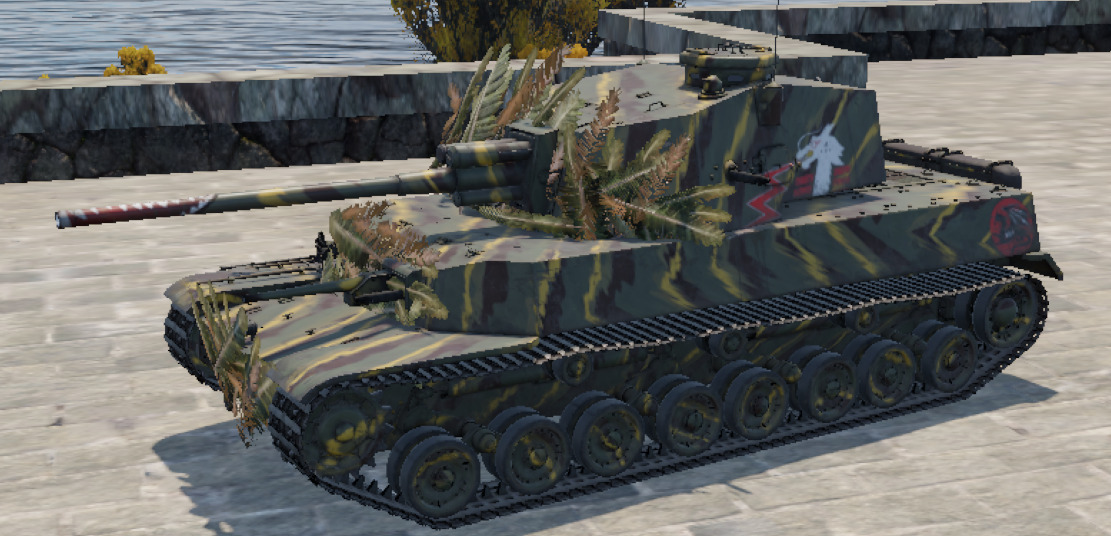
I dunno, I think it really is an improvement unless you’re doing CQB and really need that 3.3s intraclip. The sustained fire ability it has now is amazing, and you can easily rack up multiple kills from a good position.
I agree it should have stayed at 5.0 though.
It’s at least a 5.3 vehicle.
4.7 is the Firefly which isn’t very mobile and the T-34-57.
The Chi-Ri deals way more damage with its gun, has a better RoF and very good mobility.
The armor is weak but compensated by the above average mobility.
No lol. It never should have left 5.0
Mobility is not that good. T-34-57 is way smaller and faster. Firefly has much higher penetration. 5.0 is still higher tham both and perfectly fine.
1 Like
Penetration is good enough and deals way more damage than solid shot. And the RoF is much better.
Some time ago I was playing Chi-Ri and came across a Tiger I. The duel took place at a distance of less than 100 meters. I fired the first shot, and out of panic, I missed. The Tiger also fired and missed as well. My second shot didn’t penetrate the Tiger’s armor. At that moment, I used the super skill “divine Hirohito” and the Tiger didn’t penetrate me (it hit the joint between the roof and the front plate). Only with the third shot did I manage to destroy the Tiger. That was probably the most stressful duel I’ve had in War Thunder. The new reloading system doesn’t give me any sense that it’s better than the old system.
Chi-Ri really shouldn’t be at 5.7. It’s a huge barn with paper armor and some sort of reload (5.8-4.5 s compared to 7.6-5.9 s in the M4A3 (76) or 9.6-7.4 s in the T-34-85 or 9.6-7.4 s in the Panther). When I play at 5.7, I always prefer to choose the M36 over the Chi-Ri. Additionally, the only zero with useful A2G armament, the A6M5 Hei, lost its only squad.
6 Likes
I always compared Chi-Ri to a Pz-4 G
Ace Pz 4 G reloads in 5.9s (from 7.6s)
Base Chi-Ri reloads at 5.8s (up to 4.5)
Armor wise, Pz 4 has 5mm more on the front aspect, 10mm from the rear…
Chi Ri has 2hp per ton more (14 vs 12)
Pen is same ish, explosive filler difference in practice doesnt mean much
Pesky 37mm adding 2.0 BR
1 Like
Ace Pz 4 G reloads in 5.9s (from 7.6s)
Base Chi-Ri reloads at 5.8s (up to 4.5)
It’s actually 14.9hp/t
Just gonna ignore the turret?
1 Like
Yes… don’t think that impacts playstyle much (both vehicles can’t tank much in uptier \ same tier, so they are more of a ‘sniping’ \ slow flanking idk what are the proper terms) Yes ultimately Chi-Ri would be better, but not 2.0 better, 1.0 - 1.3 imo
Misremembered Pz4 armor, thought it had 80mm front on turret, or are you talking about 37mm ? I used to use it the same as 75mm on a maus - faking shots, imo “double gun” aiming is funky at best in wt (I would love for them to aim simultaneously at appropriate elevation translated from main gun elevation)
The Pz IV has very poor mobility for it’s BR the Chi-Ri has actually above average mobility.
Coupled with the fastest RoF for a medium tank, this makes it very effective exploiting the enemys flank.
1 Like
Chi-Ri is much better than the Pz4G. Let’s not pretend otherwise. The turret alone is much more trolly.
4 Likes
Yes, i meant the weak turret.
I mean, yeah, the Chi-Ri can get there faster, it’s 3km/h faster than a Sherman and accelerates faster than a T-34, but the difference between a Chi-Ri flanking and a Panzer 4 flanking is “THAT HOUSE IS MOVING, SHOOT IT!” and “I thought I saw that little thing move, but the longer I look at it the more I think I just imagined it.”
The Panzer 4 may not get to that flank as fast, but in all likelihood it’ll stay there a bit longer. And it being at a lower tier, sometimes that being less visible will improve your survivability by quite a bit more than usual because low tier players tend not to be looking for things in unusual places, they’re not quite there yet. But the Chi-Ri? Well, given my uptier to 6.7 rate is roughly 70%, well, people are looking for big ass tanks like Tiger IIs, T34s and IS-2s, the Chi-Ri blends right in size-wise, but might as well be paper in comparison…
And really, the Chi-Ri is not a bad tank in-game by very many means, it’s just that it gets nothing to make it worth it in the land of the uptier, a system which does (sometimes) make queue times faster, but really doesn’t like a lot of vehicles. Until the BRs are decompressed, the Chi-Ri at 5.7 is just going to face things it just doesn’t have good options against (unless your target is on the left of a T26E1-1, then they’re both very dead). Hence, why Chi-Ri should NOT be BR 5.7.
Sometimes. 75mm at a 15 degree constructional slope can do… Something. That gives it an effective thickness of 78mm when facing it head on, and yes, hitting a joint between plates will make just about anything non-pen. Those 50mm turret sides hit a little over 100mm if you shoot them and not the turret face, so yes, the Chi-Ri is better armored than the Panzer 4… If you’re making some of the worst possible shots known to War Thunder. And let’s not forget that some guns can just lolpen those 50mm plates, though of course that’s rare, what guns pen 100+mm at 60 degrees? Oh, yeah… A lot of stuff at 6.7+, any round with a cap has good enough normalization values can punch through that armor. And given how just about every round at that BR has a cap, it’s not hard to see the trouble.
3 Likes