Analysis of External Maintenance and Safety of Airborne Radars
Author: Zhou Zhenglong
Organization: Chengdu Aircraft Industry (Group) Company Ltd., Flight Test Site
⸻
Abstract
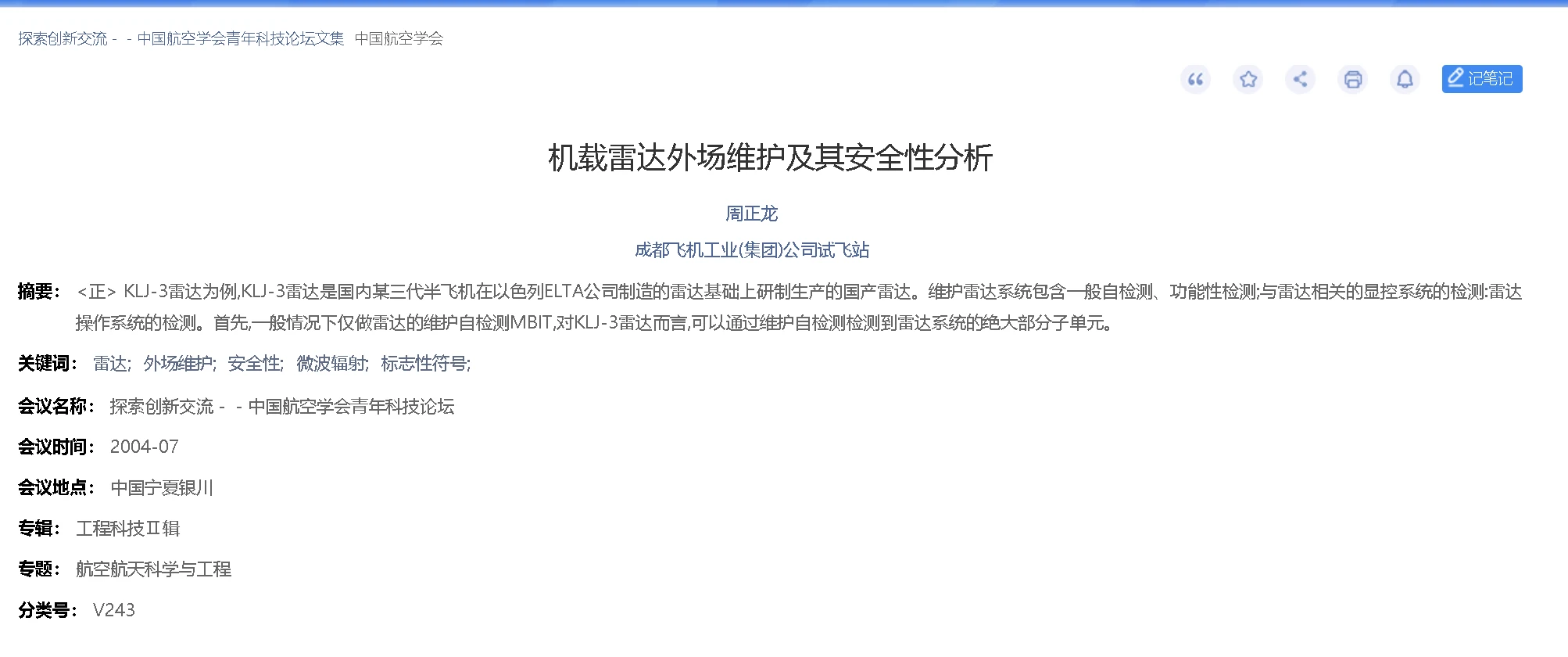
Taking the KLJ-3 radar as an example, the KLJ-3 is a domestically produced radar for third-generation fighter aircraft, developed and manufactured on the basis of the ELTA series radar technology. The radar maintenance system includes general self-tests, functional tests, and tests of display and control systems related to the radar. The radar operation system is tested through these means. In general, maintenance tests not only conduct routine self-tests (BIT), but for the KLJ-3 radar specifically, faults in major sub-units of the radar system can be located through these maintenance self-tests.
⸻
Keywords
Radar; External field maintenance; Safety; Microwave emission; Identification signal
⸻
Conference Information
• Conference Name: Exploration and Innovation Exchange – Forum of Young Scientists and Technologists of the Chinese Society of Aeronautics and Astronautics
• Conference Date: July 2004
• Conference Location: Yinchuan, Ningxia, China
⸻
Editorial Information
• Editorial Board: Engineering Science and Technology II Volume
• Specialty: Aerospace Science and Engineering
• Classification Number: V243
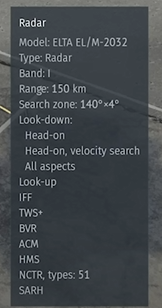
@Yamahagi the only Zhuk Chinese air craft was a one off j-8 used for evaluation of the radar right? Do you know which Zhuk variant it tested?
Also, is Klj-3 = 1471 or is it 1473
Zhuk-8-II on J-8IIM, an export variant of the basic Zhuk.
Klj-3 = 1473. The Type 1471 traces its origins to the Type 208 and APG-66, but it never actually entered service with the PLAAF and maybe intended for the unfinished J-8III project.
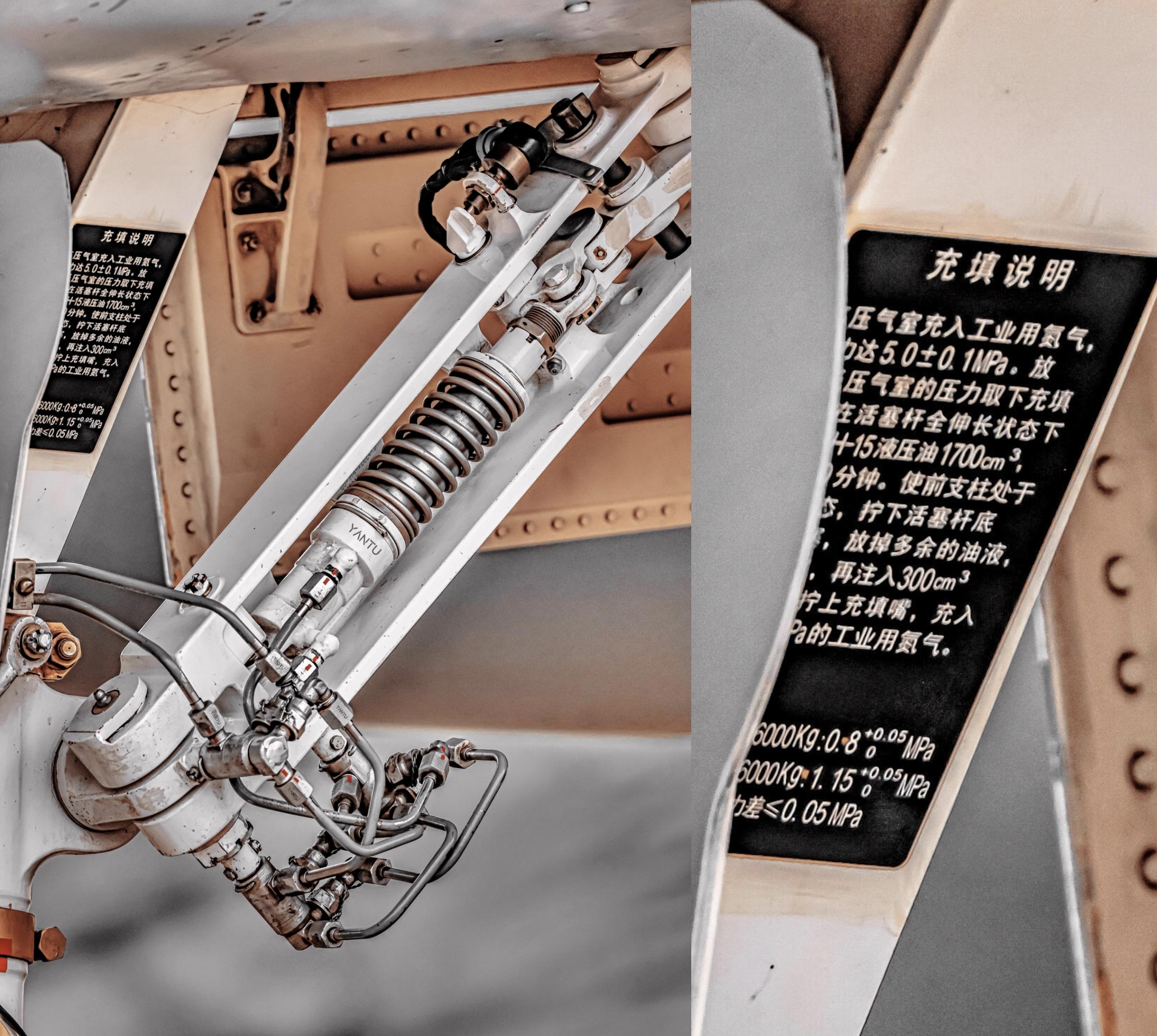
Good news—we now have a more reliable source regarding the J-10C’s weight than previous PAF data: information from the J-10C’s (WS-10B) main landing gear indicates a normal takeoff weight of 16,000 kg. The bad news is, we don’t know exactly what is included in that 16,000 kg under “standard mission payload.” For the PLAAF, the most common loadout consists of 2×PL-10 + 2×PL-15 + 3×drop tanks, though it’s unclear whether the given takeoff weight corresponds to this configuration.
PS: I also came across corresponding information on typical production batches of the J-20, but to avoid stirring up unnecessary trouble, I’d prefer not to share photos here. That said, since the normal takeoff weight standard for stealth aircraft is clearly defined, it can be reasonably estimated that the J-20’s empty weight does not exceed 17.5 tons.
So with 2×1600 + 1, 800 tank, 2 PL-10’s and 2 PL-15’s and pilot thats roughly around 4200kg’s how much internal fuel does the J-10C carry down we know?
If we are being extremely rough on estimates I would say 3,000kg internal (at least) and 4200kg payload, maybe 1000kg of additional unaccounted for weight, empty weight somewhere north of 9000kg then.
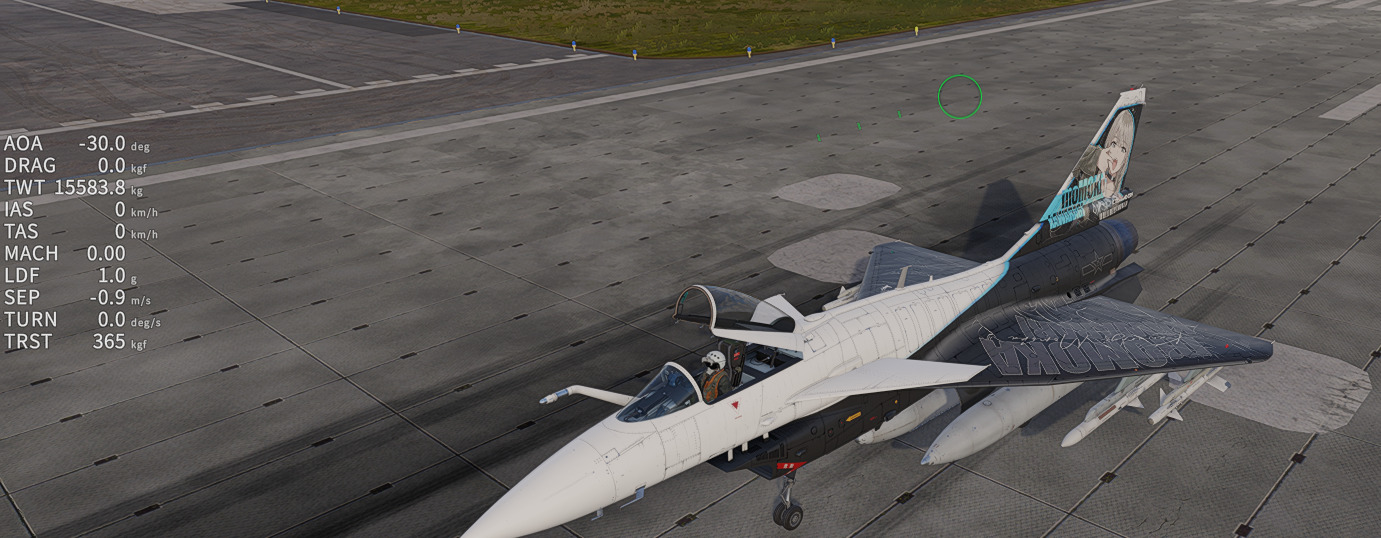
Assuming the J-10C’s internal fuel capacity is the same as that of the J-10A, the calculated empty weight would be 16,000 kg - 834 kg (for missiles and empty drop tanks, adjusted using in-game data plus the weight corrections for PL-15 and PL-10) - 2,900 kg (internal fuel) - (664 kg + 1,328 kg + 1,328 kg) (external fuel) - 90 kg (pilot) - 30 kg (oil) - 72 kg (CMs) - 60 kg (ammunition) = 8,694 kg.
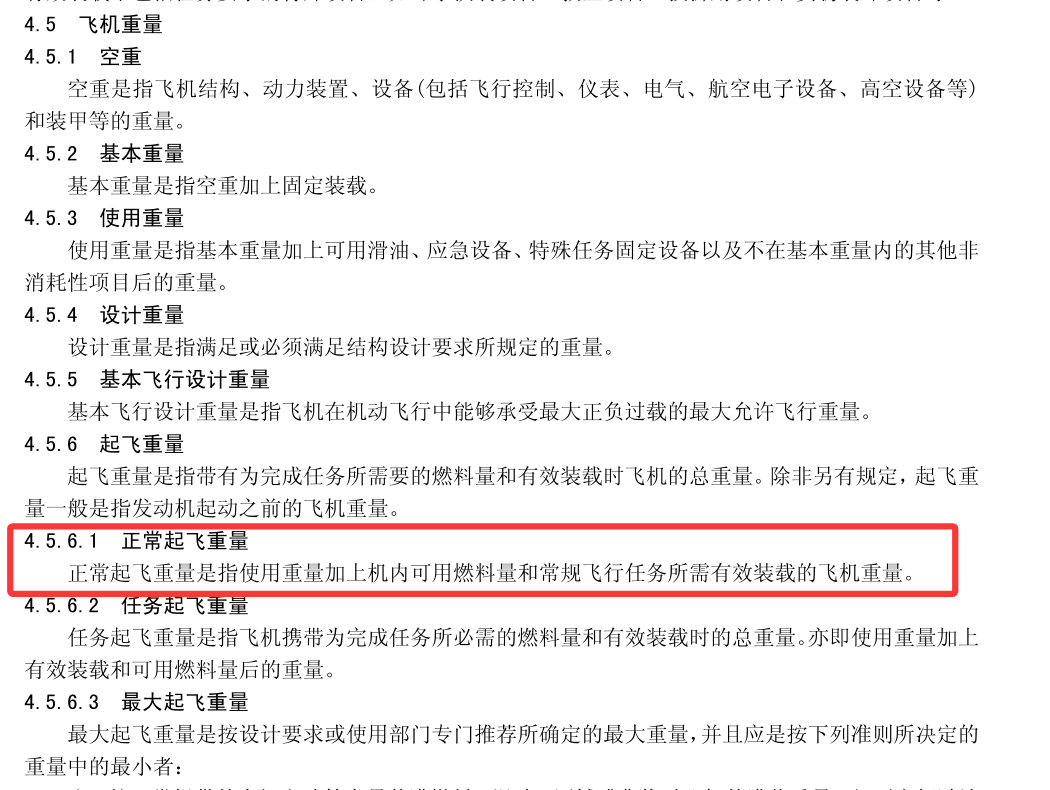
Normal takeoff weight comprises empty weight plus fixed loads, oil, emergency equipment, mission-specific fixed equipment, other non-consumable items, full internal fuel, and the standard mission payload.
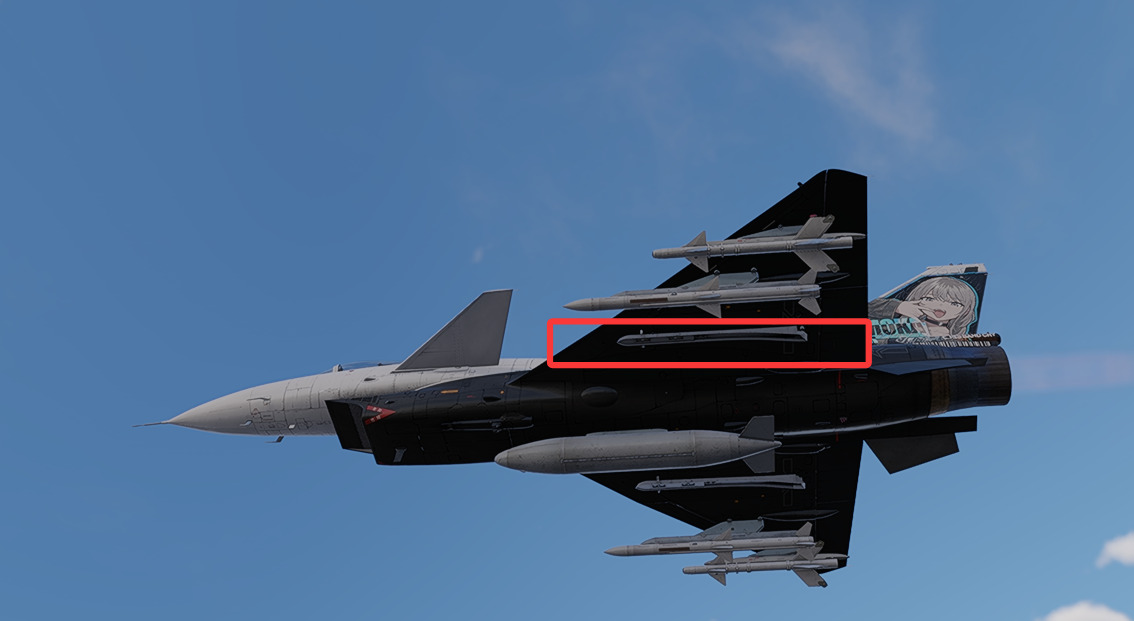
By the way, Gaijin still hasn’t fixed the external fuel tank modeling on the J-10—the entire assembly should be jettisoned as a single unit, rather than leaving the pylon attached to the wing as it currently does.
Do you know the thrust for ws10b on afterburner? I’ve seen anywhere from 13500 kgf to ~ 15000 kgf for ws-10b.
Does it get special afterburner mode like the al-31f derivatives that provides more thrust?
The WS-10A’s 132 kN thrust represents a special afterburner mode, as the J-11B’s air intake—originally designed for the AL-31F—cannot stably supply the higher airflow required by the WS-10 series. This limitation does not affect the J-11BG, J-16, or J-10C.