Which means I agree to your point
Thank you. Bombers were definitely too weak before. IMO they are too strong now. I just want a healthy middle ground. There was a TU 95 in one match and a B-52 in another and in both matches the team was helpless to prevent the damage to players in ground units.(I play a bunch of nations) One time a had a TU 95 on my team. We won but I didn’t feel good about it.
ECM missed and should be added btw.
This is what reasonable people want, me included.
While i agree these two are an issue with the current damage model, the biggest offenders are at lower BRs where fighters are relatively slow and have to get much closer for a reliable chance of a kill.
2 Likes
The TIS MA was a nightmare in a low tier match I played.
I saw Spookston’s video on it. Tried it for one GRB match.
7 kills with just the TIS MA in a matter of 2-3 minutes. 3 planes and 4 ground targets. I went in without caring about taking hits just to test how broken it is. Got hit plenty, got set on fire multiple times.
Landed without tail control, lost my tail on landing, got a bit over a minute repair timer. Match ended as i was taking off.
Su-8 and TIS MA should have never received any kind of buff.
3 Likes
Mostly arb and naval
I’m talking about its performance in GRB.
“someone got lucky therefore an AIRLINER eating six 75mm shells is a skill issue”
I see your logic hasn’t gotten any better since the last thread
Not just any converted civilian airliner, one known for having a weak tail that would regularly fold on itself when landing.
"Since 1933, the design and development of new civilian aircraft in Germany was virtually halted. The Aviation Ministry allocated funds only for those projects that could later be adapted for a bomber version. Therefore, for every successful civilian aircraft model, the Luftwaffe had a plan for its military use. The Condor was not spared this fate.
After some strengthening of the supporting elements of the fuselage, it was adopted for service under the designation Fw 200C."
Not designed, of course.
Thank you for proving my point.
Means nothing when it comes to durability.
Does not explain the overall durability, and especially why it’s comparable to all other bomber types in all areas.
1 Like
Literally a plane that was meant to be a bomber and designed to be easilly adopted as a bomber
At the moment you just have to advise everyone to stay out of the 2.7 through 4.7 area. Every lobby has swarms of BV 238s flying low, being totally invulnerable, and kill every fighter and and AI in their way, winning the match. The only way to kill them is a pilot snipe, and getting one of them is hard.
Has Gaijin not realized how much SLs these pilots make right now?
They are so concerned about economy, but these planes must be cashing out.
You just used some source to disprove this:
You do realize that you can’t say
without contradicting yourself.
All sources say it was designed as a civilian airliner. The fact that it had conversion work done to adopt it as a bomber, doesn’t mean it was designed for that.
1 Like
God, it was designed to be adaptable, you can’t just say that they grabbed a random airliner and made a bombing bay in it or something, lmao.
Source?
But alas, you seem frustrated and i can’t explain it to you with crayons, so here you go:
That’s how conversions work. You convert something designed to do one thing, to do another.
Edit: Since i thought you might need couple examples of civilian-to-military conversions:
Vespa 150 TAP
“Modifications from the civilian Vespa included a reinforced frame and a 75 mm (3.0 in) recoilless rifle mounted to the scooter.”
C-47 Skytrain / AC-47 Spooky
“The legendary Douglas DC-3 airliner became the military C-47 Skytrain, widely used for troop transport and paratrooper drops. In Vietnam, heavily armed variants outfitted with miniguns were designated as AC-47 “Spooky” gunships”
This is what i find when reading about it:
“The Focke-Wulf Fw 200 “Condor” saw extensive military use during World War II, primarily by the German Luftwaffe, after being converted from its original civilian airliner design.”
“Focke-Wulf hurriedly militarised the airliner into the Fw 200 C: a reconnaissance-bomber with a bomb bay, a ventral weapons gondola, defensive guns and extra fuel. It was never designed for the job, but nothing else in the fleet could reach where the convoys were.”
“In 1939 the Luftwaffe decided that the Fw 200 could meet its own requirement for a long-range maritime reconnaissance aircraft, and instructed Focke-Wulf to develop the Fw 200V10 into a more robust aircraft with a bomb-carrying capacity”
“A longer ventral gondola, with a bomb bay, was planned but not fitted to the first production aircraft. When fitted, the gondola, which was offset to starboard, housed a 20mm MG FF cannon in front and a 7.9mm MG 15 machine gun aft.”
And since crayons are not an option, here is a picture of said gondola:
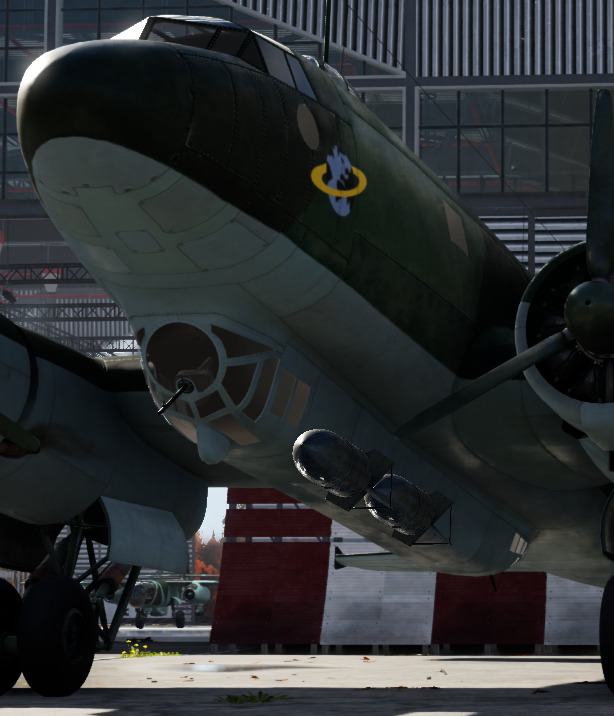
So, to quote you “lmao”.
And since this started with a discussion about it’s durability:
About the 200 C-1
“The Fw 200C was always an improvised combat aircraft, with many deficiencies. The crews also complained about inadequate armament and an vulnerable fuel system.”
About the 200 C-3
“The Fw 200C-3 introduced some more reinforcements, although still insufficient”
So more reinforcements came only at a later model.
How real are these planes btw? I just watched the vid and a fragile plane operating several of these long barreled 45mm cannons looks questionable. How was it possible for any plane to withstand the recoil of this without getting structural damage? I found no WW2 accounts about russian WW guncas either.
Balancing wise a nightmare. GRB is unplayabe against these russian guncas planes. Was an issue before, but now with bomber DM. Jesus. And why do they even outmaneuver most fighters with all those bulky long cannons + alot weight. How did it frontally penetrate a Sherman? This vid somehow makes me angry.
No clue, haven’t really looked into them at all.
As stated above, no clue about these 2. But the Yak-9T notoriously had issues with it’s 37mm shooting through the propeller hub. Firing the gun would cause shaking to a point where it damaged engine components, causing oil leaks for example.
No data on this, but i would assume structure of planes the size of Su-8 and TIS MA could handle the recoil. Real life firing not being continious long bursts like we can do in-game.
TIS MA having them mounted at the wing roots, probably with reinforcing to handle recoil.
Aren’t the Su-8’s guns in a ventral pod of sorts? (Not on my PC atm)
Wing loading and control surfaces matter too. Bigger wing area might give good turning capability, for one or two turns, after that they’ve lost energy to continue maneuvering effectively. Verticality in maneuvers is even more detrimental to losing energy.
1 Like
I don’t as
A) They’re massively smaller targets so in order to reliably get hits you have to lose the altitude advantage
B) A ‘majority’ of bombers lack sufficient Anti-shipping armament such as torpedoes or early Guided munitions such as Bat and Fritz-x and HS-293. The best you typically get is AP bombs but it depends on the carrier whether or not it’s modelled properly to make use of them and refer back to point A
Bomb targets and airfields don’t have either of these problems as they’re large static targets
1 Like