Changes to Bomber Survivability

No. I excluded the WT match setup on purpose and focused on real data to show how misleading official statistical averages are. Citing low mission loss rates is the same kind of trick as arguing that people statistically have less than two legs. Connecting real historical data to WT is futile by definition.

I am not obliged to propose anything. I answered a post that tried to use campaign averages to prove a point. My reply simply showed the inherent flaws in those statistics.

If anyone in the community actually wants a more realistic historical comparison:

  • The only logical approach is to look at known results from sorties in which bombers were intercepted and match the outcomes of the aircraft involved.

  • Even that is limited. US claims about interactions with enemy fighters (and especially gunner kills) were systematically exaggerated and cannot be treated as reliable combat data.

  • For Bomber Command the picture is worse: once night fighters made contact, survival rates were extremely low. The Nuremberg raid in March 1944 remains the clearest early-1944 demonstration of that.

  • Later in the war, after D-Day, the progressive collapse of the German early-warning network changed the equation, but that does not rewrite the earlier record.

  • Even for the relatively rare Axis bomber operations after they lost air superiority, loss rates varied sharply depending on the tactics used.

Campaign-wide averages that mix hard contact sorties with milk runs, weather aborts and unopposed raids simply do not describe what happened when fighters actually found the bombers (RAF BC) or managed to find a gap in the escort screen (USAAF from mid '44). The relative success of Sturmgruppen is widely documented and kills the entire low loss rate narrative rather easily.
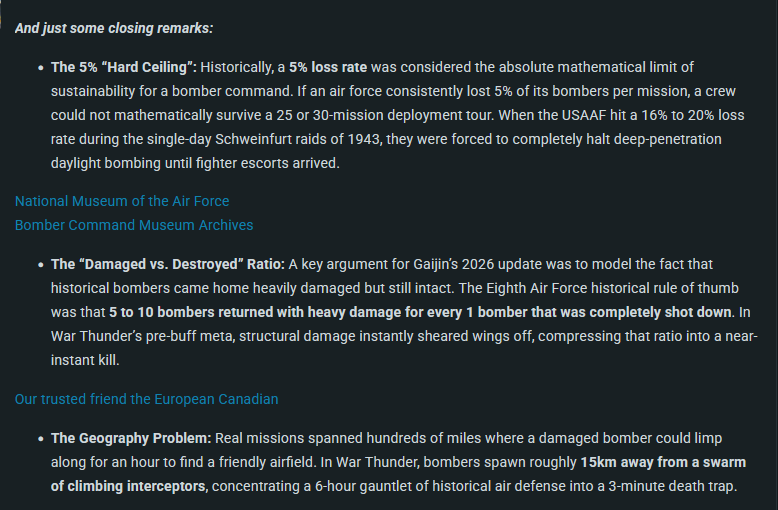
I already agreed to this point.

How and why?

If it can be statistically proven that during certain types of engagements where enemy fighters were encountered an average of % amount of bombers where [this much] damaged and [this many] where completely lost; would that not be a valuable statistic to use for how to balance bomber survivability as an average based on player statistics?

Correct, but in my personal opinion just arguing against someone’s use of data (and their argument) without providing an alternative (even if not complete) is also sort of redundant at some level. Not completely redundant obviously, but imo it does stagnate the discussion instead of pushing it forward.

1 Like

The maximum number of bombers in Air RB is just 4.

IRL that Schweinfurt raid had bombers vastly outnumber their interceptors, and yet they still lost almost 20% of their force.

How many do you think they would have lost if they were faced by 1200 intercepting aircraft coming for them, which is much closer to the situation here in WT? How about if they weren’t flying in a tight formation that made approaching them more difficult?

This whole part also REEKS of AI.
image

2 Likes

I just play naval mode and shot like 150 proxy HE shells into a bomber without any result. Proxy detonations seem to do nothing now.

Gajin should end this experiment now, its getting rediculous and kills off all balancing.

Well BVVD did say they were reworking damage and such on bombers. We have to wait and see I suppose.

3 Likes

WT and historical data is a story on its own - it boils down that WT is video game working with way to much compromises in order make the vehicles playable for masses.

Your question is therefore just opening a can of worms as real historical data plays zero role in the game design which includes the setup up BRs, fictional g-forces, way too large combat distances, way too high cruising speeds of bombers at way too low alttitudes (USAAF) or even daylight attacks (RAF BC) you already have an answer.

In other words: When wt allows me to open concentrated fire at approaching enemy fighters at 2.5 km (with actual hit probabilities) and i can spray outside SB modes with infinite reloads of my defensive guns - whilst the average enemy has to get at least within the 1 km range to hit something you have enough evidence that wt game play is disconnected from reality.

No - as the used hardware and applied tactics played the decisive role - same as numerical advantages or disadvantages, the above mentioned compromises and, ofc, the nature of the game which is outside SB modes a more or less glorified Arcade shooter, the label RB is misleading on purpose.

I actually gave an alternative in my last post in order to show a way to make things way more reliable than misleading sortie data.

My initial reply has to be seen as what it is: A fellow player tried to make a misleading comparison implying credibility by referring to a degree in history. Idc about such wild claims in general - but when this post is actually counterproductive as it creates a false narrative which puts the discussion back i will reply accordingly.

This whole thread is a mix of factually wrong narratives and more or less toxic interactions between certain groups (either pro or against recent changes). Instead of questioning gaijin’s motivations or strategy which led to this change players fight each other with more or less accurate statements try to prove or disproving the “other side”.

As i play all aircraft classes i see both fractions just waste their energy.

1 Like

I have yet to fly my SU-8 tbh.

I’ll have to try that next. Been super sick though.

1 Like

Depending on the period analyzed:

For mid-early 1943 (the peak for bomber losses), around 6.67 fighters had to be deployed to achieve a single bomber kill, at a rate of 0.15 kills per fighter.

This means that in the game, a team of 12 fighters would statistically yield only 1.8 bomber kills.

To destroy all 4 bombers in the match, you would need 27 intercepting fighters.

In a way, Gaijin actually managed to capture the war effort of taking down bombers (though through questionable means)

image

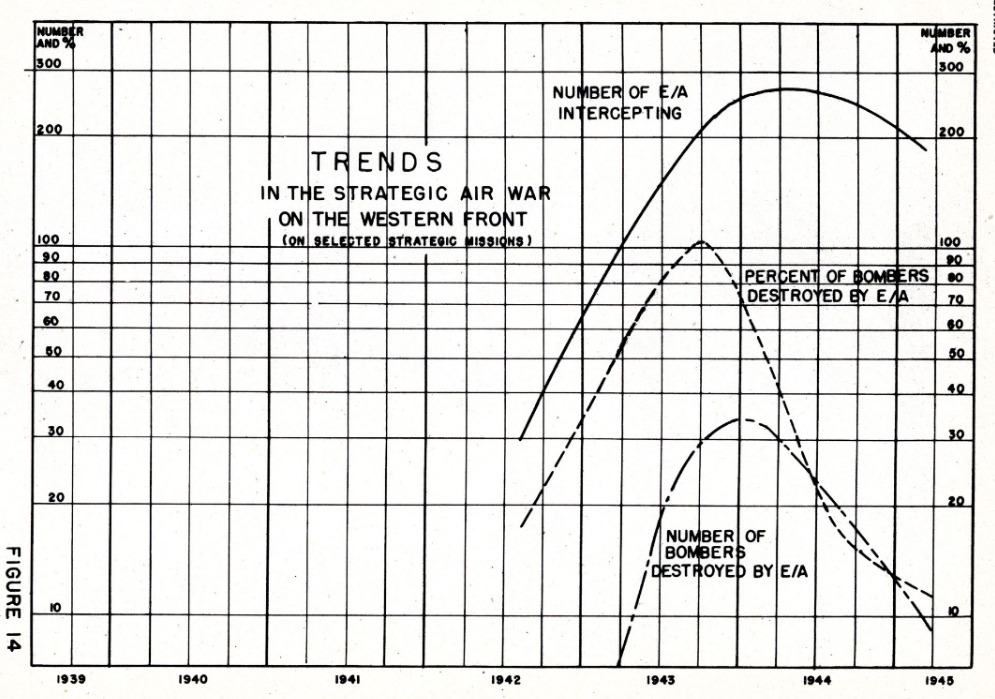
Is this graph showing that more than 100% of bombers were destroyed by E/A (presumably enemy aircraft) in the 3rd quarter of 1943?

By the way I think you read the graph wrong. The bigger, thicker vertical lines are saying where each year started and ended. The actual year numbers sit between these thick vertical lines (so, for example, right where it says 1943 is actually mid 1943).

Hence, the graph starts in roughly mid 1939, and ends in roughly mid 1945.

Well as I don’t have the Su-8 I can’t give you any valid opinion on it’s performance in a match.

But test flight gives a pretty good picture of it’s flight characteristics. And in my opinion it falls to the category of aforementioned twin engine planes → doesn’t have any other redeeming qualities than “more guns”

This graph makes no sense. Are we to believe that just over 100% of bombers were destroyed by enemy aircraft?

And that 100 enemy aircraft managed to shoot down… ZERO bombers?

Yeah no.

1 Like

I also just realized that, yeah, it shows 0 bombers destroyed by enemy aircraft between the 1st and 2nd quarter of 1943… but also ~55% of bombers in that exact time period were destroyed by enemy aircraft.

There’s something here that’s being missed.

I didn’t even notice that. Pretty big contradiction.

No offense - but this conclusion is based on a graph with questionable (to be polite) data. You might look up where these data are coming from (=mainly estimations of bomber crews which are as reliable as their kill claims) and do not consider actual contact with enemy fighters.

I tried to address this limitation here:

Trying to construct a connection between “deployment” and kills does not cover the actual range (and time) constraints on opposing LW fighter units and efforts of allied planers to create diversion attacks which were aimed to waste deployed fighters and their fuel.

The average fighter (109 or 190) had roughly 1 hour flight time with internal fuel and up to 2 hours with a 300l drop tank.

That means that LW ground control had to anticipate targets and put fighters with enough fuel near the expected flight path whilst allied planners tried to use this resource allocation to their advantage with diversion attacks.

There are enough reports that both sides managed to outsmart the other side - whilst the root cause for the disaster of first Schweinfurt raid is mainly based on the delay of the 2nd group which allowed the LW to refuel and rearm.

Your 27 fighters vs 4 bomber conclusion is therefore a rather bold assumption. If you want to go down this path i recommend to focus on encounters which can be verified by sources on both sides for specific battles. That means a fight between known units on both sides which had actual contact and with verified losses on single unit levels. There are various battles 1943-1945 described in books eliminating statistical distortions whilst giving a much more accurate picture.

There is no zero mark on that axis.
The scale starts at 10 as its baseline.
Also, it’s a logarithmic scale, zero can’t be represented. So no contradiction.

Can you back that up, or is it just your assumption about how the study’s data was put together?

With the huge amount of material captured by the Allies, cross-checking against Luftwaffe records should have been straightforward:

  1. Number of bomber crews who claim to have been intercepted.
  2. Number of bombers German fighter pilots claim to have intercepted.
  3. Number of bombers German fighter pilots claim to have destroyed.
  4. Number of bombers Flak claims to have destroyed.
  5. Number of bombers actually destroyed (recovered on German soil).
  6. Number of bombers actually destroyed (never made it back to base).
  7. Number of interceptors actually deployed.
  8. Number of bombers actually deployed.

Also, there’s a huge gap between kill claims - which are prone to bragging or double-counting (“I definitely got him”) - and routine operational reports (“made contact with enemy aircraft”). Unless the entire Eighth Air Force was collectively hallucinating fighters in the sky, contact and deployment numbers remain a very reliable baseline.

More importantly, the precise nature of any single data point matters less than whether a trend actually exists (read the graph header).

Ofc, i can back that up. Ur graph is part of the USSBS (Stategic Bombing Survey) report. Ideal material if you look for bedtime lecture.

You will find your chart and an additional graph here:

The Defeat of the German Air Force

The Number 20 (text) describes the content of two subsequent graphs which are clearly marked as 8th AF data and selective for selected missions.

Everybody already knows how the USSBS reports were put together. They are postwar summaries built on wartime operational returns, crew observations and whatever German material could still be found. Your confidence in the American ability to process mountains of paper is touching, but it does not turn selective 8th Air Force mission data into a clean, cross-checked dataset against intact Luftwaffe records.

The charts you are using are explicitly labelled as 8th AF data for selected strategic missions. That is not a comprehensive postwar reconciliation of every contact, every claim and every loss on both sides. Large parts of the late-war Luftwaffe records were (often deliberately )destroyed; what remained was incomplete. Treating those graphs as if they represent fully verified, two-sided contact statistics is simply wrong.

The same postwar American analytical machine that produced the USSBS also managed to miss the area rule for years. That omission contributed directly to the early F-102 design problems. They were busy with jets, rockets, U-boats and industrial target analysis. Precision on every fighter-versus-bomber contact in 1943 was not their priority, and the surviving numbers reflect that.

Your list of eight ideal data points sounds neat on paper. In reality the surviving material does not support that level of clean matching. The graphs remain cumulative observations from selected missions, not the hard two-sided verification you are claiming.

If you want more reliable evidence, pick a specific battle with detailed data on bomber and interceptor sorties (local time, duration, area) and cross-check three publicly available sources:

  1. Official US kill claim lists sorted by date and unit,
  2. Official Luftwaffe loss lists for the units involved,
  3. The unofficial Luftwaffe claim lists that end in December 1944.

That combination gives a usable rough picture Even the official (=finally credited) US kill claim list is not accurate and most people can’t read LW kill claim lists as they mattered also for the Knights Cross (see “HSS” vs “e.V”). Most other lists (especially those mixing “lost” and “damaged beyond repair”) are less reliable and introduce additional bias.

2 Likes

Great, so we have ~120 aircraft for 10 bombers brought down. And for 20 bombers… only ~160.

Yeah I’m not buying that.

Then at least show what you’re saying. Gnza is already defending something, so show that you support it too. At least don’t let it just stay in writing.

No idea what you want from me. I am not here to claim or defend anything – I just point out why certain data make no sense to use as they lead to wrong conclusions.

You can try by yourself to verify data – you need to be retired or have a decent corporate job with a lot of time between meetings to invest a hell of a time to reconstruct engagements of already well documented battles.

Best example for your test: US 8th AF Mission #458, 7 July 1944:

  • You will find overclaiming of engaging LW fighters in various sources of at least 50 % (~300 claimed by the 492nd BG versus less than 200 actually deployed overall, of which roughly 75 engaged in the main fight).
  • Overclaiming of US gunners and escorts killed LW fighters (~120 claimed versus 57 single- and twin-engine fighters according to the Luftflotte Reich loss return).
  • About 40 bomber losses (29 B-24s, 11 B-17s) were inflicted mainly by IV.(Sturm)/JG 3 with 44 Fw 190 A-8/R2 as part of those ~75 LW fighters, while their top cover accounted for the 6 escort fighters lost.
  • The Sturmgruppe plus its assigned top cover lost 5 aircraft and 4 pilots. The US side confirmed 37 bomber losses plus several Category E write-offs.

Alone this example shows:

a) unreliability of statistical data if not clearly assigned to a specific date
b) significant overclaiming of bomber gunners (who claimed 39 fighter kills)
c) unreliability of any statistic based on bomber observations and claims

The result of the battle itself leaves room for several clear interpretations:

  1. Bombers had minimal survival chances even against less experienced opponents once fighter cover was absent. The Sturmgruppe attacked in a large V-formation that deliberately split the defensive fire of the combat boxes.
  2. Attacking bombers even from 6 o’clock can be performed with very low own casualties when the formation stays closed and the pilots press to point-blank range.
  3. The bulk of the Luftwaffe fighter losses that day came from units that were unable to find a gap in the escort screen and were bounced while trying to reach the bombers.
  4. Roughly 75 fighters that actually engaged the bombers produced 37 confirmed bomber losses.
  5. Trying to construct ratios such as “200 fighters deployed (while 300 were reported) leading to 43 kills” simply kills the credibility of the table from the USSBS that Gnza is citing.

To make this clear: this is no personal criticism of bomber crews - imagine being in a life-or-death situation with your body flooded with adrenaline. It is quite natural that you see threats everywhere.

I recommend this for further reading:

Luftwaffe Sturmgruppen cover

2 Likes