Changes to Bomber Survivability Feedback and Discussion

It’s hard.

But then there’s this video of B-17 taking a burst of 20mm and 30mm and being instantly doomed due to fires and general damage which shows a short burst was perfectly deadly under right conditions.

Because being “hard to kill” IRL.doesn’t mean a bomber can tank exorbitant amount of damage, as IRL dealing said damage is the hard part.
Fighter pilots are not THAT comfortable attacking things that shoot back IRL.
Some will aim carefully, and then land a good burst. Most will fire at long range, hit barely anything and GTFO because you never know if someone is lining up a shot against you, either from the bomber, or somewhere else where you’re not looking.

1 Like

Fun fact, German brandgranate 44 had around 15g of explosives onboard (same explosive type as late m-geschoss), it had thicker walls than normal m-geschoss (hence less capacity) and a hydrodynamic fuse that only activated once fluid was encountered (or piece of metal capable of crushing the fuse and causing it to detonate anyway).
Americans considered it a very effective design, as shells exploding inside the fuel tank walls have the best chance to cause fuel fire.

Meanwhile, in game, such shell would be absolutely dogshit. Just like current 20mm incendiary-tracer unfortunately is and will be.

2 Likes

I’m not entirely sure about that. The maximum thickness mentioned there is 1/2in thick aluminum, a 75mm HE shell can certainly do some substantial damage to it.

But assuming the spar did survive well enough, the fuel tanks are right there as well:

image

and THAT is certainly a killing blow, there’s zero way any fuel tank in the world is gonna seal a hole that big.

A hole that big at that rate the fuel tank may run out of fuel to burn before stuff gets melted assuming the wing didnt fall off like that b24, massive fireball that burns out too quickly

It would need to be leaking out absurdly fast for it to not get hot enough to cause any damage

I should elaborate. Survive not necessarily as ‘get-back-to-base-safe-and-sound’ but ‘I-got-two-wings-and-some-engines-I’ll-do-the-best-I-can’

Like, not instantly falling apart like a lego.

I get that bit, but I don’t think most B-17s went down like lego pieces on a regular basis from cannon fire.
The distances we travel in-game is not the same as flying several hours out. Almost all airfields are roughly 5-8 minutes away from one another. So what would be deadly to a B-17 if the airfield was 2 hours away is not so deadly when you’re literally an exhibition ride away from the airfield.

Again, I’m talking about just folding like a pretzel mid-air. Not a plane going down because all the controls were ganked and there’s nothing to be done to save the plane, or the fires are so egregious that any firefighting measures are worthless.

The distances on some maps would theoretically enable a bomber to literally glide back home assuming its not so shredded that its drag is through the roof and its lift through the floor

have people taken a look at this

Only 16 B-29s were shot down by MiG-15s throughout the Korean War.

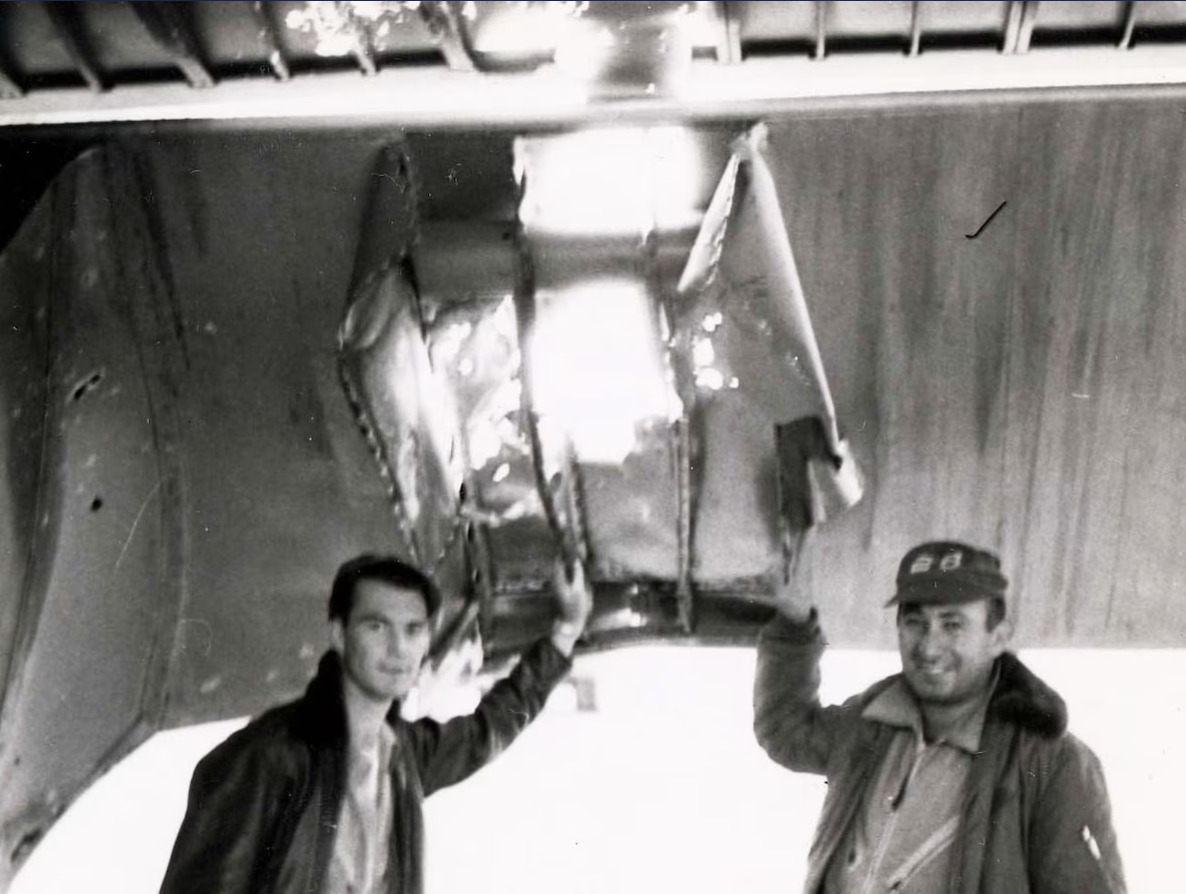
On Oct. 27, 1951, "Command Decision" flew on a strike against rail bridges at Sinanju, North Korea. On this mission, the crew shot down their fourth and fifth MiG-15 (they shot down the other three on Oct. 17). A MiG-15 cannon shell caused serious damage to Command Decision’s flap on the Oct. 27 mission. (U.S. Air Force photo)

Post-war cannons don’t shoot magic shells compared to WWII cannons. Their damage potential should just be relative to their physical properties.

For any B-52 image, National Archives Catalog Search has tons of NIGHT TRAIN/GLOBAL SHIELD '84 B-52 Stratofortress aircraft damaged repair Exercise images.

1 Like

I’ve played this game for over 9 years, 3 months, and 15 days. I’m aware they keep adding stuff. What you fail to understand is what they prioritize years later, to the point that the category becomes useless. Case Example: Japan.

There are a lot of vehicles, and I mean a lot, that we have suggested over the years that could be added to fix a lot of holes that Japan currently has; however, due to Gaijin’s heavy focus on Modern, a lot of people think they can sign up and boom, realize they need to grind all the way there. Unfortunately, most of em never bother. I am also not the first to say this; many current and previous CC’s have stated this as well. It is also why people were pissed when Gaijin tried to hide away many of the low-tier tanks that weren’t great. Such as the Type-95 Ha-Go, and that was very, very controversial; heck, even the R2Y2s and Ho-Ri hidden away were controversial in their own ways. Cause nothing fulfills the roles they serve in the game at the moment. F-84 can’t, nor can any of the so-called “Replacements”.

In terms of the Ho-Ri, we have 3 laid-down Ho-Ri variants that could be added, as historically they are classified as unfinished prototypes. Are we going to see them? Maybe in 5 years? When this game turns 19 years old, if it even survives that long.

So what a lot of people are concerned about is whether this is just a lazy developer attempt to band-aid a problem until A: They fix it or B: They fix it an unknown number of years from now.

1 Like

Most development was not dedicated to shooting down bombers. This job was already given to missiles and rockets in the 1950s, long ago.

1 Like

“Only 16 B-29s were shot down by MiG-15s” does not really tell us how resistant a B-29 was to cannon hits.

That number includes the entire operational context: escorts, interception opportunities, tactics, the restricted area around the Yalu, and the fact that B-29 tactics were changed because daylight operations against MiGs became too costly. It is not a controlled test of how many 23 mm or 37 mm hits a B-29 could absorb.

The Command Decision example does not really contradict this either. The USAF caption itself says that a MiG-15 cannon shell caused “serious damage” to its flap. That is actually much closer to what I am arguing.

The aircraft does not need to instantly lose a wing or break apart.

But serious cannon damage should be capable of leaving it uncontrollable, barely controllable, unable to maintain altitude, on fire, or otherwise incapable of continuing the mission.

And regarding post-war cannons not firing “magic shells”, I completely agree. Their effectiveness should be based on their actual physical characteristics.

An ADEN, DEFA or NR-30 should not be stronger simply because it is newer. Its damage should follow from projectile mass, explosive content, velocity, rate of fire and where the rounds hit.

For example, RAF documentation describes the 30 mm ADEN projectile as roughly twice the weight of the Hispano round, while its HEI ammunition produced around four times the blast effect.

So I am not asking for some arbitrary “post-war cannon bonus”.

I am asking for those physical properties to actually matter when multiple HE shells hit engines, fuel tanks, controls or structural components.

Less instant structural breakup is perfectly reasonable.

But that should be replaced by more meaningful internal and aerodynamic damage, not by turning bombers into aircraft that can absorb serious cannon hits and continue flying almost normally.

5 Likes

How fast were they lost? In the first encounter 1 vs 1?

Or like several migs attacked a B-29 2-3 times and shredded it into pieces?

This seems very hard to achieve just by blowing flip up in real life. Bomber are just very stable platform, and the crew within it can fix it, while the pilot can keep it fly straight for a long time.

Those new ammo still doesn’t guarantee anything compare to the 50 mm shell and A2A rocket Germany used in WWII. But the missile and large explosive shell damage really need to be overhaul.

It varied from aircraft to aircraft.

Some B-29s on Black Thursday were attacked by multiple MiGs, so I would not claim that this proves a literal “one burst and dead” scenario.

But the records also do not show MiGs having to sit behind every bomber and slowly shred them apart. Several B-29s were lost after cannon hits caused engine fires, tail damage or other serious failures. Lucky Dog, for example, suffered an engine fire after being hit and was eventually forced down.

The Avro Lincoln shootdown in 1953 shows a similar pattern. Two MiG-15s attacked RAF Lincoln RF531. After taking cannon fire, the bomber entered a steep dive, caught fire and was ultimately lost. The MiGs continued firing afterward, but the aircraft was already in serious trouble.

So I am not arguing that every bomber should instantly disintegrate after the first burst.

The point is that effective cannon hits could very quickly turn a structurally intact heavy bomber into an aircraft that was burning, losing engines, losing control authority or otherwise doomed.

That is the kind of damage model I would rather see.

3 out of 48 B-29 bombers Shot Down by 30 MiG-15

1 Like

B29s were historically prone for engine related troubles and fires, makes sense

the B-29 is so survivable that they halted bombing operations for 3 months

3 Likes

Because they cannot fight back. The box formation and escort don’t work anymore.

I think “the pilot can keep it flying straight for a long time” sets the bar far too low.

An aircraft can remain roughly straight and level while already being effectively out of the fight. The real question is whether it can still turn properly, hold altitude, compensate for asymmetric thrust, stay in formation, evade another attack, continue the mission, and eventually return and land safely.

The crew can also only fix or isolate damage that is actually recoverable. They cannot repair a destroyed engine, reconnect severed controls, restore badly damaged structure, or rebuild a fuel system that has been physically damaged by HE cannon fire.

And I agree that a 20 or 30 mm shell does not individually guarantee the same result as a German 50 mm shell or an air-to-air rocket. But that comparison misses how post-war cannon were actually used. ADEN, DEFA, NR-30 and M61 were designed to put multiple rounds into a target during a very short firing window.

Real combat also shows that this could be enough without physically tearing the bomber apart. A MiG-19’s cannon fire damaged the wing and engines of an RB-47H before it entered a flat spin, while a Mirage IIICJ’s 30 mm DEFA burst set an Il-28 on fire and brought it down shortly afterward.

So I agree that missile, large explosive-shell, fire and collision damage need work.

I just think cannon damage has the same basic problem, surviving structurally should not automatically mean remaining controllable or mission-capable.

2 Likes