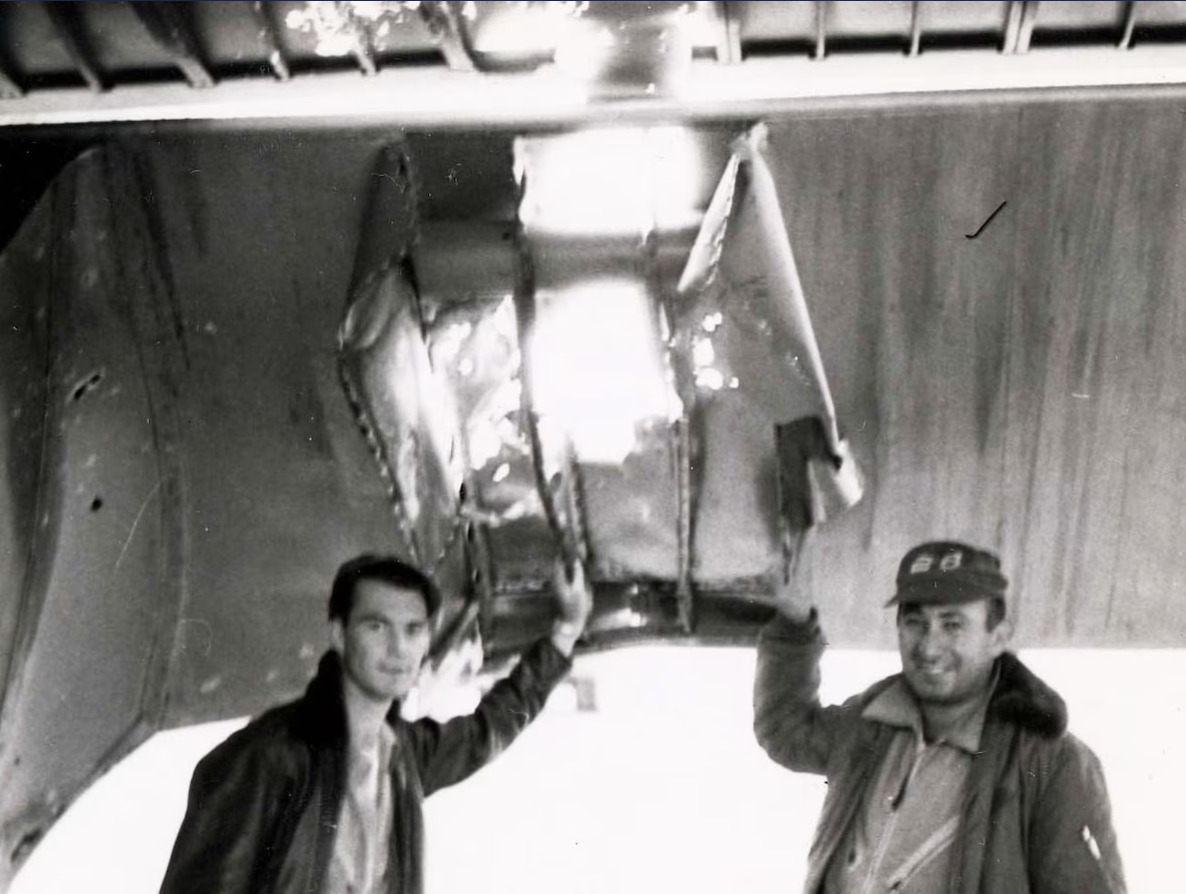
“Only 16 B-29s were shot down by MiG-15s” does not really tell us how resistant a B-29 was to cannon hits.
That number includes the entire operational context: escorts, interception opportunities, tactics, the restricted area around the Yalu, and the fact that B-29 tactics were changed because daylight operations against MiGs became too costly. It is not a controlled test of how many 23 mm or 37 mm hits a B-29 could absorb.
The Command Decision example does not really contradict this either. The USAF caption itself says that a MiG-15 cannon shell caused “serious damage” to its flap. That is actually much closer to what I am arguing.
The aircraft does not need to instantly lose a wing or break apart.
But serious cannon damage should be capable of leaving it uncontrollable, barely controllable, unable to maintain altitude, on fire, or otherwise incapable of continuing the mission.
And regarding post-war cannons not firing “magic shells”, I completely agree. Their effectiveness should be based on their actual physical characteristics.
An ADEN, DEFA or NR-30 should not be stronger simply because it is newer. Its damage should follow from projectile mass, explosive content, velocity, rate of fire and where the rounds hit.
For example, RAF documentation describes the 30 mm ADEN projectile as roughly twice the weight of the Hispano round, while its HEI ammunition produced around four times the blast effect.
So I am not asking for some arbitrary “post-war cannon bonus”.
I am asking for those physical properties to actually matter when multiple HE shells hit engines, fuel tanks, controls or structural components.
Less instant structural breakup is perfectly reasonable.
But that should be replaced by more meaningful internal and aerodynamic damage, not by turning bombers into aircraft that can absorb serious cannon hits and continue flying almost normally.