When I use comments from memoirs, interrogations, and interviews, I am not trying to claim that a single personal account can determine the whole conclusion. My point is more limited: these accounts can show that 4 × 20 mm armament did not have universally persuasive superiority in the eyes of every pilot. In other words, it was not automatically or absolutely superior to its counterpart arrangements, such as 6 × .50 cal, due to the amount of conterexamples exist.
Of course, individual memories and combat accounts have limitations. A single case should not dominate the conclusion. But the same also works in reverse: a few examples of cannon fire destroying an aircraft quickly do not prove that 20 mm armament was always overwhelmingly superior in practice. These sources are useful when they show that real combat effectiveness was more conditional and more complicated than a simple “20 mm is always better than .50 cal” argument.
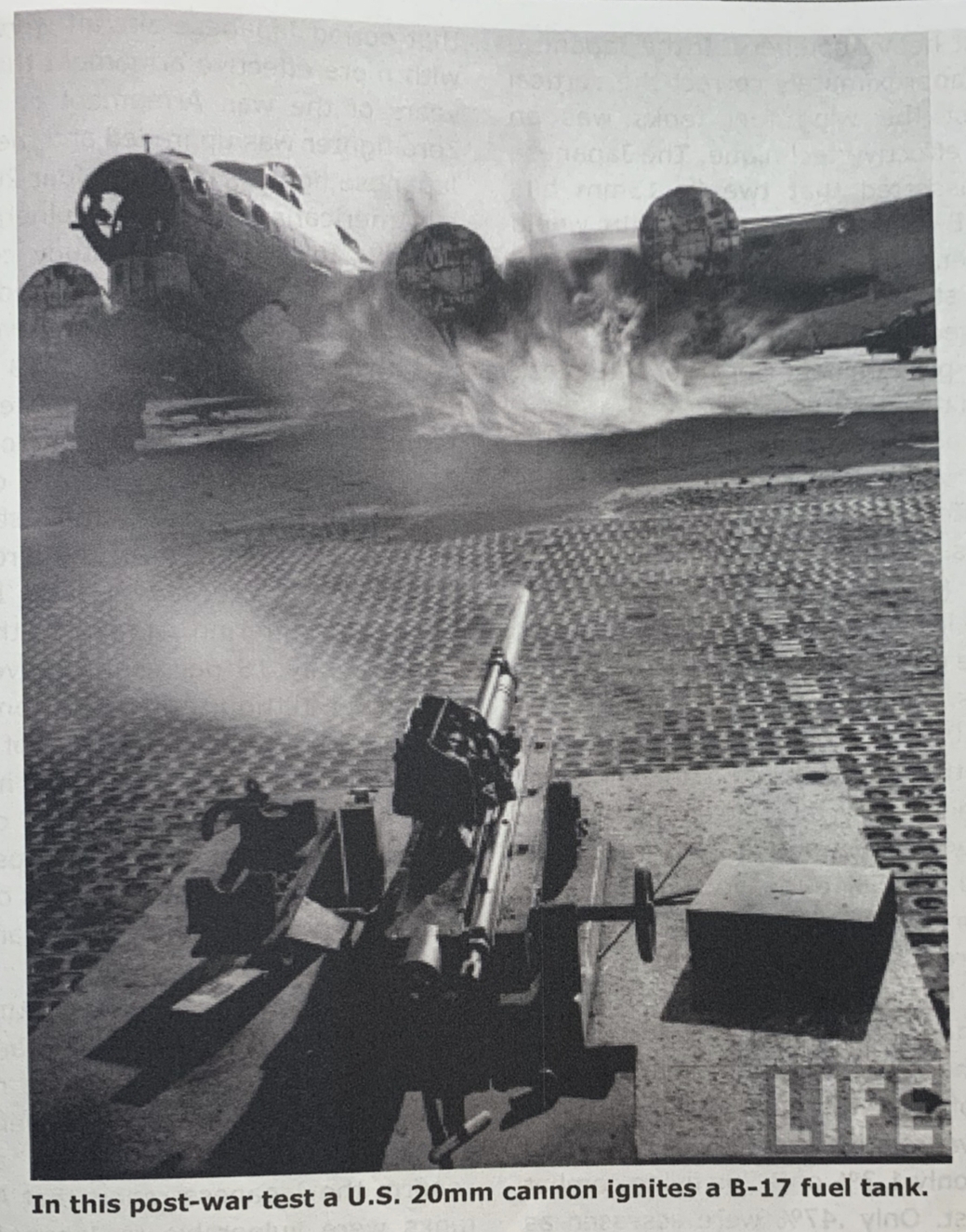
The U.S. Navy’s move toward 20 mm guns should also be understood in context. Much of the demand came from front-line complaints that .50 cals were less effective for ground attack, especially against AA gun positions, small ships, and de-gased parked aircraft. That does not necessarily mean the .50 cal was considered inadequate for air-to-air combat. In fact, .50 cals remained highly effective in A2A shooting as quoted in the same report asking for 20mm. For example, in the case of late F6F-5N aircraft equipped with 20 mm guns, pilots often preferred to switch the 20 mm guns off during air-to-air combat and use them mainly for ground or ship strafing.
In that sense, the argument that Japanese aircraft must have been more protected than German aircraft because the U.S. Navy adopted 20 mm guns is weak from the start. Late-war Navy interceptors intended to counter kamikazes, such as the F4U-4 and F8F-1, still used .50 cal guns, with the F8F-1 even carrying only 4 × .50 cal. At the same time, the USAAF had already standardized the M8 API round in the ETO from 1943, while the Navy continued using earlier .50 cal belt compositions until March 1945. These differences make a direct “Navy chose 20 mm, therefore Japanese aircraft were tougher” conclusion untenable.
So the adoption of 20 mm guns by the Navy was not simply proof that .50 cals had failed as fighter armament. It was also driven by a broader mission requirement, especially the need for better destructive effect against ground and naval targets, so it was adopted first by SB2C, not by VFs.
Likewise, U.S. Navy 20 mm guns were not a silver bullet either. Admiral DeWitt Clinton Ramsey reportedly believed that the F4U-1C would “shoot Japs into a million pieces,” but the combat cases I mentioned earlier suggest a more mixed picture. Even an F4U-1C with 4 × 20 mm guns still required consistent aiming to bring down Ki-84s and A6Ms, and in some cases multiple firing passes were still needed.