What’s stabilized is the third-person camera (which has horizon lock), not the gun itself. If the aircraft rolls, the gun rolls with it and you always have to compensate.
Though that could be solved by forcing a third-person camera that stays locked to the aircraft, not necessarily a first-person camera (I wish they’d do that and remove those ugly placeholders).
Well, the He 111, Fw 200, and others had sling seats for the gunners, so they would’ve remained level with the horizon (during certain maneuvers).
Even as we share a lot of similar thoughts about this specific topic there are some things you might not be fully aware of.
US 0.50 cals as defensive armament have (like the Swedish 13.2 mm Akan cannon) a very annoying artificial bullet spread. That means that you need to fire a hell of bullets in order to hit anything. On top of that no US bomber has the from 1943/44 onwards used belts with 4 to 5 AP-I and just one API-T. There was some time ago a nice vid regarding US aerial gunnery and their used belts.
The damage output is actually extremely disappointing. I used the US A-20 G for a lot of matches as heavy fighter (aced the plane to get 10 sec reload time) and i estimate less than ~ 5% were actual gunner kills, most of them even delayed B kills as i hit cooling or engine.
In total opposition to that any turret with a caliber of 20mm (or more) seems to have way less spread (i exclude MG 151/20s) - my new hobby is now to die to Yer-2s with the 360° degree turret on top :-)
I encourage you to use test flights wiith various bombers. Spawn at the airfield and try to kill the trees around you. You will find out the multi-turret 0.50 cal turrets are far less accurate than 20mm cannons. The 20mm ShVak turrets with one barrel per turret are real sniper cannons, with some practice you can one-shot those trees 😎
The issue is that the gunners are also stabilized to the outside world. So you can pull all sorts of maneuvers and your gunners stay fixated on one point effortlessly, even if your plane is flatspinning.
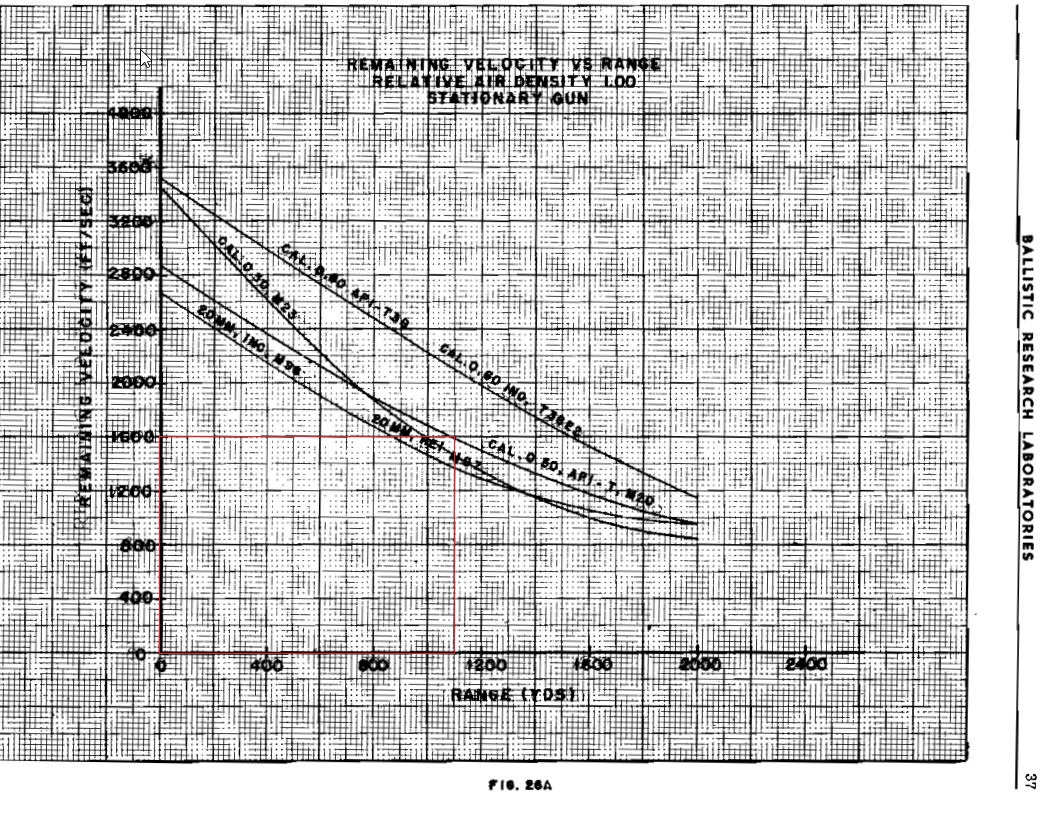
That chart uses the formula. I have no clue what numbers you put in to reach that, and I’m using the higher velocity of 530 m/s 1780fps close enough to 1800 because the M20 API-T is a higher velocity round than regular AP
You don’t even need to input the formula and just line up the velocity of the round of the range it would be striking at on the chart.
Never said it wasn’t a big deal. Just that it was a problem that needed to be corrected. If your guns got too hot, pilots would report bursts that basically did nothing to the aircraft because none of the ammunition got there.
The M23 was a competitor to the .60 cal at the time because it basically was doing nearly what the .60 cal could do without having to rearm your entire airforce.
The little green circle is supposed to be where the barrel is pointing. This leads into a problem where when you have fixed turrets like the P-61C the guns just bounce all over the place. How the hell are 4 fixed guns bouncing in fixed positions?
You already have a diceroll where cumulative damage to fueltanks don’t matter. So this make it even worse for turret .50s
btw, even if the turret isn’t actually firing spread still happens, you can see it when you try to fire while you repair.
Merely the input of the fire button causes the turret to bounce, even on remote weapons stations like the B-66.
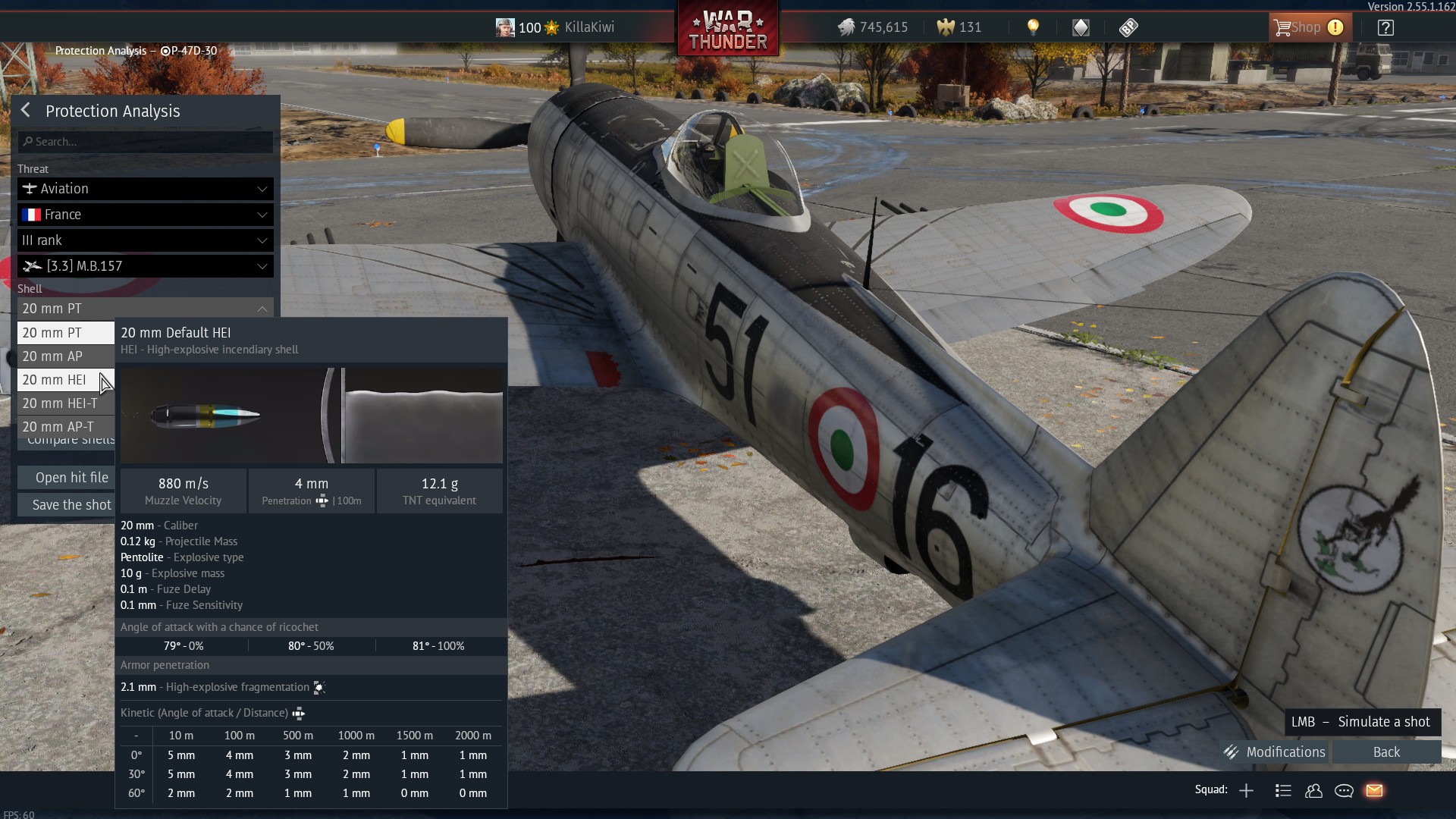
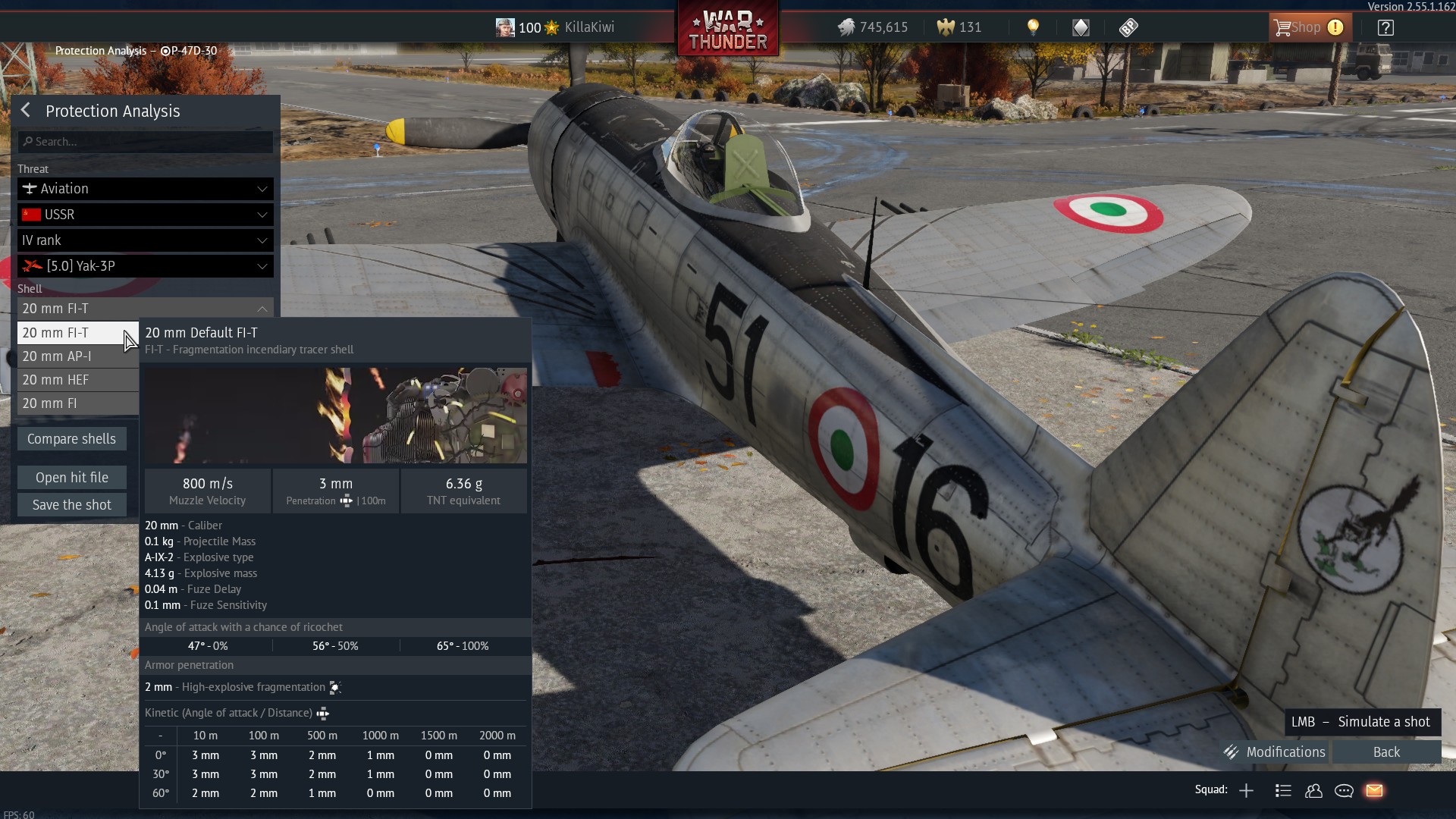
Funnily enough 6 shells with 6.02g of tnt equivalent do the same as the quad 20mils of the F4U.
So the damage upside of the F4U is barely felt
I’ll define a burst of one person holding the trigger for 0.5 seconds.
Because their ballistics are fine.
Type 99s are unique in the fact the ballistics are average, the firerate falls below most 30mils and their explosive filler is very low.
Most 20mils are simply copies of the Hispano cannon with small differences in filler.
They should be shit to use compared to other 20mils, yet they are not, maybe because the frag effect, which according to you is better than structural damage, isn’t simulated.
Main cannon I was talking about were the mk-108, mk-103 and NS-23/37.
They went for more filler, but it doesn’t matter since 6g of tnt are apparently able to remove a spitifre’s enormous wing in 2 hits.
How is this relevant to the Type 99-2? And why would they be bad, when Oerlikon-types did quite well even in real life, with some pilots noting that going from two MG FF/Ms (also an Oerlikon-type) to a single MG151/20 was a big downgrade?
MK103 is present on zero single engined fighters that anyone sane would actually want to fly. That aside it’s still a great cannon.
NS-23s are quite good too, only a little slow.
The brits used much lower safety margins than, say, the americans. The Spitfire in particular is very lightly built.
At 1100yd (1006m) the velocity of M20 API-T is merely 1600fps (487m/s), so the chance drops to 7% and it’s going to be around 1% for the M8, since it loses speed faster compared to the M20.
Of course the formula isn’t very accurate and only based on a few scenarios.
From the actual data against the P-38:
M23 only caused a fire 23% of the times the fuel tank was perforated, with a velocity of 1590fps. So you can imagine how M20 with 1.17g of IM-11 incendiary would do compared to 5.83g of IM-28.
Absolutely normal weight of explosive filling, pretty similar to Hispanos rounds (I mean IRL when we compared British Hispano rounds and Type99. In game Type 99 rounds even much more better than Hispano)
If someone has not made Mine round, it doesn’t mean their cannon has “very low” explosive filling
Honestly I also don’t understand why this gun is so heavily criticized.
“It’s crap, it’s crap” but somehow this “crap” has been flying and shooting down enemy aircraft since the Zero’s introducing on service.
While the Zero’s main opponents couldn’t even establish adequate production of 20mm cannons (which was desperately wanted) and only began real mass production at the end of the war.
It was heavily criticized due to its lack of ammunition (much like the original Hispano), low rate of fire and low muzzle velocity. Didn’t even Sakai say that the trajectory of the cannon was similar to taking a p*ss?
Like the MG FF the Type 99-1 had a similiar muzzle velocity of 600m/s, very much like the 37mm M4, that was sometimes called a grapefruit launcher.
So those shell drop around 2.5-3m below the target at 400m and require a lot of lead to hit a moving target.
Compared to 7.7mm bullets that would maybe drop maybe 1.5m in comparison. So at 400m it was much more easy to hit with machine guns than with 20mm shells going 600m/s.
So you had to get closer, where the flight time difference didn’t matter as much.
While with the Type 99-2, firing shells at 750m/s, the ballistics were much closer to the 7.7mm MGs.
They do, from the third shell onwards the wing already fell off.
Multiple cannons are redundant apart from accuracy by volume.
I meant in-game most cannons are simply reskinned hispanos with different belts, look at the ballistics from akan to an/m2 they are all the same.
They are kind of the average.
Type 99s are the few cannons that aren’t hispano copies.
The thing is that it is dealing concentrated blast damage, result of a thin case with a lot of filler like mine rounds, instead of fragmentation.
And I could even tell you the mg151/20 is punching too hard.
All 20 mils in game deal a similar damage a 30mm HE would.
Apparently this is “balanced” even when taking this liberty no one decided to go a step further and fix belts and ballistics, since those cannons with weaker fillers had acess to full explosive belts (type 99, B-20 and ShVAK “tracer belts”).
No need to read a shell’s statcard to see the TNT filler and plan around it, just look for more yellow or in rare cases look for the best muzzle velocity.
Yeah but it’s not a technical document. It’s a report, so data could be incorrect.
But it does mention that the 30mm Incendiary shell uses the regular Al-Mg-Ba(NO3)² mix and not thermite as often said on the internet. The filling is 110g and not 140g. Which seems far more plausible.
The 140g filling probably refers to the entire filling weight of the empty body, inclucing the metal ring used for structual reinforcement.
They also mention the reason for the development of the 30mm Mine-Incendiary shell for not having to equip fighters with two or more types of ammunition.
HEF and Mineshells for attacking fighters, Incendiary ammo for attacking bombers.
The 30mm Incendiary shell basically contained too much filler and was overkill, while not ideal against fighters.
Thus they wanted to combine a large explosive payload for blast damage with the Incendiary performance of the 20mm Incendiary shell, creating a shell that contained 40-50g of explosive and a 20mm like Incendiary capsule with 8-10g flash poweder, sufficent to set fuel tanks on fire.
Coincidentally DEFYN made a video on the A6M5 the other day.
Go ahead and count how many shells that P-47 ate. Right at the start of the video too!
This is because the AN/M2, M3, Akan m/41 are literally license-built Hispanos.
The list of non-hispano 20mm cannons is longer though.
For starters, all Type 99s (we have three in-game), and MG FFs (two) are Oerlikon-types. Ho-5 is Browning type. MG151 is its own original design. Ho-1 and Ho-3 are Hotchkiss-derived. ShVAK was derived from ShKAS. Berezin B-20 was derived from the UB which in turn was derived from a Lahti AT gun.
Indeed, a lot of aircraft have been shot down by this cannon. It’s also probably the lightest one you could put on a plane, just 24kg for the short model, which would be the MG FF and Type 99-1. There’s no free lunches in physics however, so of course it has downsides.
The MG FF might have shot aircraft down before the Zeros with the 109s, and was only replaced on the 109 Fs and late 190 As. Even Germany kept it in service until the end of the war, due to existing stocks of working guns.
AN/M2 and M3 cannons are right up there for the hardest hitters and they have full HE belts.
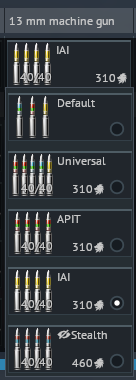
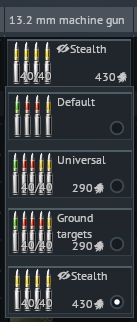
Until we have custom ammo belts it’s impossible to pick all the “good” shells, as almost every belt is suboptimal in some way - plagued by near-useless IT, Tracer, Practice, and too much AP. Especially if you want to have tracers.
For example, this is the MG FF/M Tracer belt. It’s only IT, despite the FI-T shell being available in other belts. Even if IT was performing realistically, there is no reason not to include FI-T as well for more well-rounded performance.
The FF/M belts in general are a mess. Air Targets is way too long and mixed.
Type 99s require you to sacrifice most or all of your tracers if you want APHE. The full HE belt is worse in a tail chase.
MG131 and Type 3 belts have no middle-ground between a good amount of AP and IAI.
We could go on all day about this. But players have always wanted at least one belt that reliably does damage, and will complain a lot when zero belts fulfill that criteria. Whatever shells are in that belt are ultimately insignificant.
It’d also be cool to be able to pick different belts for each gun, or pair of guns.
EDIT:
No wonder Ho-5 was relatively little explosive filler. All its shells have a lot of incendiary as well.
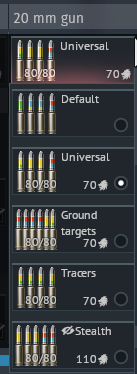
He is using the Universal belt, which has 1/4 AP and 2/4 HEF.
And funnily enough, HEF with twice the explosive deals actually less damage than HEF-T.
Let’s call it the ShVAK paradox.
Where more explosive most likely create more but less damaging fragments, which will in return reduce the structucal damage of a shell, instead of increasing it.
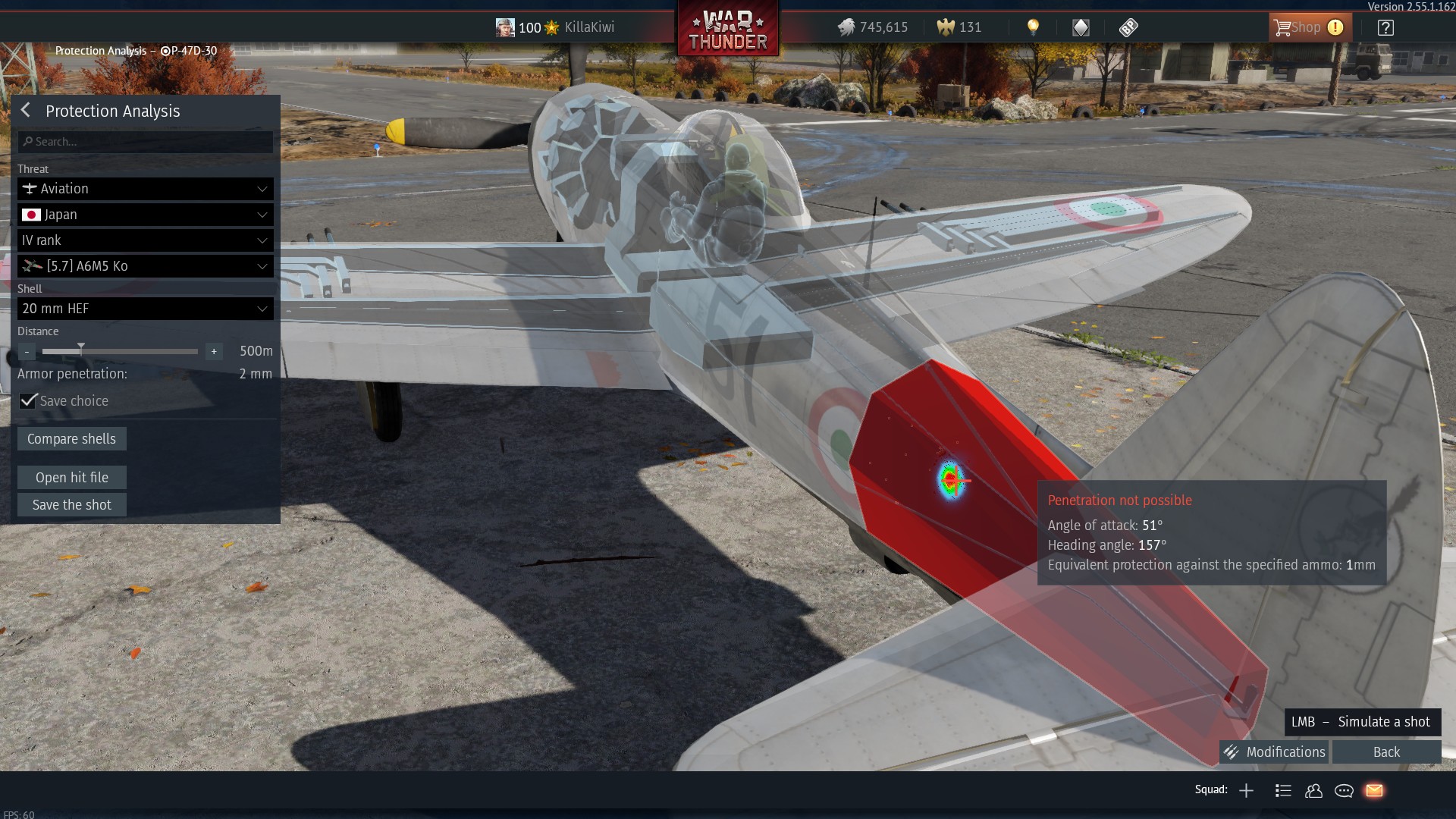
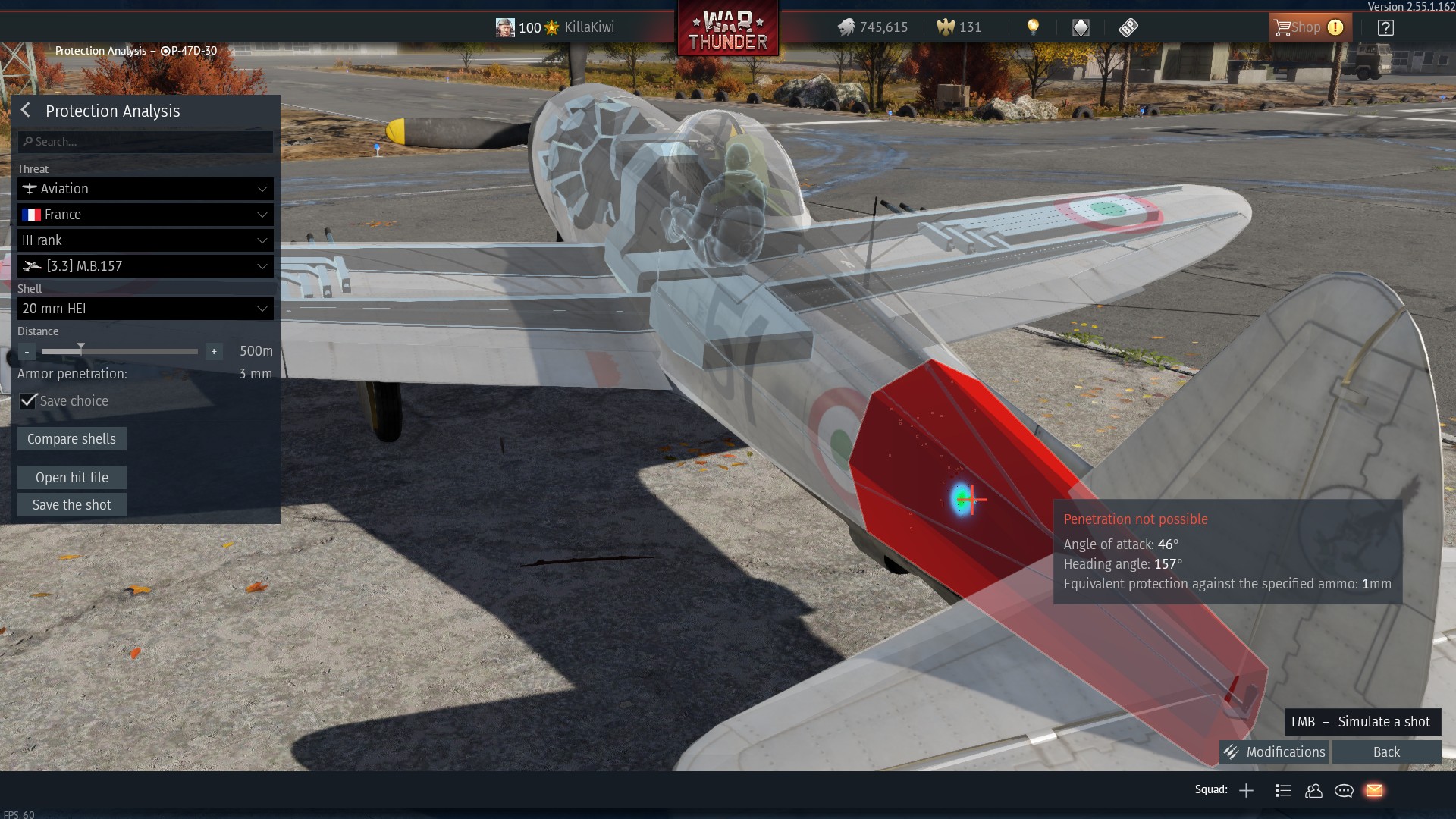
I went on a custom mission and tap fired at P-47 and most of the time I would kill them in one hit, taking wing or tail off. Sometimes they survived and I needed a second shot and only one P-47 took like 3 or 4 taps to kill. Using the HEF-T belt.
I ended up killing 8 P-47 spending merely half my 20mm ammo.
Again. How are you getting those results? because the chart I posted is the application of the formula and it doesn’t line up with your results at all. and at 1600-1800 FPS it’d still be close to 20%. At that point, you’re throwing random results out. Unless you’re trying to say the researchers did their own formula wrong.