It’s probably simply related to kinetic energy transferred into a fuel tank.
The more energy a projectile has, the more fuel shoots out of the tank, increasing the chance the fuel is ignited from the lingering burning incendiary filler outside the tank, under nice oxygen rich conditions.
Actually, I apologize, I don’t think you’re deflecting. I think you forgot or didn’t know what the OG question was and I didn’t iterate it well enough. Not holding that against you, my bad.
Knowing that the current DMs are not right, and weapon mechanics aren’t functioning. What would be your best choice in mind to actually fix it. I listed 3 options.
The gunshipping goes beyond “DM problems” and into the fact that players are having third person control of the gunners Sim. At which point I already have a solution. Gunner accuracy is affected by the amount of AoA and G pulled as others I think have pointed out in the past. It’s hard to be a gunner if your bomber is literally looping and you’re literally going upside down, you’re more going to worry about holding onto dear life than actually shooting. The amount the gunner is affected depends on where they’re at and their role. Gunners who control remote control turrets and are seated? Minimal. free standing gunners who are basically just strapped to their guns? Good luck. They are more worried getting tossed out of the plane than fighting whatever threat is coming their way.
.30 cal would still be pretty effective, but just up close and if it gets clean hits on the fuel tank. Even if it seals, the tank won’t seal within 7 milliseconds you’ll still get ejection, and if it penetrates, you’re still detonating the ullage in the tank, damaging it. The entire point of the self sealing tank is to try and keep the tank together with a skin, and to not let fuel leak out. You could have it where the tank itself is ruptured, but the self-sealing bladder is barely holding it together.
.30 cal is not particularly effective when you’re shooting at some dude 300-400 yards away and he’s got a piece of armor covering his fuel tank and he has a lot in the way. To our knowledge, the .30 M1 incendiary should be multitudes more effective than the British Dixon round as it was still able to light a He-111 in two shots. At close ranges without any substantial armor plating .30s should still be plenty dangerous
That’s why the U.S. was making sure their pilots could hit targets from 600 yards away, and make sure each round was an effective hit as much as possible hence the change to .50 caliber.
The game already differentiates but there is barely any differences.
Forcing a bail out with fire would put players up in arms because you run into the forced bailouts that were implemented before and everyone hated it. I would say make it where your pilot is more susceptible to fire damage and your pilot will eventually die or the plane goes out of control.
You’d replacing fires with “my fuel tank just detonated” it would still be better IRL than it is in-game currently. Ballistically, even at 1000m away .50s still keep around 60% of their total energy.
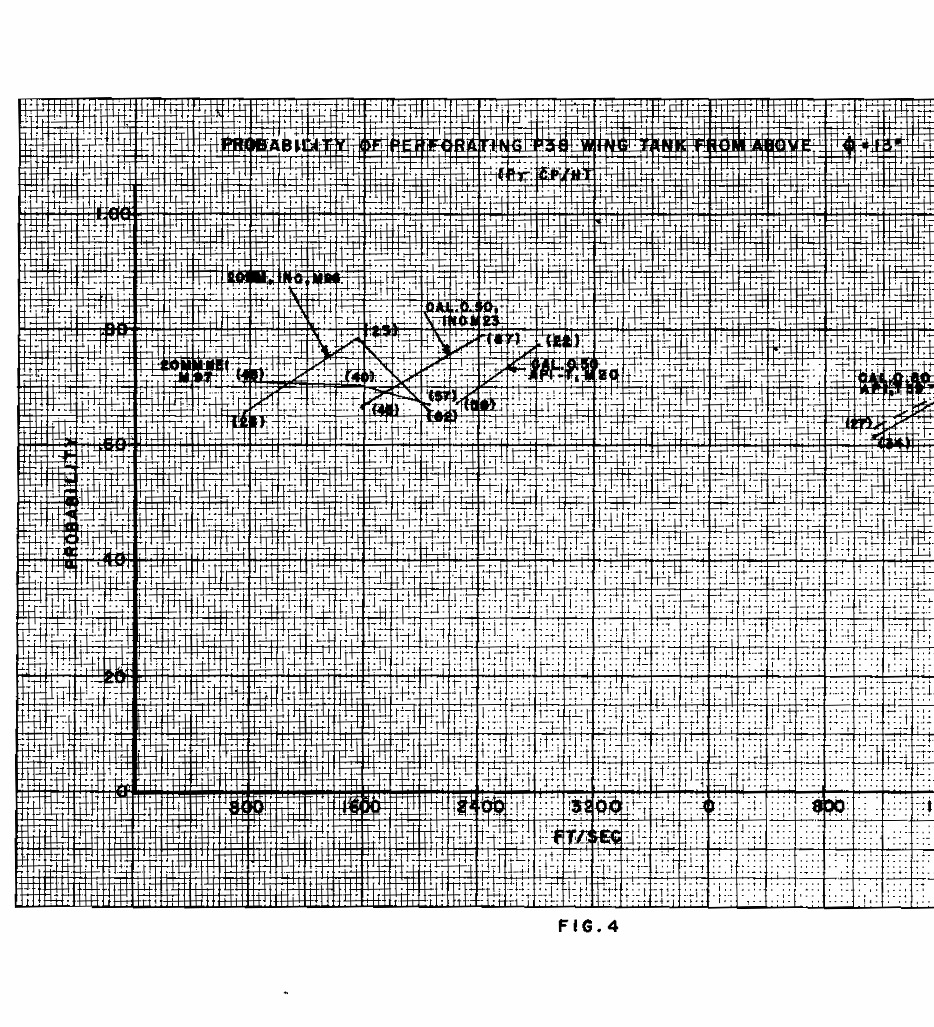
This is for the P-38 from above. But the penetrative capability of M20, M23 compared to 20mm. They are highly similar to one another. The graph covers velocities at which the m23 and M20 round would be at if they were from 1km away. Which would be around 550m/s Even if you kick it down to 500m/s to match the 1600fps figure in the graph, it’s still going to have around 60% probability of penetrating the fuel tank.
This I do know, and I do show-up in every “buff gunners!” thread begging for it to be only applied to ARB gunners or not at all because I already hate sim days where people spam gunship bombers and P-61s because it’s just not fun getting hard-zoned by gunner spam even if it’s just a bunch of P-61s.
Problem: In a fighter you need to get within 300-500 yards to land such hits, especially at high speed and aspect. Some fighters can do it at longer ranges but it’s a major toss-up.
Shooting from cockpit and with direct control of aileron, elevator and rudder significantly hampers accurate aiming especially at high aspects.
Bombers can just do it from third person view and with the same controls as in air RB.
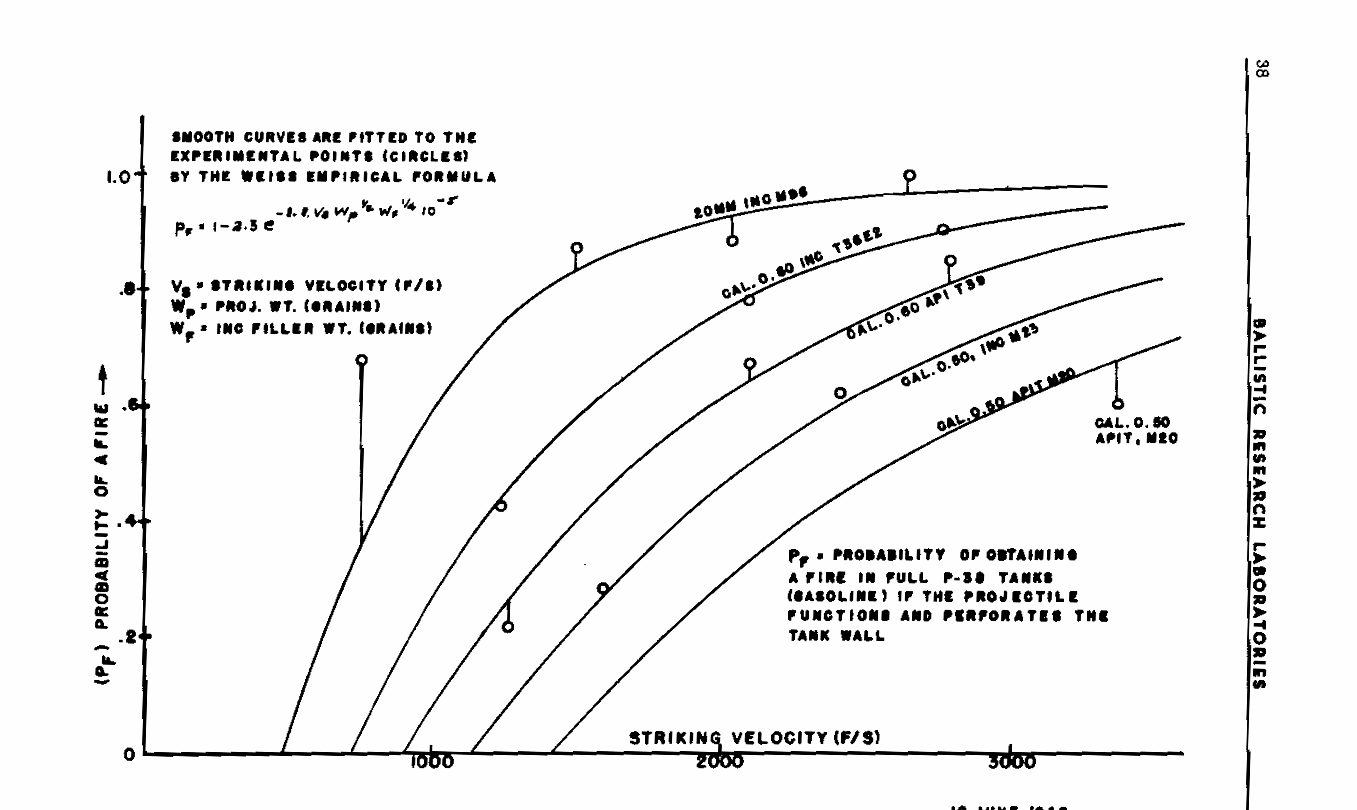
They are at 30% for M23 which has almost 6 times the filler as M8 or M20.
M20 isn’t even shown in the graph below 800yd/s.
AFAIK the M23 was never used on M2HB.
The M23 is a game changer and crazy effective but I‘m pretty sure it had some disadvantages as well.
You know, just in case we get custom ammo belts, I wouldn’t want to see US planes with full M23 belts just melting everything without some actual downsides to it’s performance.
But yeah, can’t complain about almost 6g or flash powder going off causing a fuel fire while going 550m/s.
I don’t see a problem here. It’s the same with planes spinning out of control and only giving you the kill once they hit the ground, killing the pilot because the player didnt J out earlier or left the match.
You constantly see players finishing off already destroyed planes, getting rewarded for no actual contributions other than killing a pilot who‘s either going to die or would have already bailed anyway.
If we talk realistic damage, we also need to talk realistic pilot behavior.
Which also includes not pulling 10Gs without blacking out.
Give RB respawns and a lead marker and you basically have Arcade mode.
This is a theme in every discussion around airfield AAA. “just attack ground units lol” sounds great until you think for five seconds and realize you are giving your enemy every single advantage they can possibly get by doing it.
Regardless of what I “want”, the match is ending in 25 minutes. Nobody is gonna be happy to sit there for 15min because one guy is busy doing the Mozdok 500 on his own.
And what do you think the average player’s accuracy is at 600m? Or 800, or 1000m? If you’re flying planes with small magazines this is already a thing.
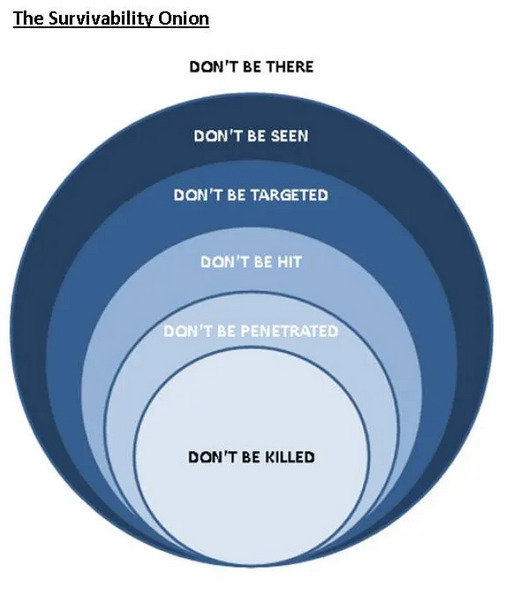
Notice how “don’t be hit” comes before anything related to survivability.
You make a plane bigger because you need to put more stuff in it, or around it. Whether that’s a bigger powerplant, more fuel, more secondary ordnance, etc. Otherwise there is no point in doing so.
Re-read what I’ve said previously:
You can see how much damage it did in those photos. Seems that unlike in-game, pilots IRL didn’t have mouse aim, so they couldn’t accurately target any one part!
“Armor” is not impenetrable nor invulnerable. Even the IL-2’s engine can be taken out by HE shells from the front.
This is the case with every single plane. 109s can do ~17deg AoA with reasonable control, with instructor they either do 12 or 13deg depending on model.
Bomber players haven’t been happy ever since gaijin took away their aimbots, though.
People pushed for more damage of any kind, because when you have cannons, you expect to hit someone and them to be visibly and significantly damaged.
Until very recently, that german 20mm FI shell you like so much made a whole two fragments most of the time and was absolutely useless. You could fire it anywhere you wanted and the most damage you got was something yellow.
two entirely different issues, and they also reduced the minimum thickness to fuse for many shells last time
Every 3U i’ve shot at has readily exploded or disintegrated.
It is required because those games typically don’t have an airfield you can go back to, that is covered in AAA.
…You have bigger problems than cannon damage being too high (which also didn’t help you, ain’t that funny?)
How does this change gameplay in a way that is relevant and not you guys’ aversion to seeing a wing get destroyed
We’ve gone full circle to “losing a wing is realistic, actually”. I’m vindicated yet again.
What is “a burst”? Is that… 6 shells from a Zero for ~0.33s trigger time? Or 16 shells from an F4U-4B, for the same trigger time?
What if I open fire for a full second with the latter, that’s 50 shells. Should an IL-2 or P-61 survive being hit by 50 shells all at once? Because at that point, any armor they may have is getting caved in.
Type 99-2s are doing just fine with their relaxed 490rpm right now, that’s just not true.
P-61s are a pain even in RB. They’ll make one pass, probably miss, and then sit on the gunner for the rest of the game. The only difference is that shooting back while dodging is much easier.
I just don’t want dudes who fly the entire match just on fire. Realistically. Should it get worse? Yeah, but I’m already imagining scenarios where someone just flies around burning the entire time.
At 1000 meters, it’d be around 24-25%. If we use the fire chance we have in-game as a direct comparison, it would be a few percentage points higher at that range.
Yeah, but we’re the pilot. You’re going to have to let the game breathe a bit so you don’t run into the same situation like before where pilot injury made the game straight unenjoyable.
A wing fire isn’t going to kill the pilot anytime sooner than it’s going to kill the plane but if it’s a giant fireball coming out of it, then there’s little chance the plane would survive anyway.
The „few planes returned, which where set on fire“ might just be „few pilots stayed in their burning plane“.
It’s kinda the same deal with tanks.
„oh my god, the tank is on fire“.
Instructions say „remain calm, if not an ammunition fire, extinguish it“.
Reality says „oh my god, I’m getting out of here as fast as possible“.
Well, at least when the fire is caused from getting shot at.
Yeah but I remember you telling us it wasn’t a big deal. Like they tested it and it shouldn’t do that anytime sooner than your typical overheated .50cal becoming an issue.
So I was thinking it probably overheated the barrel more quickly due to its even higher than .50cal typical muzzle velocity.
Well, thats based on the empirical formula.
Using that formula you actually end up with 5%.
(Edit: That’s M8 API. M20 API-T still gets around 11%, using the formula)
Or maybe I’ve implemented it incorrectly when I switched it to metric units.
(Edit: No, I get the same result with imperial units.)
The problem is there is no references for M20 at low velocities, since there’s no actual test data.
(Edit: Then again, the formula is pretty basic, gives you negative results for LMG bullets and it also didn’t predict M96s low velocity performance. So the formula probably is pretty useless other than for the range of test cases)
But we can see that M96 test data shows a high chance to set a tank on fire even at very low velocity were the formula predicts a much lower chance, which means that either size or incendiary content play a big role. Since .60cal Inc is superior over API with the same size and weight, we can conclude that incendiary filler amount plays the biggest role.
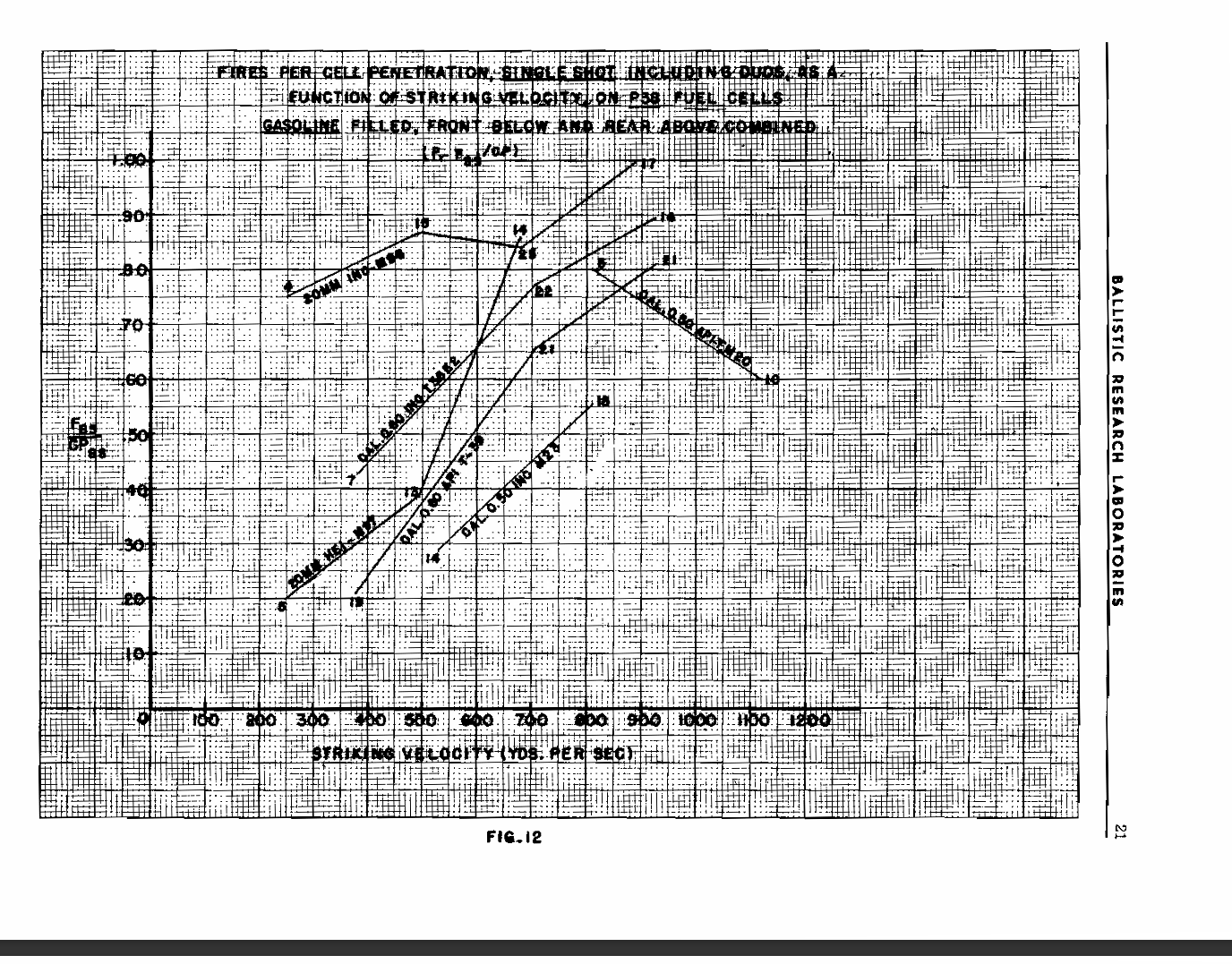
But we do have some data from the firing against P-47 at 500yds, where 20mm M96 is almost 21 times more likely to cause an A kill due to a fire over M20 and still nearly 6 times as likely to cause a B kill.
Against the B-25 fuel tanks it’s only 2.8 times for a B kill. Oddly enough the the chance is 4.4 times higher for 20mm M97 HEI, which always struck me as odd.
In general it’s somewhat strange since the .60cal API is also shown having a higher chance to kill a P-47 due to a fire than .60cal Inc, from the front and below. Against the B-25 from above and behind it’s reversed, just like with M96 and M97.
But maybe it just means there’s more to incendiary chance than just weight, size, speed and filler but that projectile behaviour also play a big role.
.60cal API is a pointed heavy steel penetrator, so you could imagine it can penetrate through the fuel tank more efficently than .60cal Inc that is most likely going to tumble from the heavy lead slug in the back, while the more balanced API keeps it’s orientation better.
It also appears that attacks from below aren’t as effective as from above.
30mm Mineshells and 37mm have much higher A kill chances, while the B kill chance doesn’t or increases very little compared to the P-47, where both calibers saw a much larger increase in from A to B kill likelyhood.
An attack from above with M97 might cause major damage to the fuel tank from the blast wave, right were oxygen can fuel the fire, compared to attacks from below, where the fuel might simply drain from the tank.
Likewise a shell that can penetrate all the way through the top from below, would cause more problems than only causing damage to the tank from one side.
Which would explain the differences in performance when the attack direction changes.
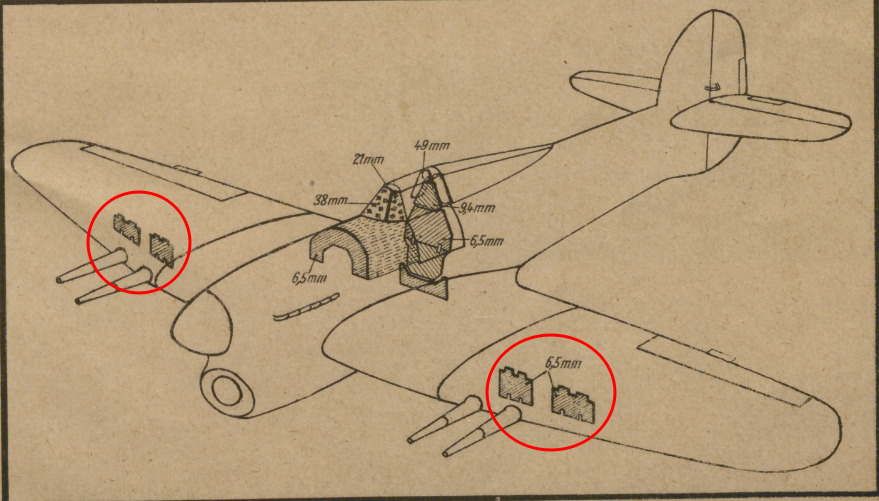
It would be great if ammunition explosion were modeled. At the very least, it would give armor designed to protect storage an actual purpose instead of being just another decoration overshadowed by excessive structural damage.
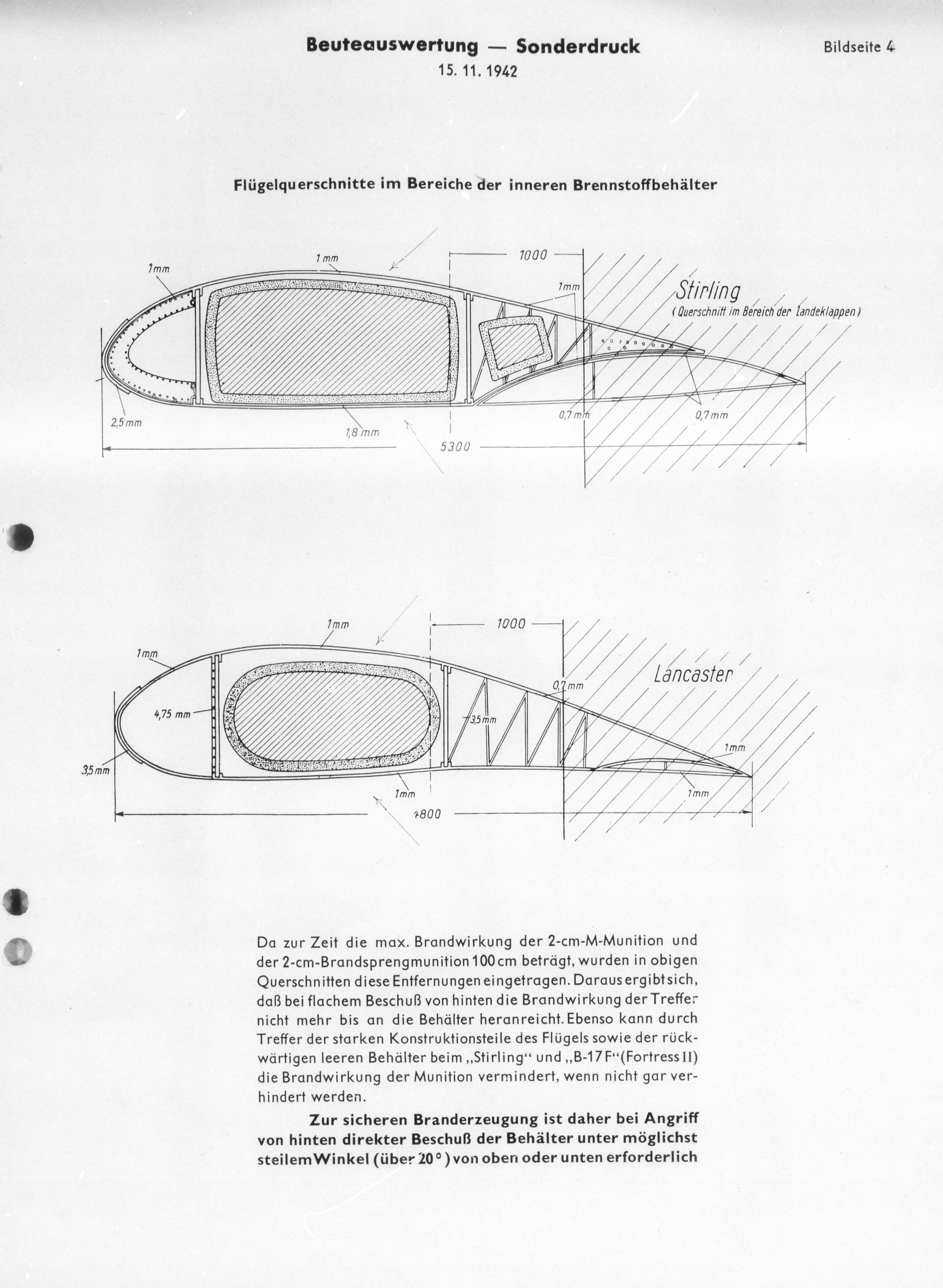
Apparently, German 20mm HEI ammunition had difficulty reaching and igniting fuel tanks on large bombers due to their wide cross-sections.
Of course, in our case. What does it matter if we can’t ignite the tanks? A single high-explosive hit on the trailing edge would have already shredded the wing anyway, which is ironic since it completely dismisses the tactical analysis.
I mean, aiming a free hand-held gun is almost as close as you can get to pointing a mouse cursor. Even turrets with hydraulic aiming systems controlled via joystick allowed very fine adjustments. You can’t compare or equate that with controlling an entire aircraft --a multi-ton fixed gun-- against air instability.
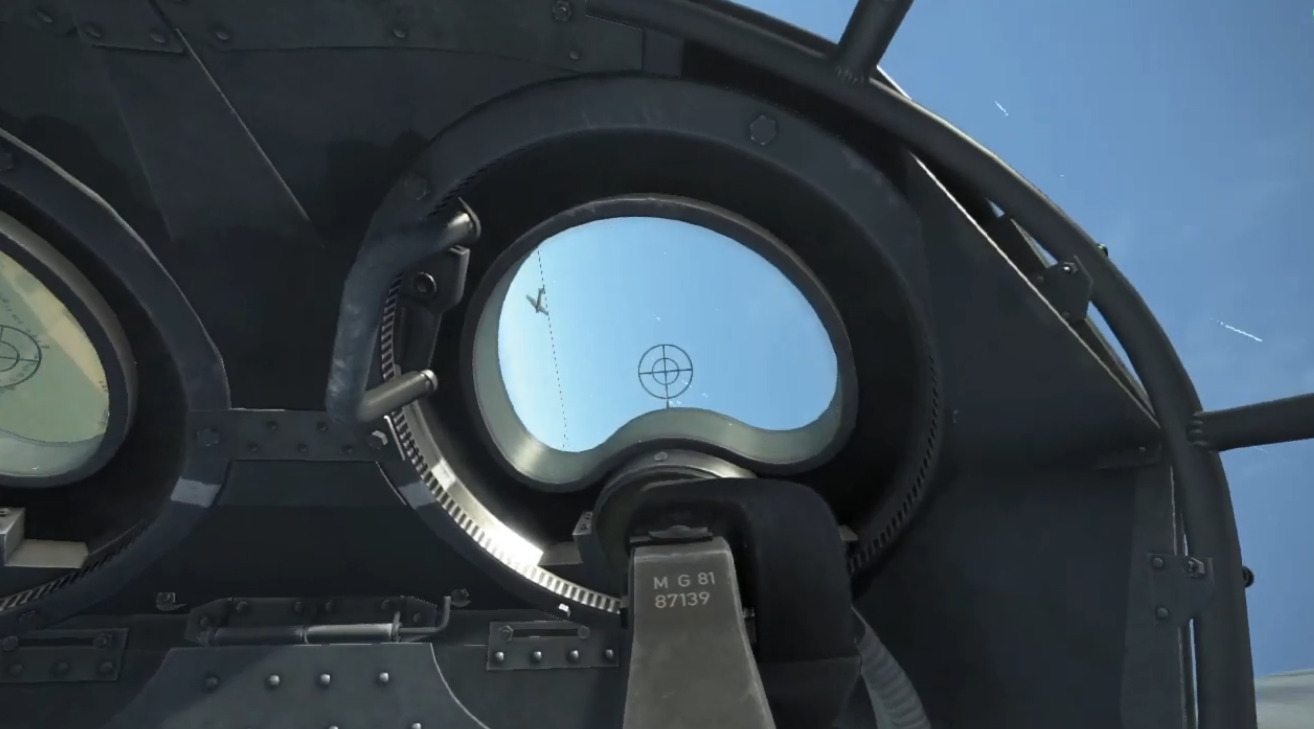
The issue isn’t the mouse. It’s the third-person view giving an unfair advantage in spatial awareness. On a Ju 88, the gunner should see like this.
Not exactly.
Plane is vibrating constantly.
While firing, gun is vibrating too, so your sight picture becomes more like a suggestion.
You swing a gun? You’re working against inertia.
If planes maneuvers, now you’re fighting against acceleration in 3 planes at once.
Yet in WT gunners are 100% perfectly compensated for that.
Plane can be tumbling though the air, with gunner experiencing -4 to +4G and he will still aim absolutely steady. I’ve been sniped by a tail-less bomber performing front flips from 1200m away.
I mean, may be propellant indeed, hard to tell, propellant explosions, at least initially, are often of a more chain-explosion and fire kind, because without a chance for proper pressure buildup, most of the powder fails to ignite initially, and if the charge is big enough it just happily burns but a drum mag for 20mm (haven’t looked what year that is…) or just maybe thay section of a wing would maybe provide enough of a pressure vessel if a few rounds got hit at once…
It would be mighty ironic if that was 30mm incendiary going off, since in WT pilot can facetank such shell with confidence.
But those are external forces acting only during flight and maneuvers, they have nothing to do with the fundamental nature of aiming free guns versus fixed guns. Which, as I said, comes very close to mouse aiming. I also don’t understand what you plan as an alternative. Aim turrets with keys? When real turrets move like this?
By the way, in the game, the sight doesn’t stay fixed or track the target (like in Naval). It moves with the aircraft’s own movement too. Trying to aim at the enemy while performing maneuvers forces you to compensate (and it’s far from easy). That’s why, to actually land hits, the aircraft has to fly straight or at least turn steady.
It’s 3-plane stabilised, while the gunner would be tumbling around his post and wholly incapable of aiming. In 1st person yes, it can become problematic.
In 3rd person it’s an absolute clown show.
Never thought about it how tanks in the back might actually be empty by the time the bomber arrives in enemy territory, thus acting as another obstacle for shells.
No wonder they developed the 20mm Incendiary shell for this purpose.
Smaller calibers like .50cal would also immensely struggle to set the tanks in the front on fire when they first pass through the other tank, slowing down in the process.