What does that have to do with anything, especially my report?
You are claiming a British weapon system that the US never purchased or operated to be removed from the British Apache and added to the US apache because they refused to let anyone else to do the intergration for it.
So im saying that if that is a valid argument, British aircraft that the US didnt build, such as the Harrier are in the wrong tree as well
2 Likes
You are completely wrong.
The US was the one who went through the integration (on their own AH-64s no less), not on the behalf of UK, but because they were evaluating the Starstreak as a replacement to the unsuccessful AIM-9 tests and as “competitor” to the Air-to-Air Stinger.
Here’s the budget document on ATASK integration with the AH-64D:
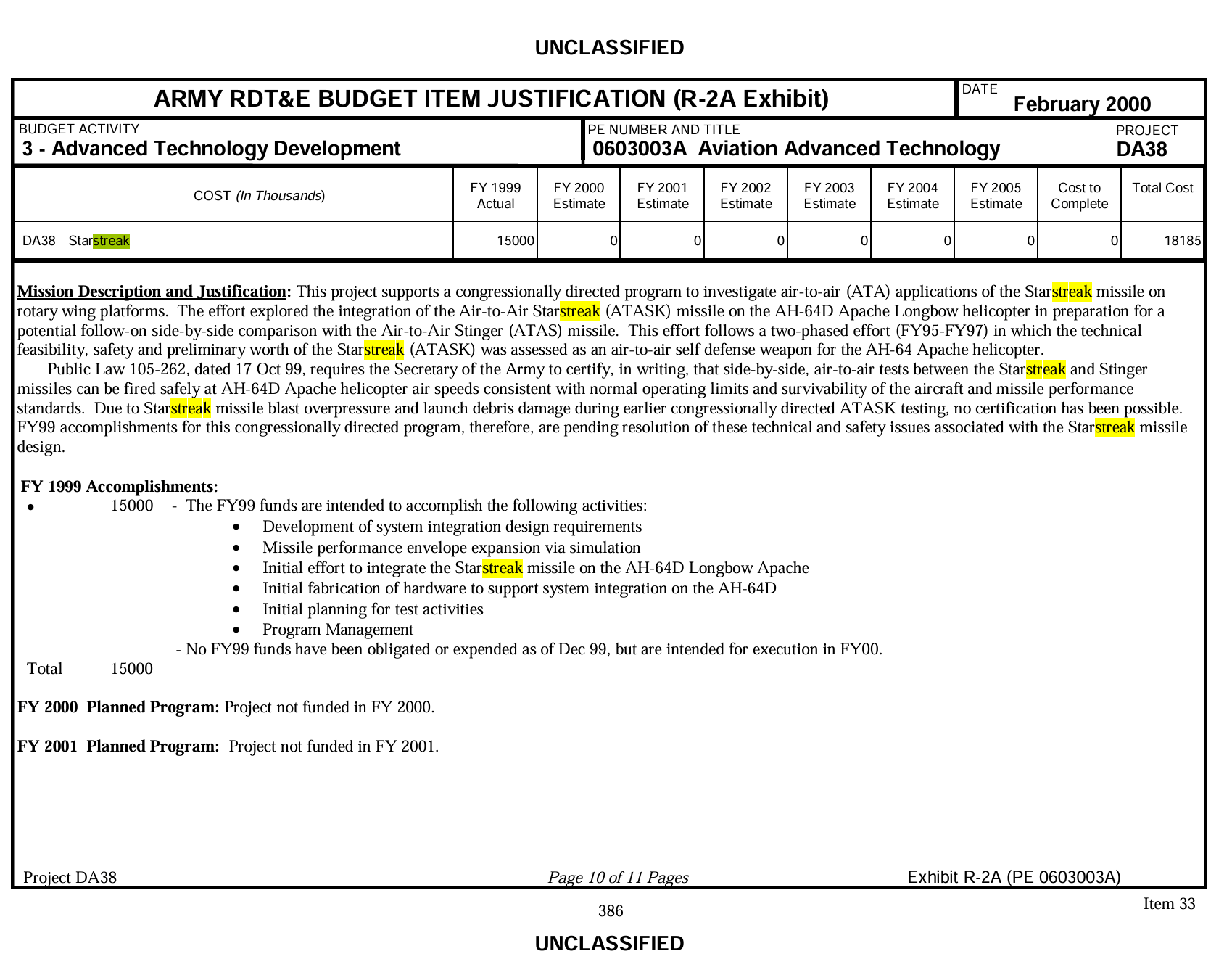
Now, my question is, why the hell should the UK freeload off of a US initiative to upgrade their own AH-64Ds with ATASK, when the UK did no such thing - they gave up on their ATASK program without ever even mounting them because the US ATASK program had failed.
Please provide a primary source that states the US purchased Starstreaks.
2 Likes
I’m not going to waste my time searching for the elusive President signed signature stating that the US used Starstreaks when you’ll deny that as well, but here’s an easily findable news article from 1999 confirming multiple rounds of tests, and if you want more proof, just google a picture of an AH-64 firing a Starstreak - they’re all US AH-64s anyways.
Pretty sure it’s known that the US wanted to test Starstreaks, but did not in the end, even saying they “never wanted to test them”. I did see some images of Apaches having Starstreaks, but I did not bother to look which Apache it is. It appears one of those reasons might have been that normal mounted Starstreaks could damage the Apache
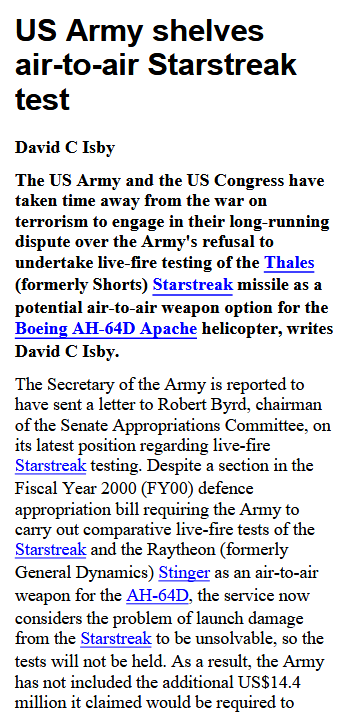
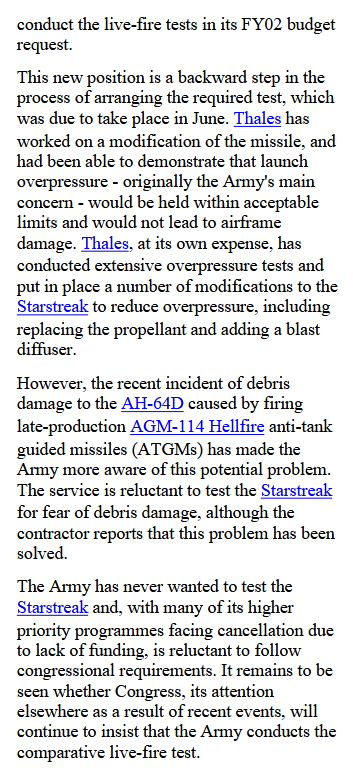
Screenshots are from Janes from 2002, which are dubious from time to time, but it would have to make due
2 Likes
I mean you can find a video of an Apache firing a Starstreak online
Hello, US AH-64A
3 Likes
Aight, thanks
I’ll try to find the image of the mentioned Apache carrying Starstreaks tomorrow or smth. I do remember it being on the ground, and the Starstreak launcher looking different (compared to the in game one)
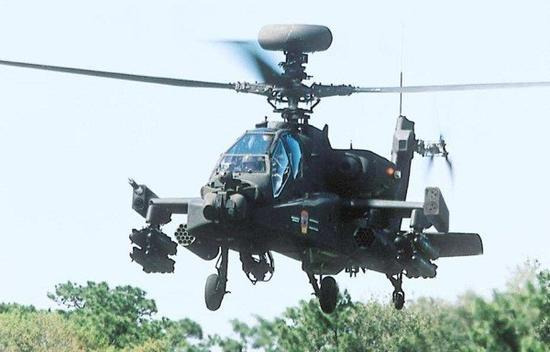

Nah it looked different I think, was a close up too at what I assume might have been a military exhibition
Nope, was in black and white. As I already said, it was on the ground
I can just look for it tomorrow I guess
1 Like
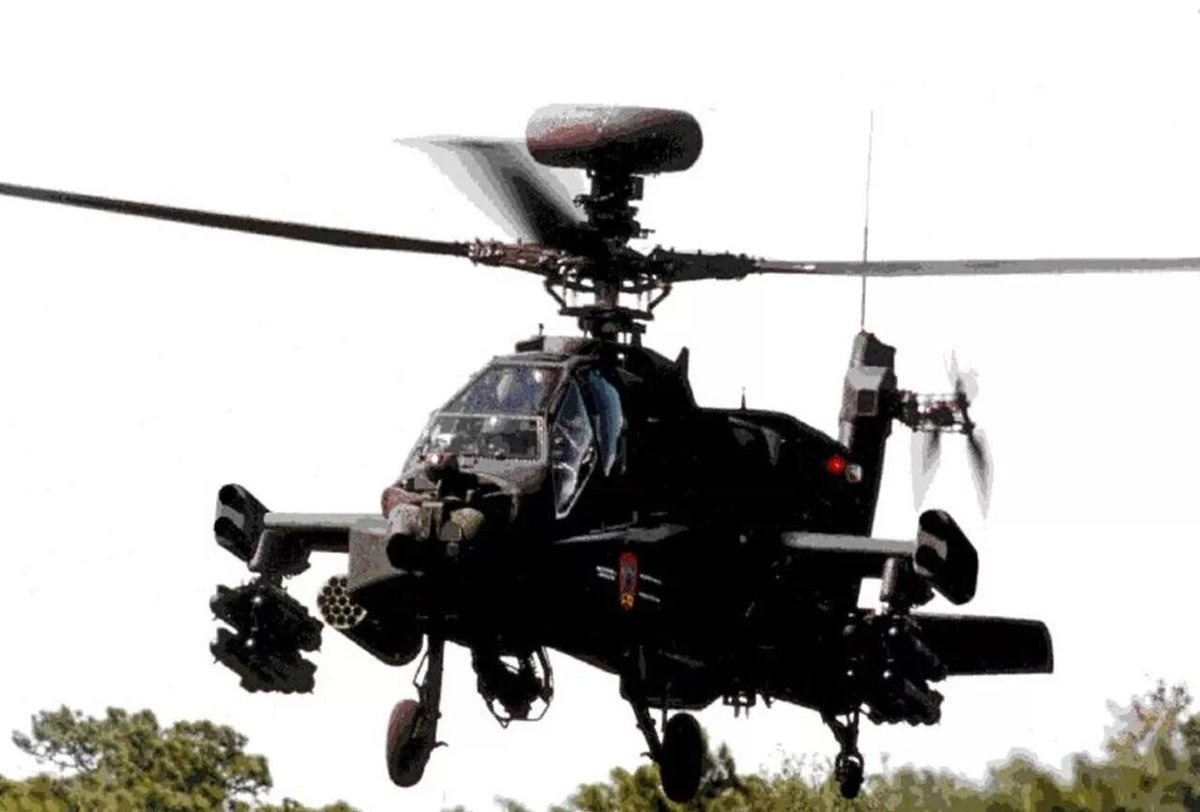
As far as I’m aware, both of these images were airbrushed to add the launchers in. They’re the same photo of the 1990s “Longbow Apache” prototype, but with two different prospective appearances for the Starstreak launcher. The first image appears to have a revised appearance based on how Starstreak looked after it entered service in the UK in 1997. The Second image at least, was generated as part of the pitch to sell AH-64Ds to the UK - it appeared a lot in MoD pamphlets in the mid-90s for the UK’s future Apaches, before the first WAH-64D prototype flew in 1998.
The only Apache that actually carried and fired Starstreaks used in tests for the US, was the AH-64A shown in the video you posted. Those tests were carried out in the 1996. But AH-64A was displayed in European air shows with Starstreak (and Mistral) as a prospective weapon as far back as 1988 in a bid to generate more European interest in the helicopter.
The 2000/2001 series of tests on AH-64D for the US Army didn’t take place. As outlined in Surbaissemaxxing’s post, it was decided that the engineering challenges couldn’t be overcome, even before any live firings on AH-64D were carried out.
Ultimately both the UK and US AH-64Ds are eligible to have Starstreak. It was proposed for the Longbow Apache for both countries, but never actually fired by the AH-64D by either nation.
1 Like
It’s not that. In order to be able to launch a starstreak, you need a beam rider module, which as far as I know has not been used anywhere else but this Ah-64A.
1 Like
I thought about this from a less biased perspective as someone else made similar points, but I’ll be honest, I can’t see the logic. (Not in your argument but the programme).
Just cancelling was the only logical decision. As a thought exercise I took the argument that to be fair, the Army didn’t concretely know they had no IFV in the future, CVRT replacement was the immediate thing. But then I researched the timeline. Initially, discrediting the IFV side of things is absolutely right about the FRES SV tender. But then it changes. And no, not with the benefit of hindsight.
Should’ve cancelled in 2021. Reason? In 2018 the issues with noise vibrations were internally noted in a report by DE&S, in 2020 they were made public. In March 2021 the Commons Defence Committee released a report with the headline calling it ‘A chronic exercise in programme mismanagement’ blaming primarily the manufacturer and then also the Army. In March 2021 Warrior CSP was ALSO cancelled.
That was the point in time to kill the whole thing, because now you have no IFV either, and you know you need one, you have an AFV-Recce, that’s failed due to your ridiculous requirements and an incompetent manufacturer. Same month, no hindsight needed both things have failed. At that point you go we an IFV can do both, won’t be as good of a scout but will be an IFV and by virtue of that more useful to the wider British Army.
Even though IFV’s were originally a factor, they became one, and we had (and still have to a lesser degree) the perfect out.
Buy the Wales line from GDLSUK. Similar has been done before. Have a clean break, absolve them of coming for further costs involved in their failure to deliver the contract requirements in exchange for a reasonable offer by BAE to purchase the Merthyr Tydfil facility.
This is now harder because some collosal imbecile (that’s the nicest damn thing I can say) authorised IOC which absolved GDLSUK of their major contract point.
The Wales site for GDLSUK is also only an assembly and integration line, there’s no manufacture there. The same is true of CV-90 license production. There’s next to no skill gap and there’s no difference in staffing.You can have a clean break there with GDLS UK after only spending 3.2bn (if we cancelled in 2021) which is 1.3bn less than currently which means ~270 CV-90’s more like 230 when factoring UK turret and manufacture, then buy the line from them.
I’m biased towards CV-90 as it’s a BAE product and I simply think that it’s better. But Lynx would also be suitable.
The problem is the extent of modifications to meet requirements would mean several more years without a replacement. That and most of the problems with Ajax seem to stem from fixable problems that GDLS and the MOD tried to partially mitigate instead of committing to a fix.
Ajax was due to be ready in 2017, the issues are very clearly not fixed and they’ve been trying to fix them internally since 2018 and publicly since 2020. You’re going to have to wait regardless, the difference is with CV-90, or KF-41. You get a replacement for both Warrior and CVRT, with Ajax, you get a replacement for CVRT, and then have to rely on an un-turreted Boxer, or a Boxer with a turret but no tracks, or ideally a boxer with tracks and a turret, that’s 50% more expensive than CV-90 MK.IV and delayed too…
The Army needs to get told to get a grip and use the same vehicle every other country uses with minimal modifications.
If they care about the huge radio that much then remove the seats from the crew compartment and put it there and you’ve got your recce. You can even order the amphibious variant for superior independence :)
I don’t know what the current British obsession is with fighting through flawed and poorly performing procurement programmes.
1 Like
A Meteor fired by a Brazilian Gripen E, 2 cool things we can see, the smoke from the conventional rocket motor is much more visible than the smoke from the Ramjet and the much less agressive loft in comparison with conventional ARH missiles
4 Likes