"Bomber Survivability Increase" Balance discussion

Anybody interested in the subject probably is aware of Gaijin’s recent announcement of a bomber survivability rebalance:

But I really want to discuss the potential scaling of survivability between two of my benchmarks, that being the B-17 and the Tu-95M.

The B-17 is already well known for its survivability while being very well researched. As for the Tu-95M, it currently represents the “pinnacle” of gunship-style bombers in the scale, while offering a great comparison.

Now to derive possible “survivability,” or more so structural integrity (strength of the aircraft not getting ripped apart), we need to do some math and educated guessing.

BS labeled as math

1. Maximum Takeoff Weight (MTOW) based on public sources

B-17G Tu-95
MTOW 29,700 kg 188,000 kg
Empty weight 16,330 kg 90,000 kg
Wingspan (b) 31.6 m 50.1 m

Weight ratio (MTOW): 188,000 / 29,700 = 6.33x

2. Educated guess at load factors (kinda BS)

Neither manufacturer’s structural design load factor is public (I am not using or accepting of classified documents). Using typical class values for heavy bombers of each era (fighters run +6g to +9g; heavy bombers run lower):

  • B-17: limit load = 3.0g → ultimate = 4.5g (limit × 1.5)
  • Tu-95: limit load = 2.5g → ultimate = 3.75g

3. Ultimate load (total force the airframe must survive without failure)

Formula: Ultimate Load = n_ultimate × W, where W = MTOW × g (g = 9.81 m/s²)

  • W(B-17) = 29,700 × 9.81 = 291,357 N
  • W(Tu-95) = 188,000 × 9.81 = 1,844,280 N
  • UL(B-17) = 4.5 × 291,357 = 1,311,107 N (≈294,700 lbf)
  • UL(Tu-95) = 3.75 × 1,844,280 = 6,916,050 N (≈1,554,400 lbf)

Ratio: 5.28x

4. Wing-root bending moment (this is the number that governs whether the wing rips off)

Formula (elliptical lift distribution):

M_root = 0.106 × n_ultimate × W × b

(0.106 derives from: half-wing lift = nW/2, acting at 4/(3π) ≈ 0.4244 of the semispan from centerline → moment arm = 0.4244 × b/2 → M = (nW/2)(0.4244)(b/2) = 0.1061·n·W·b)

  • M(B-17) = 0.106 × 4.5 × 291,357 × 31.6 = 4.39 MN·m
  • M(Tu-95) = 0.106 × 3.75 × 1,844,280 × 50.1 = 36.73 MN·m

Ratio: 8.37x — bigger than the weight ratio (6.33x) because bending moment scales with weight × span, not weight alone.

5. Estimated structural mass (airframe only: wing + fuselage + tail + gear; excludes engines/systems/furnishings)

Assumption (BS): structure = 40% of empty weight (standard statistical baseline used in aircraft conceptual design, e.g., Raymer-style weight breakdowns)

  • Struct(B-17) = 0.40 × 16,330 = 6,532 kg
  • Struct(Tu-95), flat-scaled = 0.40 × 90,000 = 36,000 kg (this is the naive/wrong number, see step 6)

6. Correction: split structure into wing vs. non-wing, scale each by its own driver

Assumption: wing structure ≈ 33% of total structure, non-wing (fuselage/tail/gear) ≈ 67% — typical statistical split.

  • Wing(B-17) = 0.33 × 6,532 = 2,156 kg
  • Non-wing(B-17) = 0.67 × 6,532 = 4,376 kg

Wing mass should track the bending moment ratio (8.37x), not the flat weight ratio, since that’s what’s actually loading it:

  • Wing(Tu-95) = 2,156 × 8.37 = 18,046 kg

Non-wing mass tracks the weight ratio (6.33x):

  • Non-wing(Tu-95) = 4,376 × 6.33 = 27,700 kg

Total corrected structure (Tu-95) = 18,046 + 27,700 = 45,746 kg

7. Final comparison: structure as % of total aircraft weight

Structural mass MTOW % of MTOW
B-17G 6,532 kg 29,700 kg 22.0%
Tu-95 45,746 kg 188,000 kg 24.3%

Now the Tu-95M has somewhere around 45,745 kg of structural mass compared to the B-17G’s 6,532 kg.

Now we can do some further, more educated guessing:

Structure group Est. landing gear (steel) Est. aluminum portion
B-17G 6,532 kg ~980 kg ~5,550 kg
Tu-95 45,746 kg ~6,860 kg ~38,890 kg

To deduce a very rough figure, keep in mind I take these figures as educated guesses with a lot of salt, but it’s good enough to get the point across that the Tu-95 has around 7x the structural mass. This may seem irrational, but the reason I did all of this was to talk about something in particular: given the multiple times more excessive amount of structural mass (aluminum), you would reasonably expect there to be some sort of better durability.

To be clear, more structural mass doesn’t linearly translate to more damage tolerance. Where a hit lands and how load paths are architected matter more than aggregate tonnage. This is meant as a directional “more material to absorb damage into” argument, not a claim that the Tu-95 is proportionally X times tougher.

This means I can reasonably claim that “the Tu-95 has substantially more structural material and margin at the airframe level, which is a reasonable directional input toward expecting better survivability.”
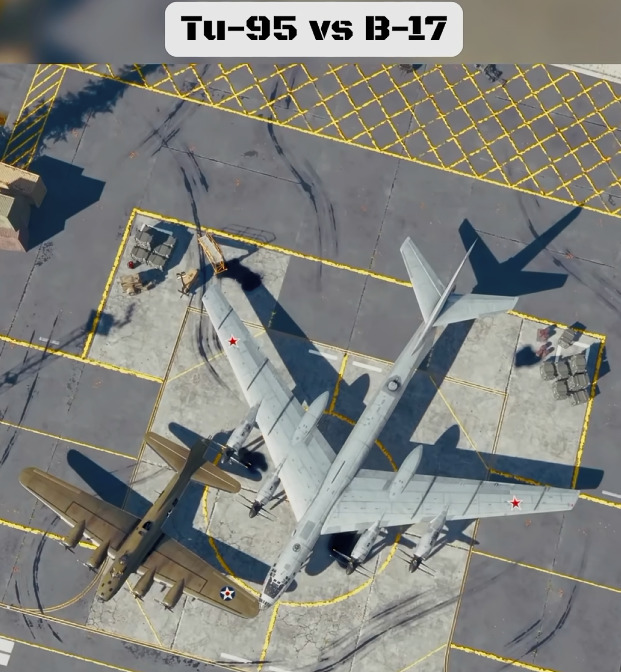
Tu-95 Vs B-17 scale comparison

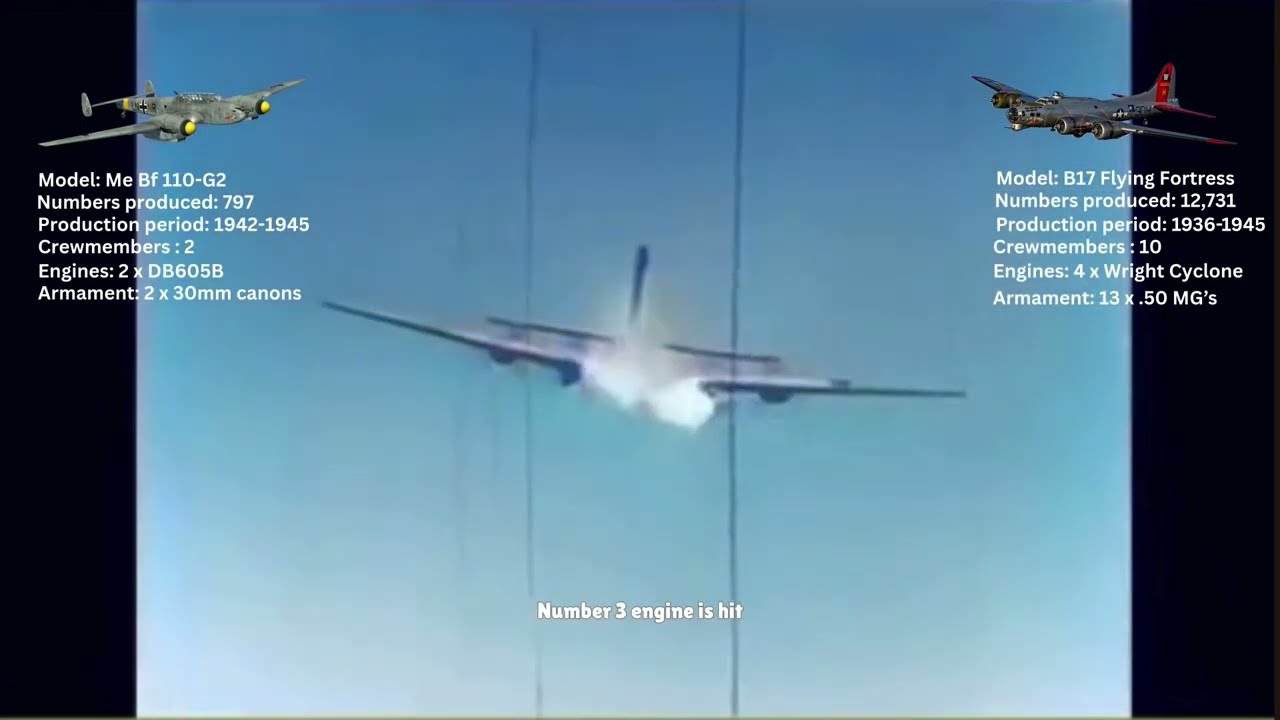
This finally gets me to the question and conclusion I want to make: if in-game modeling is anything like the video above, how would airframe durability get handled? There are cases where missiles in-game already don’t do that “much damage.” If we follow the durability logic from the video above and assume Tu-95M B-17 in terms of durability, then the Tu-95M, already with countermeasures, would be very hard to take down with missiles.

I frankly have no idea how there going to go about it without making bombers battleships or not dis-servicing the data, I’d to hear y’all thoughts regarding the potential balance of the rework.

That’s a lot of math. Props to you for doing all of that.

I see that most of your argument is with structural mass, but from your picture it’s quite obvious the Tu-95 is way bigger than the B-17. Perhaps looking at the material density/strength would be more insightful. This is analogous to how total mass is less relevant for tanks (in war thunder at least) than individual armour plate quality and thickness.

I think Gaijin might draw a parallel from the current naval hull section mechanic, basically splitting the wing into sections (more than what we currently have) and assign a health bar to each section. Perhaps if two or more consecutive sections are destroyed, the wing would break there. If too many sections are damaged, you lose lift proportional to the damage.

You would also have “critical component” like engines and control surfaces, I guess, and those will get their own health bars.

Summary: more detailed damage model, but buff health of all parts.

3 Likes

They’ll need to rework manual gunner control, specifically the viewpoint.

Currently it is stablized on all 3 axis, If you make it like the “attached” camera on replay, rolling over or pitching would tilt your view too, making it harder to fire back while manouvering.

For the bomber to fire back it needs to stay still, which leaves the enemy a small window they need to use very quickly to fire at the engines or nearest-to-center fuel tanks (the ones that carry the most fuel) to take them down.

So now both the bomber and interceptor have time to line up their shots on equal terms.

Or just shoot at the bombay and have it explode because that’s lovely of course (it isn’t)

But it is very alarming just how many players just “shoot” at the bomber instead of somewhere vital and really park themselves behind you and expect to come out alive, really felt in lower tiers in stuff like B-25s or Ki-49s

Those 20mil armed bombers will take a lot more victims with them for sure.

You can also try to calculate section health based on volume per section/module.
You’d have stuff like the think wing sections of the B-24 be less durable than the B-17’s sections.

Or hampden’s very thin tail be more fragile in comparison to a let’s say a LeO 451.

Bombers should be flying Battleships IMO, if i play a bomber i want to feel like a heavy tank back in 2014 war thunder…when the game was still fun…

3 Likes

By the way, since Tu-95 is a prop, there is a funny little button called “I” that makes you immune to all IR missiles. At least, it works for me every time in my Tu-4. Love to see the occasional Sea Vixen trying desperately to lock onto my room temperature plane.

Radar missiles are still a death sentence though …

image

image

3 Likes

That’s it until Gaijin return Tu-95Ms’ Meteor-NM electronic countermeasure complex, which I doubt. Still, ECM is in very early stages from what I can remember in the Nuclear Thunder april fools, seeing how Gaijin may handle this, only higher battle rating airplanes will have access to proper electronic countermeasures or may never been implemented.

The B-17s (and USAAF bombers in general) are romanticised due to propaganda reasons - there is a reason why the USAAF lost 10,000 bombers in Europe. Yes, you find noteworthy exceptions like the Memphis Belle or Old 666 - but the pure data shows that surviving in a bomber irl vs determined fighter opposition was based on luck - and nothing else.

Thw wt game play boils down to unescorted deep penetration strikes leading to 1 vs 1s (in the best case) vs enemy fighters. And in opposition to irl bombers like B-17s fly in wt too low (which makes it easier to kill them) and way faster than their actual cruising speed - which makes them harder to kill.

Besides that: Your Bf 110 G vs B-17 vid is ai modified and shows just 20mm surface hits, no 30mm used - and German gun cams never had audio…

This rework is nothing more than a long overdue damage model reworks of components and is basically the rework attempt of gaijin’s own decision a decade (?) ago to replace B kills (=delayed) with A kills (=instant) as gratification for dopamine thirsty (fighter) players.

Successful bomber gameplay at prop-BRs was always centered around avoiding getting spotted and attacked in the first place - and not about the amount of punishment you can take.

So gaijin addressing that they rework damage models might be helpful for a niche mode like Air SB but won’t change anything regarding the outcome for Air RB - as the bomber “problems” are rooted in:

  1. No real game impact when flying a classic base bomber (with just a few exceptions) means than no experienced players (except real fans) fly bombers without offensive capabilities as the risk attached to flying bombers compared to rewards or actual game impact is way too high. The way too low ticket impact of base kills makes them dead weight even for the PvE aspect of Air RB.

  2. The cannon damage buff of 20mm cannons like ShVaks increased massively the damage output whilst gaijin added artificial spread to return fire fom LMGs/HMGs - that 20mm cannons as defensive weapons are still incredibly dangerous is nothing new - that’s why just rookies tailchase a Pe-8 or G8N1.

  3. Base bombing in Air RB became mainly a RP grinding tool - meaning less experienced pilots flood the mode and teams collapse way earlier than years ago - leaving you in a heavy bomber flying a detour either flying 1 vs 6-8 even before you drop - or the enemy team is dead before you can drop.

That means that balancing bombers require substantial changes in the setup of the game play - a damage model rework might help to delay a bomber kill, but the role of bombers in general is way more decisive.

3 Likes

They will mess it up like always and bombers will be tanks for a good 6 months

grafik
this dvd set, which ive watched roughly a decade ago, has alot of gun footage and historical footage of b-17 and b-24 b-29 over europe.
I havent found it elsewhere yet but maybe that could be of use

Yeah, but last time that happened the Tu-4 jumped from 6.7 to 8.7. If this rework follows the same “good old days” logic, I bet a lot of people will end up complaining about it too.

If they actually put in the effort, they’d probably do something like that. I seriously doubt it’ll get much effort though, given Gaijin’s recent track record, but I could see it working out if they did.

I think that’s partially why they quietly removed EEGS from the Tu-95M and are ignoring my bug report about the missing radar and gun laying radar. For some reason they’ve currently put any radar guided bomber’s radar sighting on hold indefinitely. That could be because of an incoming rework, or it could be that BVVD just has some kind of vendetta against bombers. Honestly, I don’t know why.

a picture of a nuclear explosion with the words " truth nuke " on the bottom

Thankfully, most of this could be solved by Nuclear Thunder, if they’d actually let you spawn in with the B-52H or Tu-95M, which sadly they don’t.