Statshark tells me at a 120km range launch only on IOG, the AIM-120C actually does better and hits first, which makes me think something is wrong there:
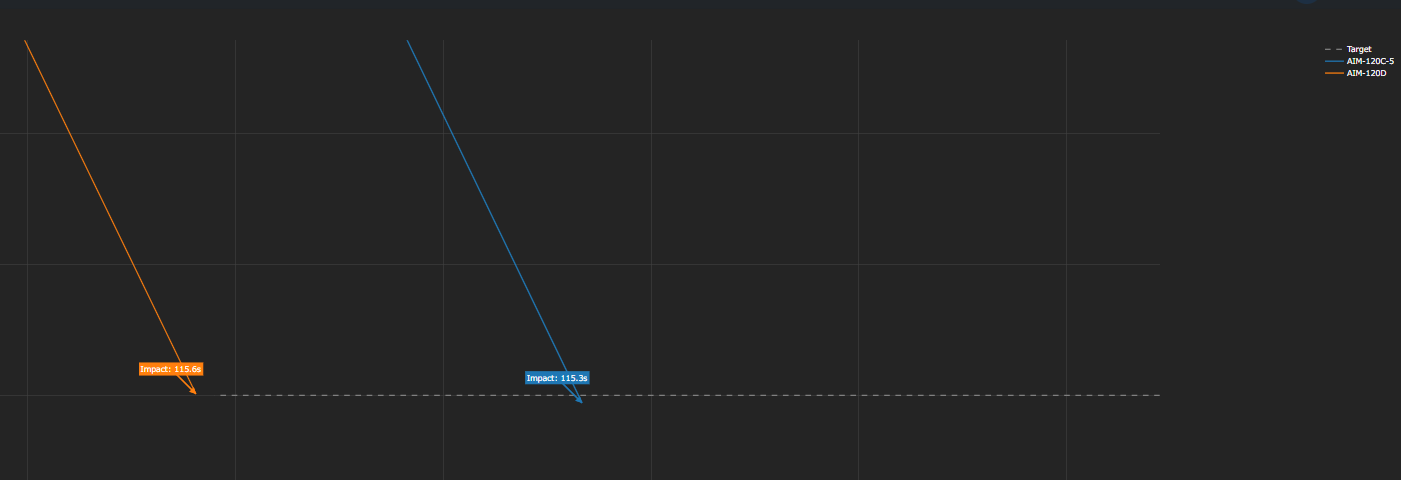
This is largely the point of GNSS from what I understand. With IOG drift being high enough that the target might not even be within the seekers FoV but might be for the GNSS (of course asusming the aircraft didnt deviate from the predicted intercept point)
The missile not being in the wrong place with GNSS should mean it does not need to waste the missile’s energy in correcting to the right place before doing terminal maneuvers.
Could GNSS help improve the missile actively programming its trajectory? Since it would know its position very precisely
But if what Morvran is saying is true, and IOG only gets bad at longer ranges, then the GNSS drift reduction will not really make a difference at realistic ranges for the AIM-120D’s NEZ.
So what could be causing that improvement?
I get the logic, but I doubt it makes much difference, because it will know its speed, travel time and probably altitude, and from that it can give a fairly good picture of where it should be. Granted GNSS would tell where it is, not where it thinks it is. But at least in the war thunder context, its probably no different.
I get that you’re pointing towards motor improvement but some might ask why they didn’t state that outright like they did before with the AIM-120C-5?
IOG drift the way I understand it (both in-game and IRL) is that its the amount that the weapon drifts of course due to little accumlative errors. This might just be 0.1m per 100m traveled. But that would mean 1m of drift at 1km and 100m of drift at 100km. At which point the target is no where near the seeker.
probably makes more sense switching from degrees to m of miss actually.
Extreme example, but you get the idea
In-game that figure is probably set to be waaaaay too high. As I said above, Brimstone has an accepted report for its drift from a 20km shot being only a few metres, currently its 10s of metres.
1 Like
If you remember from a little bit ago, I sent you an article quoting a Raytheon employee (vice president of something iirc) saying the D-3 fit a little bit bigger motor than before. As far as I know, this is not mentioned in any USN or USAF documents regarding the 120D-3.
It’s also possible to fit more propellant without necessarily lengthening the motor a lot through making other components smaller, or making the motor casing more space efficient
These sources/slides are for the original D and not the D-3 though.
same as c5
I know, I’m just saying that motor improvements without outright official statements from USN/USAF have happened
1 Like
which is why i had to mention it as it more demanding and harder to do and esp hard in Sim
1 Like
I think the core question here, and what OP is trying to say.
Is why cant a B/C5 be fired at a target that is within the FoR of a gimballed radar.
I can get the argument why firing an AMRAAM on nothing but IOG in high HOBS could be problematic and how GNSS would “greatly improved HOBS performance”.
IRL the GNSS weapon could be provided the GNSS coordinates of the target as provided by other sensors or a third party and fly towards that position, but IOG is more “keep heading that way”
But for the Gripen E and Typhoon with gimballed radar providing DL information to the missile the entire time…
Why is it still locked to the gimball limits of the seeker to fire? Its not like the seeker needs to lock the target to fire, otherwise you would never be able to fire at anything past 20km.
Its just a bit weird
1 Like
Iirc C-7 got improved HOBS and that was pre-GPS
So that might have been just improvements to the IOG then.
improved hobs means nothing as long as you cant prove what was improved for ingame
like i can tell you that the C-8 is an F3R of the C-7, but there is nothing you can do with this info
and that they replaced the actuator section of later models but it changes nothing
Then anything with IOG + datalink could be fired outside of its gimbal limits such as AIM-7P and R-27R/ER?
Probably.
But not a lot has a radar with suffecient gimball limits (larger than the gimball limit on the seeker) to be relevant a lot of the time.
For example, nothing with Aim-7P, and only a few with R-27ER (Mig-29SMT and Su-30SM2 I think)
I’ll have to find out if AIM-9X Block 1 has IOG, if so then it is the clearest example that anything with IOG doesn’t mean it can be fired outside of gimbal limits.
I think a large part of the NATO playerbase wouldn’t be okay with R-27ER getting hobs capability so they can get smacked 50km away from a notching SM2 based on a maybe that it could operate like that.