History
In September 1952, the Navy Bureau of Aeronautics issued a new requirement for a new supersonic, carrier-based, air-superiority day fighter. Vought, with real experience with carrier-based aircraft, had only eight months to come up with a proposal, so it led to the design of the Vought V-383 model. It featured a high-mounted wing that was hinged to move seven degrees in incidence with its hydraulic system. Because of the high wing, the landing gear was mounted on the fuselage, and it was short and had the strength required for carrier operations, as part of the lessons learned with the long-legged F7U Cutlass, which experienced a lot of failures with its very tall nose gear.
The 42-degree swept wing was unique, with devices called droops. They were located along the entire span of the leading edge, while the ailerons and small flaps were located inboard of the wing fold on the trailing edge. This was done to give the supersonic aircraft good handling and flight characteristics required at slow carrier landing speeds. The cockpit was located as far forward as possible to provide good forward and lateral visibility. Internal armament was to include four Colt 20-mm cannons in the forward fuselage and 32 x 2.75-inch rockets in a drawer mounted just forward of the main gear in the lower fuselage and hinged at the rear. Provisions were planned for AIM-9 Sidewinder missiles on each side of the forward fuselage. Extensive air-to-ground weaponry was not considered since it was not part of the original requirement. A Pratt & Whitney J57 afterburning turbojet engine was selected to power it.
In May 1953, the Navy selected the Vought V-383 design as the winner of the competition and ordered Vought to produce several mockups and wind-tunnel test models. The designation XF8U-1 for construction of the prototype was assigned. A total of three prototypes were ordered. Only two of these prototypes were built, with the third one cancelled before it was built.
On March 25, 1955, the first prototype completed its maiden flight and exceeded Mach 1, making it the first aircraft ever to do so on its first flight. The second prototype flew for the first time on September 30, 1955. The Navy was satisfied with the test flight program, and the design of the first production version was barely different from the prototypes. The Crusader name was christened for the aircraft.
The initial order had been for 448 F8U-1 aircraft, but the last 130 were delivered as F8U-1Es (F-8Bs). With few changes from the prototype, the F8U-1 began to roll out of the Dallas assembly line, and it first flew on September 20, 1955. A total of 318 were built between 1956 and 1958.
The first thirty aircraft were fitted with the Pratt & Whitney J57-P-12 engine, but this was replaced with the more powerful J57-P-4 version in all subsequent F8U-1s. The original thirty were then retrofitted with the -4 powerplant as well. This allowed the F8U-1 to reach a maximum speed of Mach 1.5 and altitudes near 50,000 feet. Other improvements added during the production run included the retractable in-flight refueling probe in a blister on the forward left side of the fuselage. This feature was begun with the fiftieth production aircraft, and it was retrofitted to the earlier airframes. During production, the original Vought ejection seat was replaced with the Martin-Baker Mk-F5A seat, and the capability was added to carry Sidewinder air-to-air missiles on launch rails mounted on each side of the forward fuselage.
The F8U-1 did not have a search radar, and it had the AN/APG-30 gunsight, radar, and fire-control system installed for weapons delivery. It simply provided ranging information to a target that had to be acquired visually. There was no radar scope in the cockpit. The antenna for the ranging radar was in a very small radome on the front of the nose cone. Unlike all subsequent fighter versions of the Crusader, the nose cone consisted of the small radome on the front, with the rest of the cone being made of metal.
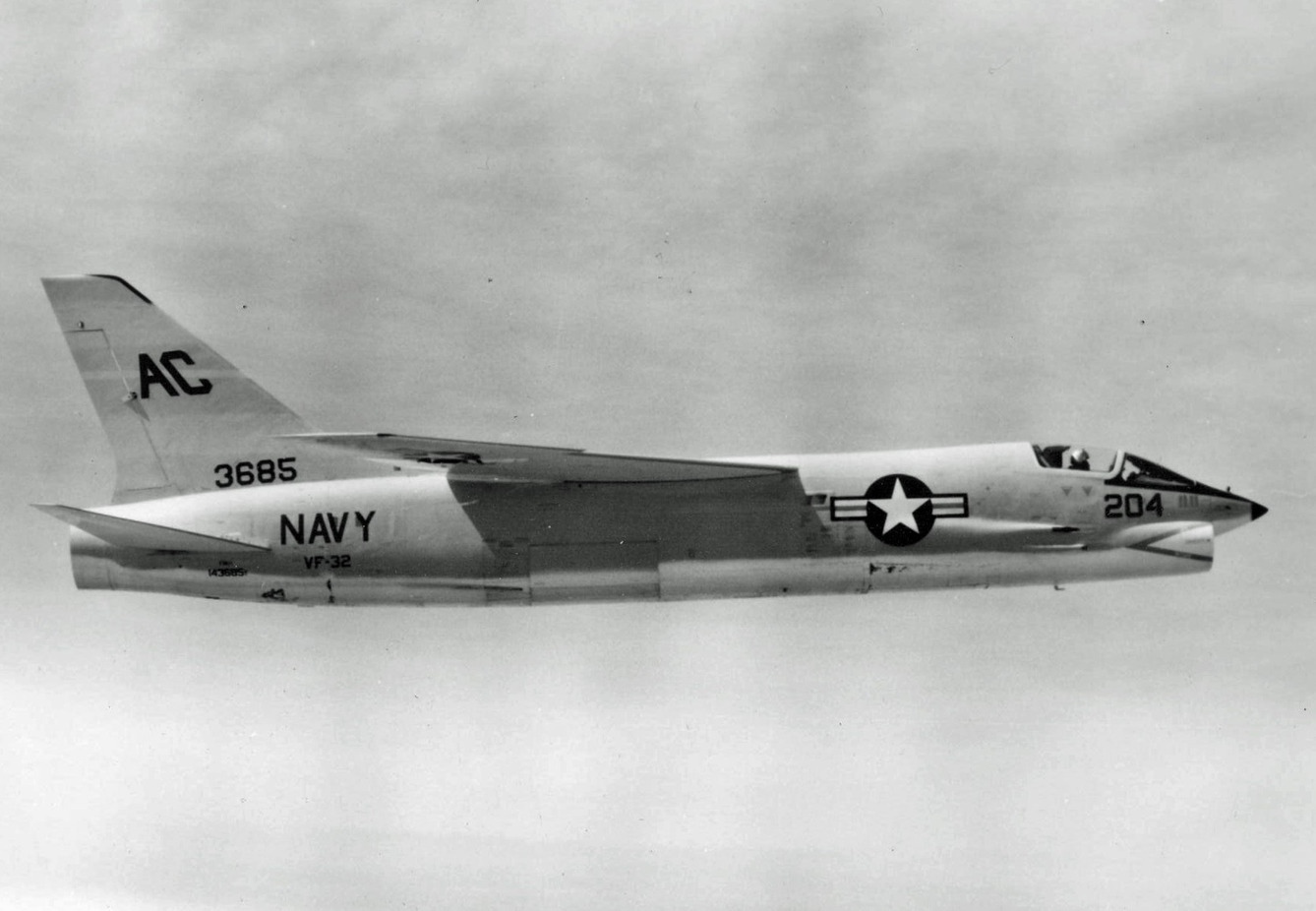
The first aircraft was accepted for service in December 1956, just four years and three months after the issue of the original requirement by the Navy. It was delivered to VF-32 in March 1957, with VMF-122 being the first Marine squadron to receive the Crusader. The first carrier deployment was made by VF-32 aboard USS Saratoga, CVA-60.
After subsequent versions of the Crusader were fielded into USN service, the F8U-1s were relegated to training roles, serving as advanced single-seat trainers. VF-701, VF-703, VMF-111, and VMF-112, the Naval Reserve units, began receiving these F-8A trainer jets at NAS Dallas. Twenty reserve squadrons had been trained with the F-8A aircraft before the fighter was withdrawn from service for good.
The F8U-1 was redesignated the F-8A in September 1962. No F-8As saw combat, as all had been withdrawn from active Navy fleet squadrons by the time the war in Vietnam began.
During 1966, an F-8M designation was to be assigned to F-8As that were originally planned for the remanufacturing program, but none were ever upgraded. The F-8M would have retained the J57-P-4A engine.