Would you like to see this in-game?
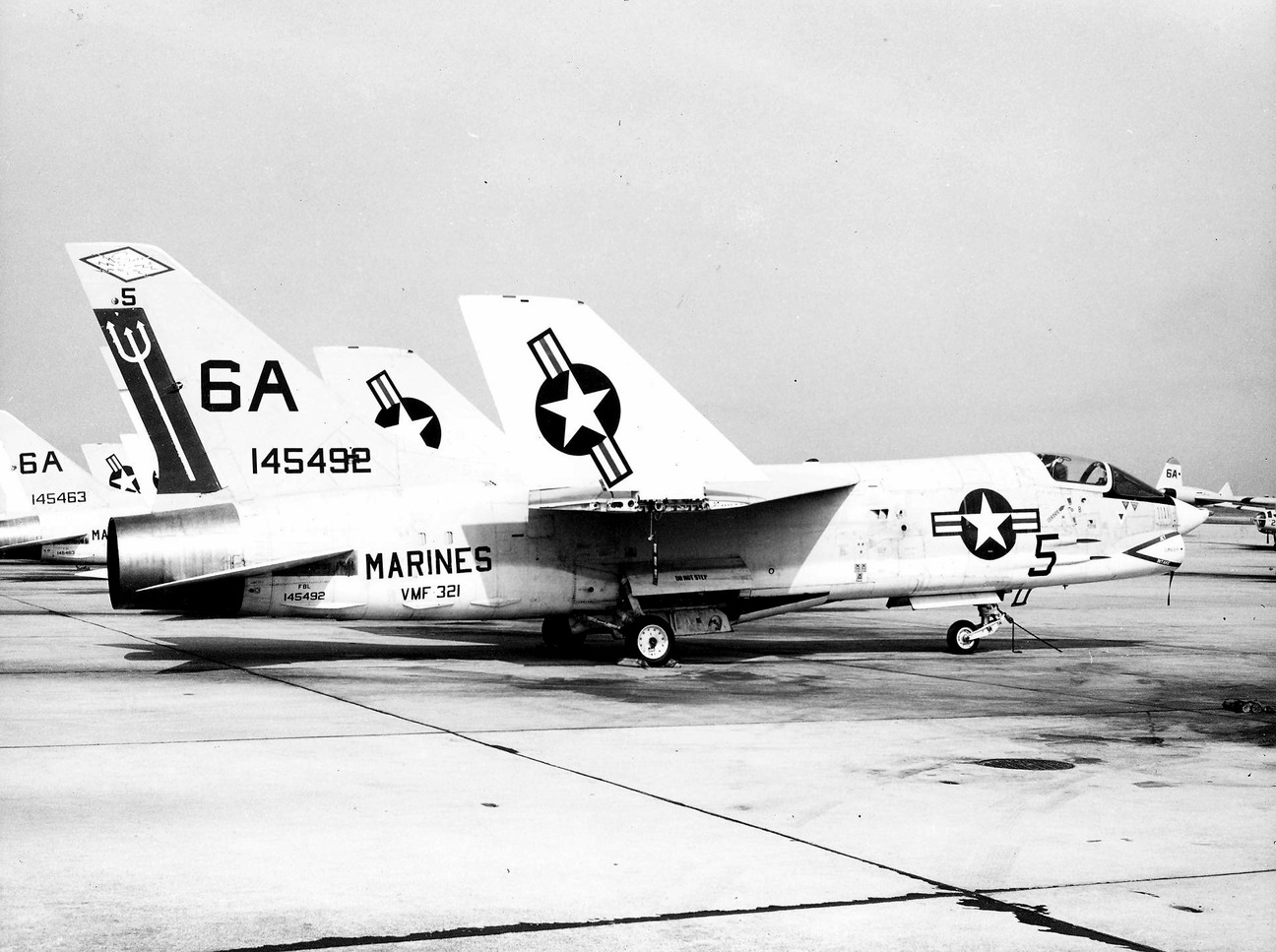
🇺🇸 Vought F-8L Crusader 🇺🇸
History
On September 3, 1958, the YF8U-1E prototype flew for the first time. F8U-1Es were an improvement over the F8U-1 in terms of radar. They were operational for a relatively short period of time with several Navy and Marine squadrons, but they served primarily as advanced trainers during most of their operational life. In September 1962, they were redesignated F-8Bs.
Because the F-8Bs were very limited in their capabilities even with the new radar, they did not see any combat, as all had been withdrawn from active Navy fleet squadrons by the time the war in Vietnam began.
Eventually, as part of Vought’s remanufacturing program in December 1968, sixty-one F-8B models were refurbished under the F-8L designation. This variant had the smallest production number of any remanufactured version.
This program extended the service life of the Crusader by adding 4,000 flight hours. The F-8L had instrument changes and cockpit modifications to the F-8E standard, which brought about an increase in night-flying capabilities. The wing was changed to the extended-service-life F-8H wing with wing pylons. The main landing gear and nose landing gear were upgraded to the F-8D/E standard. New catapult keels were installed, and approach power compensators were installed to assist in carrier landings.
Interestingly, this remanufactured variant omitted the ventral fins. Provisions were also made to add a pylon under each wing for carrying external stores, but because the ventral fins were required when carrying external stores, underwing munitions were not fitted to operational F-8Ls.
Most F-8Ls went to Marine Corps squadrons, along with a few Navy utility squadrons, and served primarily as training aircraft.
Specifications
🇺🇸 Vought F-8L Crusader 🇺🇸
General Characteristics
Crew: 1 (Pilot)
Dimensions:
Length: 54 ft 3 in (16.5 m)
Height: 15 ft 9 in (4.8 m)
Wingspan: 35 ft 8 in (10.9 m)
Wing Area: 375 sq ft (34.8 sq m)
Powerplant:
Type: 1 x Pratt & Whitney J57-P-4 afterburning turbojet
Power Output: 16,000 lbf (71.2 kN)
Fuel/Oil:
Fuel Capacity: 1,273 US gal (4,819 L)
Oil Capacity: 5.5 US gal (20.8 L)
Weight:
Empty: 15,513 lb (7,037 kg)
Gross: 20,995 lb (9,523 kg)
Max. Takeoff: 27,500 lb (12,474 kg)
Engine Ratings
Afterburner
Military
Normal
Flight Performance
Power-to-Weight Ratio: 0.76
Wing Loading: 56 lb/sq ft (273.6 kg/sq m)
Max Speed:
Sea Level: 637 kts (733 mph / 1,180 km/h)
At Altitude: 880 kts @ 35,000 ft (1,013 mph / 1,630 km/h @ 10,668 m)
Rate of Climb: 20,000 fpm (101.6 m/s)
Service Ceiling: 51,500 ft (15,697 m)
Armament
Avionics:
1 x AN/APS-67 search radar
Guns:
4 x 20 mm Colt Mk.12 cannons (125 rpg; 500 rds)
Missiles:
Rockets:
32 x 2.75-in FFARs in fuselage
Related Suggestions
Sources
Thank you for taking the time to read my suggestion! 😃
1 Like
Bro how did your suggestions been accepted FIVE times in tandem?
Like at the same time.
I just submitted all five suggestions concurrently by copying and pasting from Google Docs. All it took was a suggestion moderator to review and approve them in one sitting.
It really depends on the backlog of pending suggestions for the suggestion moderators.
Dude my suggestion is like 5 lines and it havent been approved for like a week…
( also nice suggestions, i read them ).
Five lines might not be sufficient to pass for approval. I am aiming for at least 200 words and ensuring the content is of high quality.
I recommend reviewing the suggestion guidelines and contacting one of the suggestion moderators if you need assistance.
Thank you!
23* lines sorry i needed to be specific.
Yw brother.
Thanks for your response.
+1 for more gunfighters
+1, an interesting aircraft that I believe should either be foldered with both the F-8C and F-8K, or both the F-8A and F-8B (better option). The lack of flares and having only 2 9Ds makes it unique in this case.
1 Like
+1
well technically is it compatale with AIM-9C?
No, AN/APS-67, as used on F-8B, F-8C, F-8K, and F-8L, is not compatible with guiding the AIM-9C.
1 Like
aw…welp at least i know now