- Yes
- No
 USS Prinz Eugen (IX-300) - The Atomic Spectre
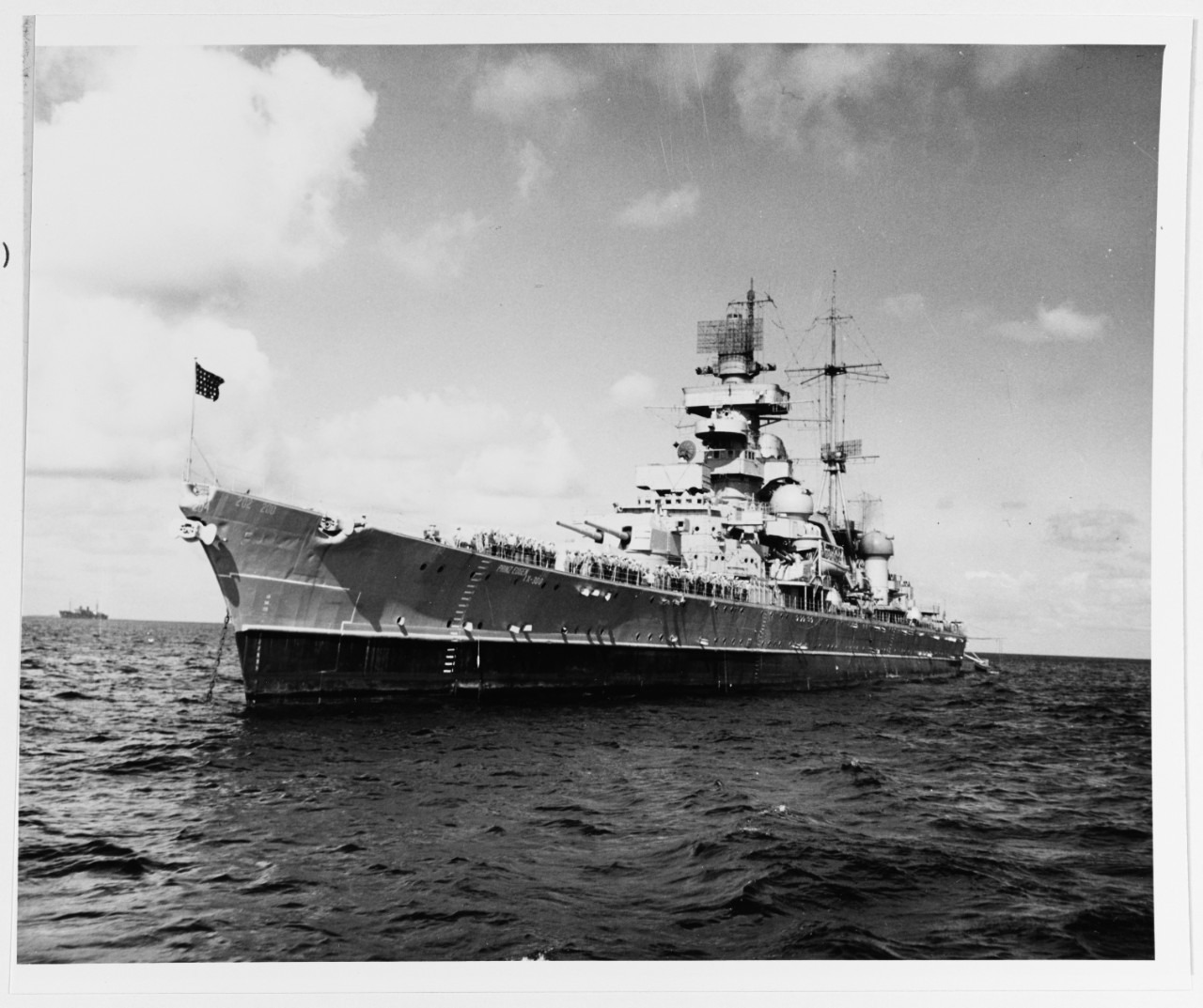
“USS Prinz Eugen on 14 June 1946, arrived at Bikini Atoll. By this time all Germans had left and without their help, the #3 boiler and most of the radars were not functional. The big white hash marks painted on the hull were so that any list on target ships could be determined from a distance through binoculars. The small numbers at irregular intervals just below the main deck are internal frame markers for damage assessment”
History
When Germany surrendered in May 1945, Prinz Eugen was anchored at Copenhagen, Denmark. Handed over to British control, she was allocated to the United States Navy as a war prize in a post-war lottery. On January 5, 1946, she was commissioned into American service as the unclassified auxiliary USS Prinz Eugen (IX-300) .
To transit the ship across the Atlantic to Boston, the U.S. Navy assembled a joint crew: 574 German Kriegsmarine officers and sailors under the command of U.S. Navy Captain Arthur H. Graubart, alongside 93 American personnel. Upon arrival in the U.S., Navy technical teams thoroughly investigated her design. Engineers removed her advanced GHG passive sonar array for installation on American submarines and carefully documented her gunnery fire-control systems. When the German crew was repatriated in May 1946, American personnel found her complex high-pressure boiler system notoriously difficult to maintain, leading to 11 of her 12 boilers failing.
Operation Crossroads and Kwajalein
Towed through the Panama Canal to the Marshall Islands, USS Prinz Eugen joined a fleet of target vessels for Operation Crossroads at Bikini Atoll a series of tests designed to measure the impact of atomic weapons on warships.
- Test Able (July 1, 1946): Positioned roughly 1,200 yards from the airburst blast center, the cruiser survived with minor superficial damage.
- Test Baker (July 25, 1946): An underwater nuclear detonation subjected her hull to severe shockwaves. While she remained afloat, the blast fractured internal plumbing fittings, opened slow hull leaks, and heavily contaminated her structure with radioactive fallout.
Towed to Kwajalein Atoll for observation, intense radiation levels prevented repair crews from boarding the ship to address the incoming water. By December 21, 1946, she was listing severely. An emergency attempt to tow her onto the beach failed, and on December 22, 1946, USS Prinz Eugen capsized and came to rest on Enubuj Reef. Today, her upturned hull and propellers remain visible just beneath and above the surface of the lagoon.
What the U.S. Harvested from USS Prinz Eugen
In February 1946, USS Prinz Eugen arrived at the Philadelphia Naval Shipyard. Because the U.S. Navy knew the cruiser was slated as a target vessel for atomic testing at Bikini Atoll, American technicians had a short window to harvest her most advanced technology, clear out hazardous materials, and reverse-engineer her innovations before sending her to the Pacific.
Harvesting the GHG Sonar System
The single most prized piece of technology on board was her Gruppenhorchgerät (GHG) passive sonar. Unlike American active sonar of the era, the German system used a curved array of hydrophones mounted around the hull that could detect and track distant ships with remarkable accuracy without broadcasting the cruiser’s position. Navy divers and shipyard riggers carefully cut out and removed the hydrophone arrays from her bow. The salvaged equipment was transferred directly to Naval research labs and served as the direct technological blueprint for post-war U.S. submarine passive sonar systems, such as the BQR-2.
Offloading Ammunition and Ordnance
Shipyard crews worked around the clock to drain her magazines. Thousands of 8-inch (203 mm) main gun shells, 105 mm anti-aircraft rounds, small-arms ammunition, and her 533 mm torpedoes were hoisted out of the hull and moved onto the Philadelphia docks. Removing the ammunition served two purposes: it made the long transit to the Marshall Islands safer and ensured that internal magazine explosions wouldn’t obscure structural damage data during the Operation Crossroads blast tests.
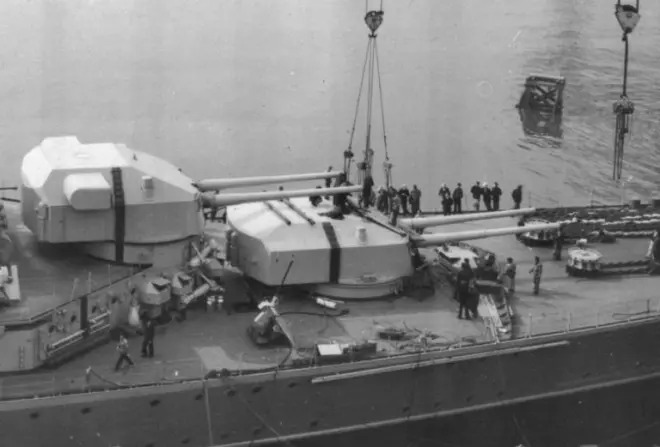
Workers at Philadelphia Naval Shipyard extract the two guns from USS Prinz Eugen’s “A” turret in February 1946.
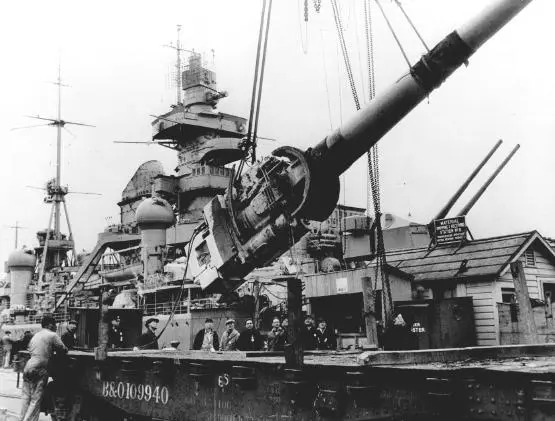
One of the extracted 8″ guns is loaded onto a flatbed railcar for transport.
Lifting Off the Arado Floatplanes
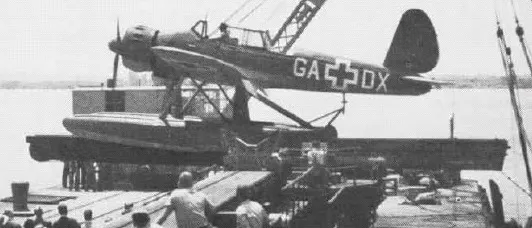
“The Ar-196 is revved up on the removed catapult at Philadelphia in 1947. After WWII, basic American markings had been applied. Later, for entertainment of the media, crude “German” markings were re-applied. The iron cross is the wrong shape and size, and the swastika on the tail is in the wrong location and tilted wrong. The swastika on the catapult was added by the Americans, as the Germans did not mark the catapult in that way.” (Swastikas removed from image)
Dismantling Electronics, Optics, and Fire Control
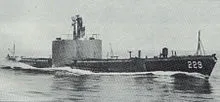
“The submarine USS Flying Fish (SS-229) in 1952, with Prinz Eugen’s GHG sonar installed around the conning tower.”
Navy technical teams removed several of her primary optical rangefinders, fire-control computers, and FuMO series radar antennas from the superstructure. Engineers cataloged and stripped out sample radio gear, gyrocompasses, and internal communication units for teardown analyses by American defense contractors.
Engine Inspections and Documentation
Engineers went down into the boiler and engine spaces to inspect her high-pressure, superheated steam propulsion plant. Because American sailors struggled to operate the finicky German boiler setup which required ultra-pure feed water and precise thermal monitoring—shipyard technicians photographed, measured, and created detailed schematics of the machinery before the remaining German crewmen were repatriated and the boilers began to fail.
By mid-March 1946, riding significantly higher in the water with her magazines emptied and her secret equipment removed, Prinz Eugen departed Philadelphia for the Panama Canal on her final voyage.
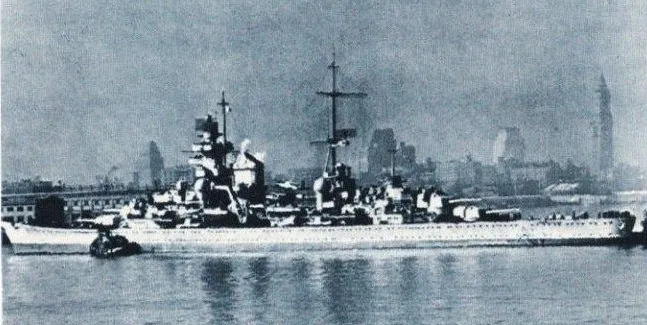
“USS Prinz Eugen arrives in Boston, MA on 22 January 1946”
Specifications
General Dimensions & Displacement
- Standard Displacement: 14,240 long tons
- Design Displacement: 16,970 tonnes
- Full Load Displacement: 19,050 tonnes (18,750 long tons)
- Length Overall: 212.5 meters (697 ft 2 in) with the extended Atlantic clipper bow
- Waterline Length: 207.7 meters (681 ft 5 in)
- Beam: 21.7 meters (71 ft 2 in)
- Draft (Full Load): 7.2 meters (23 ft 7 in)
- Crew Complement
- Designed Standard: 42 officers, 1,340 enlisted
- Late-War/Capture Operating Crew: ~1,600 officers and men
Propulsion & Performance
- Machinery: 3 sets of Brown, Boveri & Cie geared steam turbines driving 3 shafts
- Boilers: 12 La Mont ultra-high-pressure oil-fired boilers
- Output: 132,000 shaft horsepower (98,000 kW) rated
- Top Speed: 32.0 to 32.5 knots (59 to 60 km/h)
- Operational Range: 6,800 nautical miles at 16 knots
- Fuel Capacity: 3,250 metric tons of heavy fuel oil
Armor Protection
- Main Belt: 70 to 80mm (2.8 to 3.1 in) Krupp Cemented armor
- Main Armored Deck: 20 to 50mm (0.79 to 1.97 in)
- Upper Deck: 12 to 30mm (0.47 to 1.18 in)
- Main Turret Faces: 105 to 160mm
- Main Turret Sides/Roofs: 70mm
- Barbettes: 80mm
- Conning Tower: 150mm sides, 50mm roof
Armament (1945-1946 Pre-Strip Configuration)
- Main Battery: 8x 20.3 cm (8-inch) SK L/60 guns in four twin turrets (Anton , Bruno , Caesar, Dora)
- Secondary Battery: 12x 10.5 cm (4.1-inch) SK C/33 dual-purpose guns in six twin stabilized mounts
- Anti-Aircraft Suite: 18x 3.7 cm Flak guns (SK C/30 and Flak 43) and 28x 2.0 cm Flak guns (single, twin, and quad Flakvierling 38 mounts)
- Torpedoes: 12x 53.3 cm (21-inch) torpedo tubes in four triple deck mounts (24 total G7a torpedoes carried including reloads)
Aviation & Reconnaissance
- Catapult: 1 double-ended fixed steam catapult (midships)
- Aircraft: 4x Arado Ar 196 reconnaissance floatplanes
- Facilities: 1 fixed hangar, 1 collapsible hangar, and 2 deck cranes
Sensors & Electronics
- Passive Sonar: Gruppenhorchgerät (GHG) 120-hydrophone bow array
- Fire Control Radar: FuMO 25 / FuMO 26 radar sets mounted on top of optical rangefinder domes
- Search Radar: FuMO 81 Berlin microwave radar set
- Fire Control Computers: Four 7-meter optical rangefinders connected to Zeiss electromechanical analog fire-control computers
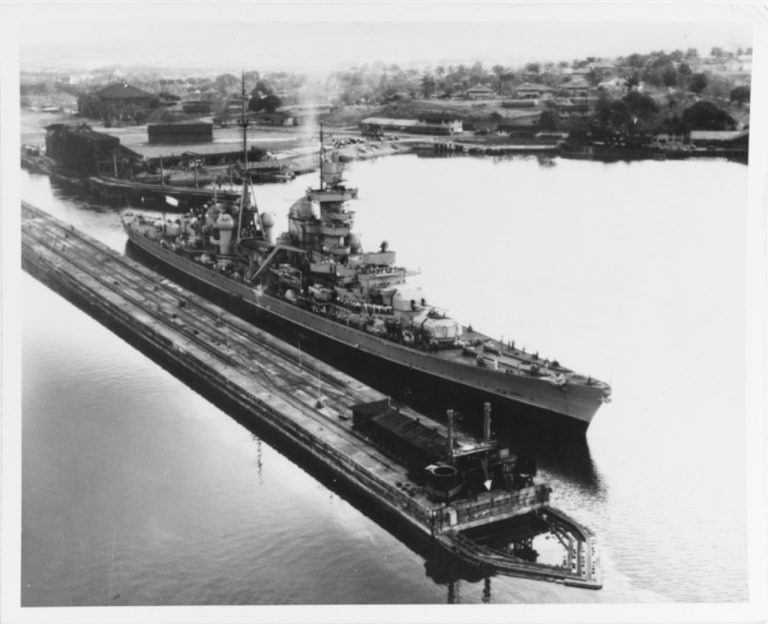
The Prinz Eugen in the Panama Canal on the way to Bikini Atoll.
