Type 10 120 mm APFSDS – Penetration investigation
Introduction
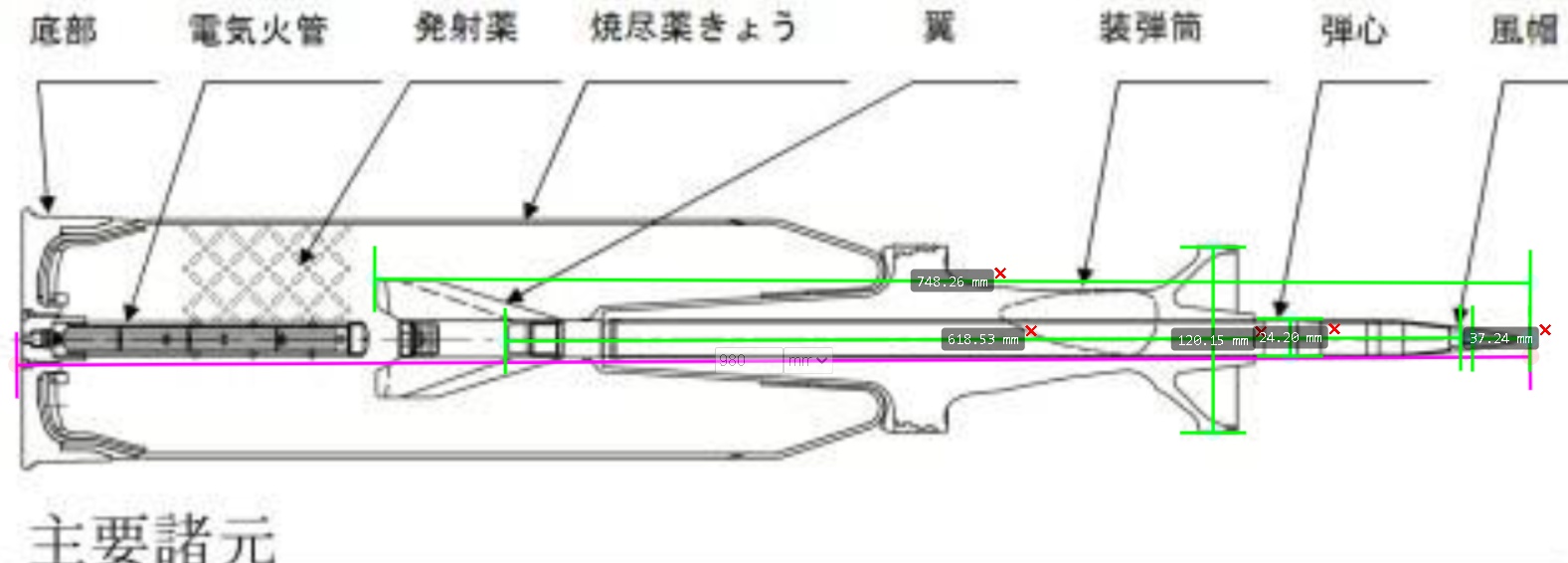
I wanted to estimate the penetration of the Type 10’s 120 mm APFSDS from the available cartridge diagram. The diagram labels each component in Japanese (sabot, fin, penetrator core 弾心, windcap 風帽), so the penetrator can be measured separately from the rest of the round. The result is then compared against the in-game value.
|Specification|Value
| — | — | — |
|Total cartridge length|980 mm
|Muzzle velocity|1,780 m/s
|Penetrator material|Tungsten alloy, 18,500 kg/m³
2. Measurements
The diagram was calibrated against the 980 mm cartridge length, then measured:
|Measurement|Value|
|Penetrator (弾心) length|618.53 mm|
|Penetrator diameter|24.20 mm|
|Windcap / steel tip length|37.24 mm|
|Steel tip diameter (average)|7 mm|
|Sabot / fin span|120.15(120) mm|
3. Penetration calculator results
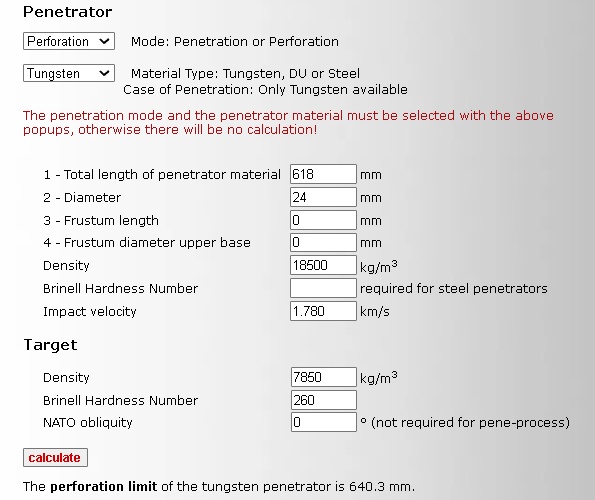
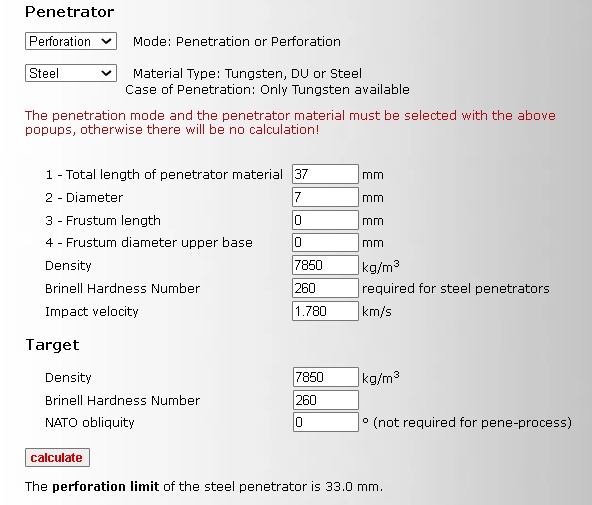
Parameters used for both runs:
- Target: RHA, 7,850 kg/m³, 260 BHN
- Obliquity: 0°
- Impact velocity: 1,780 m/s
Tungsten body (618 mm × 24 mm, 18,500 kg/m³): 640.3 mm
Steel anti-ERA tip (37 mm × 7 mm, 7,850 kg/m³): 33.0 mm
- Result
|Component|Perforation limit|
|Tungsten body|640.3 mm|
|Steel tip|33.0 mm|
|Combined (simple sum)|≈ 673 mm RHA|
The steel tip is a solid penetrator and adds to the total, because the tungsten rod follows through the crater it opens. The combined figure treats the tip as a separate perforation step added to the body.