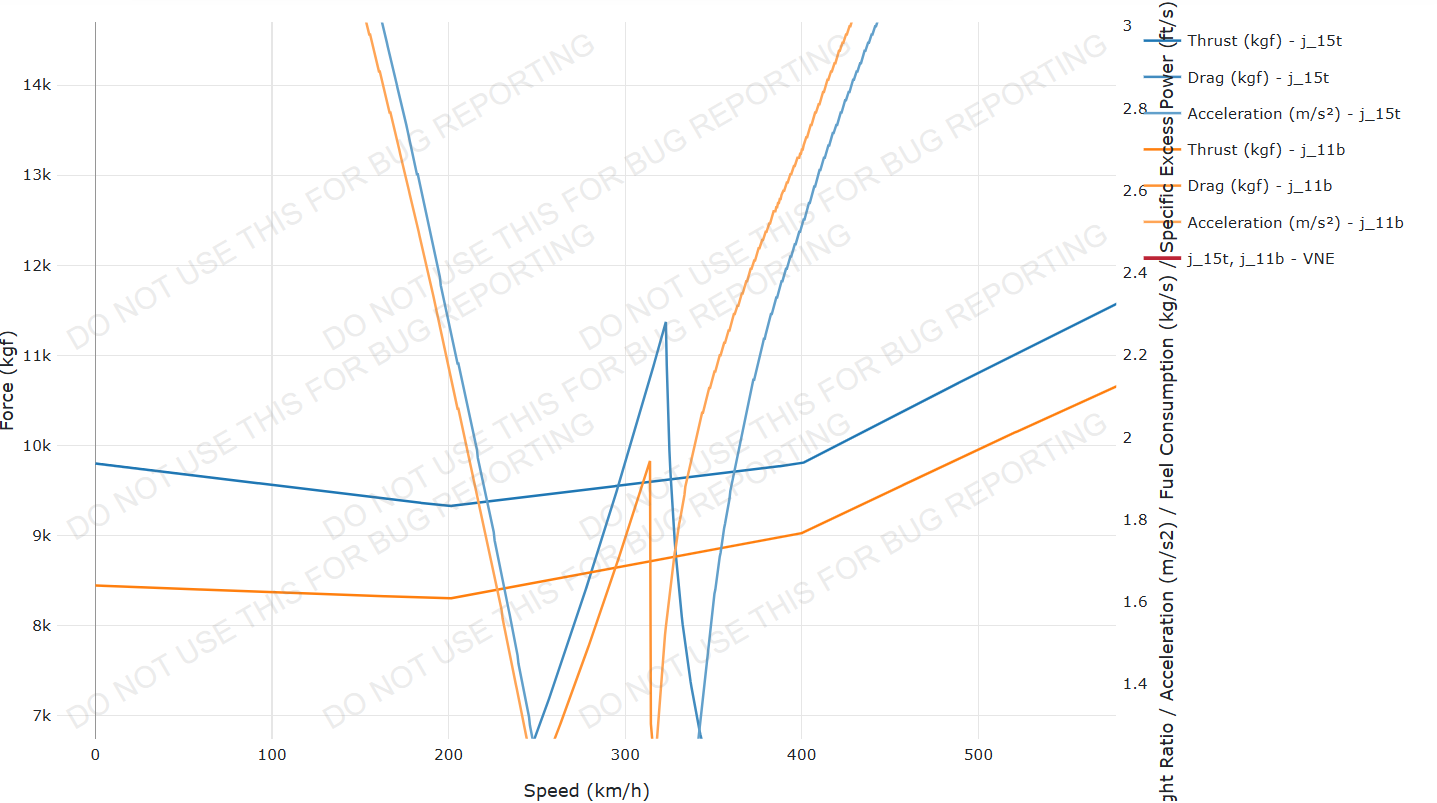
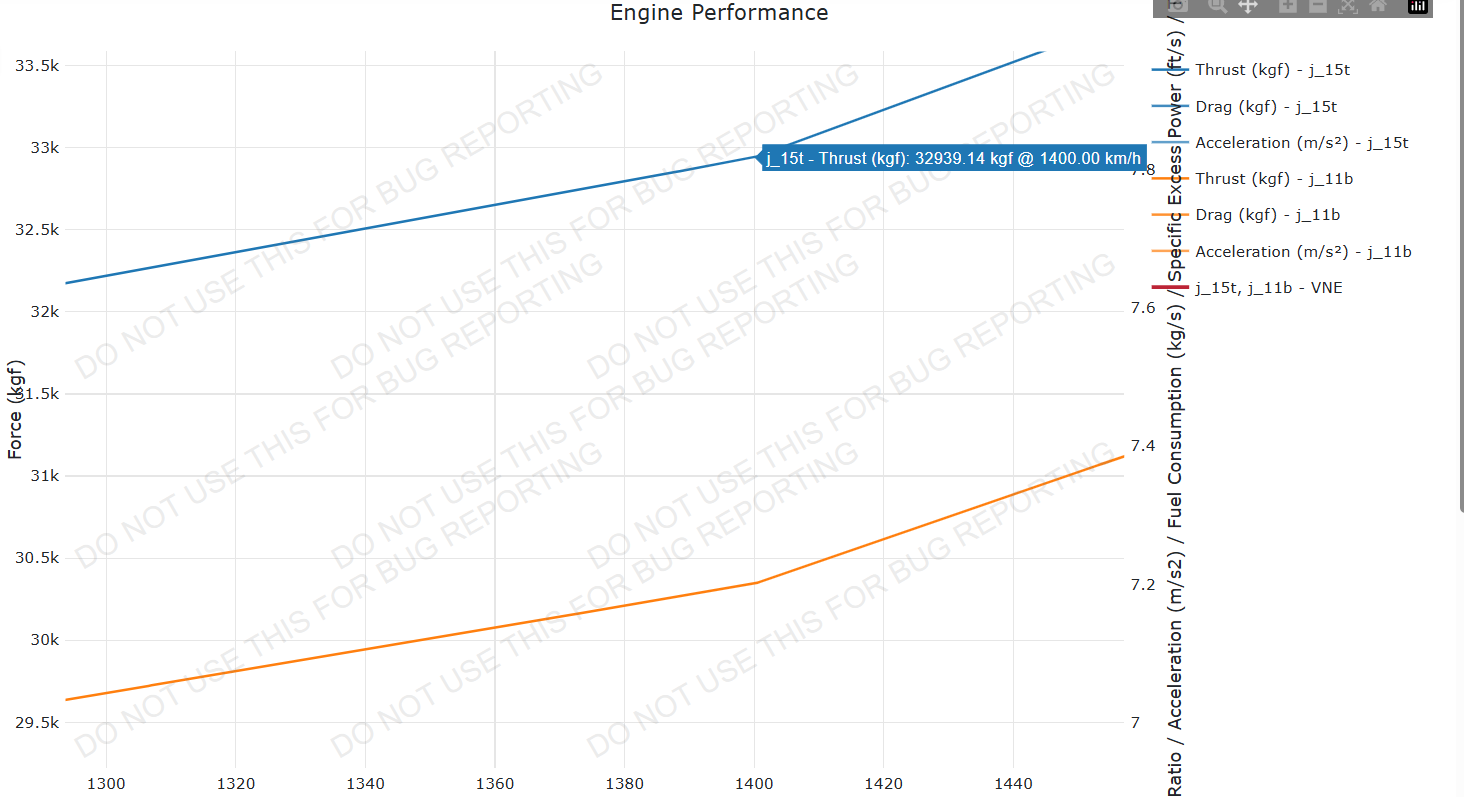
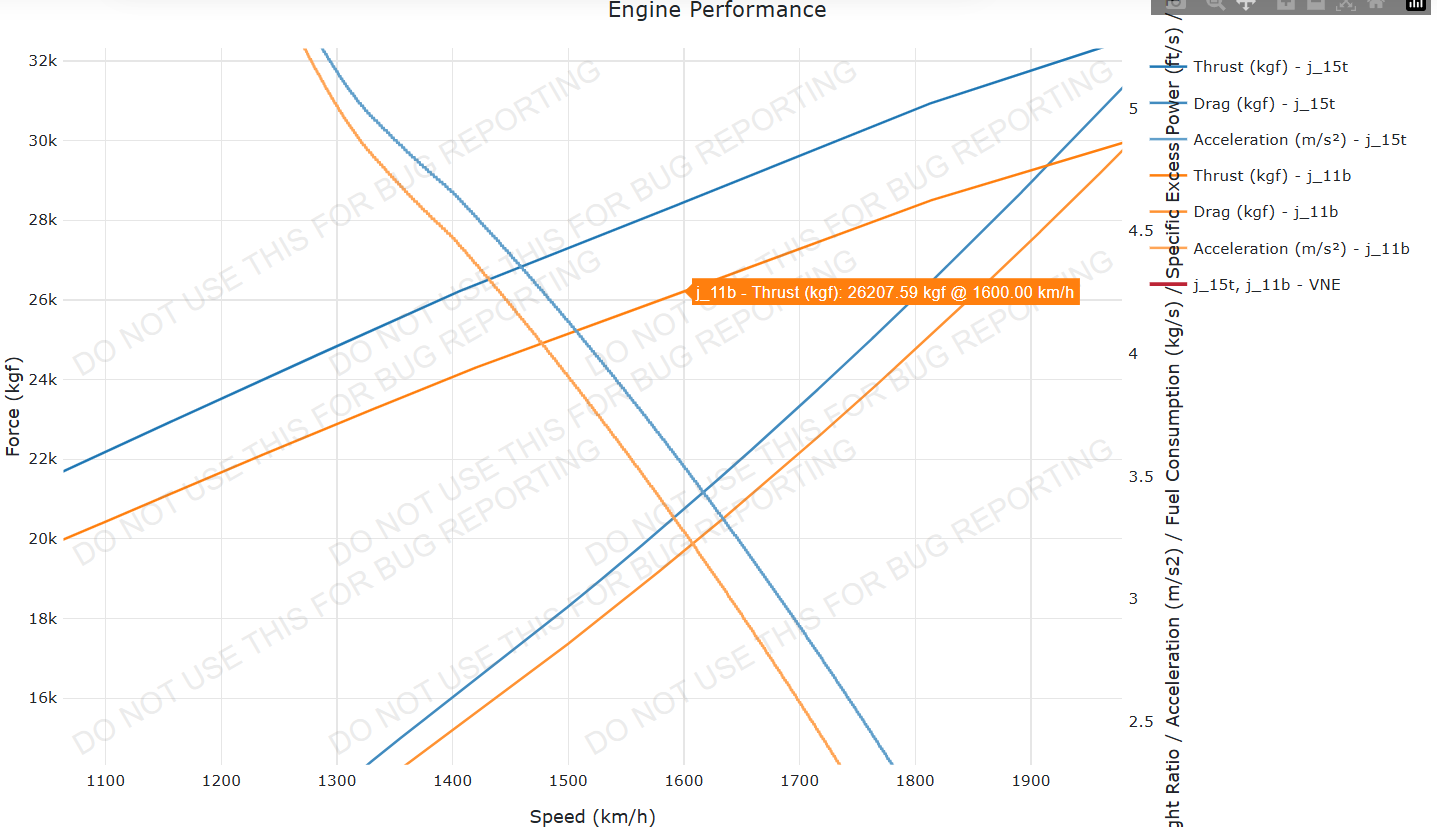
The WS‑10B exhibits a relatively low ram thrust coefficient at all speed regimes at medium and high altitudes

According to the latest flight envelope data updated in Test Server Version 0.21, the ram thrust coefficient of the WS‑10B engine is insufficient at altitudes above 4,000–5,000 meters, resulting in inadequate ram thrust gain across all speed ranges. This is because the thrust envelope coefficient of the WS‑10B is significantly lower than that of the WS‑10A in this altitude range.
In the game, the thrust envelope coefficients of improved engines in the same series are usually consistent with the previous model, and the thrust curve is scaled up proportionally based on the static thrust increase. However, the coefficient of the WS‑10B is noticeably lower than that of the WS‑10A.
At altitudes above 4,000–5,000 meters, the acceleration curve of the J‑15T across almost all speed ranges ranks last among aircraft with a battle rating of 14.7. It is reasonable to refine and adjust this issue, and we sincerely hope the game developers will pay attention to it.
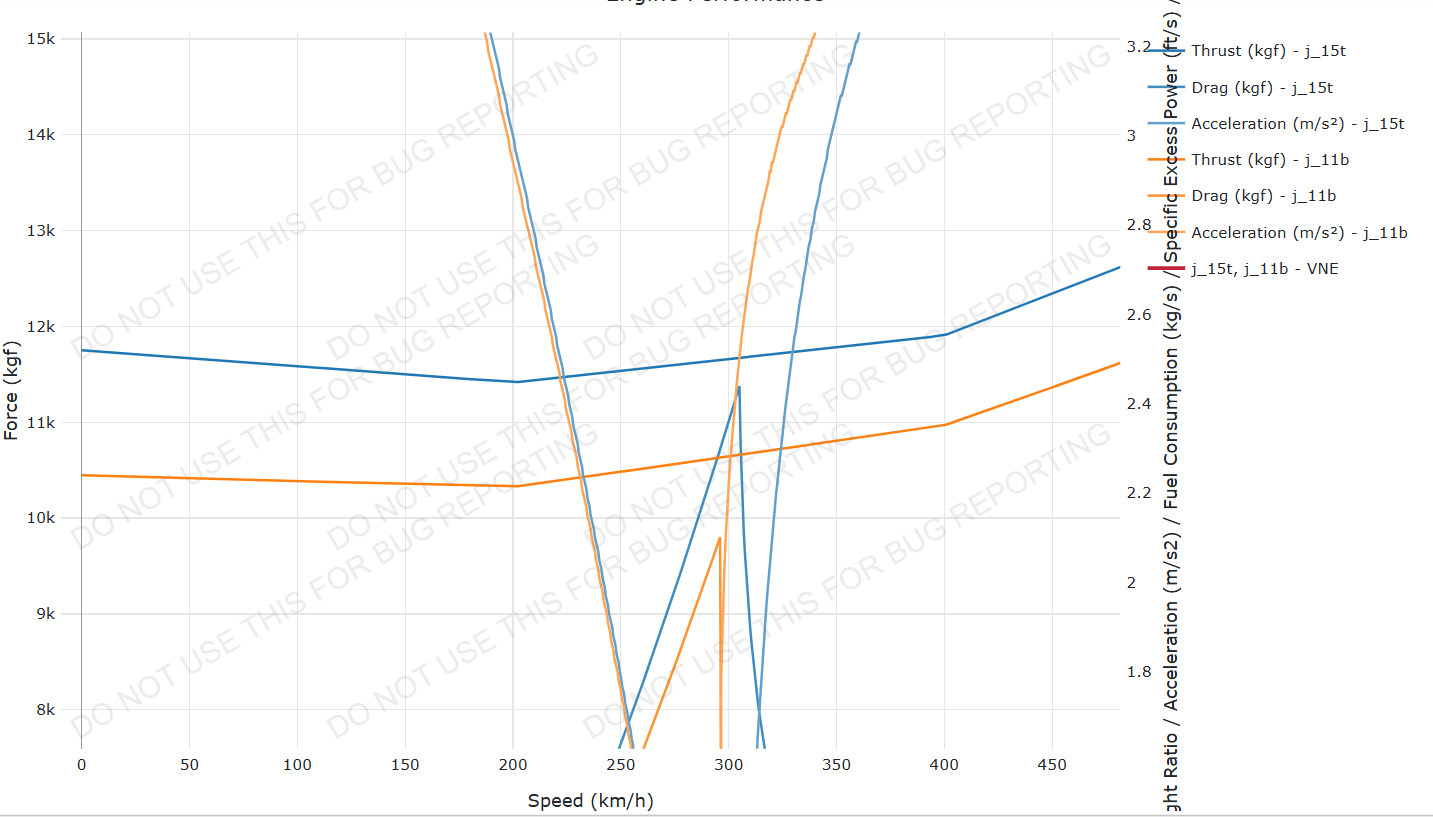
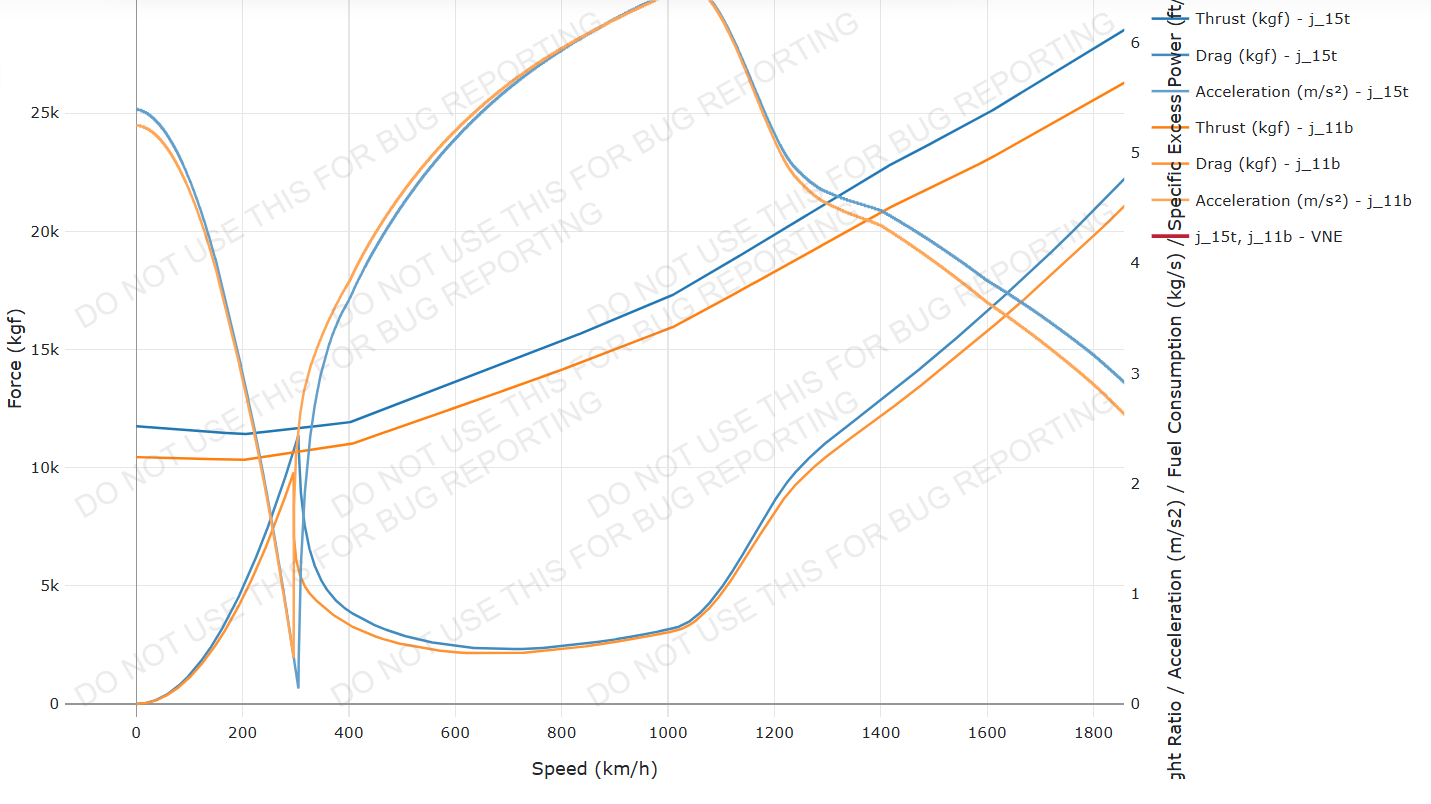
As shown in the figure below, taking 7,000 meters altitude as an example, the comparison between the thrust curves of the WS‑10B and WS‑10A clearly shows that the thrust growth ratio of the WS‑10B relative to the WS‑10A is lower than its static thrust growth ratio.
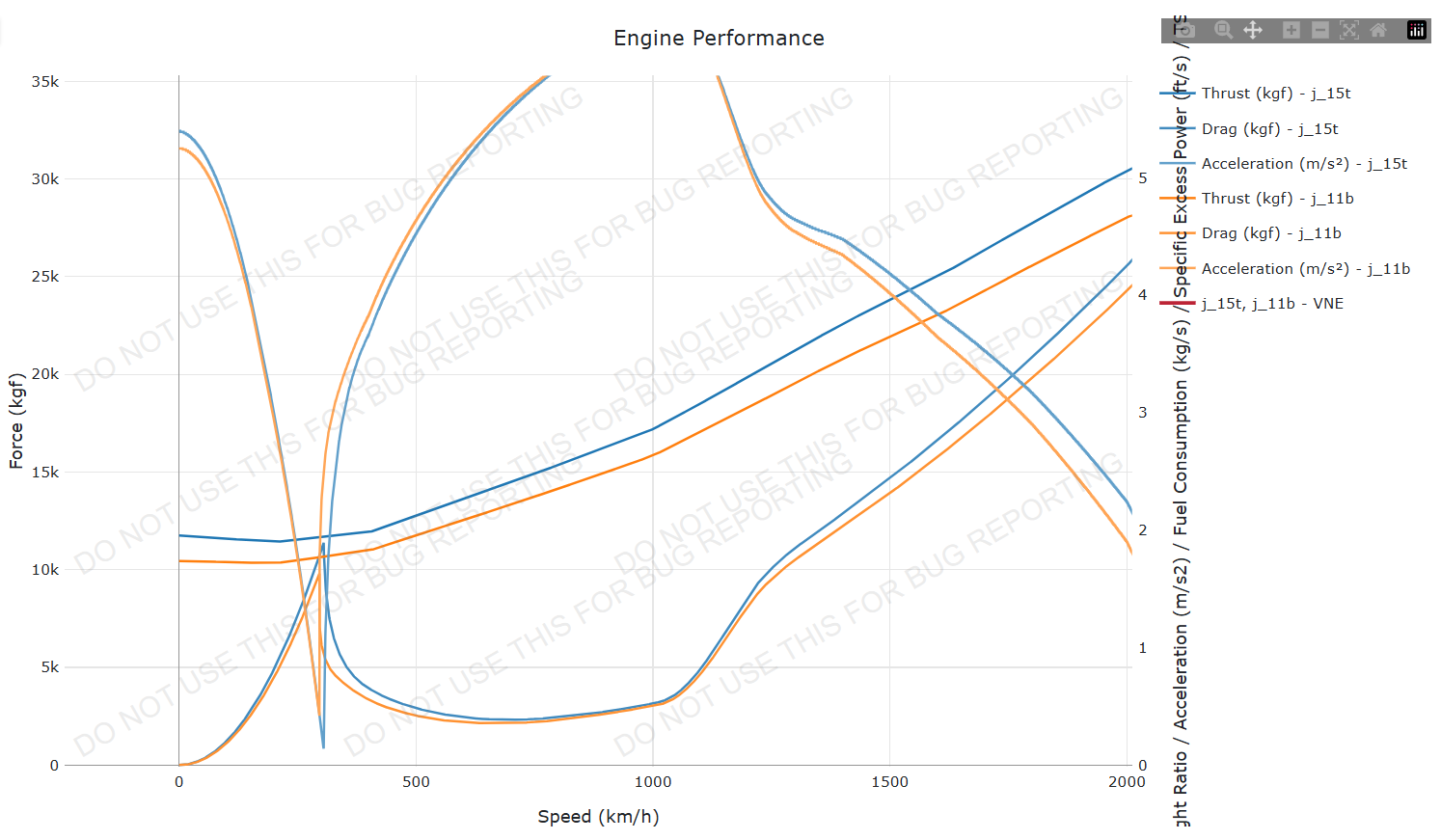

The data source is a game data-mining website, which is reliable and can be verified through actual in-game testing.
4 Likes

I believe that with reasonable adjustments, the J-15T can meet the relevant requirements. I have the following suggestions:

Taking the latest data from Test Server .21 on March 3 and the flight envelope of the WS-10B engine as an example, the engine’s ram thrust coefficient is lower than that of the WS-10A at all altitude ranges. This results in a significant difference in the growth rate of the thrust curve compared with the WS-10A.I sincerely hope the game developers will check the relevant coefficients and adjust the thrust curve reasonably.Currently, in top-tier fighter matches, the J-15T already ranks last in acceleration at high altitude and high speed, and I hope this issue can be taken seriously.

Take an altitude of 7,000 meters as an example:

At 0 km/h:Dual WS-10B thrust: 11,750 kgfDual WS-10A thrust: 10,447 kgfThrust difference: 1,303 kgf

At 400 km/h:Dual WS-10B thrust: 11,915 kgfDual WS-10A thrust: 10,968 kgfThrust difference: 947 kgf

The dual WS-10B gains 165 kgf of thrust from the ram effect at this speed range, while the dual WS-10A gains 521 kgf from the ram effect.Despite having higher static thrust and more advanced technology, the WS-10B even has lower ram efficiency than its predecessor, the WS-10A.

This may seem insignificant, but the gap will be further widened at higher speeds, even in the supersonic range, resulting in only a small improvement of the WS-10B over the WS-10A at high altitude and high speed.

According to the developers’ usual practice, thrust curves are usually made by scaling up the previous model proportionally based on the static thrust shown in the in-game stats panel.In other words, the thrust curve coefficients of the WS-10B should be consistent with those of the existing WS-10A in the game at all altitudes and speeds.However, in the latest test server, the coefficient of the WS-10B is significantly lower than that of the WS-10A, leading to insufficient thrust at high altitude and high speed.


At present, the climb and acceleration performance of the J-15T in these altitude and speed ranges is far below the average level of top-tier aircraft.I sincerely hope the game developers will attach importance to this issue.


In fact, this problem does not only appear at 7,000 meters; there are already obvious signs at 4,000 to 5,000 meters.

3 Likes

true, the thrust must be fixed and increased, we’ve had enough of your arrogance

The mere fact that in the game, the thrust-to-weight ratio of the WS10B is actually lower than that of the WS10A is already sickening. In comparison, the fact that the weight of the AL41F remains completely unchanged from the AL31FP is truly the quintessence of sincerity.

Here is another example at an altitude of 8,000 meters:At the static thrust stage with a speed of 0 m/s, the upper curve represents the thrust of the WS‑10B, and the lower curve represents the thrust of the WS‑10A. The clear gap between them reflects the improvement in static thrust. However, at speeds of 400–600 m/s, the thrust of both engines increases due to the ram effect, but the thrust increase of the WS‑10B is smaller compared to the WS‑10A, which is reflected in the narrowing gap between the two thrust curves. When this lower rate of increase is applied to the high‑speed range, the impact on the actual engine thrust becomes more significant, resulting in an even lower thrust growth rate at high speeds.

The above example intuitively shows that the ram effect coefficient of the thrust curve for the WS‑10B is lower than that of the WS‑10A.The ram effect coefficient of the WS‑10B should be equal to or even higher than that of the WS‑10A, since the WS‑10B is a more advanced engine.

At the same time, this adjustment will make the climb and acceleration performance of the J‑15T more reasonable in the top‑tier matches.

As players, we sincerely offer these reasonable suggestions to the game developers. We hope to provide a better gaming experience for the community, and also hope that the J‑15T, which you have worked hard to develop, can attract more players with reasonable and top‑level flight performance. We hope the developers will take this issue seriously and make relevant improvements.

The following is the example diagram:

3 Likes

True WS10B should be powerful than WS10A.If not why we build it?The performance of WS10B is ridiculous now!

1 Like