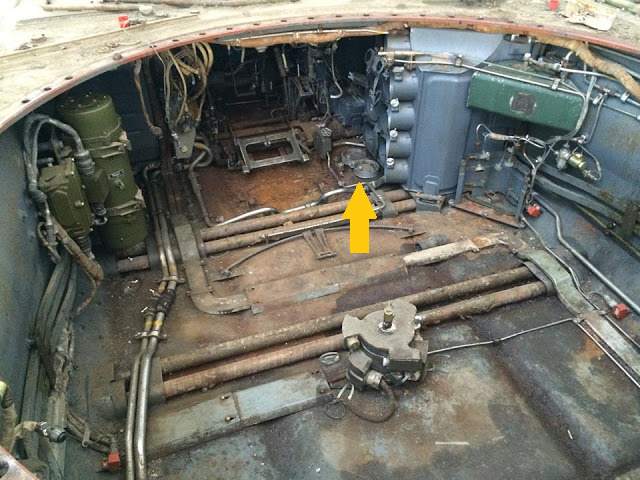
any petaling of the autoloader would have a very real chance of snagging any of this.
1 Like
I don’t have an exact measurement, but I’d say it’s about 5 cm, Deformation could happen if it gets hit lol
It doesn’t matter that the frame size (thickness, etc.) is literally less than 5 cm.
Can you imagine what the deformation should look like?
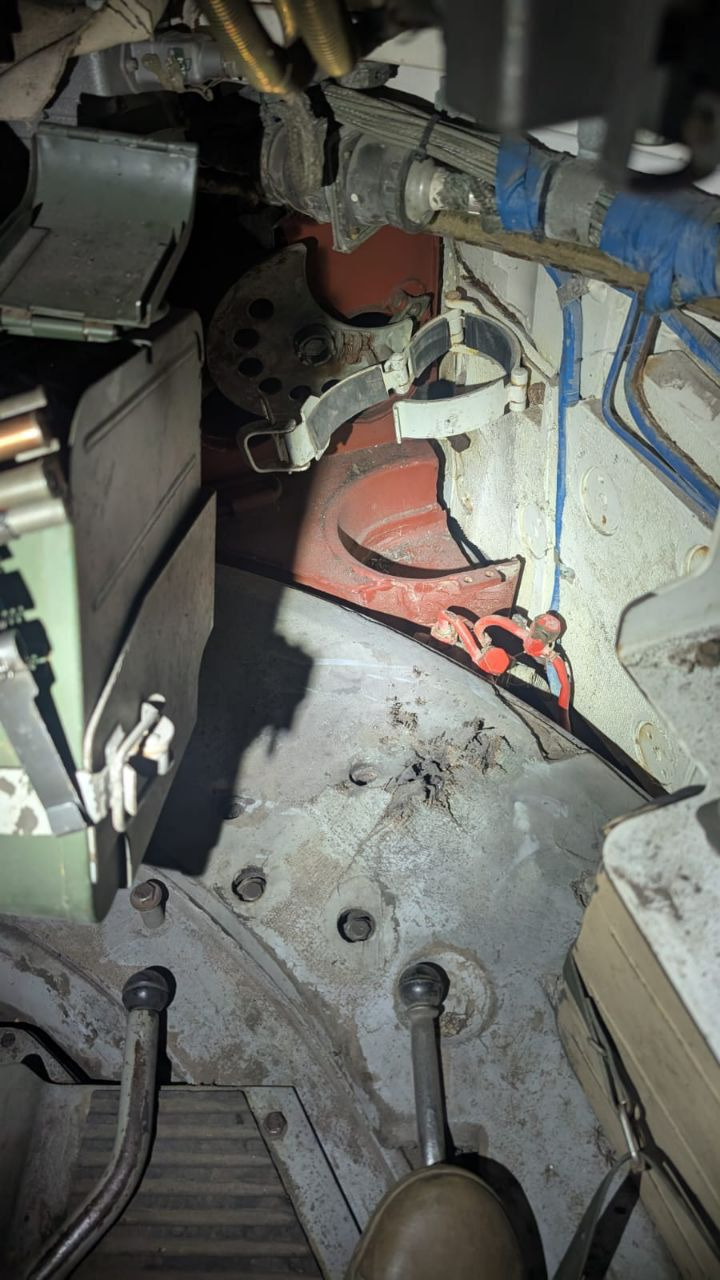
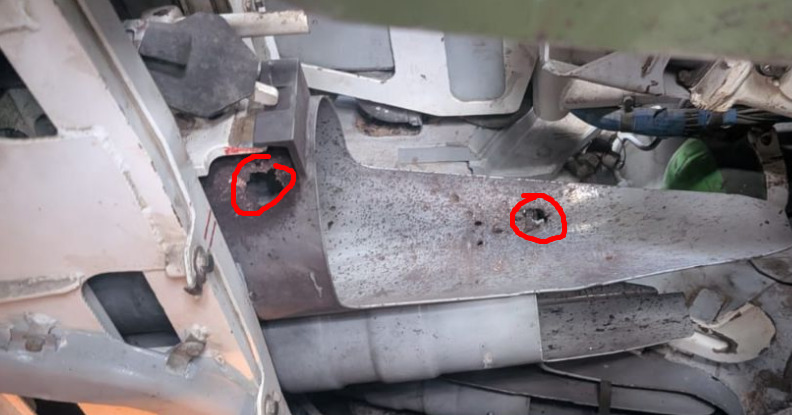
Here’s an example of a hit on a T-72 automatic loader. As you can see, there’s no deformation.
By the way, in this case the automatic loader remained fully functional.
1 Like
No, that’s not quite true. In the case of the T-72, the autoloader rotates around a central “bonnet” (exactly in the center of the autoloader’s “doughnut”). This is independent of turret rotation.
When the turret rotates, it engages the autoloader, and it rotates with it. However, the entire structure rotates, not just the lower section with the trays, as is the case with the loading mechanism.
I dunno about the T-80 (trying to read a scan of the manual screen capped and feed into google translate is giving me a head ache) but the T-72 has a brake near the commanders feet that releases the carousel to spin freely, to jam the turret rotation something would have to jam the carousel to the turret and to the hull, if it’s only jammed to one or the other releasing the brake would free the turret to rotate.
You can literally see the indexer’s spindle that drives the rotation of the cassette in the base Hull in the center of this image.
If it doesn’t rotate with the turret the Cassette is fixed relative to the Hull and so will not be in alignment with the rammer fixed to the turret. But since they are implemented as one module they should not be able to perform any function independently which is similar to all other modules, thus prevent turret rotation since in normal operation will remain in sync in order to facilitate a normal reload.
If I had a cyclogram to hand, it would be obvious that there is no allotment for the cassette’s loading position to be anywhere other than tracking the Rammer as the turret rotates. Due to the Cassette not staying stationary relative to the hull when not loading. (As asserted with Gaijin’s reasoning for the reload buff)
Especially if it can be instructed to search independently for a repeat round, for a best possible reload in order to skip the alignment step of next round and rammer that could be anywhere in the cassette if it did not also track the movement of the turret.
4 Likes
EXactly. And it isnt connected to the loading system. Ejection also happends within the turret. Shells are to be extracted through the roof
This looks like light damage from an FPV drone rather than something like APFSDS, which would cause the amount of deformation I was referring to.
Just because you can’t rotate the tray doesn’t mean you can’t rotate the entire AZ.
This doesn’t make a significant difference. Thin aluminum is also not prone to significant deformation.
I repeat: find the exact distance between the frame and the body and then depict the extent of the damage required to have any chance of locking.
Right now, this seems like a guess based on “I want it to be like this.”
if the autoloader stops working, all bearings should not rotate. The same way the Turret basket prevents vertical traverse of the gun.
1 Like
Thin aluminum is more than enough enough to jam a Turret Basket. Why not an autoloader too.
2 Likes
No, as I already said, the inability to rotate the trays does not affect the ability to rotate the turret with the AZ as a whole.
I don’t think that’s the reason.
So then how are shells transferred between the cassette and rammer during the reload, if they aren’t indexed to one another (considering that the combustible Propellant cartridge is made of nitrocellulose, you wouldn’t want to risk puncturing one if there was any misalignment); let alone always have the right shell immediately available as is described as part of Gaijin’s reasoning for the reload buff?
So then why does it also include the entire Basket, and is not just the actual elements that compose the Hydraulic drive as part of the Traverse module?
Also where are these electronics they speak of I certainly don’t see them listed anywhere in the functional description of the basket?
1 Like
Once again, tray rotation is an independent process. If your turret drive is broken, you can rotate the trays, and vice versa.
Perhaps I’m misunderstanding you or what you’re trying to say. Unfortunately, I can’t say anything more, as I don’t understand what we’re misunderstanding.
A simplification, I suppose. Just like the automatic loader, where the frame, trays, and many other parts are modeled, but IRL damage to which doesn’t affect the mechanism in any way.
Likewise, shells that may visually look like APFSDS rounds, but even if the part containing only the tungsten core is damaged, they will explode.
Obviously, modeling every line, every detail, is excessively complex if the result is the same.
This is a diagram of the basket without all the components. Above was a photo of what it actually looks like.
i guess it was easier then. I do believe we can remove basket and model the elements there as they now model with Leclerc. It would be fair enough
Independent of what? if that was the case how does the Cassette know it is in alignment with the rammer and so is properly located to safely proceed with the reloading process if there is no indexing between the two?
No, That figure is a diagram of the sum & total of functional components that comprise the Turret Basket everything else has some other purpose.
I’d be like having the race bearing of the Commander’s AA MG being damaged stop the Turret from rotating wholesale, because it’s also a motive component, and part of the turret.
Which one?
can you explain to me how you rationalize the traverse mechanism on an abrams or leopard being 10x larger than on the t series?