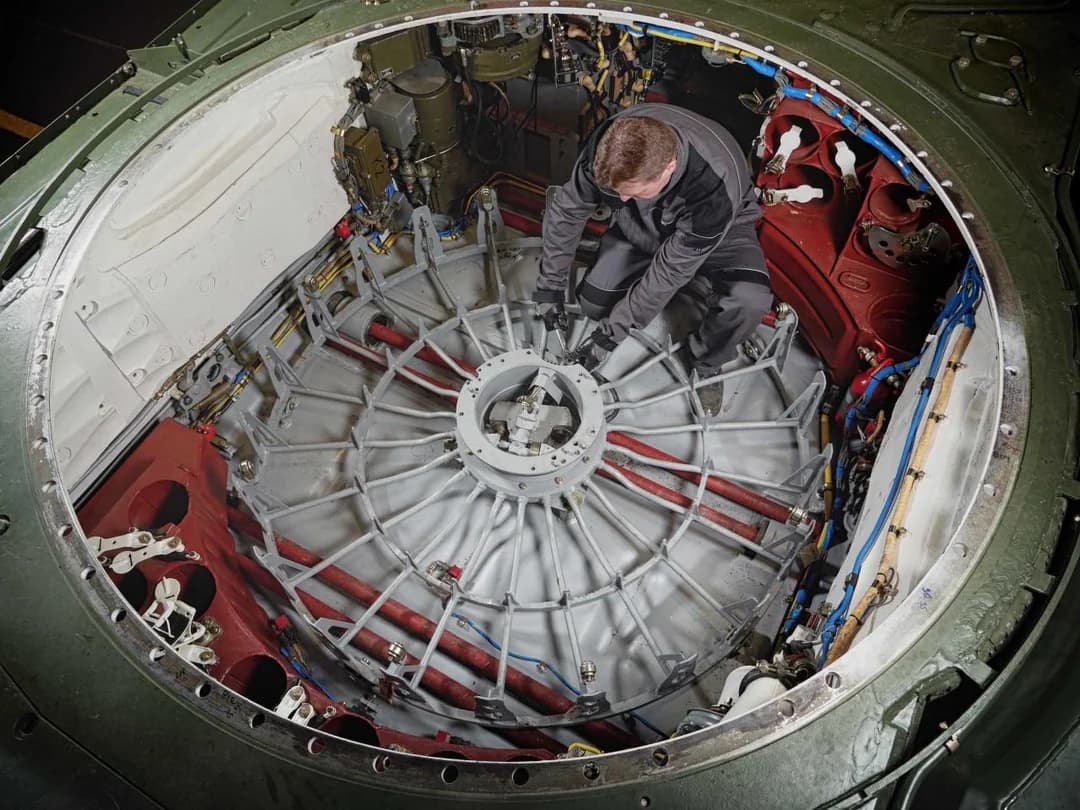
The only actual tubes you can see are held on with hose clamps. That is NOT hydraulics. Hose clamps would burst the seconds they see any meanigful pressure.
This is, as per usual when it comes to the turret basket discussion, bull. The hydraulic motor afaik is connected to the hull, the valves (which are alse in the hull) are electromechanical. There are no hydraulics entering the turret for what I know; the gun is electrically elevated.
NATO tanks, when penetrated, cannot rotate their turrets.
Russian tanks cannot reload.
It seems balanced to me… MORE EXPLANATION?
NATO tanks, if they survive (just like the Russian ones), can retreat much faster than any T-80 or even some Russian light tanks.
Russian tanks, if they survive, cannot retreat as quickly (Please, they have -4 and -10 reverse speed, do you really think that’s even good?) but they can fire.
So, a trade-off.
If you want them to have all their disadvantages plus the NATO disadvantages, my friend, just play ARB; the Typhoon and Rafale are still among the best.
As I said in another reply, it isn’t about balancing it’s about realism, and it wouldn’t make much of a difference since most of the times a shot to the carousel would destroy the tank.
That image is proof enough that Soviet autoloaders absorbing spall is a load of dingo’s kidneys.
If that level of light fragmentation punches through the ammo holders without issue then on T-64 and T-80 the ammo holders shouldn’t stop any fragmentation. On T-72, the plate separating the carousel from the crew compartment should also generate spall considering it’s fairly substantial as per that image.
It’s not a baseless assumption. The distance can be reasonably estimated from the image. It might not be exact, but it’s accurate enough to support my claim.
i also have looked at the manual and came to the conclusion that the clearence is about 3-10 cm between the carousel and some modules.
Shouldn’t it also effect the FCS? The autoloader is closely bound to the breach, if it gets damaged, it might not report a “loaded, ready to fire” signal to the FCS, preventing the crew from shooting
This is not modelled in-game though and would apply to the majority of autoloading systems(e.g. PT16/PT14(mod.), Type 90, KPz/MBT-70 etc.)
Also “without any problems” sounds like quite the stretch given how cramped the crew compartment is and how few places rounds stowed in the autoloader can be accessed from.
Sure, if there are rounds placed outside of the autoloader then they could be accessed more easily but thats rarely if ever gonna be the case in-game.
And for example, if the autoloader (AZ) cant be rotated due to damage, then the rounds could not be extracted at all or only with fairly extreme levels of effort. (given there is no round at index position at that exact moment)
I’d like to point out that in-game the autoloader (MZ, T-80BVM) already clips into the hull-sides in the dm.
So there can’t really be that much space left…
As for AZ, it probably wont get stuck to the sides, maybe the bottom if at all, spacing to sides is approx. 13-17cm (guessing from the spacing of the autoloader spars and the gun calibre of 125mm).
For some reason its bottom is entirely covered in-game, which seemingly shouldnt be the case - simplification is no excuse in this regard since the sides are modelled to have their appropriate gaps.
(and on most baskets (e.g. Boxer, Type 90, Type10/TKX, Leclerc, etc.) aswell as some autoloaders like on Puma, individual spars are modelled in the dm, which are probably the better comparison)
Although then I do wonder why the loaders panel (which is to unrestrict gun elevation/slaving and indicates the gun is loaded to the gunner/commander) is modelled as part of the FCS (which according to a devblog some time ago will eventually disable firing/aiming on mbts aswell), even though both gunner and commander can themselves unlock the gun elevation and firing permission via their control panels.
(I’ll check if I can find the picture of the switch or button, cant remember, once I am home and attach it here if applicable.)
The parts that are in the damage model do still matter, even on MBTs as the destruction of the FCS still disables NVD/TVD, Stab, LR, IRST (and afaik LWS aswell).
Ofc that is considering they dont follow their plans and do not end up making fcs on mbts disable aiming & firing aswell.
On other tank-classes it matters much more as the FCS already does disable firing & aiming.
So inaccurate modules or thereby damage models (such as the two monitors on the gunners’ side on Begleitpanzer 57 mm, which shouldnt exist - and one of which physically cant exist) do quite make a difference.
I’ve looked at internal photos with the turret attached, as well as the damaged AZ carousel picture you provided earlier. They clearly show that the clearance is really short. I know the MZ carousel is different, but based on Soviet tank design doctrine, it’s reasonable to assume that the clearance in the MZ is similar to the AZ.
The distance from the T‑64’s MZ autoloader carousel to the side armor can be calculated by taking half of the tank’s total width and subtracting the carousel’s radius. With a tank width of 3,400 mm and a carousel radius of 900 mm, this gives a clearance of 1,700 mm minus 900 mm, which equals approximately 800 mm, or about 80 cm. If you account for the hydraulics, loader mechanisms, and other components, which can together occupy roughly 77 cm in diameter, as well as ammunition that isn’t stored directly in the carousel, the actual free space is likely only around 3–10 cm.
How did you figure out that these parts take up exactly 77 centimeters and not 75 or 70?
I have a feeling your answer is being generated by a neural network.
Honestly, my photos don’t show anything, and the automatic loaders aren’t identical. As you can see, there’s a ton of space around the automatic loader, at least 10-15 centimeters.
Cool story brother, this isn’t hydraulic steering on a car, it’s an on a tank. And not hydraulics. The pressure these systems run on requires threaded connections and pressed hoses.
EDIT: Look at this diagram. See how all the hydraulic fittings are screw-on with seals? And the part that connects hose to tread is pressed on hydraulically?