The infantry CBT: Vehicle survivability needs a real solution
As we’ve seen in the second CBT, vehicles currently have terrible survivability — particularly against FPV and suicide drones. There is no credible defense against such munitions in a vehicle currently. Stay still, you die. Move, you still die. The Abrams and T-90A get to survive a bit longer thanks to their existing protection, while IFVs just explode on the first hit from these warheads.
I see balancing through increasing the spawn cost of FPVs or reducing their damage as suboptimal and historically inaccurate. Vehicles in real life aren’t defenseless against drones — militaries have spent the last several years developing exactly the countermeasures we’re missing in-game. So I propose a different solution: urban warfare kits and active protection.
ERA for more vehicles
While many in-game vehicles like the M1A2 SEP and the T-90M already have reactive armor, vehicles like the Bradley and BMP-3 still lack their well-documented ERA packages.
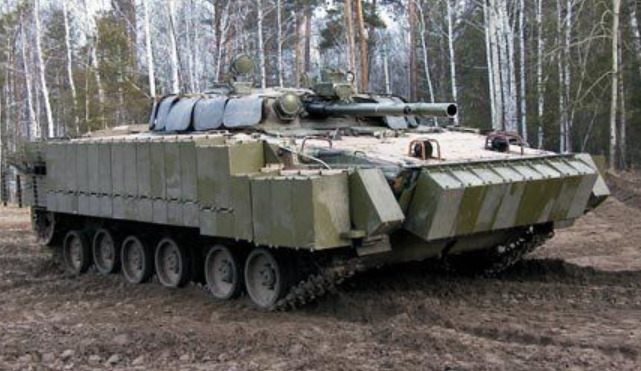
BMP-3 with Kaktus — purpose-built reactive armor designed specifically for light vehicles, with minimal backlash to the thin hull on detonation. In serial production since November 2022.
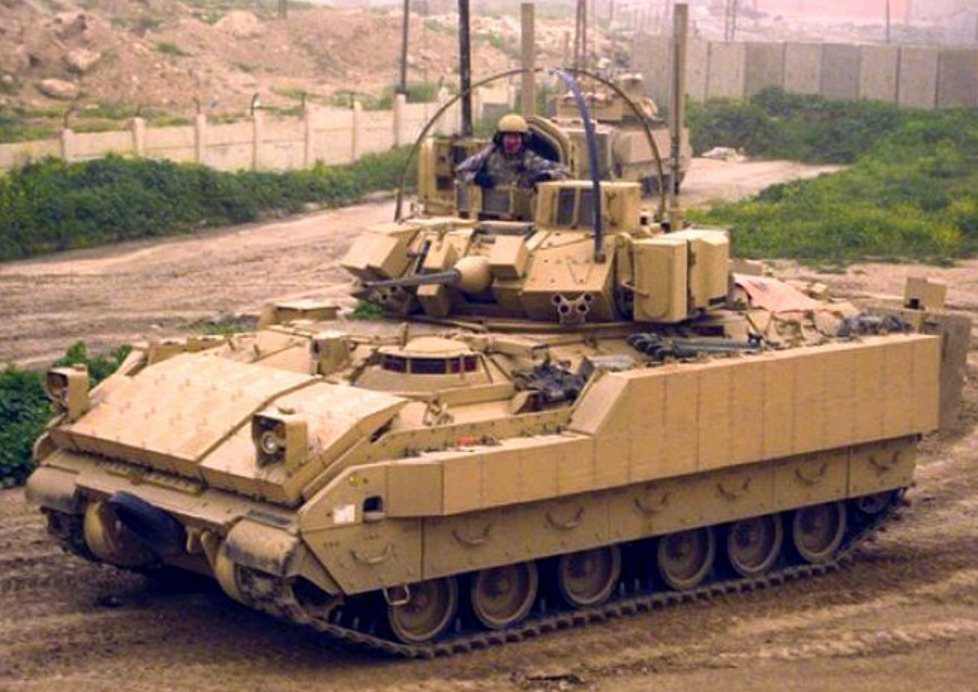
Bradley with BUSK/BRAT — reactive armor tiles integrated into the vehicle’s protection scheme, proven in combat.
These aren’t hypothetical upgrades. Adding them would give IFVs a fighting chance against single-charge shaped warheads like those on basic FPV drones, without making them invulnerable to dedicated anti-tank weapons.
Active protection — Electronic countermeasures
Active protection in-game almost exclusively exists as hard-kill or optical disruption. Not many of the ECM systems we see from the desert wars or from Ukraine are represented in-game. These are the systems that specifically counter radio-controlled threats like FPV drones.
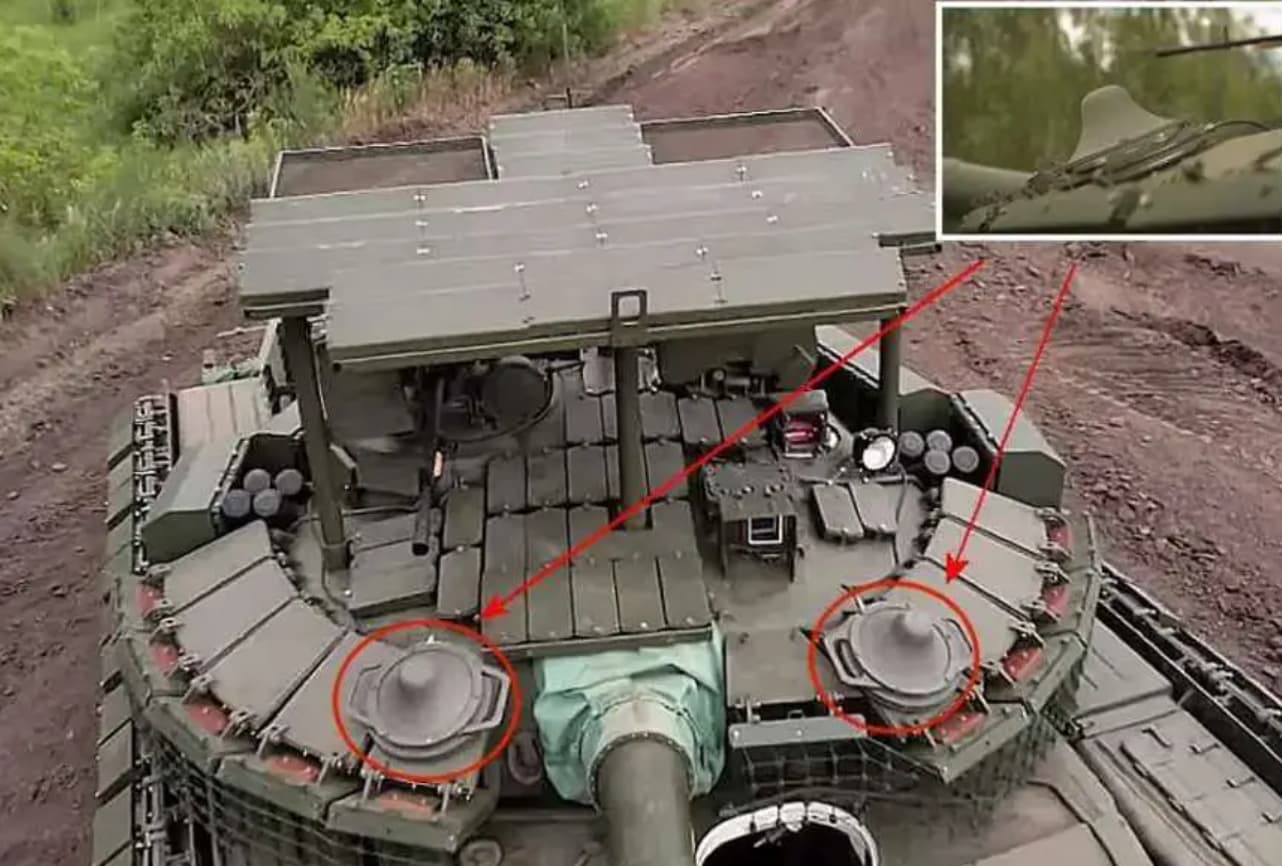
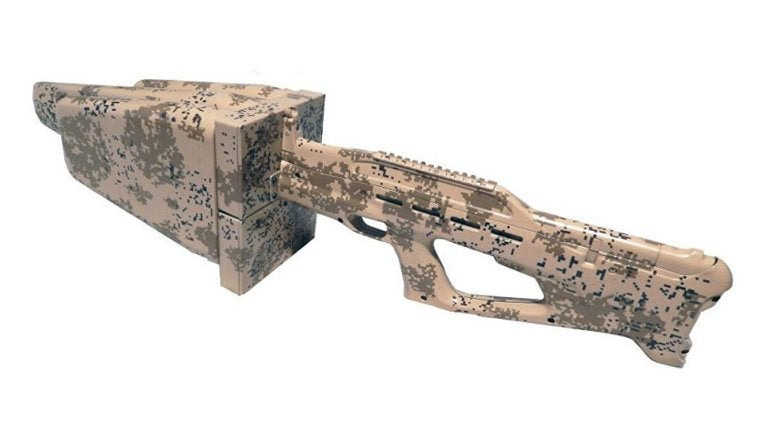
Volnorez — a Russian vehicle-mounted drone jammer that attaches magnetically, covering 900–3000 MHz with omnidirectional 360° protection. Disrupts FPV drone control links at over 1 km range.
The Americans have equivalent systems. The CREW Duke jammer family was originally developed to counter radio-controlled IEDs in Iraq and Afghanistan.
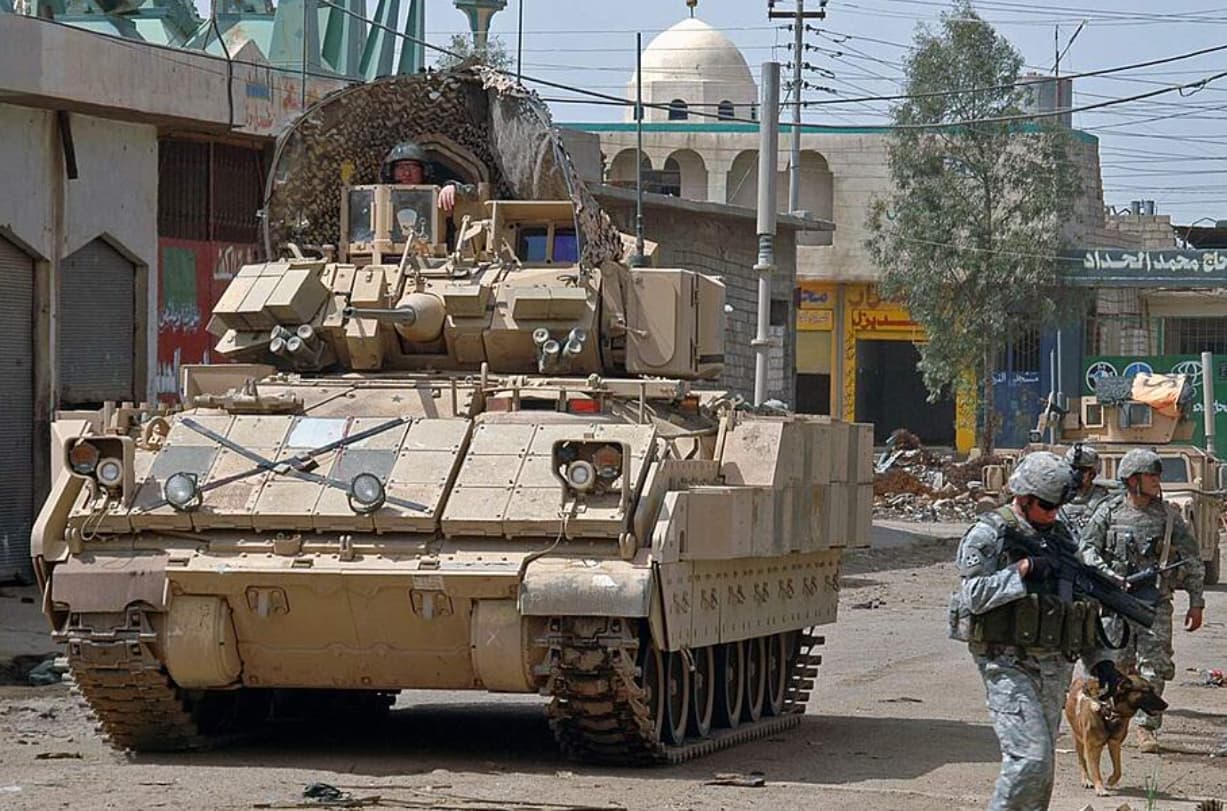
CREW Duke jammer antenna on a Bradley — the cylindrical antenna creates a radio-frequency denial bubble around the vehicle.
What I hope this does in-game: FPV drones would experience degraded video feed and eventually lose their control link entirely based on proximity to the jamming vehicle. This creates a soft counter — not an instant kill on the drone, but a zone of degraded effectiveness that forces drone operators to think about their approach. Fiber optic guided FPVs would bypass this entirely, but I don’t think those would make for a good gameplay addition.
Active protection — Hard-kill systems
Many vehicles already in-game have serviceable APS options, or ones currently in development and deployment. While we have limited information on some, the infantry CBT gives us more incentive than ever to include them:
- Arena-E for the BMP-3 — a hard-kill system that detects incoming projectiles by radar and launches interceptor munitions to neutralize them roughly 1.5 m from the vehicle. Reaction time of 0.03–0.05 seconds.
- Iron Fist Light on the Bradley — the M2A4E1 variant has already been unveiled with this Israeli-made APS integrated. Provides 360° protection against ATGMs, RPGs, and even UAS threats. The U.S. Army is equipping over 1,200 Bradleys with this system.
These would create a meaningful layer of defense that rewards smart play from both sides — vehicle crews benefit from the protection, while infantry players need to use tactics like multi-angle attacks, APS-defeating weapons like the RPG-30’s precursor projectile, or coordinated strikes to overwhelm the system.
Some other thoughts
I think War Thunder might need to improve the customizability of vehicles. The BMP-3 alone has configurations with slat armor, with Kaktus ERA, with Arena-E APS, with Shtora soft-kill — and various combinations of these. Adding each as a separate vehicle would be very annoying and serves more harm than good. Instead, expanding the modifications system or changing the whole system altogether seems like a good idea — think of it like how aircraft pylon loadouts work, but for vehicle protection.
- YES
- NO
- Something else (Comments!)
- I hate you