AIM-7 Variants and Subvariants
--------------------------------------------------------------------------------------------------------------------------
XAIM-7 (XAAM-N-2 Prototype)
-
Picture placeholder, to be added later.
The history of the Sparrow missile dates back to 1947, when the U.S. Navy contracted Sperry to develop a beam-riding guidance system for the standard 12.7 cm (5 in) HVAR (High Velocity Aircraft Rocket). The original designation for this missile project was KAS-1, which was changed to AAM-2 in September 1947 and later to AAM-N-2 in early 1948.
The original 5-inch diameter proved too small for the system’s requirements, prompting Douglas to develop a new missile airframe with a diameter of 20.3 cm (8 in). The first unpowered flight tests of the XAAM-N-2 prototypes took place in 1948.
Development proved challenging, however, and the program progressed slowly. The first successful air-to-air interception by a missile was not achieved until December 1952.
--------------------------------------------------------------------------------------------------------------------------
AIM-7A (AAM-N-2 Sparrow I)
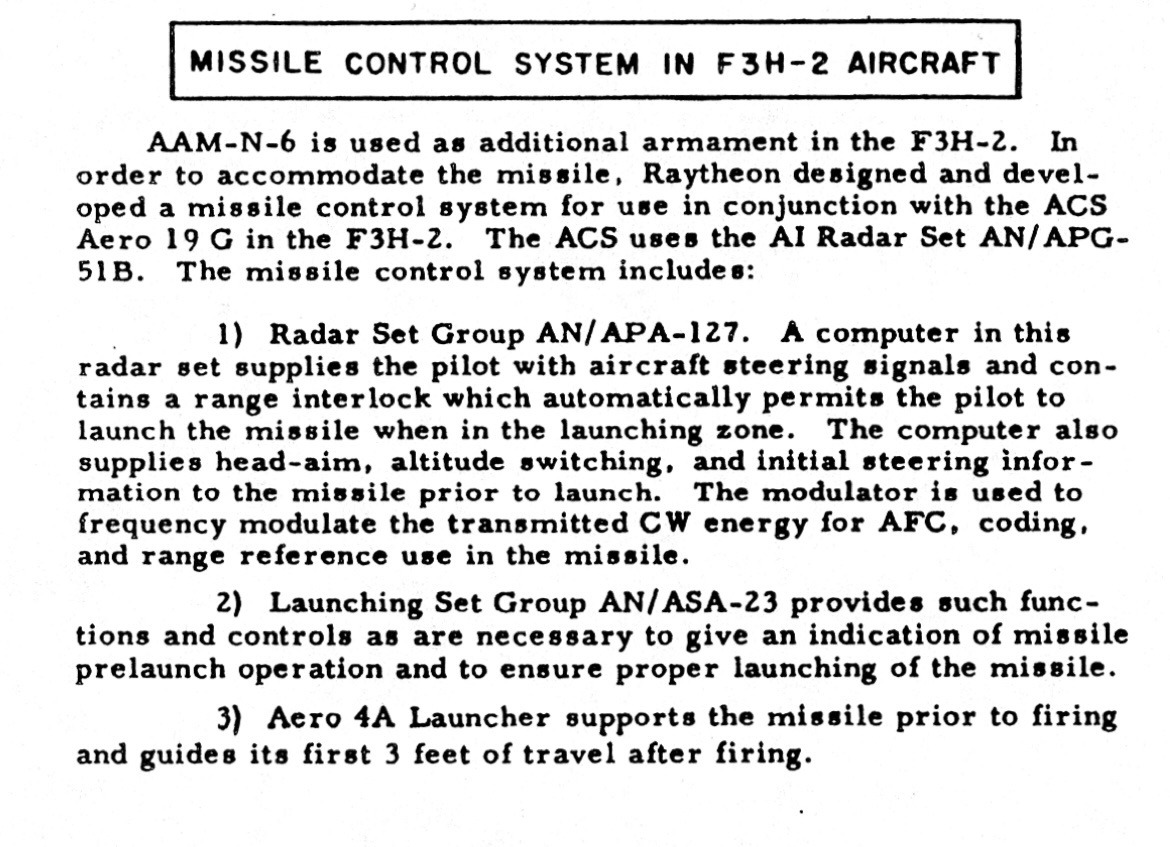
The AAM-N-2 Sparrow I entered service in 1956 with the F3H-2M Demon and F7U-3M Cutlass fighters. Due to the inherent limitations of beam-riding guidance, particularly its poor low-altitude performance, only about 2,000 Sparrow I missiles were produced, and the missile was withdrawn from service after only a few years.
Another major drawback of the AAM-N-2 was that its guidance beam was slaved to an optical sight in the launching aircraft. This required the pilot to maintain visual contact and identification of the target throughout the engagement, effectively limiting the Sparrow I to short-range, visual-flight-rules (VFR) combat.
AIM-7A’s Performance
- Length: 147.3 in (3.74 m)
- Finspan: 37 in (0.94 m)
- Diameter: 8 in (20.3cm)
- Weight: 315 lb (143 kg)
- Speed: Mach 2.5
- Propulsion: Aerojet 1.8KS-7800 solid rocket
- Thrust: 7,100 lbf (3,220kg) for 2.04 sec
- Guidance duration: N/A
- Warhead: 45 lb (20 kg) EX25 Mod. 0 warhead with 9.25 lb (4.2 kg) of H.6
- Detonation distance: 25 ft (7.6 m)
- Guidance type: Beam Riding
- Maneuvering capability: N/A
- Max Launch velocity: Mach 1.3
- Known platforms that used this type:
- F6F-5 (China Lake)
- F3D-1M & F3D-2M Skyknight
- F3H-2M Demon
- F7U-3M Cutlass
--------------------------------------------------------------------------------------------------------------------------
AIM-7B (AAM-N-3 Sparrow II)
Because of the principal shortcomings of the AAM-N-2 noted above, alternative guidance methods were explored almost from the beginning of the Sparrow program. As early as 1950, Douglas studied the possibility of equipping the Sparrow with an active radar-homing seeker.
By 1955, Douglas proposed proceeding with development, intending the missile to serve as the primary armament of the F5D Skylancer interceptor. It was later selected, not without controversy, as the primary weapon for the Canadian Avro Arrow supersonic interceptor, to be used in conjunction with the new Astra fire-control system. For Canadian production and as a secondary source of supply for U.S. missiles, Canadair was chosen to manufacture the missile in Quebec.
However, the small size of the missile’s forebody and the limitations of the K-band AN/APQ-64 radar severely restricted performance, and the system never functioned satisfactorily during testing. After extensive development work and numerous test firings in both the United States and Canada, Douglas abandoned the project in 1956. Canadair continued development efforts until the cancellation of the Avro Arrow program in 1959.
AIM-7B’s Performance
- Length: 144 in (3.65 m)
- Finspan: 40 in (1.02 m)
- Diameter: 8 in (20.3cm)
- Weight: 420 lb (190 kg)
- Speed: Mach 2.67
- Propulsion: Aerojet 1.8KS-7800 solid rocket
- Thrust: 8,000 lbf (3,628kg) for 1.84 sec
- Guidance duration: N/A
- Warhead: 45 lb (20 kg) EX25 Mod. 0 warhead with 9.25 lb (4.2 kg) of H.6
- Detonation distance: 25 ft (7.6 m)
- Guidance type: Active Radar Homing (ARH)
- Active Seeker Range: 6 nm (12 km)
- Aerodynamic Range @ 50,000 ft alt: 15 nm (28 km)
- Maneuvering capability: 20 g
- Max Launch velocity: Mach 1.3
- Known platforms that used this type:
--------------------------------------------------------------------------------------------------------------------------
AIM-7C (AAM-N-6 Sparrow III)
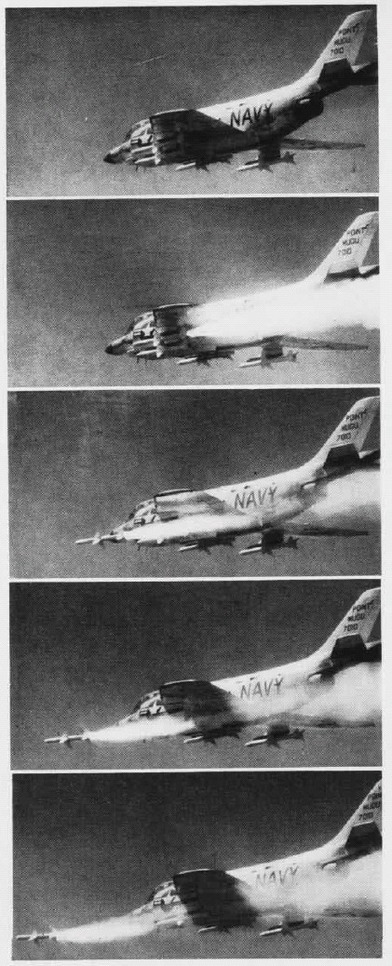
Following the failure of the Sparrow II program, other guidance methods were considered. Development of what would become the modern Sparrow family began in 1955 under Raytheon.
The Sparrow III and all subsequent Sparrow variants adopted semi-active radar homing (SARH) guidance.
Following successful testing with the YAAM-N-6 research and development missiles, production of the tactical AAM-N-6 began in January 1958. The missile entered operational service in August 1958.
The AAM-N-6 was powered by an Aerojet solid-fuel rocket motor and carried a 30 kg (65 lb) Mk 38 continuous-rod warhead.
AIM-7C’s Performance
- Length: 144 in (3.65 m)
- Finspan: 40 in (1.02 m)
- Diameter: 8 in (20.3cm)
- Weight: 380 lb (172 kg)
- Speed: Mach 4
- Propulsion: Aerojet 1.8KS-7800 solid rocket
- Thrust: 7,100 lbf (3,220kg) for 2.04 sec
- Guidance duration: 75 sec
- Warhead: 65 lb (30 kg) Mk 38 continuous rod with 20 lb (9 kg) of PBXN-4
- Detonation distance: 25 ft (7.6 m)
- Guidance type: Semi-Active Radar Homing (SARH)
- Seeker Range: 6.5 nm (12 km) w/ 200W radar output
- Aerodynamic Range @ 40,000 ft alt: 10 nm (18 km)
- Maneuvering capability: 16 g
- Max Launch velocity: Mach 1.3
- Known platforms that used this type:
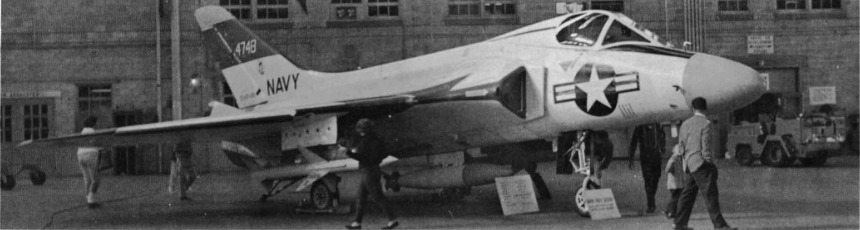
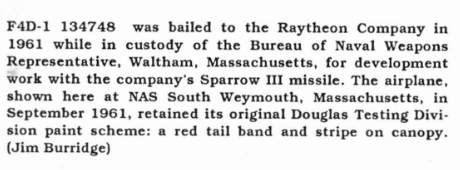
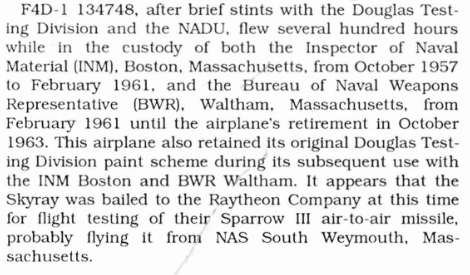
- F4D-1 Skyray (Testbed platform)
- F3H-2 Demon
--------------------------------------------------------------------------------------------------------------------------
AIM-7D (AAM-N-6a Sparrow III)
The AAM-N-6a, later redesignated AIM-7D, was similar to the AAM-N-6 but incorporated a new Thiokol liquid-fuel rocket motor, providing significantly improved performance. It also featured updates to the guidance electronics, allowing the missile to remain effective against targets at higher closing speeds.
The AAM-N-6a was selected as the primary radar-guided missile for the U.S. Air Force’s F-110A Spectre, the Air Force designation for the F-4 Phantom II, in 1962, where it was known as the AIM-101.
Production of the AIM-7D began in 1959, and approximately 7,500 missiles were manufactured.
AIM-7D’s Performance
- Length: 144 in (3.65 m)
- Finspan: 40 in (1.02 m)
- Diameter: 8 in (20.3cm)
- Weight: 435 lb (197 kg)
- Speed: Mach 4
- Propulsion: Thiokol Mk 6 Mod 3 (LR44-RM-2) liquid-propellant rocket motor
- Thrust: To be added later
- Guidance duration: 75 sec
- Warhead: 65 lb (30 kg) Mk 38 continuous rod with 20 lb (9 kg) of PBXN-4
- Detonation distance: 25 ft (7.6 m)
- Guidance type: Semi-Active Radar Homing (SARH)
- Seeker Range: 6.5 nm (12 km) w/ 200W radar output
- Aerodynamic Range @ 40,000 ft alt: 24 nm (44 km)
- Maneuvering capability: 15 g
- Max Launch velocity: Mach 2.2
- Known platforms that used this type:
--------------------------------------------------------------------------------------------------------------------------
AIM-7E (AAM-N-6b Sparrow III)
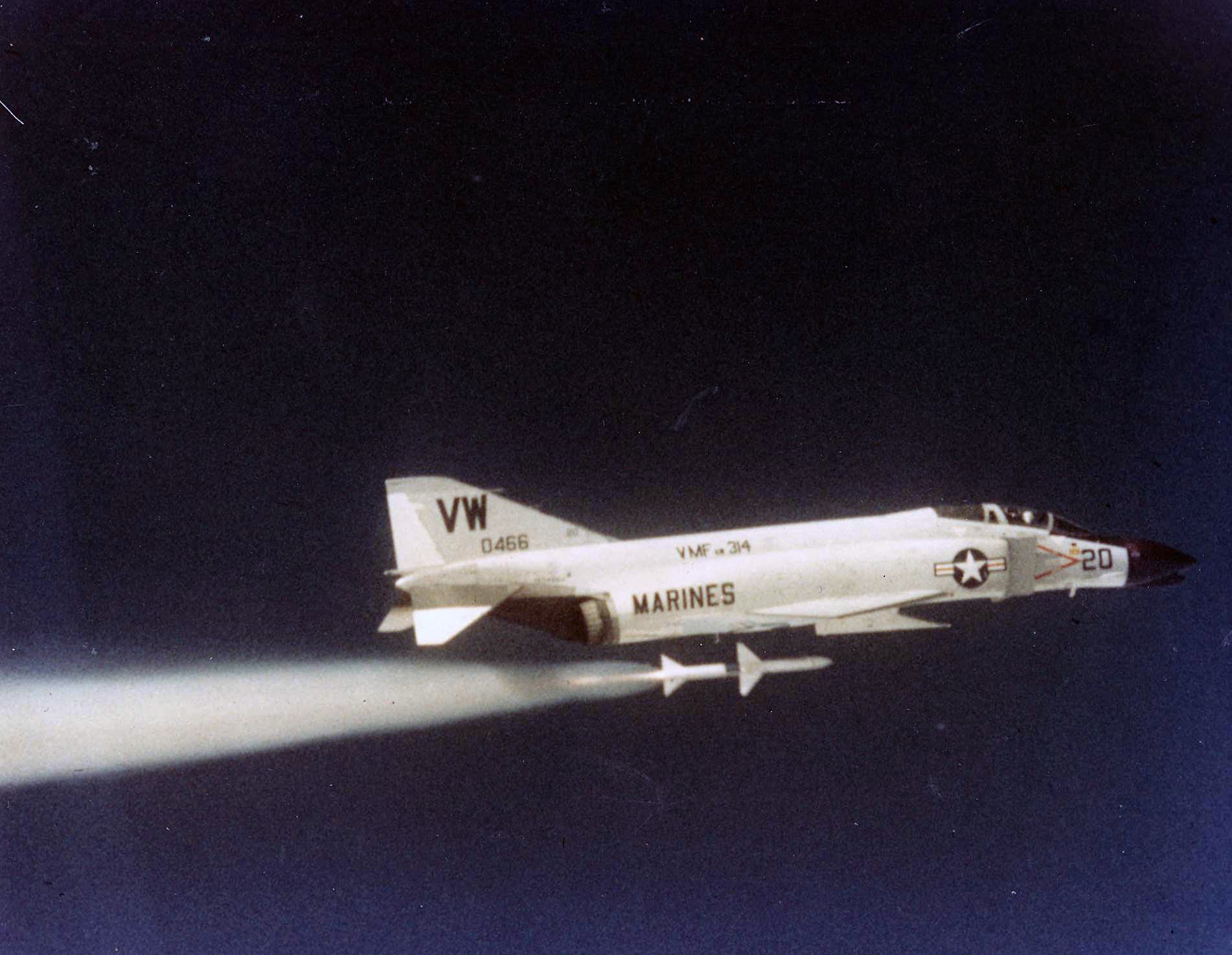
Approximately 7,500 AIM-7D and 25,000 AIM-7E missiles were produced, and the Sparrow saw extensive combat use during the Vietnam War with both the U.S. Air Force and the U.S. Navy.
The first combat kills credited to the Sparrow occurred on 7 June 1965, when U.S. Navy F-4B Phantoms shot down two MiG-17s. However, the missile’s initial combat performance proved disappointing. The AIM-7’s theoretical long-range engagement capability could rarely be exploited because the unreliable Identification Friend or Foe (IFF) systems of the era effectively required visual identification of targets before engagement.
Combined with the missile’s relatively long minimum engagement range of approximately 1,500 m (5,000 ft) and its poor effectiveness against maneuvering or low-altitude targets, these limitations resulted in a kill probability of less than 10 percent.
To address these shortcomings, the improved AIM-7E-2 was introduced in 1969 as a dedicated “dogfight missile.” It featured a shorter minimum engagement range, clipped wings to improve maneuverability, and upgraded autopilot and fuze systems. Further refinements followed with the AIM-7E-3, which incorporated improved fuzing and greater reliability, and the AIM-7E-4, which was specifically adapted for use with high-power fighter radars such as the F-14 Tomcat’s AN/AWG-9.
Despite its early problems, the Sparrow ultimately achieved considerable success in combat, accounting for the destruction of more than 50 enemy aircraft during the Vietnam air war.
AIM-7E’s Performance
- Length: 144 in (3.65 m)
- Finspan: 40 in (1.02 m)
- Diameter: 8 in (20.3cm)
- Weight: 435 lb (197 kg)
- Speed: Mach 4
- Propulsion: Rocketdyne Mk 38/Mk 52 solid rocket
- Thrust: 7,600lbs (3,447kg) for 2.9 seconds
- Guidance duration: 75 sec
- Warhead: 65 lb (30 kg) Mk 38 continuous rod with 20 lb (9 kg) of PBXN-4
- Detonation distance: 30 ft (9.1 m)
- Guidance type: Semi-Active Radar Homing (SARH)
- Seeker Range: 13.5 nm (25 km) w/ 200W radar output
- Aerodynamic Range @ 40,000 ft alt: 27 nm (50 km)
- Maneuvering capability: 25 g
- Max Launch velocity: Mach 2.2
- Known platforms that used this type:
--------------------------------------------------------------------------------------------------------------------------
AIM-7F
In January 1972, Raytheon began development of the significantly improved AIM-7F Sparrow. One of its most important upgrades was the introduction of a new dual-thrust (boost-sustain) rocket motor—typically the Hercules Mk 58, though some missiles were equipped with the Aerojet Mk 65. This propulsion system greatly increased the missile’s effective range compared to earlier Sparrow variants.
The AIM-7F also featured a completely new solid-state Guidance and Control Section (GCS), designated AN/DSQ-35, which was compatible with modern pulse-Doppler radar systems. Continued improvements to the GCS resulted in a series of variants ranging from AN/DSQ-35A through AN/DSQ-35H, the latter being used in the AIM-7F-11.
The smaller and more efficient electronics package allowed for the installation of a larger 39 kg (86 lb) Mk 71 warhead housed within the new WAU-10/B warhead section, increasing the missile’s lethality.
Production of the AIM-7F began in 1975 and continued through 1981. With the introduction of the AIM-7F, the missile’s official designation was simplified from “Sparrow III” to simply “Sparrow.”
AIM-7F’s Performance
- Length: 144 in (3.65 m)
- Finspan: 40 in (1.02 m)
- Diameter: 8 in (20.3cm)
- Weight: 510 lb (231 kg)
- Speed: Mach 4
- Propulsion: Hercules Mk 58 dual-thrust solid rocket
- Thrust:
- Boost: 5,750 lb (2,608 kg) for 4.5 seconds
- Sustain: 1,018 lb (461 kg) for 11 seconds)
- Guidance duration: 75 sec
- Warhead: 86 lb (39 kg) Mk 71 continuous rod
- Detonation distance: 40 ft (12.2 m)
- Guidance type: Semi-Active Radar Homing (SARH)
- Seeker Range: 22 nm (40 km) w/ 200W radar output
- Aerodynamic Range @ 40,000 ft alt: 53 nm (98 km)
- Maneuvering capability: 25 g
- Max Launch velocity: Mach 2.5
- Known platforms that used this type:
--------------------------------------------------------------------------------------------------------------------------
AIM-7G
-
Picture placeholder, to be added later.
The AIM-7G was a proposed Sparrow variant developed for the U.S. Air Force around 1970 for use with the F-111D. The missile featured a new seeker design intended to improve performance and compatibility with the aircraft’s advanced avionics and radar systems.
A small number of YAIM-7G prototype missiles were constructed and tested during the development program. However, the project did not progress beyond the prototype stage, and the AIM-7G never entered full-scale production or operational service.
-
Specs placeholder, to be added later.
--------------------------------------------------------------------------------------------------------------------------
AIM-7M
The next major Sparrow variant was the AIM-7M, whose most significant improvement was the introduction of an inverse monopulse seeker housed in the new WGU-6/B guidance section, later replaced by the WGU-23/B. This new seeker provided enhanced look-down/shoot-down capability and significantly improved performance in low-altitude environments.
There is no evidence that Sparrow variants officially designated AIM-7J, AIM-7K, or AIM-7L were ever adopted. Although the designation AIM-7J is sometimes associated with the Japanese license-produced AIM-7E, some sources indicate that the suffix “M” was deliberately chosen to represent “monopulse,” implying that the J, K, and L designations were intentionally skipped.
The monopulse seeker substantially improved the missile’s resistance to electronic countermeasures (ECM) while also enhancing target tracking performance against low-flying aircraft.
Additional improvements introduced with the AIM-7M included:
- A digital computer with software stored in reprogrammable EEPROM modules.
- An improved autopilot system.
- A new active radar proximity fuze.
The upgraded autopilot enabled the AIM-7M to fly more efficient intercept trajectories, reducing the amount of continuous target illumination required from the launching aircraft. Illumination was primarily needed during the mid-course and terminal phases of flight.
The AIM-7M also introduced the WDU-27/B blast-fragmentation warhead, installed within the WAU-17/B warhead section, providing improved lethality over previous Sparrow variants.
The first YAIM-7M test firing took place in 1980, and full-scale production of the AIM-7M began in 1982.
An additional improvement was later introduced to the AIM-7M, commonly referred to as the “AIM-7M H-Build” or, for simplicity, the “AIM-7MH” among flight simulation enthusiasts.
The H-Build upgrade introduced lofted guidance, providing significantly greater kinematic performance and engagement range than earlier Sparrow variants, possibly including the baseline AIM-7M. This increased capability was achieved through the use of a lofted flight profile rather than a conventional proportional-navigation trajectory.
The missile’s performance could be further optimized if the pilot placed the aircraft into the proper climb angle prior to launch, reducing the amount of maneuvering the missile would need to perform on its own. However, the missile was also capable of executing the loft autonomously even if launched in an untopmized flight profile. If lofted steering was not selected, the missile would instead follow a conventional guidance profile, resulting in reduced maximum engagement range compared to lofted flight.
The H-Build software provided pilots with the option to select either lofted or conventional steering modes, depending on the tactical situation.
The AIM-7M H-Build also introduced Home-On-Jam (HOJ) capability, a passive guidance mode that allows a missile to guide directly onto the source of an enemy’s jamming signal.
The AIM-7M in the USAF service was gradually replaced by the AIM-120 AMRAAMs.
AIM-7M’s Performance
- Length: 144 in (3.65 m)
- Finspan: 40 in (1.02 m)
- Diameter: 8 in (20.3cm)
- Weight: 510 lb (231 kg)
- Speed: Mach 4
- Propulsion: Hercules Mk 58 dual-thrust solid rocket
- Thrust:
- Boost: 5,750 lb (2,608 kg) for 4.5 seconds
- Sustain: 1,018 lb (461 kg) for 11 seconds)
- Guidance duration: 75 sec
- Warhead: 86 lb (39 kg) Mk 71 continuous rod
- Detonation distance: 40 ft (12.2 m)
- Guidance type: Semi-Active Radar Homing (SARH)
- Seeker Range: 22 nm (40 km) w/ 200W radar output
- Aerodynamic Range @ 40,000 ft alt: 53 nm (98 km)
- Maneuvering capability: 30 g
- Max Launch velocity: Mach 2.5
- Known platforms that used this type:
--------------------------------------------------------------------------------------------------------------------------
AIM-7P
The AIM-7P was largely similar to the AIM-7M and was primarily introduced as an upgrade program for existing M-series missiles rather than as an entirely new production variant.
The initial improvements focused mainly on software enhancements, which were intended to improve the missile’s performance, particularly in low-altitude engagement environments. The AIM-7P Block I has a WGU-6D/B guidance section.
A subsequent Block II upgrade replaced WGU-6/B of the Block I with a WGU-23D/B guidance section and introduced a new rear receiver that enabled the missile to receive mid-course guidance updates from the launching aircraft, allowing the pilot to re-lock the missile or switch to a different target.
Original plans called for all AIM-7M missiles to be upgraded to the AIM-7P standard. In practice, however, AIM-7P missiles were generally issued as replacements for AIM-7Ms that had been expended, lost, or removed from service inventories. The AIM-7P production began in 1987, and the AIM-7P in the USN service was gradually replaced by the AIM-120 AMRAAMs.
AIM-7P’s Performance
- Length: 144 in (3.65 m)
- Finspan: 40 in (1.02 m)
- Diameter: 8 in (20.3cm)
- Weight: 510 lb (231 kg)
- Speed: Mach 4
- Propulsion: Hercules Mk 58 dual-thrust solid rocket
- Thrust:
- Boost: 5,750 lb (2,608 kg) for 4.5 seconds
- Sustain: 1,018 lb (461 kg) for 11 seconds)
- Guidance duration: 75 sec
- Warhead: 86 lb (39 kg) Mk 71 continuous rod
- Detonation distance: 40 ft (12.2 m)
- Guidance type: Semi-Active Radar Homing (SARH)
- Seeker Range: 22 nm (40 km) w/ 200W radar output
- Aerodynamic Range @ 40,000 ft alt: 53 nm (98 km)
- Maneuvering capability: 30 g
- Max Launch velocity: Mach 2.5
- Known platforms that used this type:
--------------------------------------------------------------------------------------------------------------------------
AIM-7Q
-
Picture placeholder, to be added later.
The AIM-7Q was documented as a highly advanced Sparrow development proposal. However, very little official information is available, and the details that follow should therefore be regarded as unconfirmed.
According to available accounts, the AIM-7Q was intended to incorporate dual-mode terminal guidance, combining infrared (IR) and active radar homing capabilities. In addition, it was reportedly designed with a wide-band passive radar seeker, allowing the missile to detect and home in on emissions from the target without transmitting any signals of its own.
This passive capability would have enabled the AIM-7Q to search for targets “silently” after being launched toward the target’s general location. If no emissions were detected, the missile would briefly activate its own radar seeker and conduct a search. Upon detecting a target, a second short radar sweep would be performed several seconds later to gather additional information on the target’s speed and heading.
Using this data, the missile would navigate toward a calculated interception point, or “kill zone,” before transitioning to terminal guidance using its combined infrared and active radar homing systems.
Unfortunately, little additional information is available regarding the AIM-7Q program. The timeline of its development, the maturity of the design, and whether any prototypes were ever constructed or flight-tested remain unknown to this day.
-
Specs placeholder, to be added later.
--------------------------------------------------------------------------------------------------------------------------
AIM-7R
The caption likely mislabeled it as an AIM-7P. It appears to have an IR/optical seeker at the very tip.
The final Sparrow variant to be proposed was the AIM-7R. Developed in the early 1990s, the AIM-7R was envisioned as an advanced evolution of the AIM-7P Block II.
Its most significant improvement was a new dual-mode radar/infrared seeker developed under the Missile Homing Improvement Program (MHIP). This seeker was intended to enhance terminal-phase performance by combining the strengths of both radar and infrared guidance, improving the missile’s ability to engage maneuvering targets and operate in challenging electronic warfare environments.
The AIM-7R was also designed with a substantially upgraded onboard computer to meet the increased processing demands associated with dual-mode terminal homing.
A corresponding ship-launched version, designated RIM-7R, was also proposed. Initial plans called for a large number of existing AIM/RIM-7M and AIM/RIM-7P missiles to be upgraded to the AIM/RIM-7R standard.
However, despite successfully completing the evaluation phase, the AIM-7R program was cancelled in December 1996 due to its high projected costs. By that time, the continued development and fielding of more advanced missile systems such as the AIM-120 AMRAAM had reduced the need for further Sparrow modernization. It’s believed that only the RIM-7R had successfully test-fired during the evaluation.
The MHIP seeker was repurposed and used in the RIM-66M-5 SM-2 Block III B missile for the fighting ships.
-
Specs placeholder, to be added later.