Unlike mig23 keeps for some claiming there’s aren’t improvements in solid rocket technology in terms of efficiency per mass
The issue with missile burn time is that warthunder doesn’t have ramp up/down for the begining and end of the thrust cycle.
The R23/R24, and a lot of older Russian SRB technology in general, has a signficant thrust ramp up/down time, but in game its maximum thrust is achieved instantaneously, so much so that if it had the full thrust for the stated burn time, it would out range the R27ER
Average thrust/delta V and range are mostly correct.
Bumped.
2 Likes
did they buff the 120D and C-5?
very slightly, still pull than 120A and 7F
didnt realize it was that bad, wow

6 Likes
They are not, but documentation varies. Average thrust and deltaV for some missiles is only correct for sea level and yet they try to model their range correctly for medium altitudes. This results in errant drag and energy loss data in other conditions. AIM-54 is a great example where it meets high alt range conditions for a specific scenario… at least where Gaijin has filled in the blanks. It overperforms heavily at sea level.
That is nonsense.
Thanks
Yeah the US just spends billions every decade or so on advanced propellants just to hide the research and continue to produce no meaningful improvements in propellants for decades while our adversaries catch up… of course they have better performance over time.
That is not the only metric, though. They also work to improve shelf life and durability of the propellants so that they can handle movement, storage, and reduce maintenance costs.
2 Likes
I really dont understand your insistence on magical fairy dust technology instead of actual rocket science which hasn’t moved
AMRAAMs can be barrel rolled still
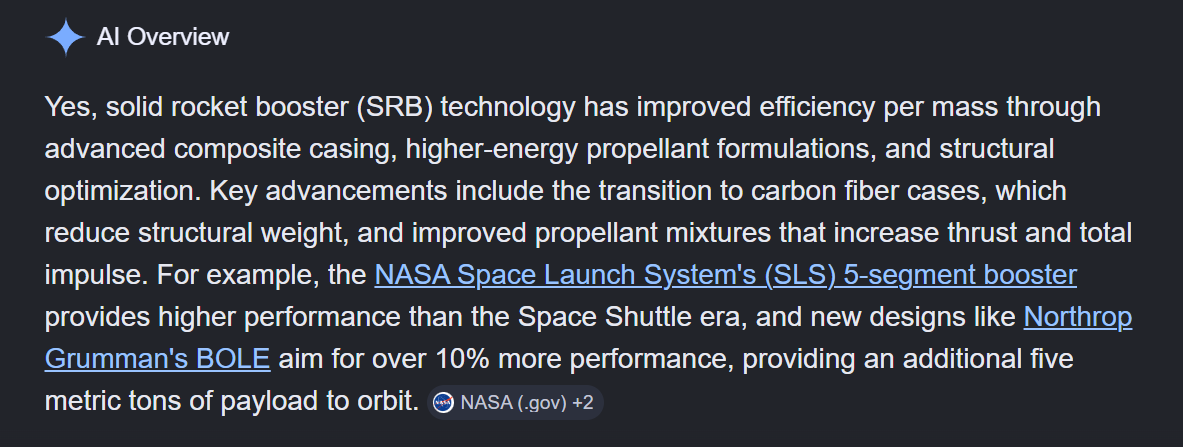
Even AI couldn’t get this wrong, and it sites valid sources immediately; Likewise AMRAAM propellant has seen advancements as there have been numerous programs detailed in budgeting documents with the goal of developing better rocket propellants.
1 Like
stop lying
solid rocket motors have been constantly developed, with this just being one of the more recent examples
11 Likes
Something I just remembered the aim120D uses a different control section. Iirc it’s VCAS (valve controlled actuator system) while the C-5 has the WCU-28/B. The aim120A/B uses the WCU-11/B. And the C-7 again got a upgrade over the C-5 with the SCAS (shortened control actuator system) not sure what the exact difference is but we could imagine more fuel for the C-7 and a bit more with the D or even maneuverability changes
another note there is a WCU-33/B though from my research it is unknown if this is inside a aim120 but it is listed as a guided missile component
Page 7
Maybe we can get together a bug report. There just isn’t any data to say how much room was made or exactly if it contributed to increased maneuverability
7 Likes
well, knowing that the control system was upgraded when combined with sources stating improved HOBS should be enough
but its gaijin so they will probably just make the upgraded control systems pull less
wouldn’t expect anything else tbh
Oh I also just remembered any missile with the VCAS should have more fuel not sure how much exactly but instead of the individual servos connecting to the fins which take up the entire sectional area, where as with VCAS it essentially uses hydraulic fluid to deflect the wings which the distribution block and pump can all be moved towards the front of the missile making more room for fuel. The lines can also be pretty small given that are strong enough to hold the pressure. It also has the added benefit for stability since as the fuel drains it becomes more stable therefore less turning losses at range. Which is also a benefit to WVR or HOB engagements where the missile is less stable with the more fuel it has.
If I can I’ll find the patent showing the control section or someone else can find it and post it
just linking this bug report here to try keep it from getting lost when dev server threads close
https://community.gaijin.net/issues/p/warthunder/i/J0XnmJvx1uBD
2 Likes
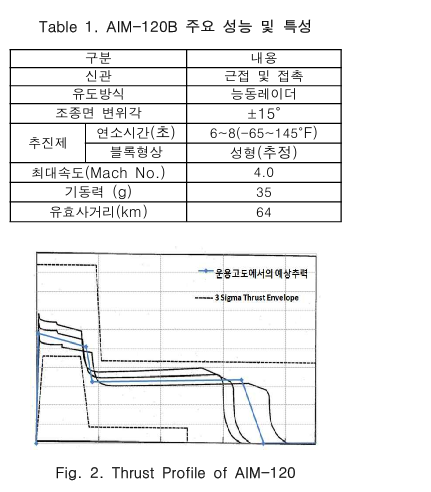
Source for AIM-120s being 35G and having 15 degrees fin AOA ±, since people were claiming that developers had arbitrarily nerfed the original AIM-120s’ fin AoA without any sources, which was not the case.
1 Like
looks like amraam is forever gonna be cooked, that’s the korean study from ages ago ain’t it
also
im so brain rotted

link to the study btw
https://scienceon.kisti.re.kr/commons/util/originalView.do?cn=JAKO201019657416464&dbt=JAKO&koi=KISTI1.1003%2FJNL.JAKO201019657416464
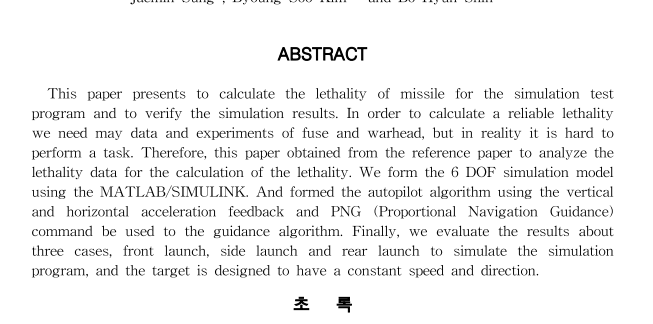
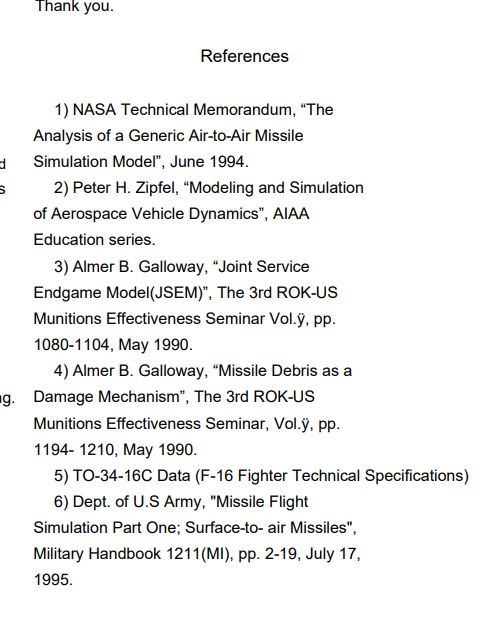
sources it uses
2 Likes
Maybe, just maybe, the AIM-120D has improved fin aoa? cause that in the video is not 15 degrees of deflection
3 Likes