Why do tanks (e.g.Leclercs, Leo2s) turn much worse stationary compared e.g. to the T80s even if they have neutral steering and the T80 havent.
To make this worse, when you want to turn with a tank equipped with neutral steering and then immediatly turn into the other direction, the hull somehow gets a kick into the original direction and therefore delays the turn into the new direction. This makes no sense to me at all.
edit: tested how long it takes to do a 360° turn for some tanks with similar hp/t ratio:
with neutral steering: (Ariete AMV, Leclerc Azur): 10s
without neutral steering: T80U-E1: 6,5s
Shouldnt the tanks with neutral steering turn better?
I guess it has something to do with the fact the T-80 can just send full power to the left or right track whereas neutral steering needs to be slower due to one track needing to be in reverse
lets assume this is the case, why would anyone then built a tank with neutral steering? Why would you take the more complex transmission into account if the turn rate gets worse?
Benefits for close quarters maneuvers. Theres nothing that actually stops a tank with neutral steering for executing the other form of turn as far as I’m aware, but turning in war thunder isnt modelled properly either. Its significantly simplified. The turning radius of stuff like the Sherman and all that should be much much worse
When a tracked vehicle turns, it has to drag its tracks sideways, which creates very strong turning resistance.
The smaller the turning radius, the greater the turning resistance, and it is greatest during a neutral turn.
Therefore, when comparing a neutral turn vs. a pivot turn, a pivot turn with a larger turning radius has less turning resistance and is therefore more likely to allow for quicker movement.
Some tanks with neutral steering drive one track forward while simultaneously driving the other track backward at the same speed. No “dragging” in these cases.
Even in a neutral turn, as you described, with one track moving forward and the other backward, the tracks are “dragged laterally,” resulting in strong turning resistance.
In particular, the front and rear ends of the tracks trace a large circular trajectory, placing a heavy load on them.
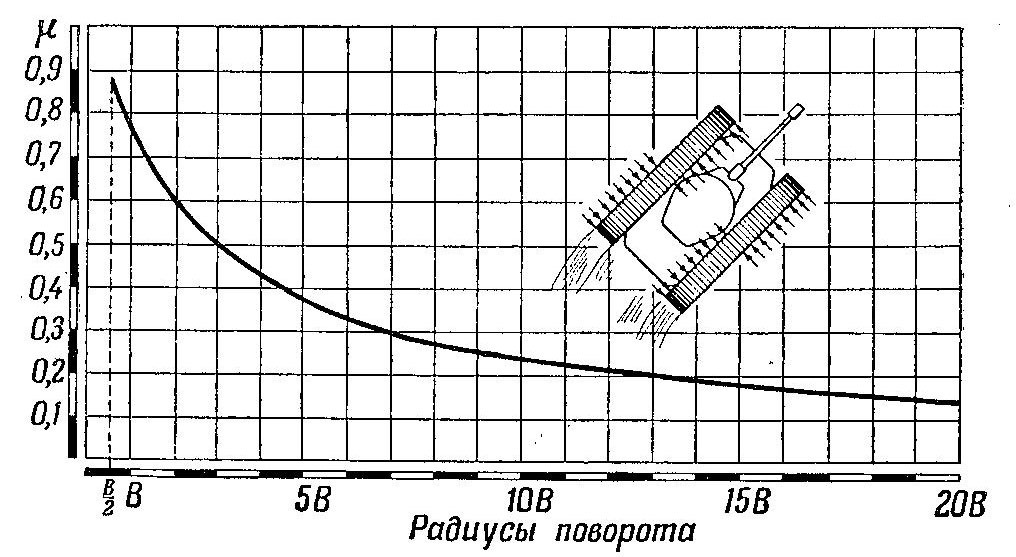
Here is a diagram quoted from a Soviet tank manual. This is a graph showing how much turning resistance is generated relative to the tank’s turning radius.
The unit B is the distance between the left and right tracks, i.e., the vehicle width. Moving to the left on the horizontal axis reduces the turning radius, ending at a turning radius of B/2, or the neutral turn. As you can see, the neutral turn generates the strongest load during a tank’s turn.
Note that the turning resistance discussed here is different from the “rolling resistance” generated when the tracks rotate forward and backward. Turning resistance and rolling resistance occur simultaneously.
Of course there is some resistance - after all it’s not a hovercraft.
But the tanks using neutral steer in the attached link - very tight turns. Less resistance on a larger radius does not necessarily mean a quicker “turn”.