Expand
External Launchers- Calliope and Whizbang
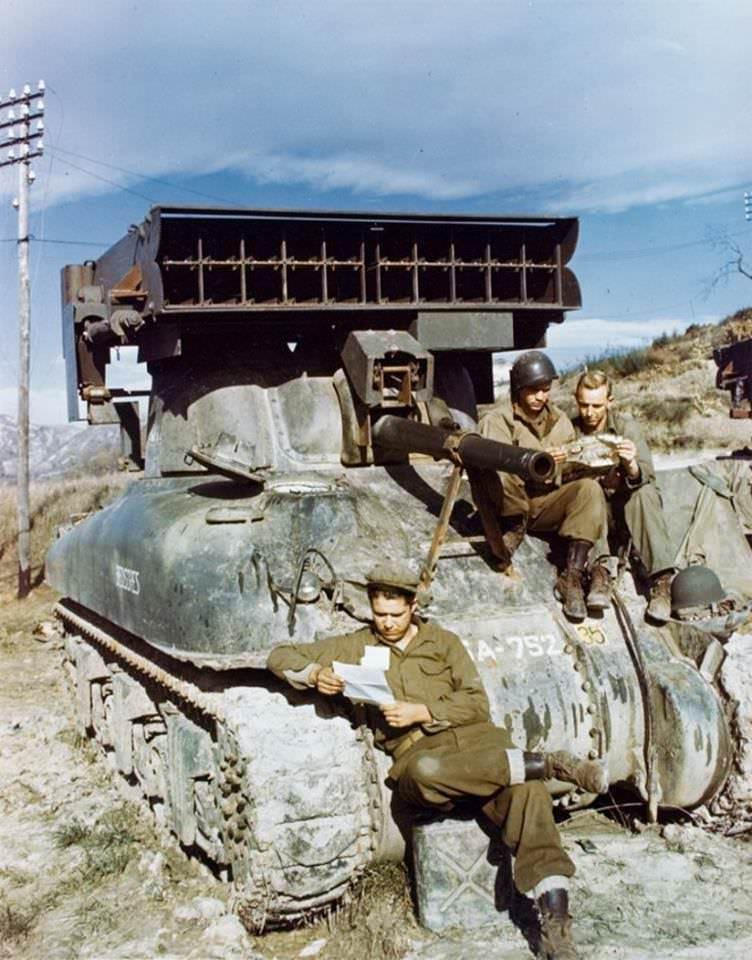
Prior to Operation Overlord, German fortifications were identified as a significant obstacle for Allied armour. The Sherman’s 75mm HE shell was effective against infantry and the 105mm could handle some emplacements, but in certain situations there would simply be a need for more explosives than the tanks could provide. The solution was simple- take the proven 114mm M8 rocket, and attach as many of them as possible to the standard M4 Sherman turret. This was the T34 Calliope, named after the instrument it vaguely resembled. While each rocket only contained around the same amount of explosives as a 105mm HE shell, the Calliope could unload its 60 rockets in seconds, saturating the target area in an overkill amount of explosives. Additionally, the sound of the rockets could have a demoralizing effect.
The Calliope was effective but for particularly stubborn targets its rocket may not have been large enough. To rectify this the T40 Whizbang was developed, featuring 20 180mm T37 demolition rockets, these being based on the “Mousetrap” anti-submarine rocket. Each T37 packed 13x the explosive equivalent of the M8, though had much lower velocity and therefore much shorter range. This launcher would be standardized as the M17, though like the T34 it would see relatively limited use.
An M4A2 with T34
An M4A1 with T40 Whizbang in the travel position. When firing the launcher would raise up to a similar height as the T34
The Engineering Vehicles- T76 and T105
The T34 and T40 shared a number of flaws. First, they were very tall systems, adding around a meter of height to the M4. This made the tanks equipped with such launchers very visible and distinctive targets for anti-tank fire. Second, the launchers were vulnerable to enemy fire and an ammo detonation of the rockets could have devastating consequences for the tank. The T40 at least had protection from rifle-calibre rounds thanks to its half-inch of armour surrounding the launcher, but the T34 was completely unarmoured and both launchers were vulnerable to any serious firepower. Finally, both launchers could only be reloaded from outside the tank, leaving the crew exposed to enemy fire during the quite long, slow process.
The T76 Engineering Tank was designed to solve these issues. Rather than adding an external launcher to an M4 Sherman, the T76 replaced an M4’s cannon with a breech-loaded launch tube for a T37 rocket. This launcher could be reloaded form inside the tank and the form factor was similar to a standard 75mm Sherman. The T76 prototype was followed by the T76E1 with a longer launch tube and improved loading mechanism, the former providing greatly improved range and accuracy and the latter slightly improved protection.
Both the T76 and T76E1 used unarmoured launch tubes. This risked the possibility of the loaded rocket detonating if hit by enemy fire. The improved T105 Engineering Tank was developed to rectify this. Similar in design to the T76, the T105 mounted a launch rail instead of a launch tube for the T37 rocket, with this rail protected by a half-inch of armour on all sides. The T105 was designed as a kit, allowing for field conversions of 75 or 105mm Shermans, instead of requiring the vehicles to be modified at the factory as was the case for the T76/E1. However, none of the above vehicles would progress beyond the prototype stage.
T76 (top) and T76E1 (bottom) prototypes
The T105 prototype
Finally, the Demolition Tank
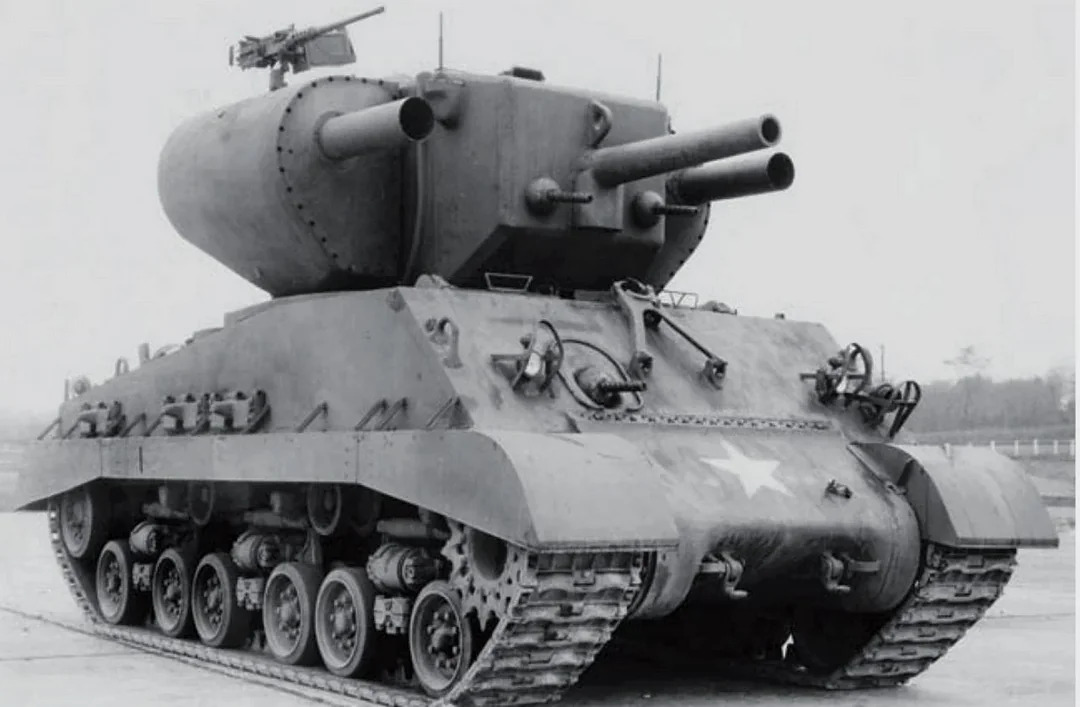
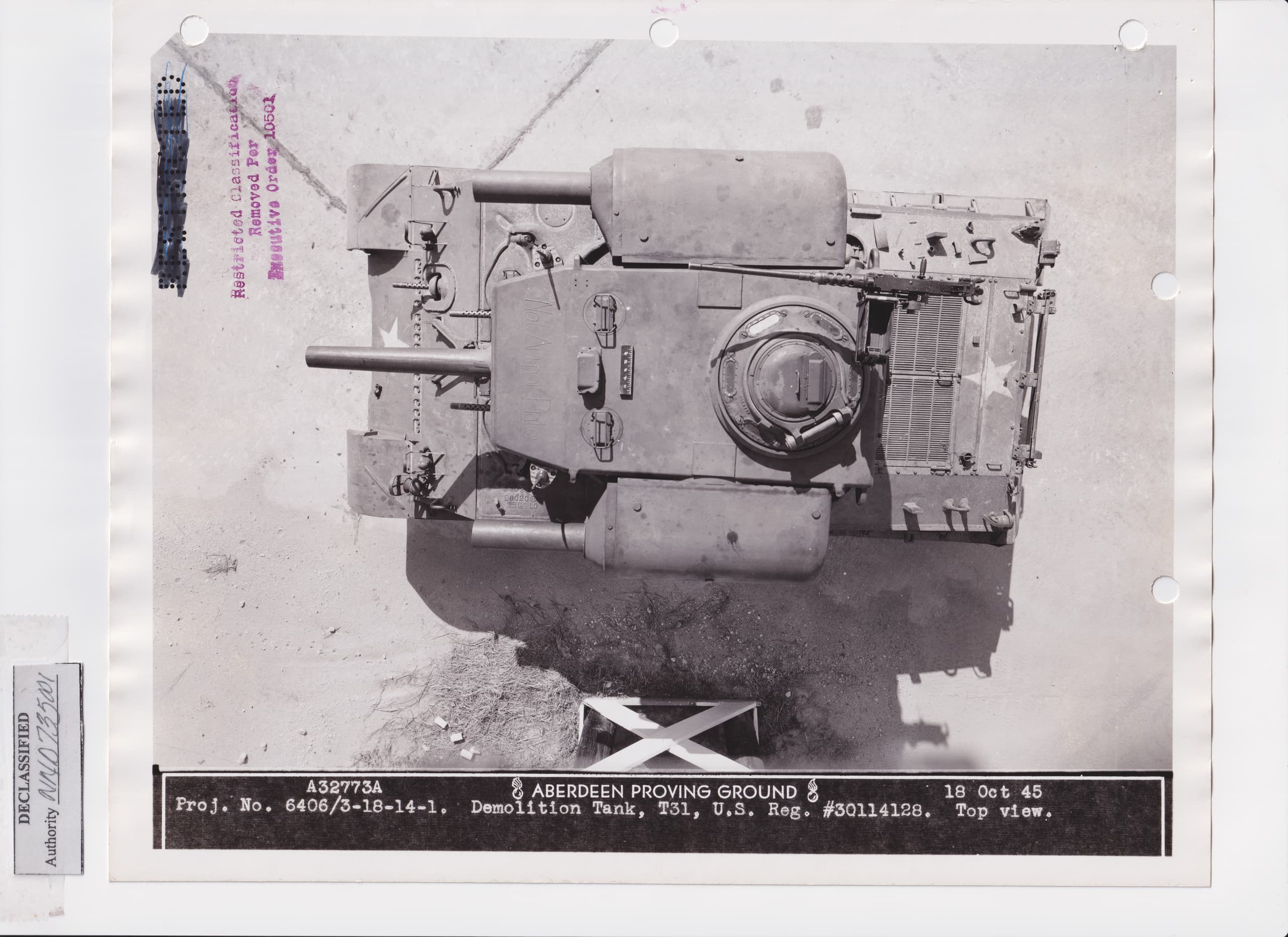
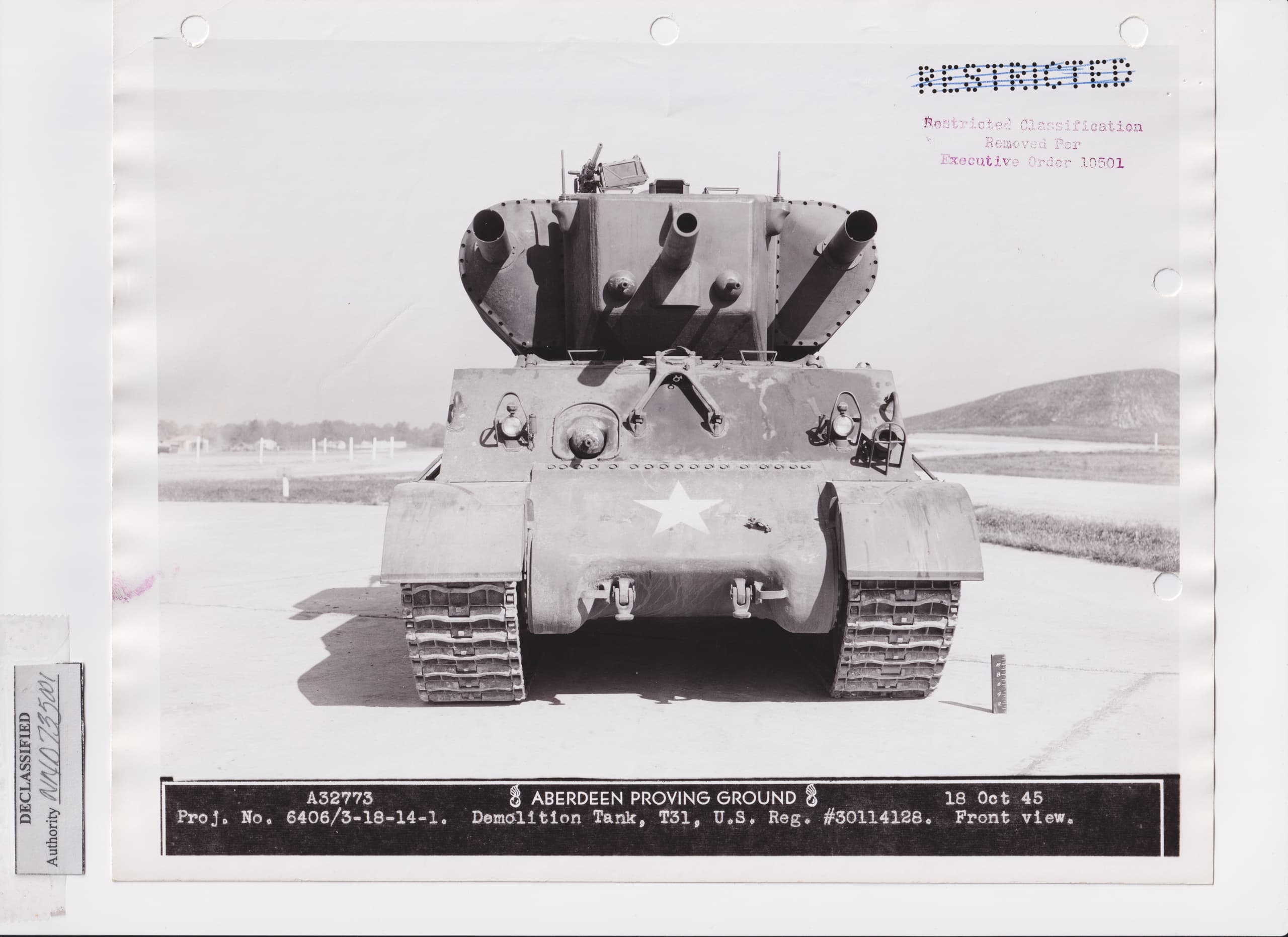
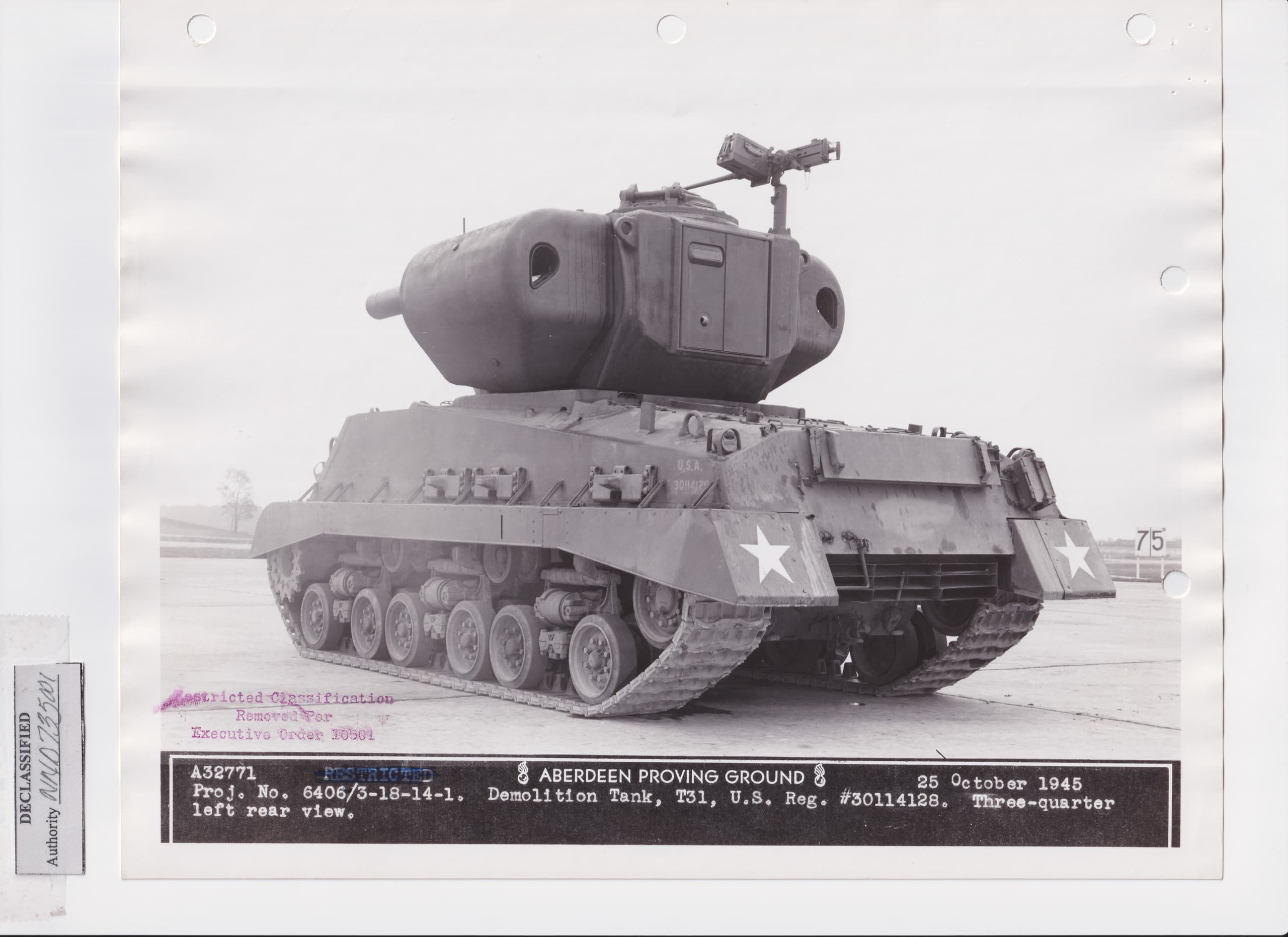
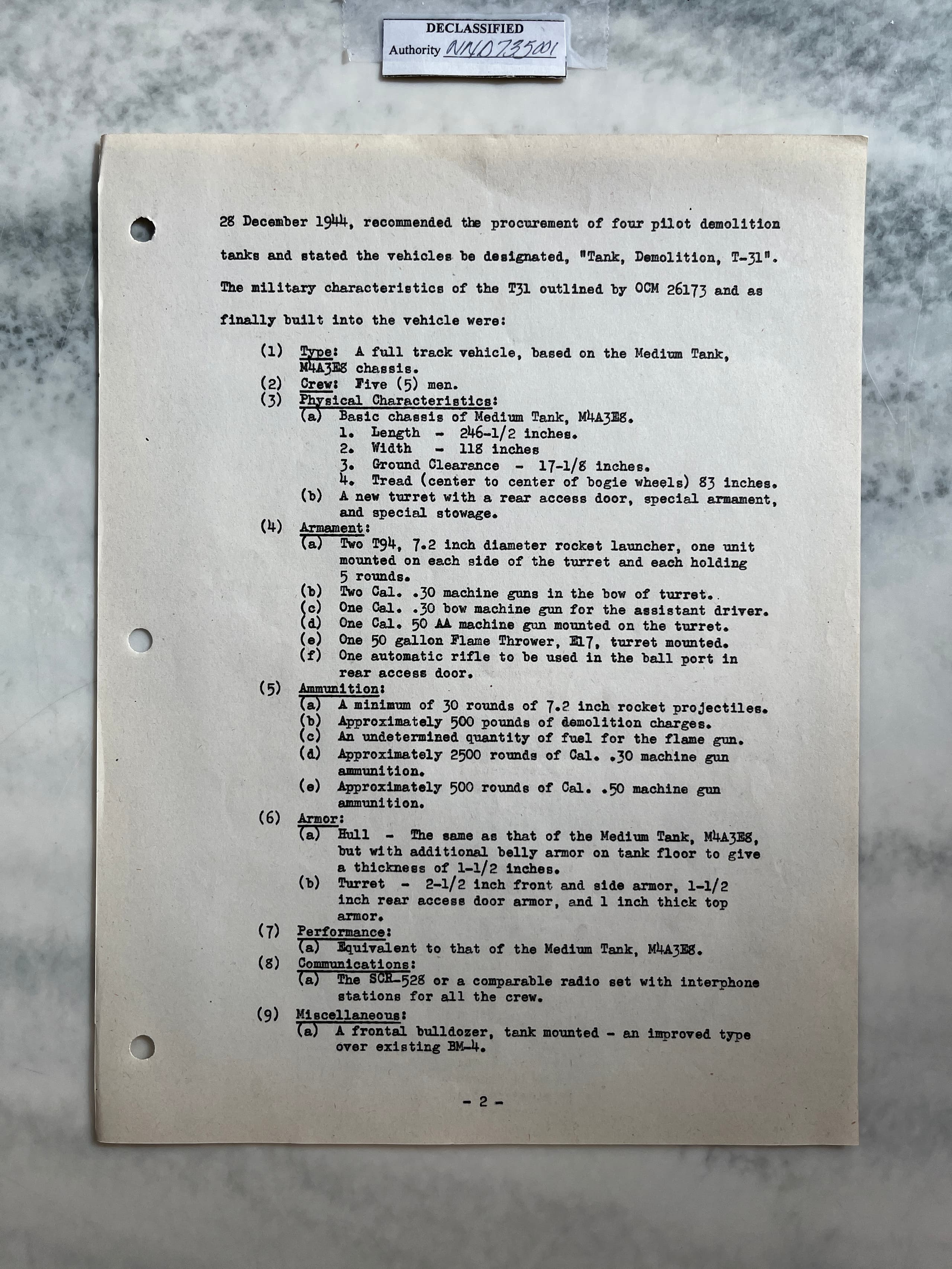
The T76 and T105 solved the issues of the M17, but introduced one of their own. They lacked the high rate of fire for saturation of fire that had initially sparked the development of the rocket Shermans. So in November 1944 development of the ultimate rocket Sherman began. Designated the T2 and later T31 Demolition Tank, the vehicle was to be built on the M4A3 HVSS chassis, with a new turret mounting twin revolver-style T94 launchers for the T37 rocket, an E17 flamethrower, and several machine guns. A dummy 105mm barrel was attached to the front of the turret, though it seems a tad optimistic that any enemies would be fooled into thinking the T31 was a standard Sherman 105. Four prototypes were to be produced as soon as possible, likely intended for use in Operation Downfall. Design was completed by January 1945, with a production of a mock-up turret beginning in February. The first (and only) prototype was constructed between April and August 1945.
Testing ran from late August to late October and went poorly to say the least. The left T94 jammed completely, and the right could only be cycled by hand. The vehicle was also found to be poorly protected and much too tall. No further T31s were built and the programme was swiftly shut down in January 1946. The war was over, the M4 was already out of production, being replaced by the M4 Sherman. It simply didn’t make sense to continue development of a specialized vehicle that didn’t work, based on an obsolete platform, and intended for a role that no longer existed in a war that had already ended. The exact fate of the T31 pilot is unknown but the vehicle was most likely scrapped during the Korean War, used for parts for the M4A3 (76)s fighting in that conflict.
An early design drawing of the T31
The prototype from a similar angle