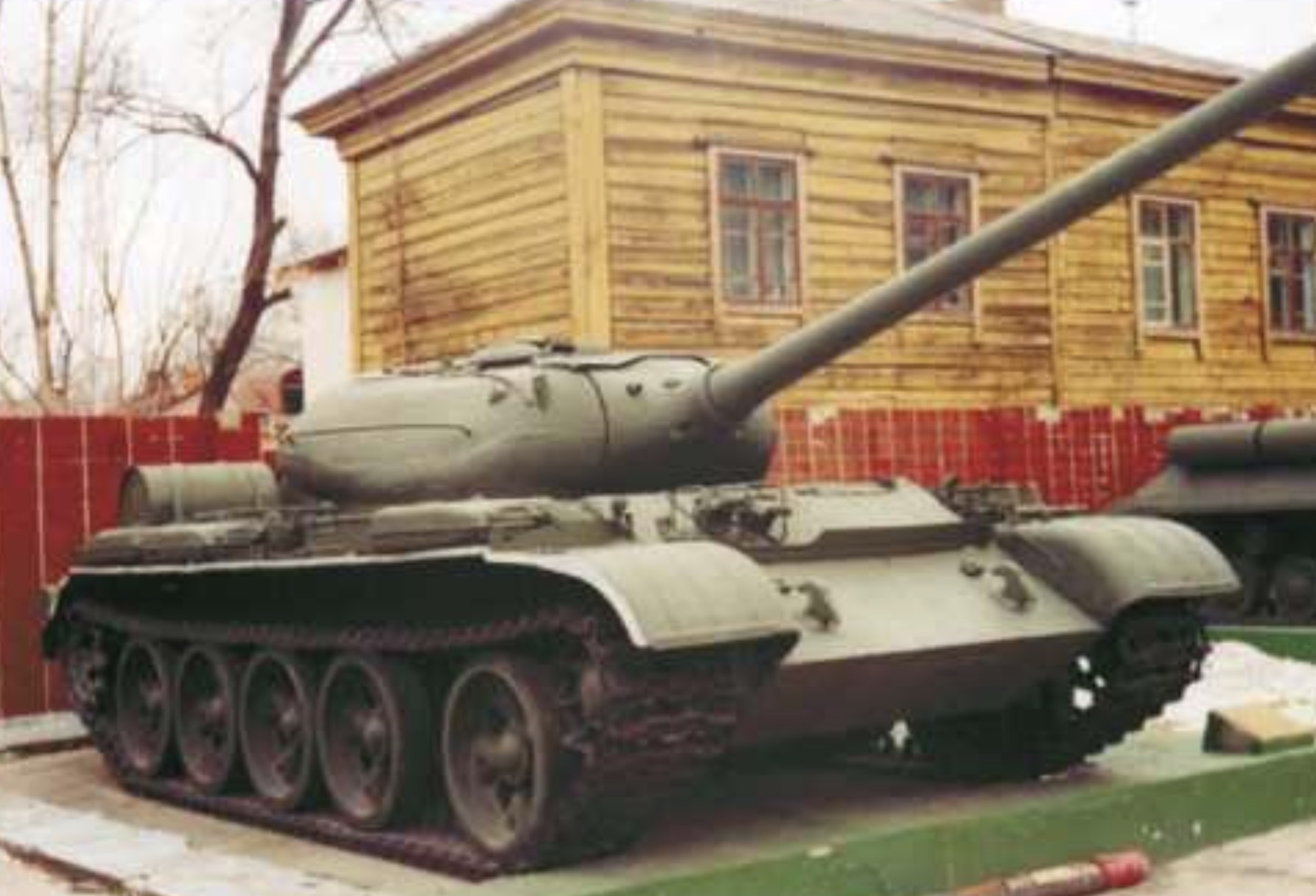
Would you like to see this T-54 in-game?
- Yes, as a Tech-Tree Vehicle
- Yes, as a Premium Vehicle
- Yes, as a Squadron Vehicle
- Yes, as an Event Vehicle
- No, I do not want to see this T-54 in-game.
T-54-1M (1960)
Introduction
The T-54-1M (1960) is the first production version of the T-54 after undergoing the partial modernization program introduced during Soviet capital overhauls from 1960 onward. Unlike the later T-54-2 and T-54-3, the first-series T-54 was never rebuilt to full T-54B standard. Instead, it retained its distinctive 1947 hull, heavily undercut turret and original unstabilized D-10T gun, while receiving updated communications and certain night-vision equipment. Some examples also incorporated a number of later T-55 components, most visibly elements of the running gear, external fuel tanks and stowage boxes. Read the full suggestion for a few pleasant surprises regarding T-54-1M’s capabilities.
The designation “T-54-1M (1960)” is unofficial and is used here purely to distinguish the modernized vehicle from the original T-54 (1947) already represented in War Thunder.
History
Spoiler
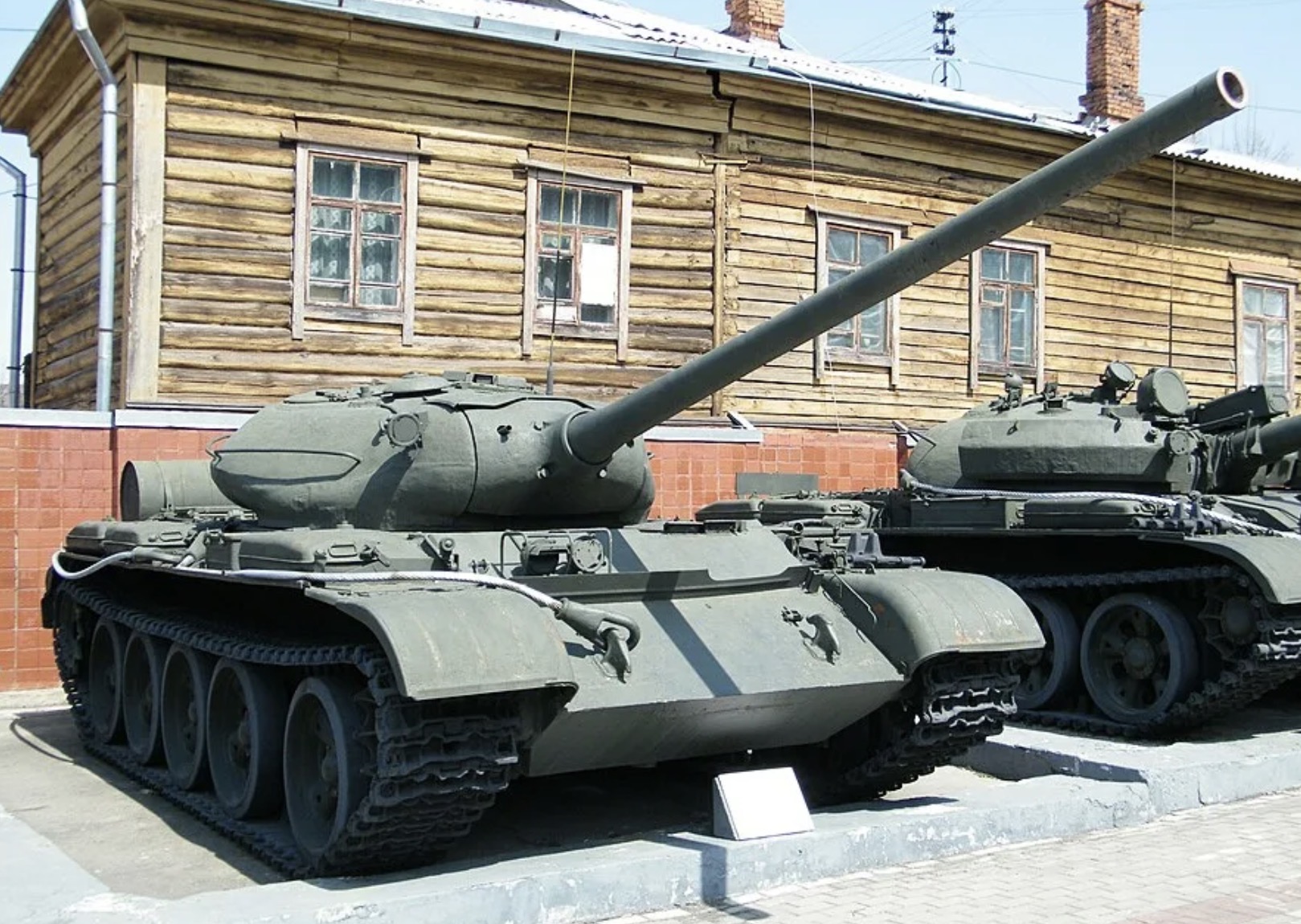
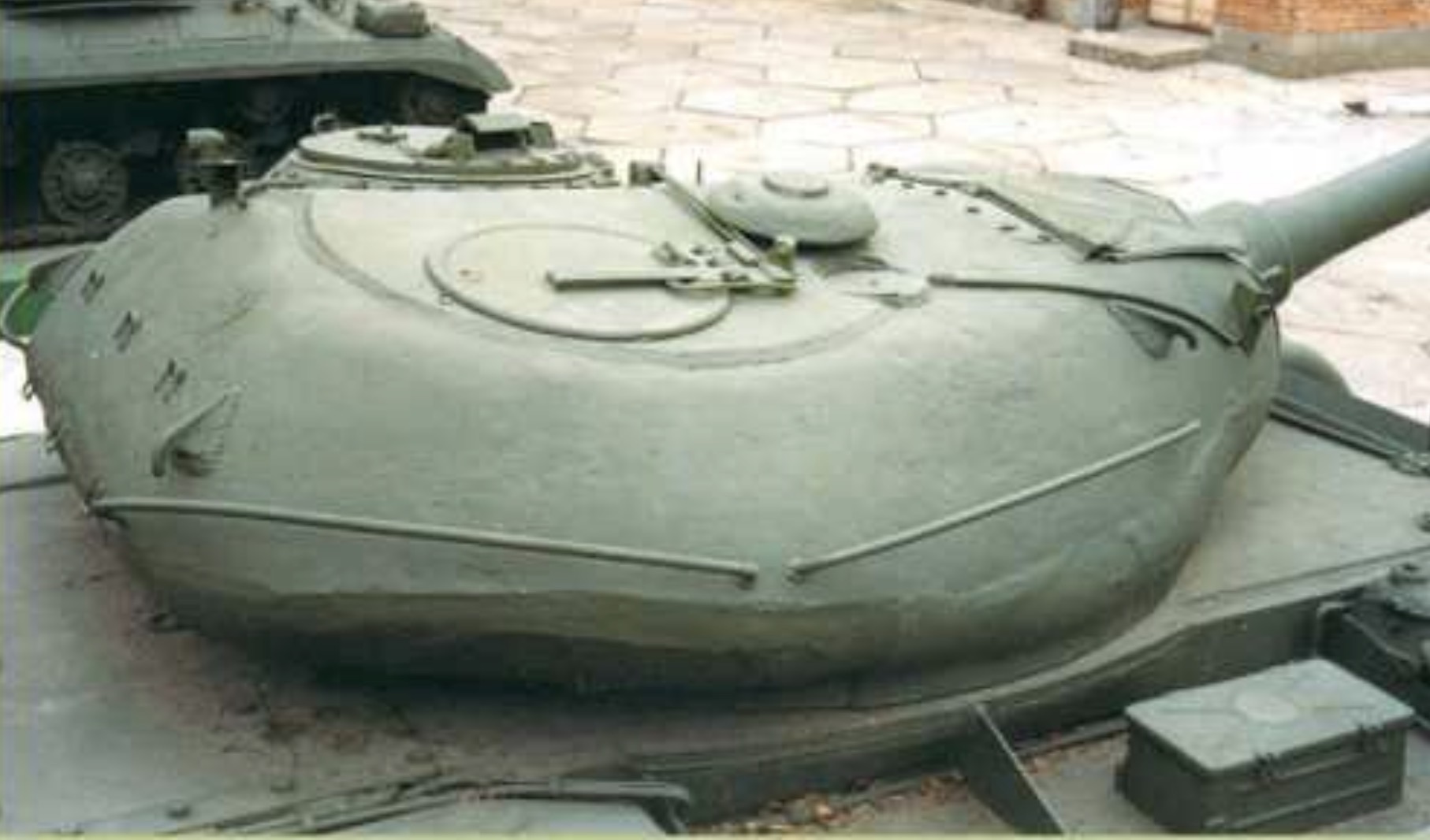
The T-54-1, also known as the T-54 obr.1947, was the first mass-produced version of what would become one of the most important Soviet tank families of the Cold War. Serial production began in 1947, with manufacture eventually expanding beyond Nizhny Tagil. The vehicle was extremely heavily protected for a medium tank of its time, with a 120 mm upper glacis inclined at 60 degrees and a large cast turret distinguished by the pronounced reverse undercut around much of its lower circumference.
Its main armament was the 100 mm D-10T, supported by a coaxial SG-43 machine gun, two additional SG-43 course machine guns mounted in armored boxes above the tracks and a 12.7 mm DShK anti-aircraft machine gun. Although heavily armed and armored, the first production series suffered from numerous mechanical, manufacturing and reliability problems. Production was halted after only 617 combat tanks had been completed, and the substantially revised T-54 obr.1949 soon replaced it.
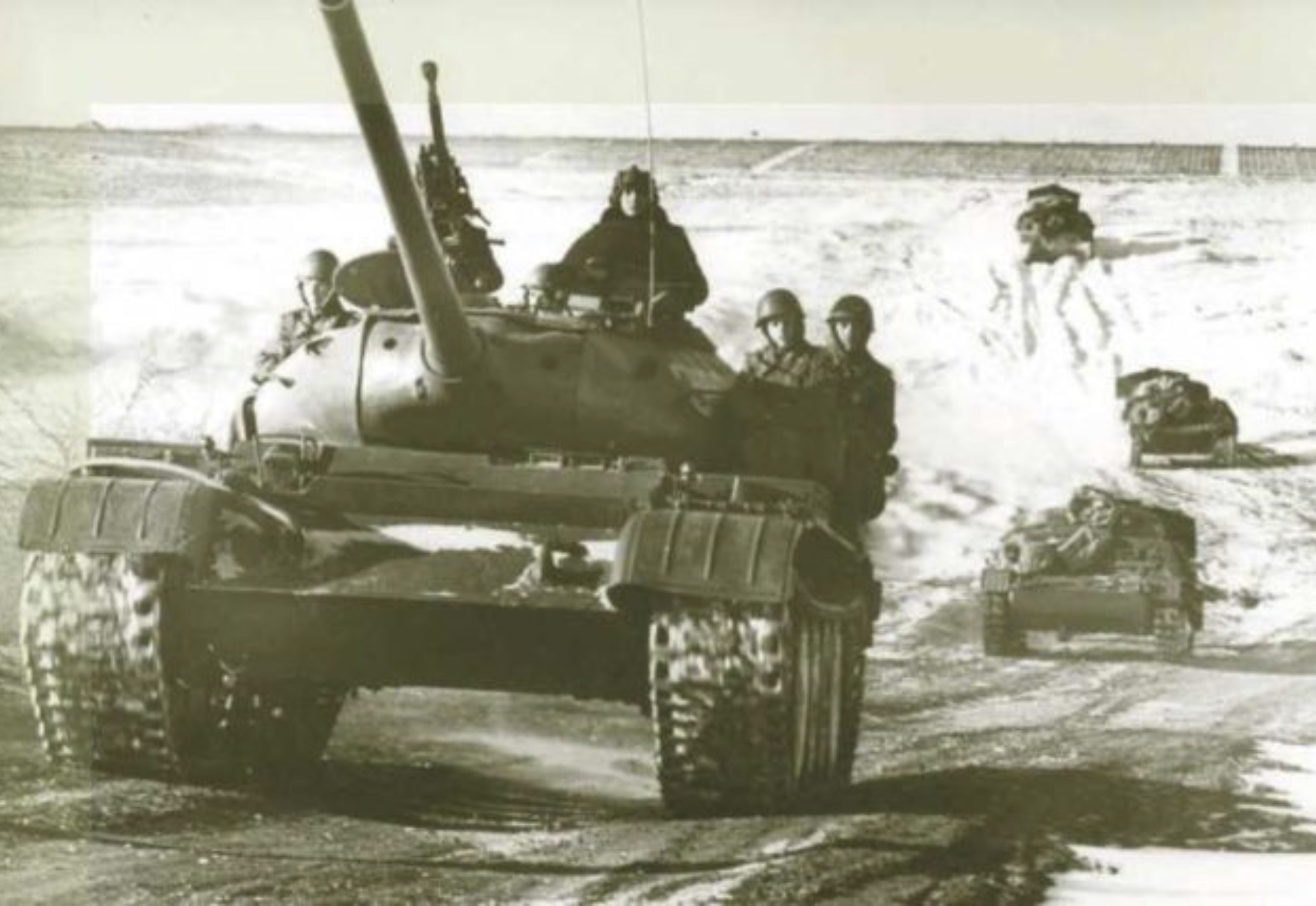
Photograph shows a modernized T-54 obr.1947 participating in exercises in December 1961.
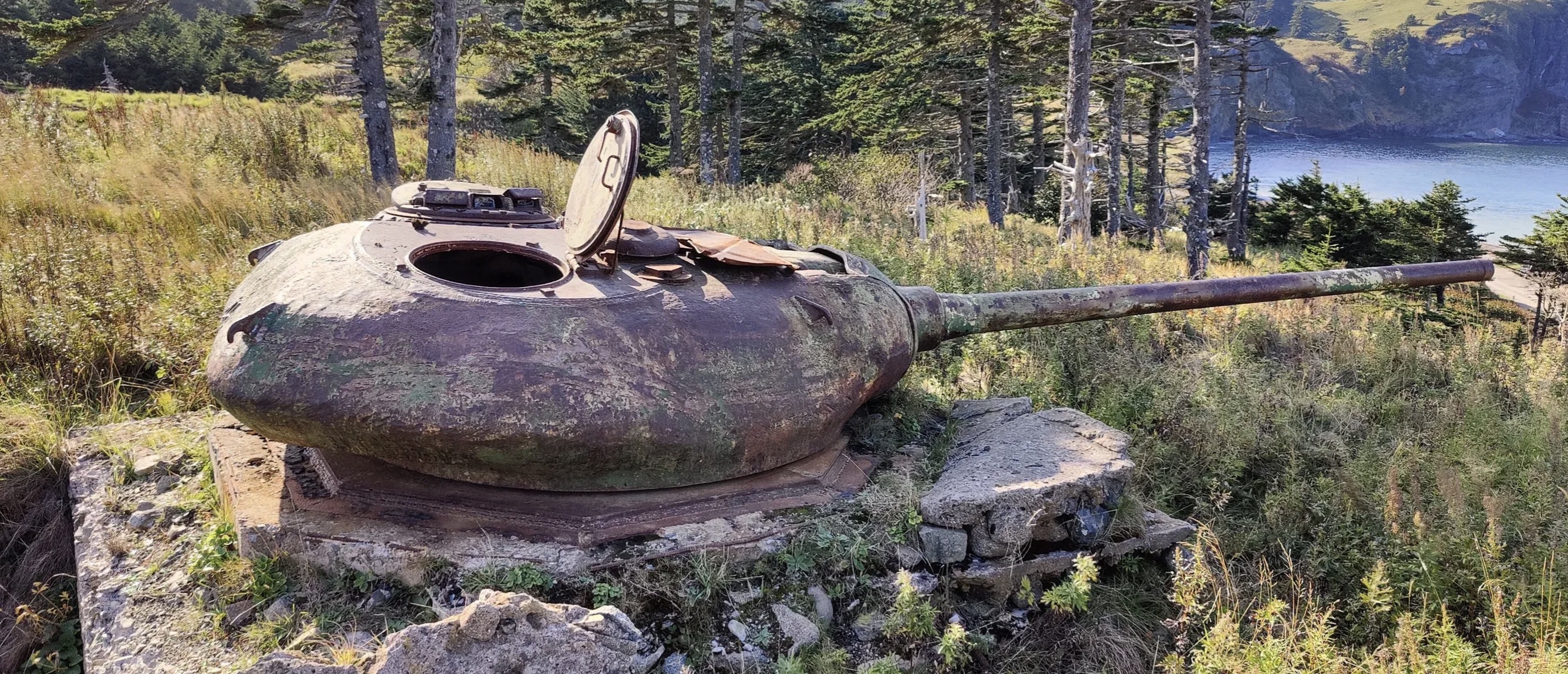
Despite its short production run, the T-54-1 was not immediately discarded. Surviving vehicles continued to serve throughout the post-war period and into the Cold War, with many later converted to support roles or reused as fixed defensive emplacements. Some of these fortified positions likely remained in use for a short period after the collapse of the Soviet Union, meaning that T-54-1 turrets may have continued serving under the Russian Federation into the 1990s.
Many surviving first-series T-54s were also converted into BTS-4A armored recovery vehicles, while their turrets were also widely reused as fixed gun emplacements along the Sino-Soviet border and in the Kuril Islands. These fortified positions remained in use throughout much of the Cold War and were gradually abandoned after its end; some sources suggest that a number may have remained active into the early 2000s. Many of the emplacements still survive today, with their turrets left permanently in place, silently guarding positions that have long since lost their military purpose. Some BTS-4-series vehicles may also remain in service or reserve use today, although it is important to note that BTS-4 hulls were sourced from several different tank types and variants, including various T-54 models and even the T-44.
1960+ Modernization In-Depth
Spoiler
The modernization of the T-54-1 was noticeably more limited than that applied to the T-54-2 and T-54-3. Some sources state that, beginning in 1960, tanks manufactured in 1947–48 received only new communications equipment and night-vision devices as part of the formal modernization program. Later T-54 variants, by contrast, were progressively brought to T-54A and eventually T-54B combat standard. However, it is clear that these T-54-1Ms received later T-54B-style running gear and associated equipment, with some examples also incorporating components associated with the T-55. Their younger T-54-2 and T-54-3 counterparts could eventually receive the newer 580 hp V-55 engine, so it is not unreasonable to consider the possibility that some surviving T-54-1Ms may have received the same engine during later overhauls. That said, I have not found firm evidence confirming the V-55 specifically on a modernized T-54-1. For the initial 1960-era modernization, the safest engine choice remains the original V-54 diesel producing 520 hp.
The tank retained its original 1947 hull and turret, including the characteristic circumferential turret undercut and the unusually thick 120 mm upper glacis. The original 100 mm D-10T was also retained. There is no solid evidence that the1960 modernization fitted the first-series T-54 with either the STP-1 or STP-2 stabilizer. The original TSh-20 telescopic gunner’s sight also appears to have been retained. This is important because, although the D-10T later became compatible with considerably more advanced ammunition, the original TSh-20 did not possess dedicated range scales for some of those later rounds.
Night-vision equipment was definitely introduced. The exact equipment fitted to the modernized T-54-1 is not explicitly identified in surviving descriptions, although photographic evidence appears to show a small OU-3-type infrared illuminator on the turret. The driver’s night-driving capability is much clearer, however: one of the front headlights was fitted with an infrared filter, indicating that the tank was equipped to use a driver’s active-IR night-vision device. In practice, these would have allowed the driver to operate the vehicle at night using infrared illumination that was largely invisible to the naked eye.
The tank also received newer communications equipment to replace the original wartime-derived radio and intercom installations. The surviving documentation does not clearly identify the precise radio fitted to every modernized T-54-1, although later R-113-family equipment is a strong possibility.
The most obvious changes were external. T-54-1Ms can be clearly seen carrying T-55-derived running-gear elements, T-55 external fuel tanks and later ZIP/stowage boxes. These additions created a particularly unusual appearance: a tank retaining the unmistakable early T-54-1 turret and armor layout while carrying many of the external fittings associated with much later Cold War T-54s and T-55s.
The original pair of fender-mounted SG-43 course machine guns was removed on modernized examples, and on some 12.7 mm DShK anti-aircraft machine gun was also deleted. The coaxial machine gun remained as the tank’s only machine-gun armament.
The tank also received two 200-liter auxiliary fuel drums on the rear hull to extend its operational range. Their installation occupied the same rear area used by the original MDSh smoke canisters, effectively sacrificing the tank’s deployable smoke charges while the drums were carried. On later T-54B/T-55s this drawback was compensated for by the TDA engine-exhaust smoke system, which generated a smoke screen by injecting fuel into the hot exhaust. However, I have not found evidence that the T-54-1 modernization received TDA, so for this vehicle it is safest to assume that the loss of the MDSh canisters also meant the loss of its normal smoke-screen capability. One nuance: on the T-54B, the 200-liter drums did not always permanently replace the smoke charges. Soviet instructions had the smoke canisters moved to the rear mudguards in a travel position, and in combat the fuel drums could be removed and the smoke charges returned to their normal mounts.
Ammunition
Spoiler
Although the T-54-1 retained its original unstabilized D-10T and apparently its TSh-20 sight, the gun itself remained compatible with ammunition developed well after the tank had entered production. The tank naturally retained access to the original BR-412 and BR-412B armor-piercing rounds, together with OF-412 high explosive. By the early 1950s, the improved BR-412D had also entered service and was fully compatible with the D-10T, making it an entirely appropriate ammunition choice for a tank modernized in 1960.
More significantly, the D-10T was later authorized to fire the 3BK5/3BK5M HEAT round. This ammunition entered service during the early 1960s and did not require the gun to be converted into a D-10T2S. The original TSh-20 lacked a dedicated HEAT range scale, so practical use would have required ballistic corrections or firing data, but the gun itself was fully capable of firing the round.
The same applies to the 3BM8 APDS projectile. Soviet documentation from the later 1960s explicitly authorized the 3UBM6/3BM8 round for the D-10T, D-10TG, D-10T2S and D-10S. This means that a surviving T-54-1 still in service later in the decade could legitimately fire 3BM8 without any change to the basic gun installation. Again, the limitation was the older sighting system rather than the weapon itself.
For War Thunder, this would make BR-412D, 3BK5/3BK5M HEAT-FS and 3BM8 APDS the most relevant later ammunition options. The tank would therefore gain significantly better anti-armor capability.
Implementation into War Thunder
Spoiler
Importantly for War Thunder, the D-10T itself remained mechanically compatible with newer ammunition developed for the gun during the Cold War. However, unlike on the later T-54 variants, the gunner’s sight on this particular T-54-1 modernization was not upgraded. In real service, the tank could still realistically fire the newer ammunition, but the gunner would have had to rely on additional ballistic data and make more manual corrections when ranging and aiming, since the original sight lacked dedicated scales for some of these later rounds. From my understanding, Gaijin does not model this limitation (meaning that T-54-1M could be given newer ammunition), although I may be mistaken.
The safest choice for the engine remains the 520 hp V-54, as this is the configuration that can be documented with the greatest confidence. The later 580 hp V-55 could still be considered by Gaijin as a balancing option, since comparable T-54 modernization programs eventually received it (in some cases).
It is also worth remembering that the T-54-1 retained the thickest hull armor of any production T-54, with its 120 mm upper glacis giving it noticeably better frontal protection than the later variants. Its main drawback is therefore not protection or firepower, but the complete lack of a gun stabilizer, which would remain its defining gameplay limitation.
Existing photographs of the modernized T-54-1 show the tank fitted with 200-liter auxiliary fuel drums in place of the original MDSh smoke canisters. Since I have found no firm evidence that these vehicles received the later TDA engine-exhaust smoke system, the safest assumption is that carrying the fuel drums will come at the cost of the tank’s normal smoke-screen capability.
Some modernized vehicles also appear with the DShK anti-aircraft machine gun removed. Since this was not necessarily universal across every overhaul configuration, Gaijin could reasonably choose whether to retain or omit it on the in-game vehicle.
Specifications
Spoiler
Historical designation: T-54 obr.1947, modernized
Country: USSR
Crew: 4
Combat weight: approximately 36 tonnes
Engine: V-54 V-12 diesel
Engine power: 520 hp (maybe 580 hp)
Power-to-weight ratio: approximately 14.4 hp/t
Maximum road speed: approximately 48 km/h
Main armament: 100 mm D-10T
Stabilizer: None
Gun elevation: approximately -5° to +18°
Ammunition capacity: approximately 34 rounds
Secondary armament: 1 × 7.62 mm coaxial SG-43/SGMT-type machine gun
Course machine guns: removed on modernized examples
Anti-aircraft armament: 12.7 mm DShK — removed on some vehicles
Ammunition
The original D-10T remained compatible with later Cold War ammunition, giving the modernized vehicle access to a much more capable ammunition selection than it had in 1947:
- BR-412 APHE
- BR-412B APHEBC
- BR-412D APCBC/APHE
- OF-412 HE
- 3BK5 / 3BK5M HEAT-FS
- 3BM8 APDS
- potentially 3D3 smoke shell
The later rounds were mechanically compatible with the D-10T, although the original sighting system was not ideally graduated for all of them.
Sights and night equipment
Day gunner’s sight: TSh-20, apparently retained
Gunner night sight: Could not confirm
Night vision: upgraded night-observation is indicated by a turret mounted IR lamp, although the exact devices fitted to the T-54-1M I could not identify
Driver night vision: active-IR driving capability is strongly indicated by the IR-filtered headlamp visible on modernized vehicles
Armor
Upper glacis: 120 mm at 60°
Lower glacis: approximately 100 mm
Hull sides: 80 mm
Hull rear: approximately 45 mm
Turret front: up to approximately 200 mm
Turret sides: approximately 125–160 mm, depending on location
Turret rear: approximately 65 mm
The tank retained the original T-54-1 turret, with its characteristic pronounced lower undercut, as well as the 120 mm upper glacis, making it the most heavily armored production T-54 hull front.
Modernization features
The documented modernization included new communications equipment and night-vision devices, while surviving examples also show considerable external commonality with later T-54/T-55 vehicles. These include T-55-derived running-gear components, later external fuel tanks and newer ZIP/stowage boxes.
The original pair of fender-mounted course machine guns was deleted, and some modernized tanks also had the DShK removed.
Photographs show the modernized tank carrying two 200-liter auxiliary fuel drums at the rear in place of the original MDSh smoke canisters. Since there is no firm evidence that these T-54-1 rebuilds received the later TDA exhaust-smoke system, assume the tank had no smoke grenades and no engine-generated smoke.
Dimensions
Length with gun forward: approximately 9.0 m
Hull length: approximately 6.0 m
Width: approximately 3.27 m
Height: approximately 2.4 m
Sources
Spoiler
https://djvu.online/file/QpvS7m4hZyhAk?utm_source
https://djvu.online/file/ymDPTONdzn8o7?utm_source
Отечественные бронированные машины 1945–1965 гг. Техника и вооружение 2011 06
Т-54 обр. 1947 г . Т-54 и Т-55. «Танк-солдат»
Т-54 и Т-55. «Танк-солдат»