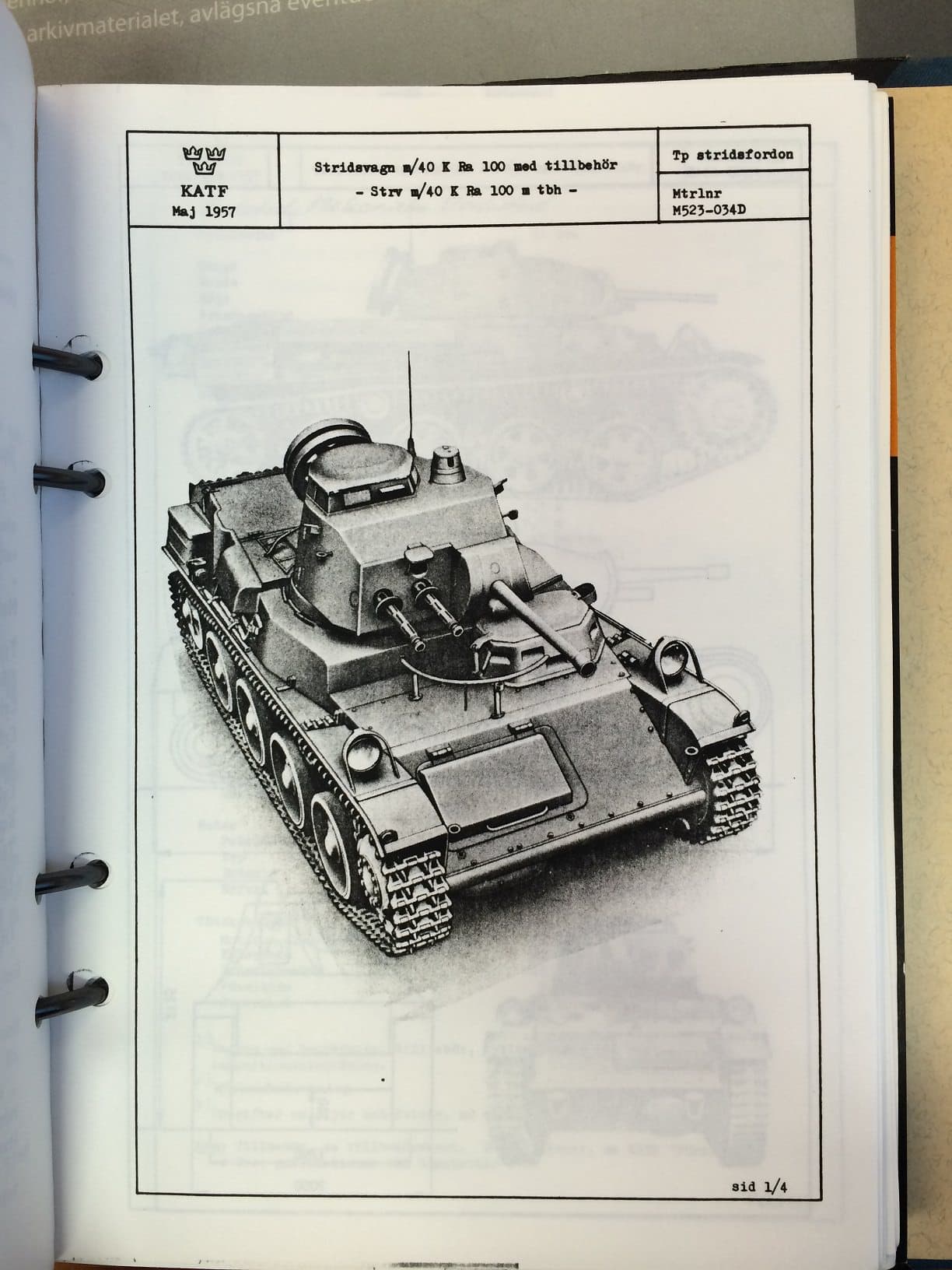
Yes that is a mortar on the engine deck. 8 cm granatkastare m/29

Introduction
The Strv m/40K was the final production development of the Swedish Landsverk L-60 family and a further improvement of the Strv m/40L . Unlike the earlier vehicle, the m/40K was produced by Karlstads Mekaniska Verkstad and incorporated its additional armour directly into the vehicle’s construction.
The m/40K also introduced a more powerful 162 hp Scania-Vabis L 603 engine , reinforced suspension and the return of the German FAK mechanical transmission . Despite these improvements, it retained the same 37 mm Bofors m/38 strv and two 8 mm ksp m/39 machine guns as the earlier m/40L.
This would make the Strv m/40K a natural addition to the Swedish ground tree as the final and most heavily protected production version of the L-60.
History
The development of the Strv m/40 began during the early years of the Second World War, when Sweden was rapidly expanding its armoured forces while foreign tank imports became increasingly difficult. AB Landsverk was responsible for much of Sweden’s tank production, but its limited production capacity meant that additional manufacturers would eventually be required.
The first version of the Strv m/40 was developed from the L-60-S III and later became known as the Strv m/40L . It improved upon the earlier Strv m/39 with increased armour and several mechanical changes. One major change was the replacement of the German FAK-55 mechanical transmission with an Atlas-Diesel Lysholm-Smith hydrodynamic transmission , as the German transmission was no longer available.
An order for 100 vehicles was placed in October 1940. Production was delayed, with the final vehicles from this order being delivered on 9 March 1942. They were initially designated simply Strv m/40 , before later being redesignated Strv m/40L , with the L referring to Landsverk.
Sweden’s 1942 defence decision created an even greater requirement for tanks. In June 1942, another 80 vehicles were ordered. However, Landsverk did not have enough production capacity to manufacture the entire order, so production was transferred to Karlstads Mekaniska Verkstad .
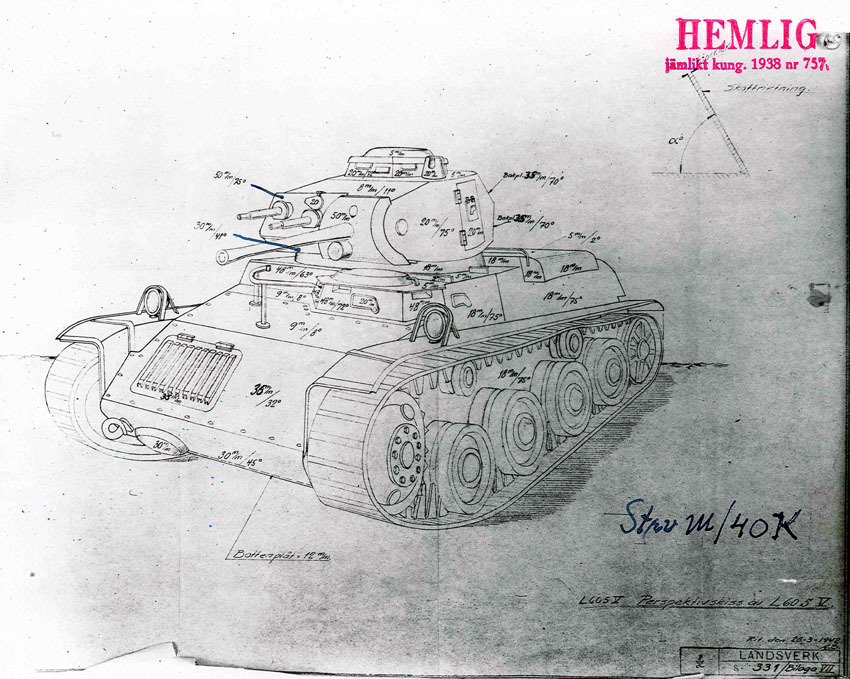
The Karlstad-built vehicle was designated L-60-S/V by Landsverk and introduced several improvements over the m/40L. Rather than using additional armour as a separate package, the increased protection was incorporated directly into the vehicle’s construction. The heavier vehicle was fitted with a more powerful 162 hp Scania-Vabis L 603 engine and reinforced suspension to compensate for the increased weight.
The German FAK mechanical transmission was also reintroduced after becoming available again in late 1942. This replaced the Atlas hydrodynamic transmission used by the m/40L.
Production was planned to begin at approximately ten vehicles per month in November 1943. Delays pushed the completion of the order back, with the final vehicles being delivered in September 1944 .
The vehicles were officially designated Strv m/40K , with the K referring to Karlstad , and received military registration numbers 415–494 . Most were assigned to P 2 in Helsingborg . The earlier Landsverk-built vehicles were subsequently redesignated Strv m/40L.
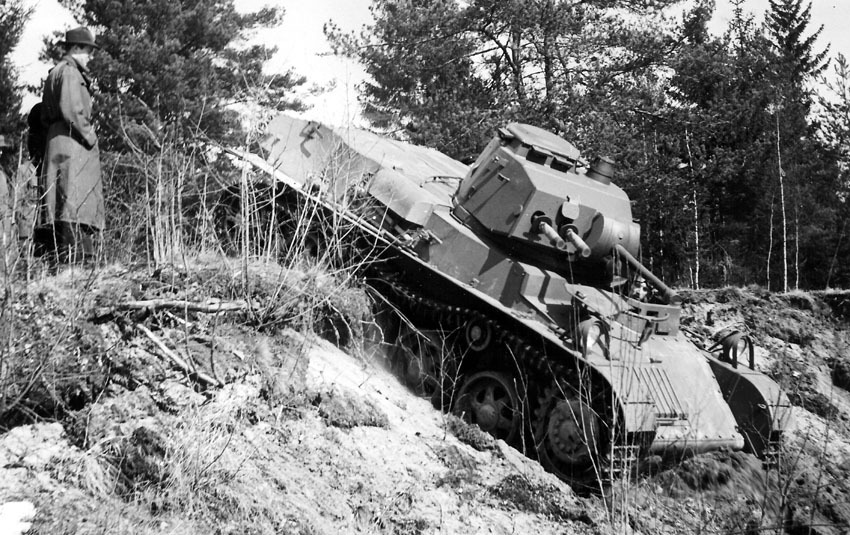
The Strv m/40K remained in Swedish service considerably longer than the m/40L and was not removed from the wartime organisation until 1960 . Several vehicles were also used for various trials, including experiments with deep-water fording and snorkels capable of reaching depths of approximately three metres.
The m/40K therefore represents the final production development of the L-60 family. While externally similar to the m/40L, it incorporated meaningful changes to its armour, engine, suspension and transmission, making it a distinct Swedish tank rather than simply another production batch of the earlier vehicle.
Specifications
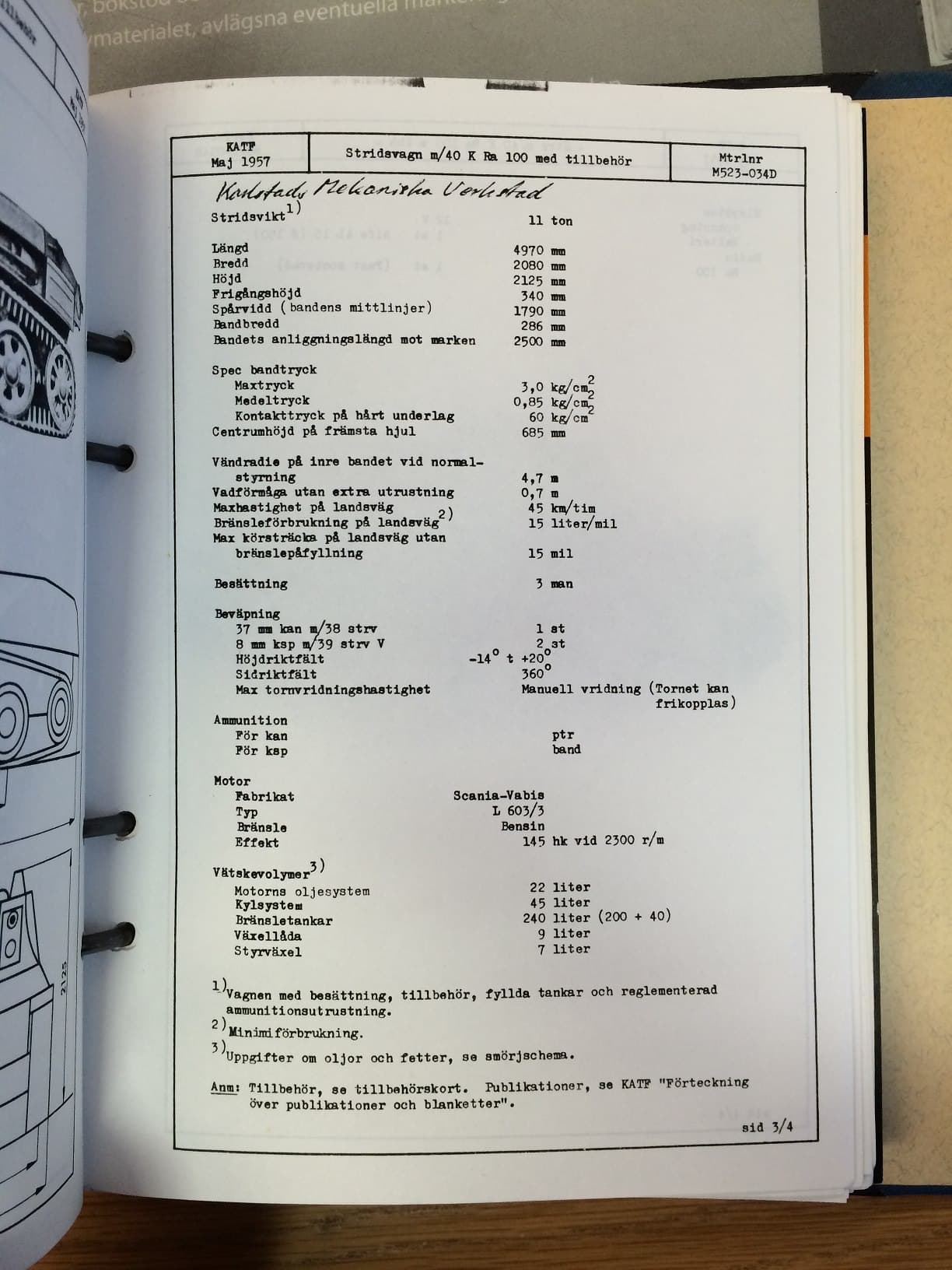
Strv m/40K
– Combat weight: 10,95 ton
– Crew: Commander/Radioman/loader, Driver, Gunner/Machinegunner
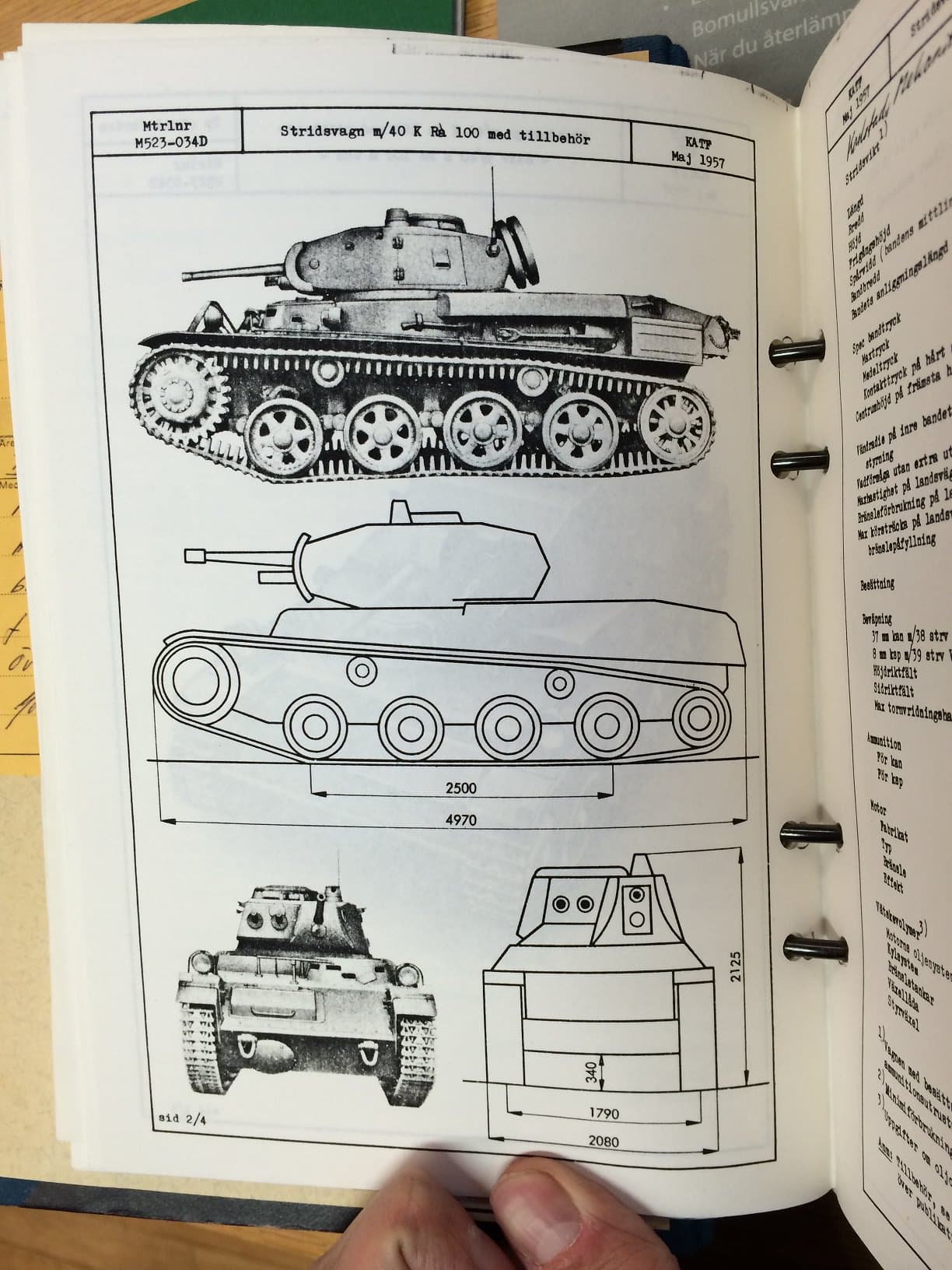
– Length: 4970 mm
– Width: 2080 mm
– Height: 2140 mm
– Top speed: 45 Kph (-5)
– Gradient: 40 dg
– Side slope: 30 dg
– Trench: 1,75 m
– Ground clerance: 340 mm
– Track width: 286 mm
– Ground contact length: 2690 mm
– Ground pressure: 0,71 kg/cm^2
– Turning radius: 6,5 m
– Vertical step: 0,7 m
– Fording: 0,7 m
– Engine: Scania-Vabis L 603/3 (Gasoline 165 hp at 2320 rpm)
– Power to weight ratio: 15 hp/tArmor (turret)
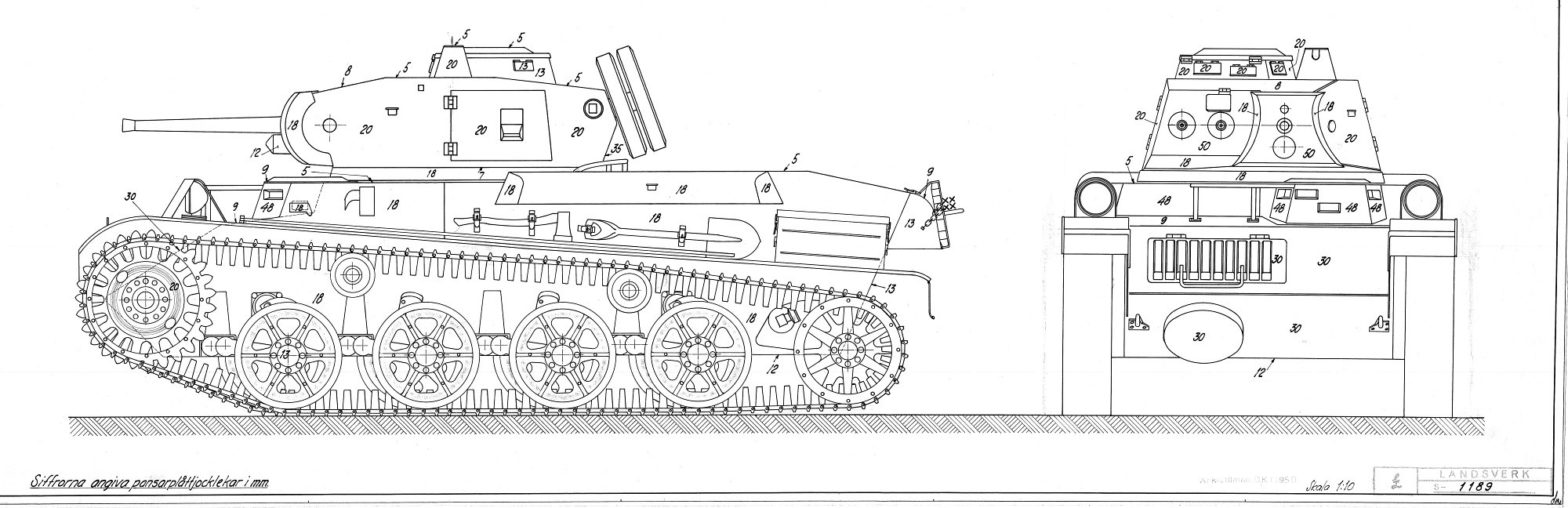
– Front: 50 mm
– Side: 20 mm
– Rear: 35 mm
– Roof: 5 mmArmor (hull)
– Front: 35 mm
– Side: 18 mm
– Rear: 13 mm
– Roof: 5-9 mm
– Floor: 12 mm
Armament
– Main armament: 37 mm kan m/38 strv
– Secondary armament: 2x 8 mm ksp m/39 strv
– Gun elevation/depression: +20/-15 dg
– Ammo: 100 rounds 37 mm, 3500 rounds 8 mm
Strv m/40K compared to the Strv m/40L
The Strv m/40K should not be considered simply an m/40L with more armour. Although the two vehicles share the same basic L-60 design and 37 mm armament, the m/40K introduced several mechanical improvements.
The m/40L used the 142 hp engine and Atlas-Diesel Lysholm-Smith hydrodynamic transmission, while the m/40K received a 162 hp engine , reinforced suspension and the FAK mechanical transmission . The m/40L’s additional armour was also applied as an armour package, whereas the m/40K incorporated its increased protection directly into the vehicle’s construction.
The m/40K was consequently heavier, at around 10.9 tonnes compared with approximately 9 tonnes for the m/40L , but the additional engine power helped compensate for this increase. Both vehicles retained a maximum speed of approximately 45 km/h and the same 37 mm Bofors main armament.
Visually, the two vehicles remain very similar, but the differences in construction, transmission, engine, suspension and armour make the m/40K a distinct production variant worthy of separate representation.
POLL
- Yes
- No
Sources:
Sources Here
Online sources:
Strv m/40
L-60 in Swedish service: Strv m/38 – m/40k – From the swedish archives
Comparative data of swedish tanks (1946)
First hand technical source material:
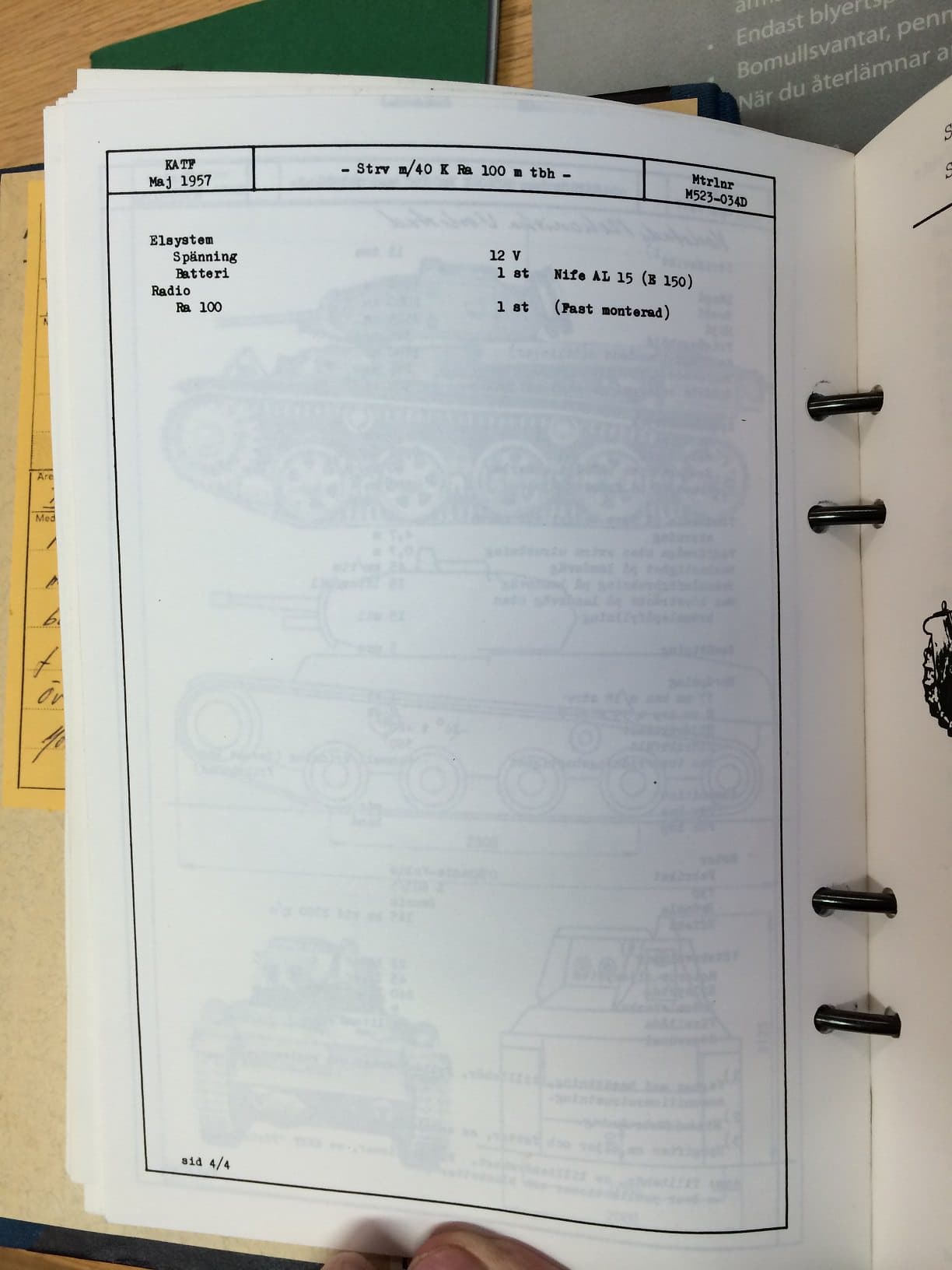
- Kungl Arméförvaltningen Tygavdelningen Fordonsbyrån (KATF) Maj 1957, Tp stridsfordon.
Stridsvagn m/40 K Ra 100 med tillbehör
Mtrlnr: M523-034D