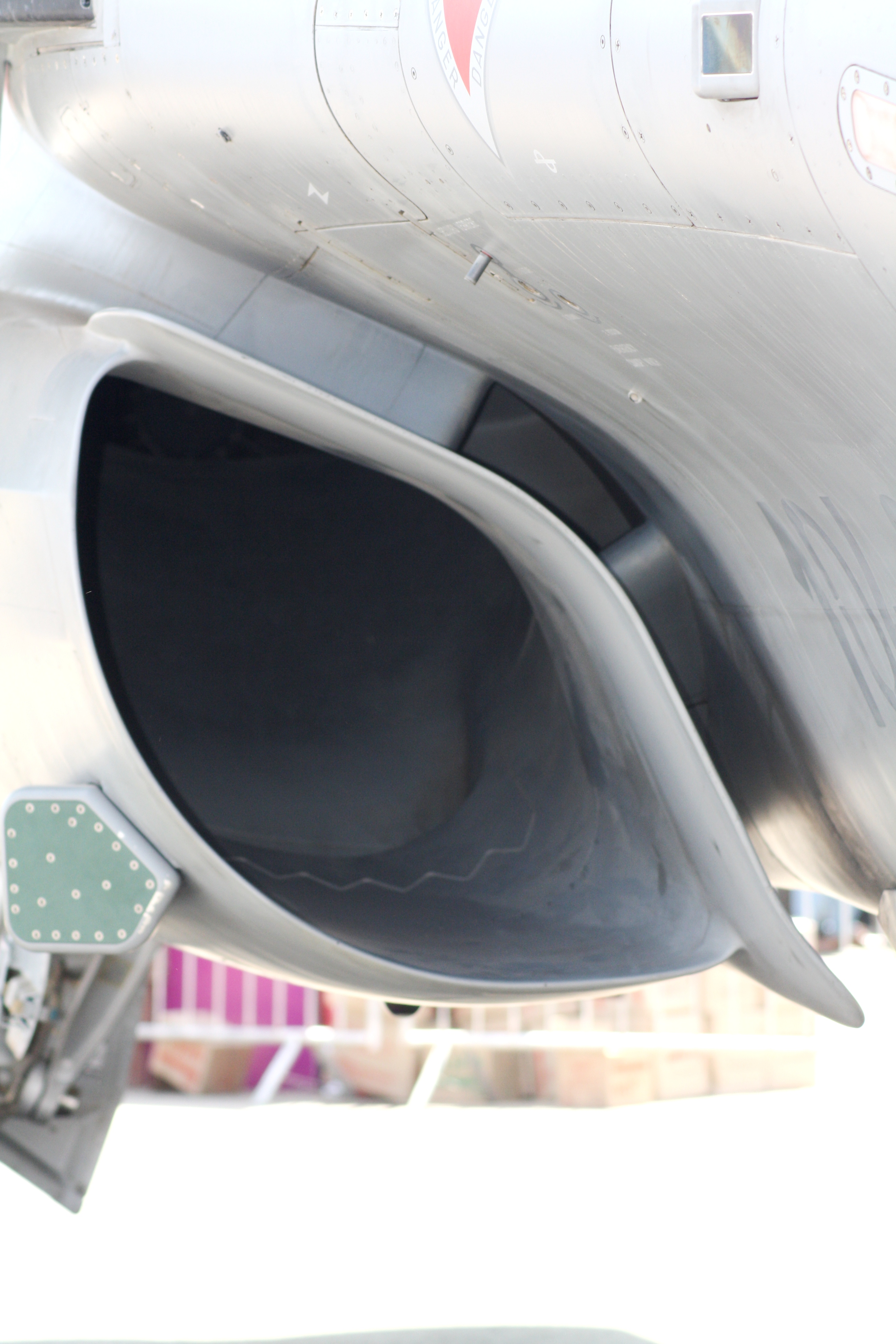
Seriously. It’s absolutely absurd that helis can ignore the entire ammunition stock of something like an SAMP/T or Sky Sabre merely by standing still causing the missiles to miss for no reason. Rotor blades are literally the worst possible things in terms of radar signature, as the blades moving forward and away from the radar create a constant radar return. There’s a reason why modern fighter jets uses stuff like S-duct intakes to hide their compressor blades:
The only thing that should prevent a radar missile from hitting an heli should be terrain and extreme maneuver. Standing still while being within the radar FoV? That should be an absolute death sentence.
This is an especially important change considering that some helicopters have DIRCM that act like force fields against IR guided missiles (which is another can of worm in terms of absurdity but that’s a topic for another thread), meaning that they can’t be used to shoot those helis down either.
Add the widespreadness of F&F missiles to these problems and you have some helicopters that are virtually untouchable and makes top tier infuriating to play.
Just completely shrug off 3 Asters without taking any evasive actions and a further 3 being slow as hell to get to a safe position.
All they did was chaff once. These aren’t early era SARH, these are modern ARH missiles. They shouldn’t be that easy to defeat, and indeed they aren’t: planes have to be proactive on top of chaffing to defeat them. A plane reacting the same way this heli player did would’ve died straight away.
The only reason the chaff was successful at defeating SIX missiles is because the radar return of helis is pretty much nonexistent.
I agree with this change, but on the flip side of this, gaijin needs to make trees block radar, or at the very least more consistenly. I have so many videos of my helicopters just getting beamed through forest by either radar spaa, or by radar guided missiles. Surroundings of Volokolamsk and Japan are the worst from my experience, the trees don’t block squat, and missiles go straight through them unimpeded.
If gaijin makes this change, but also does not change the “line of sight requirements” for the radars, a lot of especially flat maps like Poland are going to be really really rough to play. You’re only source of cover is going to be the little warehouse at the heli spawn 💀
Firstly, no, helicopter rotors are not 1:1 analogous to compressor blades. The reason compressor blades are so bad is due to the small angular difference between the blades, and the constantly changing angle between stator and rotor blades. Heli blades, being relatively thin and widely angeled apart, do not have this issue. Additionally, they’re generally made out of composite materials as opposed to metal, thus causing much lower returns.
Additionally, just becaus the rotor blades provide doppler returns at all times, does not mean a PD radar can actually track them. As the doppler shift is constantly bring modulated during the rotation of the blades, it will cause large discrepencies between coherent processing intervals of the radar, aka, it will be filtered out by ECCM.
This isnt to say tracking a stationary heli is impossible, only that it would depend greatly on both the helicopter and radar system in question. Although search radars should more generslly be able to detect them, just not track them, atleast if they were properly tuned for it.
This has been a solved problem, since the AIM-7MH.
since there are multiple rotor blades, they tend to process at similar speeds (since each blade is attached to the same rotor all should be processing at similar rates, the effective “PRF” remains fairly constant between pulses) so as any individual blade changes it’s closure rate another is there to begin sweeping that sector so will keep producing a similar return in a sense.
So the answer is basically to only track a particular swept sector of the rotor with a “Kalman filter”, and plug that synthetic return into a digital autopilot that like most digitally predicts the point of intercept for the missile and minimizes the flight vector’s error using onboard sensors.
Which should be sufficient for the TTD to function in the terminal phase of flight.
Mmm, i’m not entirely sure if that would solve it.
Its true that kalman filters could solve the issue of variance across coherent processing intervals, but theres still other issues. Mainly that such filters are generally confined to CPIs, and across processing periods would potentially run into filters such as angular velocity gates, as between periods the relative velocity of the target is moving quite substantially. The only way this would be avoided is if the PRF of the radar matches the rotor blades, which would generally be a low-PRF not ideal for high accuracy PD terminal tracking, or if angular filters were removed, which would lower the seeker’s reliability against chaff disperesed by moving targets.
Also, it should be noted, by using this approach not all guidence algorithms would work. A strict PID like we have in WT would actually be best, because it works off of angular differences to the source. But any guidence algorithm that measures angular velocity or distance as anything other then angular differences would become innacurate.
Chaff can be rejected (prevented from capturing the range / speedgate) automatically due to failing a coherence check. see Para. (16) of the provided excerpt.