SNCAC NC.1070

[Would you like to see this in-game?]
  • Yes
  • No
0 voters

Hello and welcome to this new proposal.

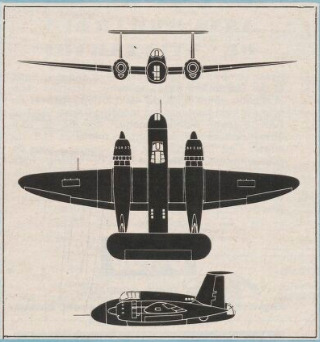
Today, I’m introducing you to a new French aircraft, a prototype intended to revolutionize French naval aviation, which unfortunately never entered service. I’m talking about the SNCAC NC.1070.

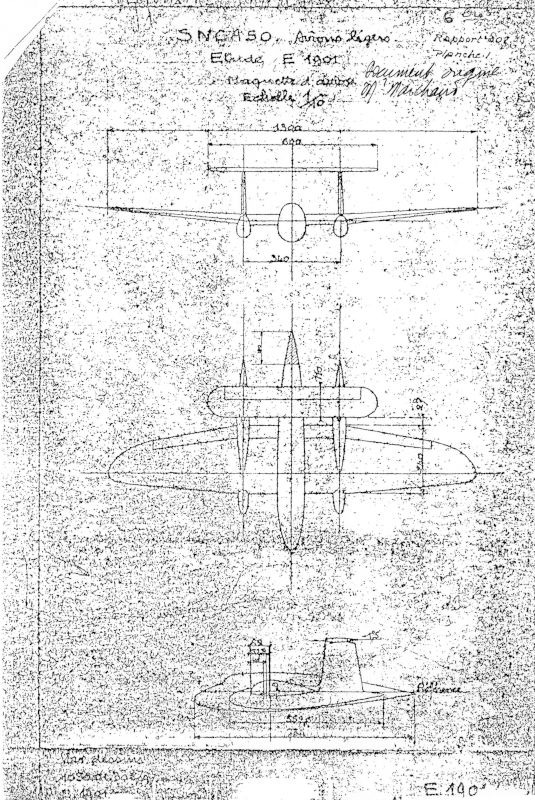
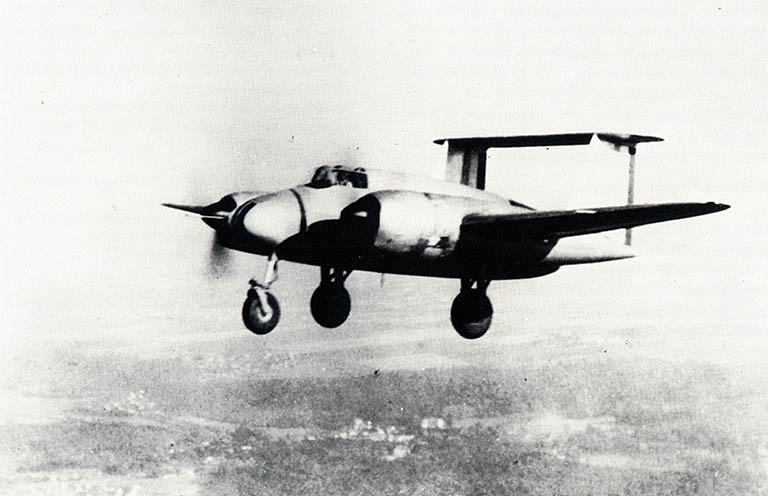
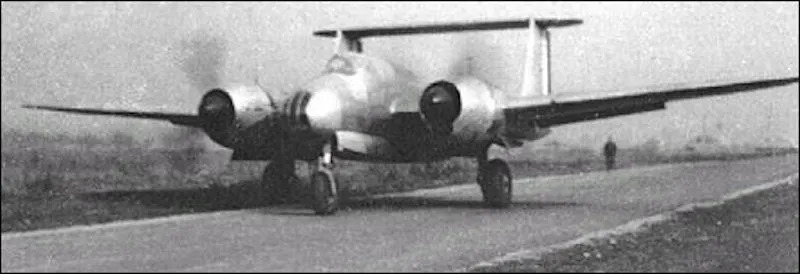
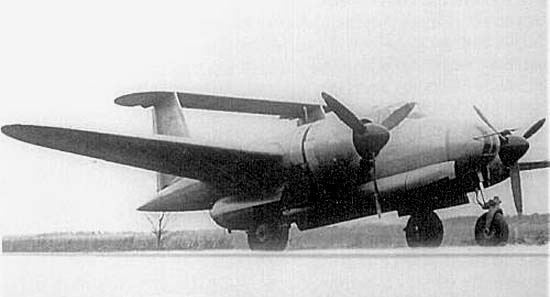
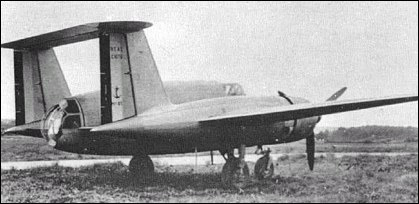
During the Second World War, the French government informed the country’s manufacturers that it wanted a French aircraft capable of operating from an aircraft carrier for bombing and torpedoing purposes. No results were provided for this request before the end of the war. However, in 1947, the SNCAC (Société Nationale des Constructions Aéronautiques du Centre) proposed an aircraft designed to meet these specifications. It was visually striking (twice as wide as it was long) but offered interesting performance and more or less met the required criteria (the aircraft was slightly too heavy to be operated from an aircraft carrier). This aircraft was the SNCAC NC.1070.

This aircraft, therefore intended for a torpedo bomber role operating from aircraft carriers, will unfortunately never see its production, in fact if it met the specifications requested 5 years earlier, this aircraft no longer corresponded to the needs or the technologies of the time (the end of the 40s saw the arrival and the putting into production of numerous prototypes of jet aircraft). In addition, a landing accident in 1948 damaged the aircraft which was never repaired, marking the end of the NC.1070. However, the work carried out on it will not have been in vain because the SNCAC will use a similar chassis for the production of its next aircraft, the NC.1071. This first prototype will still remain in the history of French aeronautics as an original aircraft but behind its time.
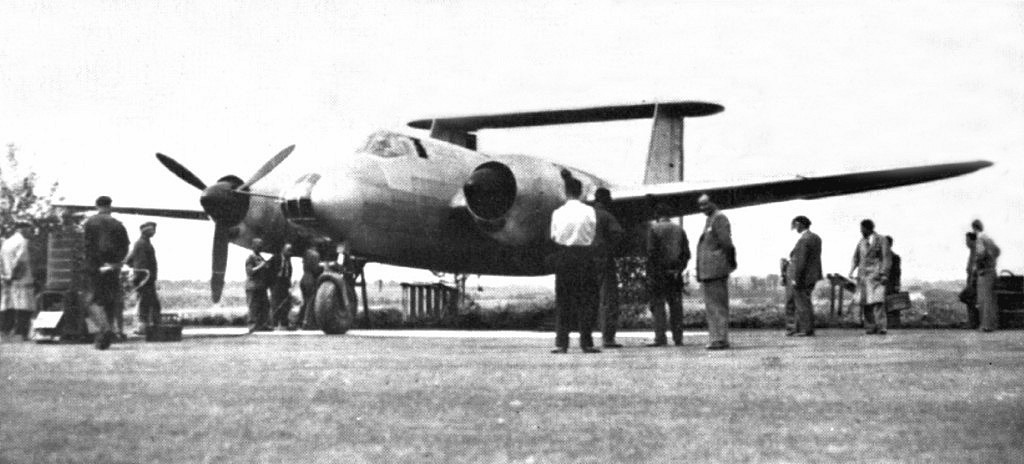
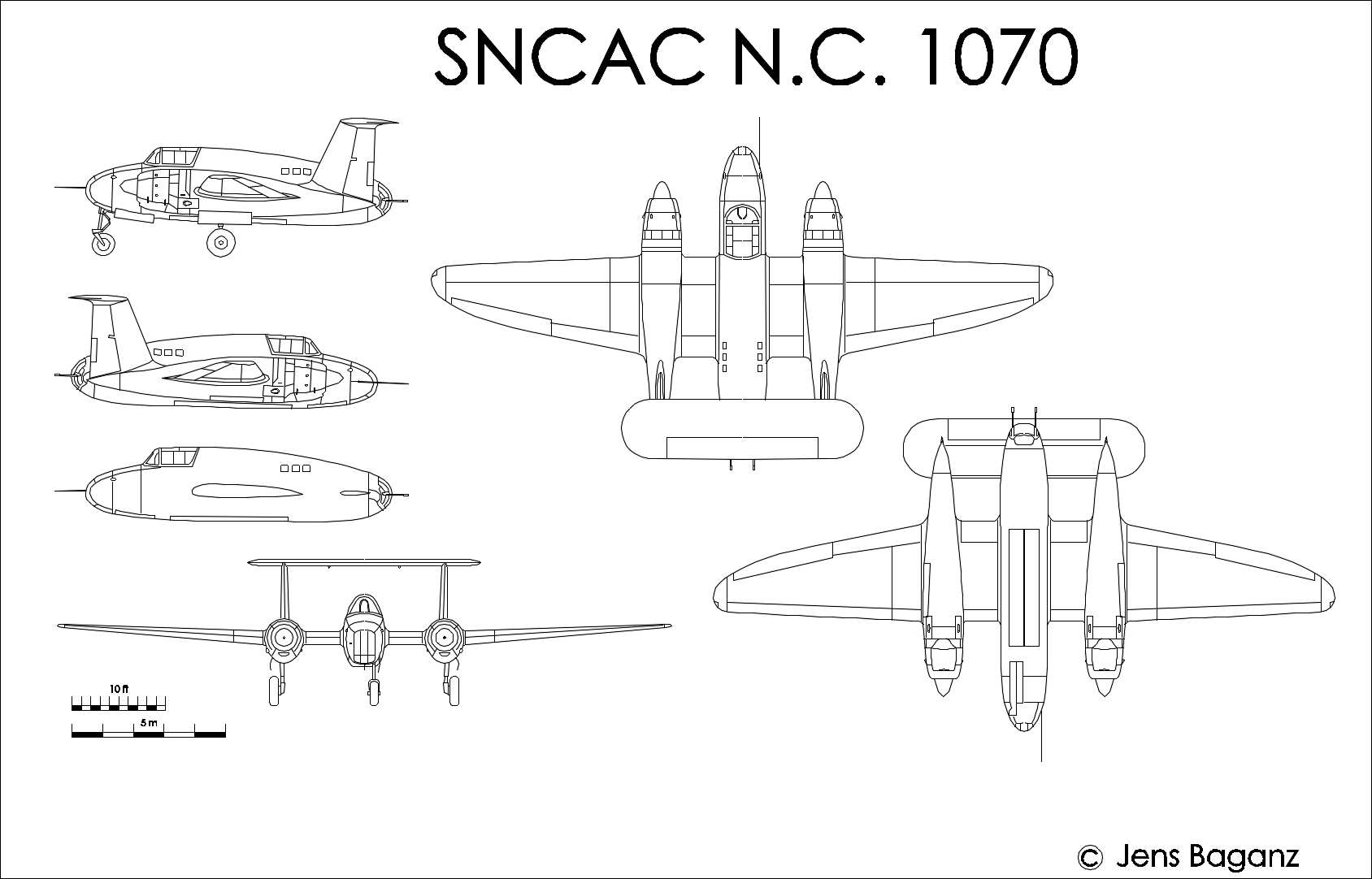
Characteristics
  • Length : 20.00 m

  • Width : 10.20 m

  • Height : 4.60 m

  • Wing Area : 50.00 m²

  • Mass :

    • Min : 7,850 kg
    • Max : 10,700 kg

This prototype is powered by two 1600 hp Gnome & Rhône 14R-24s, enabling it to reach a top speed of 578 km/h at an altitude of 6900 m. Its ceiling is 9950 m and its range is 3400 km.

The crew consists of three people: a pilot, a tail gunner, and an observer, located in the nose of the aircraft (the nose is partially glazed).
image

Weapons

The aircraft has basic armament allowing it to defend itself effectively against various threats that may threaten it but also to attack light targets. In addition, it can carry 800 kg of secondary armament in its bomb bay or under its wings.

  • Guns :

    • 2 x 30mm Hispano guns (fixed barrel facing forward)
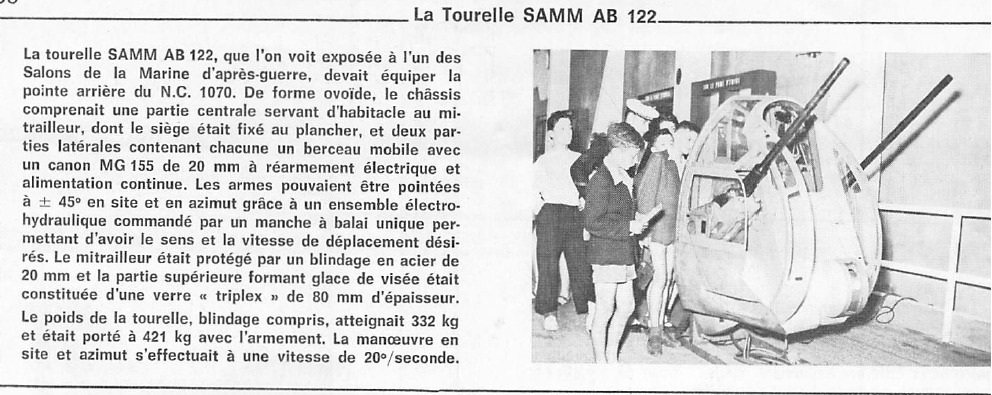
    • 2 x 20mm MG 151 guns (rear turret)
      • This turret allows aiming at 45° in all directions at a rate of 20°/s; for more information, see the armor section below.
  • Bombs :

    • Up to 800 kg of bombs (american 500lb or depth charge in the bomb bay)
  • Rockets :

    • 127mm HVAR rockets
  • Torpedo :

    • 1 x 780 kg Torpedo in the bomb bay (unknow model)

Protection :

A huge thank you to @Drasleon for the sources and information he provided me for this part.

I wasn’t aware of this initially, but this aircraft is actually a veritable bunker for its crew. I will try here to summarize the main informations concerning plane protection. There will probably be some missing information; I will try to update the topic over time with all the information possible.

  1. Pilot’s Armor:

The pilot is protected by various armor plates, including 14mm vertical plates at the front protecting him from frontal fire, as well as two 20mm steel plates located on his back and underneath.

However, these plates are not the only protection the pilot has. He is also extremely well protected by his canopy, which is made of two 40mm thick armored panes (Triplex glass).

  1. Rear Gunner’s Armor:

The armor of the AB 122 turret is equally impressive, its glass also being made of two 40mm thick armored panes (Triplex glass), thus protecting its occupant from enemy fire. The rear of the turret (protecting the gunner’s back) is armored with 20mm of steel plate.

  1. Front Observater Armor :

Unlike the rest of the crew, the forward observer is not protected by any special armor, as his role is less vital to the crew.

Protection sources
image

Pictures

image
image
image
image

In-game, this prototype aircraft would be extremely interesting for the French tree, bringing a more modern bombing/torpedo aircraft than the aircraft already present in the tree and possessing a very unique silhouette. In addition, this aircraft would completely complete the ground attack tree and would therefore be a great addition.

Sources
9 Likes

+1 Very odd tail

These are the kinds of planes I want added to the game! +1

1 Like

Hell yeah, more unique French planes at prop tiers. And this one would have amazing defensive armament so that’s a huge plus

2 Likes

+1; More weird and wonderful French props please!

1 Like

its so short and stubby i love it

1 Like

EDIT: Added information regarding the aircraft’s armor (I’ve probably forgotten some things; I’ll update the thread with sources as I go).

2 Likes

The french IL2
+1, for this plane which deserves to be better known.

Historically speaking, it is one of the first French military aircraft produced in the post-war period.

Equipped with excellent offensive and defensive armament and exceptional armor up to 80 mm thick both front and rear—rare for a French aircraft—it could truly add value to the French tech tree.

I’d like to thank Mathll for adding the information I provided, which he incorporated into the post (just as I thank him for mentioning me).

However, there’s an error regarding the rear armor: the 20mm plate doesn’t protect the pilot’s back but his abdomen (it’s the one located under the armored glass, the one made of two superimposed 40mm panes of glass).

1 Like

A good French pass plane. Of course, it can also be used as an activity or a gift package.

What about French getting something unique into their regular Tech Tree?

3 Likes

Something unique, preferably in a unique way, and of course, players who don’t get it, should also get it in some way. Instead of only appearing once and never getting it again. This is where GAIJIN needs to improve.

There are still two possibilities:
First, this aircraft was designed for naval aviation.

It had a system allowing its wings to be folded for loading and unloading onto an aircraft carrier.

Since the aircraft carrier in question was never built, the aircraft never flew with this system. However, it’s possible that it was only tested on the ground (like the turret, for that matter).

I need to find the source, but this system added 60 kg to the aircraft.

We could have a premium version presented with the wings folded in the hangar (which would be visually appealing) and slightly heavier and less maneuverable, but just as interesting.

The second possibility involves airbrakes.
The NC 1070 never had airbrakes, at least not the first prototype. However, we know that airbrakes inspired by the Ju 87 were tested on the ground on the wings of the second prototype.
17681562356826697901074197633007

This prototype, you know it by another name: it’s the NC1071, and at that time, it wasn’t yet planned to be developed into a jet.

So the following question arises: Should we give the airbrakes to the NC1071 but not the NC1070? Should we give them to both, or should we add both prototypes, the first to the regular tech tree and the second to the premium tech tree?

It’s an idea worth exploring, especially since the two ideas mentioned above could both be combined.

2 Likes

We can add to that the fact that there are NO ground attack aircraft between the SB2C in 3.7 and the AD4 in 6.0, and that both of these aircraft are American.

Then there’s the Narval, except that it’s also a premium aircraft.
At least the NC 1070 could fill this gap.

2 Likes

What br would that plane even be?

Its so sad that even though France made some very interesting prototype aircraft in the late 1940s to 1950s but all we get in the early french tree is a bunch of US and UK copy slop…

4 Likes

It’s hard to say, but in any case, Gaijin will decide.

We should expect to see a difference in Battle Rating between air battles and combined battles.

Now we have a plane faster than an IL-10 with more armor and better offensive and defensive armament. Add to that the fact that this plane served as the basis for a jet, so we can expect it to reach 800 km/h in a dive without breaking its wings.

Those are the positive points. As for the negative points, don’t expect a very maneuverable plane (for those who thought dogfighting was a good idea, it seems very impractical).

Furthermore, regarding climb rate, if we look at other aircraft with similar tail in the game (the Narval and the Swedish J-21), don’t expect anything exceptional. For external armament (bombs and torpedoes), we can expect something very limited.

The big unknown is the gun penetration of the 30 mm; since we don’t know the exact model, we don’t know it completely.

Then there’s the question of the air spawn. In theory, this aircraft is a torpedo bomber (like the SB2C and the MB175T) and it could benefit from a bomber spawn.

Honestly, that would be a very bad idea: I don’t know about you, but the last thing I want to see while farming my PB4Y is a mobile bunker charging at me with 30mm cannons. Again, I remind you that this aircraft is more heavily armored than an AMX-13.

That leaves the attacker spawn, and I see it being closer to 5.3-5.7. But again, that remains to be seen and it is discussed

2 Likes

That’s genuinely hilarious

Originally, GAIJIN had to make things for 8 countries, but now it only needs to make 3-4 countries by copying and pasting. If you look at the United States, the Soviet Union/Russia updates a new vehicle every time, and then copies the existing vehicle to other countries.In this way, the worklIn this way, the workload is reduced by half! Isn’t it?oad is reduced by half! No