SIBMAS C25: Belgian wheeled IFV

Would you like to see this in-game?
  • Yes, don’t care how
  • Yes, as a researchable vehicle
  • Yes, as a premium/squadron/event vehicle
  • No
0 voters
Where would you like to see the vehicle?
  • Belgian or BeNeLux tree
  • French tree
  • Other
  • I said no
0 voters

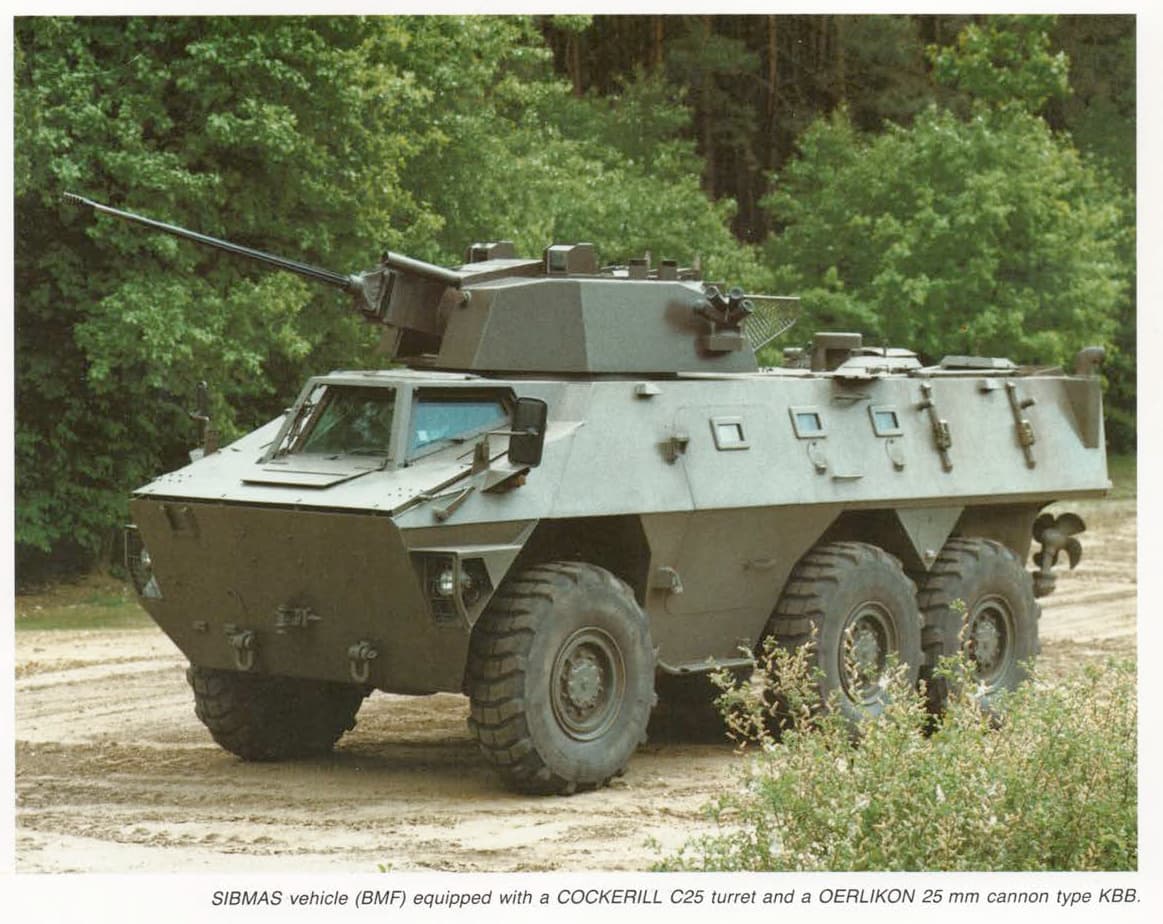
Welcome to another suggestion, this time we’ll be looking at a variant of the Belgian SIBMAS vehicle, this version is fitted with Cockerill’s C25 turret.
https://img-forum-wt-com.cdn.gaijin.net/original/3X/4/e/4e1377a02139780151943b80e6b18ba5b405cf71.jpeg

The SIBMAS first saw the light in 1975 as a private venture by B N Constructions Ferroviaires et Métalliques. As you might notice, the type resembles the South African Ratel APC, which is no coincidence. Both vehicles seem to be designed from a common ancestor. However, despite the resemblance, SIBMAS is very much a different vehicle with some nice extras. The first prototype was finished in 1976, this was tested extensively by the Belgian and Malaysian armed forces. A second improved prototype was finished in 1979, this featured improved driver visibility and a better engine. After a large order from Malaysia, the producer continued to market the vehicle with a wide variety of turrets (yes there will be a lot of suggestions). One of these was the SIBMAS fitted with a Cockerill C25 turret which had an Oerlikon KBB 25mm cannon as the main armament, the same turret as can be found on the Cobra AFV 25. The type did not achieve export success and as such remained in the prototype stage.
Now let’s take about the details of the vehicle. As mentioned before it had a main armament of one Oerlikon-Contraves 25mm KBB cannon. This cannon is capable of firing up to 600rpm and can fire a wide variety of ammo types, these include Armor Piercing, Discarding Sabot-Tracer, Armor Piercing-Tracer, High Explosive Incendiary, and Target Practice-Tracer types. The cannon was mounted in a Cockerill C25 turret which also had a secondary 7.62mm machine gun along with an OIP/SCS-5 x 8 periscope each for the commander and gunner, a x8 night sight for the gunner and a x6 night sight for the commander. The cannon was able to be elevated to 60 degrees allowing this vehicle to double up in the air defense role as well. A stabilizer is optional in this turret, but it is currently unclear to me if the prototype had this fitted. The ~15-16 ton vehicle is powered by a MAN Diesel D 2566 MK six-cylinder water-cooled diesel engine which produces 320 hp. This gives the SIBMAS a respectable power-to-weight ratio of around 20hp/t and gives it a top speed of 100km/h. Unlike the Ratel, the SIBMAS is also amphibious. The Malaysian vehicles were all fitted with propellers which gave them a top speed of 11km/h in water. As you see (and know from the Ratel) the vehicle is unfortunately quite bulky. Measuring 7.32m long, 2.5m wide, and around 3m high.

image (5)

General characteristics:

  • Mass: 15-16 ton
  • Length: 7.32 m
  • Width: 2.5 m
  • Height: +/- 3m
  • Crew: 3 (commander/loader, driver, gunner)
  • Engine: MAN Diesel D 2566 MK six-cylinder water-cooled diesel producing 320 hp at 1,900 rpm
  • Power/weight: 20 hp/ton
  • Operational range: 1,000 km
  • Maximum speed: 100 km/h

Armament:

  • 1x 25mm Oerlikon-Contraves KBB cannon.
  • 1x coaxial 7.62mm machine gun.

Systems:

  • NVD
  • (optional) stabilizer
  • Thermal sight

In-game:

The SIBMAS C25 would probably be quite comparable in role to the Type 87 RCV, albeit a bit bulkier. It would be a rather fast vehicle capable of flanking enemy troops and scouting them, or it can engage lightly armored targets if the opportunity allows it. This similarity in playstyle is only reinforced by the two vehicles sharing (almost) the same gun (Type 87 uses an a slightly inferior version, the KBA). The SIBMAS is also amphibious which will allow it to reach some unexpected positions on the map. All-in-all this should be a fun and engaging vehicle that can be enjoyed by players of whatever nation it ends up coming to.

Sources

Janes_Armour_and_Artillery_1979-80_Sibma

Army Guide

Cold War Belgian Prototypes Archives - Tank Encyclopedia

https://manualzz.com/doc/30923397/kba-kbb-25-mm-cannon---forecast-international

Army Guide

https://www.armyrecognition.com/belgique_armee_belge_vehicules_blindes_roues_fr/sibmas_wheeled_armoured_vehicle_personnel_carrier_belgian_army_belgium_technical_data_sheet_descript.html

2 Likes

What a boat of a vehicle. +1

2 Likes

Why does the third picture say thermal sight?

1 Like

I’m guessing the extra box added to the gun might be one. I don’t think it’s present on the other images

1 Like

could be added as a mod perhaps?

1 Like

I’ll add it in the systems section of the suggestion already

1 Like

Hello @panzerknoef

I found a really useful information about C25 with Oerlikon KBB 25mm on the

Spoiler

Full text of "Jane's Armoured Fighting Vehicle Retrofit Systems 1993 94"

And here is the text about C25, its sights and FCS
The turret with two sights was fitted and tested with the stabilizer.

1

Cockerill C25 25 mm Turret and Cockerill CB30 30 mm Turret

Development

The C25 is a joint development between Cockerill, responsible for the turret
and systems integration, and Oerlikon-Contraves. responsible for the 25 mm
KBB cannon. For trials purposes the turret has already been installed on the
SIBMAS (6 x 6). M113A1-B. Puma. Valkyr and Warrior armoured vehicles.

The C25 turret is under evaluation by the Norwegian and Swiss armies.
The fully stabilised turret is equipped with the Officine Galileo fire-control
system and a thermal sight. The turret is installed on the Krauss-Maffei
Puma chassis for the trials

For the same projects and based on the design of the C25 turret
configuration, Cockerill is designing a 30 mm turret with the same overall
design features. The main armament is the Mauser 30 mm Model F
cannon; as an alternative it can be fitted with the 30 mm MDH Bushmaster
II Chain gun. The turret is scheduled to undergo customer evaluation in
1993 and has been named the CB30

The turret weapon system has been designed to achieve high hit
probabilities whilst firing on the move against moving ground targets, as
well as in the anti-aircraft mode of fire.

Description

The turret is of all-welded steel armour construction and can be delivered
with ballistic protection against penetration by armour-piercing projectiles,
as required by the customer. The additional armour protection is provided
by add-on composite panels fastened to the turret. These are lightweight
and can be replaced in the field if damaged by impact.

The commander is seated on the left side with the gunner on the right;
each is provided with a single-piece hatch cover that opens to the rear. The
gunner has three observation periscopes to his right, while the commander
has seven periscopes. In addition, both turret members have a day or day/
night sight for aiming the weapons which also incorporates an observation
channel.

Main armament comprises an Oerlikon-Contraves 25 mm KBB cannon
with a 7.62 mm machine gun mounted coaxially to the left. Mounted either
side of the turret towards the rear is a bank of four electrically operated
smoke dischargers. The empty 25 mm cartridge cases are ejected from the
turret on the forward right side.

Turret drive is electromechanical and controlled by commander or gunner
with the former having override. Turret traverse is 360 c and weapon
elevation is from -10° to +60°. The high angle of elevation enables it to be
used to engage low flying aircraft and helicopters.

2

Cockerill C25 turret, Officine Galileo Janus anti-aircraft sight, thermal sight.

Oerlikon-Contraves 25 mm KBB cannon and 7.62 mm coaxial MG

In a joint development programme with Officine Galileo of Italy. CMI has
installed a Janus anti-aircraft sighting system on the C25 turret. Firing trials
of this modified turret on a Belgian Air Force practice range against towed
airborne targets gave outstanding first round hit probabilities.

The turret is fully stabilised by means of turret and vehicle-mounted
gyros. The various turret functions at the turret crew’s disposal are controlled
from a box containing solid state components only, mounted on plug-in
printed circuit boards. This arrangement gives a high degree of reliability,
rapid fault-finding by the use of a separate test unit and instantaneous
repairs through circuit board substitution.

Toxic gases produced by the 25 mm cannon and 7.62 mm coaxial machine
gun are removed by two ventilated exhaust fans. A 500 000 candlepower
white light searchlight is mounted coaxially with the main armament.

As an alternative this turret may be fitted with an Oerlikon-Contraves
25 mm KBA cannon, 25 mm Mauser Model E cannon or a McDonnell
Douglas Helicopter M242 25 mm Chain Gun. A single TOW launcher can
be fitted to the right side of the turret and associated with an electronic
control system and thermal imaging day/night sight with built-in tracker.
Various sighting and fire control systems are available for the Cockerill C25
turret depending on the user requirements.

3

Specifications

SPECIFICATIONS

CREW 2

COMBAT WEIGHT 3000kg

ARMAMENT

main 1 x 25 mm KBB cannon

coaxial 1 x 7.62 mm MG

smoke dischargers 2x4

AMMUNITION

main
100 APDS-T

  • 150 HEI (2 boxes)
    ready rounds

coaxial 250 ready
(+ 500 stowed in
turret)

smoke grenades 8 ready
(+ 8 stowed in turret)

TURRET DRIVE
electromechanical

TRAVERSE
360 r

ELEVATION
-10° to +60°

ELEVATION/TRAVERSE
RATES
0.5 mils/s to 457s max

GYROS
2 axes

VISION
2 sights
1 0 periscopes

AIRTIGHTNESS
NBC system
compatible

4

Galileo JANUS Fire-Control System Sight Assembly and Control Panel

The system comprises the following components:

1 ) stabilised periscopic optical aiming sight assembly with fixed eyepiece,
graticule illumination and dimming, control panel and dual axis servoed
scanning mirror

  1. 16-bit ballistic microcomputer with five main software sub-programs
    for kinematic, extrapolation, ballistic, lead angle and crossing range
    estimation tasks. The computer:

a) calculates the future target position by processing the estimated
target data, its tracking speeds and the stored ballistic information of the
ammunition type selected

b) then calculates the relevant lead angles for that position and. using
the independent line-of-sight mode, transfers the information to the gun
control system

c) controls the sights’ independent scanning prism servos

d) provides all the interfaces to the turret

e) operates a control test facility

f) generates all the voltages required by the system to operate

  1. commander s control panel, which is used to control the computer
    and manually input the target information on type, speed and range

  2. passive second or third generation night vision image intensifier unit
    which is inserted into the eyepiece of the aiming sight when required for
    night time engagements

  3. gun elevation and traverse transducers which are used to sense the
    angular position of the gun and turret for the fire-control computer’s
    calculations

  4. interconnecting cable set.

The system’s operating principles are indicated in the block diagram
showing the inter-relationship between the independent sight’s LOS and
the gun’s Line-Of-Fire (LOF).

In this way it is possible to continue viewing the target through the sight
itself whilst the gun is actually orientated towards the calculated future
target position.

The system’s two firing modes are directed against the target types
expected to be encountered. These are:

a) the ground target engagement where the target has to be visually
observed in the sight in order to produce an angular tracking speed and the
fire-control parameters, entered manually into the computer. The relevant
algorithm then calculates the gun lead angles

b) the anti-aircraft engagement where the lead angles are calculated
from the target speed only and manually introduced into the system. The
target crossing range is automatically calculated by the fire control computer
by processing the target speed and the relevant aiming angular velocity.

2 Likes