i gone back to see that old post, hilarious try
Yep, China breached the contract first, but they couldn’t help it — it was part of the PLAAF’s own development path. All they can do is just not export the Chinese Flankers.
If it helps to the research I think it was posted by Smin
1 Like
no no XD
i meant that i seen that post once again, it was gaijin’s try that was hilarious, wasn’t going back at you
2 Likes
just because the racks are real doesn’t mean they can or are mounted on the Su-27SM and the Su-30SM
Su30SM2’s duel pylon may also be unrealistic. Its fire control system can identify the duel rack but su35 has a reworked back frame, Its shape(especially between the engine) are different from su-30. The problem lies physically, not on the software.
2 Likes
how the tail itself looks dosent change how the pylons behave
the engine still have the same distance from each other
the Su-27 and Su-33 have different tails and can still carry the same armament on the centerline for example
1 Like
yep, wasn’t minimally changed between airframes so if they aren’t compatible it isn’t for the engine distance
Not about the tail, Sorry the pics I found maybe a little misleading. The source of Su35 and Su30’s rear fuselage are completely different in both internal and its contour. So the info is not enough to prove that.
Also, no duel pylons are photographed on Su30SM2.
For example, If SM2 don’t have duel rack in Warthunder and you want to create an issue about that, U need to provide sources otherwise your issue will be taged “not enough info”.
1 Like
True, in my comment i indeed putted a maybe on the SM2 as you indeed said the FCS can recognize it, i’ll be honest and tell you that i see where your argument is going but sadly we still don’t know and my knowledge stops quite hardly on airframes a tiny bit after dissolution, so i really cannot help you more then this…
Honestly tho i’d be surprised seen how modern the upgrade for SM2 is, if we get hard evidence it cannot use dual racks
1 Like
Heres my full radar bug report, denied within minutes for “3rd party websites arent reliable sources”, but its the most in-depth and official one i could find, have a read:
Category: Aircraft / China / J-16 / Radar equipment
Previous report:
https://community.gaijin.net/issues/p/warthunder/i/DUO1Hltxf8vq
The J-16 is currently modelled with a radar designated “KLJ-16” and limits of 140° × 140° .
I request a review of this configuration because additional Chinese sources provide a documented connection between the J-16 and three-array wide-angle radar capability , while I have been unable to find comparable public documentation for a J-16 radar actually designated “KLJ-16.”
I am not claiming that the exact exhibition KLJ-7A is conclusively proven to be the J-16 radar , nor am I requesting that its >300° figure simply be copied into the game.
The issue is which configuration currently has the stronger evidentiary basis.
1. J-16 specifically linked to three-array wide-angle radar
Source: Reference News / 参考消息, 6 November 2018
https://mil.sina.cn/zgjq/2018-11-06/detail-ihnknmqx7115958.d.html
The article discusses the KLJ-7A three-array wide-angle AESA and attributes an important statement to Zhu Xinguo / 朱新国 , identified as the radar development project’s responsible person.
It reports that airborne radars possessing three-array wide-angle radar capability had already been installed on the J-20 and J-16 .
The relevant Chinese wording is:
具有“三面阵”广角雷达功能的机载雷达已经装备歼-20和歼-16等新型国产主力战机
This does not explicitly prove that the J-16 carries the exact export/display KLJ-7A unit. However, it directly links the J-16 to the same three-array wide-angle radar concept being discussed . citeturn744127search5
Provenance of the statement
Zhu Xinguo is independently identified by Economic Information Daily, a Xinhua publication , as:
中国电科14所一部副主任 — deputy director of a department at CETC 14th Institute .
Source:
https://www.jjckb.cn/2019-05/27/c_138092328.htm
This matters because the J-16 claim is therefore attributed not to an anonymous website author, but to a named senior figure from one of China’s principal radar-development institutes. citeturn513500search4
2. CETC itself confirms KLJ-7A as a three-array wide-angle AESA
CETC 2018 Corporate Social Responsibility Report
Primary source — China Electronics Technology Group Corporation
Source PDF:
https://28.cetc.com.cn/zgdk/resource/cms/article/1592494/1611038/2020120710370957207.pdf
Printed page 17 describes:
KLJ-7A“三面阵”广角机载有源相控阵雷达
— KLJ-7A three-array wide-angle airborne AESA radar .
This is CETC’s own corporate publication describing its own radar technology. citeturn744127search65
CETC 2021 publication
CETC later again described the KLJ-7A fighter fire-control radar as using a:
“unique three-array design”
which greatly expands the fighter’s detection field of view and provides a “look backward” capability.
Source:
https://www.cetc.com.cn/zgdk/1592571/1592576/2021djjsjldblh/xczj97/1659821/index.html
This independently confirms that the three-array architecture is a defining feature of the publicly documented KLJ-7A. citeturn513500search0
3. Chinese government defence-industry source
Organisation: State Administration of Science, Technology and Industry for National Defence / 国家国防科技工业局 — SASTIND
Source:
https://www.sastind.gov.cn/n152/n6759918/n6759920/c6803854/content.html
SASTIND describes the system as:
KLJ-7A“三面阵”广角机载有源相控阵雷达
and specifically describes it as a radar capable of “looking backward.”
This is an official Chinese government defence-industry publication, not a forum or private military database. citeturn744127search2
4. Official PLA publication
Publication: China Military Online / 中国军网
Source organisation: 解放军报记者部 — PLA Daily reporting department
Date: 7 November 2018
Source:
https://www.81.cn/2018zt/2018-11/07/content_9337965.htm
The article documents and photographs the KLJ-7A three-array airborne AESA fire-control radar .
It states that its field of view can exceed 300° and explains that the three-array configuration enables stable tracking and missile guidance during large-angle manoeuvres.
I am not proposing 300° as the J-16’s proven in-game value . This source is included because an official PLA publication independently confirms the architecture and purpose of the same technology referenced in the J-16-specific statement. citeturn744127search1
5. Xinhua confirms KLJ-7A’s developer
Publication: Xinhua News Agency, 4 November 2016
Source:
https://www.xinhuanet.com/mil/2016-11/04/c_129350879.htm
Xinhua identifies CETC 14th Institute as the developer exhibiting KLJ-7A and directly quotes institute technical expert Wang Hongzhe.
It also identifies CETC 14 as the developer of airborne radars for aircraft including the J-10, J-11B and J-15 .
This establishes the KLJ-7A as a documented CETC 14 radar programme rather than an internet-derived designation. citeturn744127search0
Why this matters for the current “KLJ-16”
The available public evidence currently produces this chain:
CETC 14 → documented KLJ-7A → three-array wide-angle AESA
Named CETC 14 project representative → three-array wide-angle radar capability → J-16 and J-20
By comparison, I have been unable to locate equivalent public documentation establishing:
J-16 → “KLJ-16” → 140° × 140° total coverage
This does not prove that “KLJ-16” is incorrect . Gaijin may have another source.
However, based on the publicly available evidence, the possibility that the J-16 uses KLJ-7A or, more conservatively, a related CETC three-array wide-angle radar architecture appears better supported than an otherwise undocumented radar designation and fixed 140° configuration.
The Zhu Xinguo statement is particularly important: it directly associates the J-16 itself with three-array wide-angle radar capability.
Therefore, if “KLJ-16” and 140° × 140° are estimates or placeholder parameters rather than documented specifications, the three-array configuration deserves reconsideration.
Requested outcome
Please verify:
- What source identifies the J-16 radar as “KLJ-16”?
- What source establishes 140° × 140° as its complete radar limits?
- Does 140° represent only electronic scanning/search limits, or the complete antenna/tracking field of regard?
- Is the in-game radar assumed to use a single fixed array?
- How is the statement attributed to CETC 14 deputy director Zhu Xinguo , explicitly linking three-array wide-angle radar capability to the J-16, assessed?
I am not requesting an unsupported numerical replacement .
I am requesting that the developers compare the evidence supporting the current configuration with the documented Chinese evidence for a three-array wide-angle architecture.
Source reliability
The previous report was closed with:
“Всевозможные сторонние сайты не являются достоверными источниками.”
The sources above should not all be treated simply as “third-party websites.” Their original provenance includes:
- CETC itself ;
- CETC 14th Institute technical personnel ;
- SASTIND , China’s national defence-industry authority;
- China Military Online / PLA Daily ;
- Xinhua News Agency ;
- and a published statement attributed to a named CETC 14 senior technical figure .
War Thunder’s own Technical Knowledge Base states that historical reports require either one primary historical source or two secondary sources and explicitly includes websites and expert publicationsamong secondary-source examples. citeturn964745view0
War Thunder source guidance:
https://wiki.warthunder.com/195-navigation-technical-knowledge-base
If any source above is considered unacceptable, please identify the specific source and reason rather than rejecting them collectively based on the websites through which they are accessible.
The central question remains:
What evidence supports the current “KLJ-16” / 140° × 140° configuration, and does it provide stronger evidence than the statement from a named CETC 14 radar-project representative that three-array wide-angle radar capability had already been fitted to the J-16?
5 Likes
bla-bla-bla
A bunch of useless text about a fictitious 300-degree radar
6 Likes
the fact that the J-16 still has a normal radome
if it had side looking arrays you would see windows for those
1 Like
The radar is more real than the one currently on the J-16, KLJ-16 isnt even a real designation nor is it mentioned anywhere
1 Like
No, dude
The radar can have any name, but 95% of AESAs are very similar in performance
If the J-16 had anything resembling a 300-degree radar, we would have seen it in its design
1 Like

This radar also has a tilt angle
1 Like
dosent matter because the J-16 dosent use this radar
or any radar with side looking arrays
this is the KLJ-7A proposed to Jeff block 3 right?
a fun fact
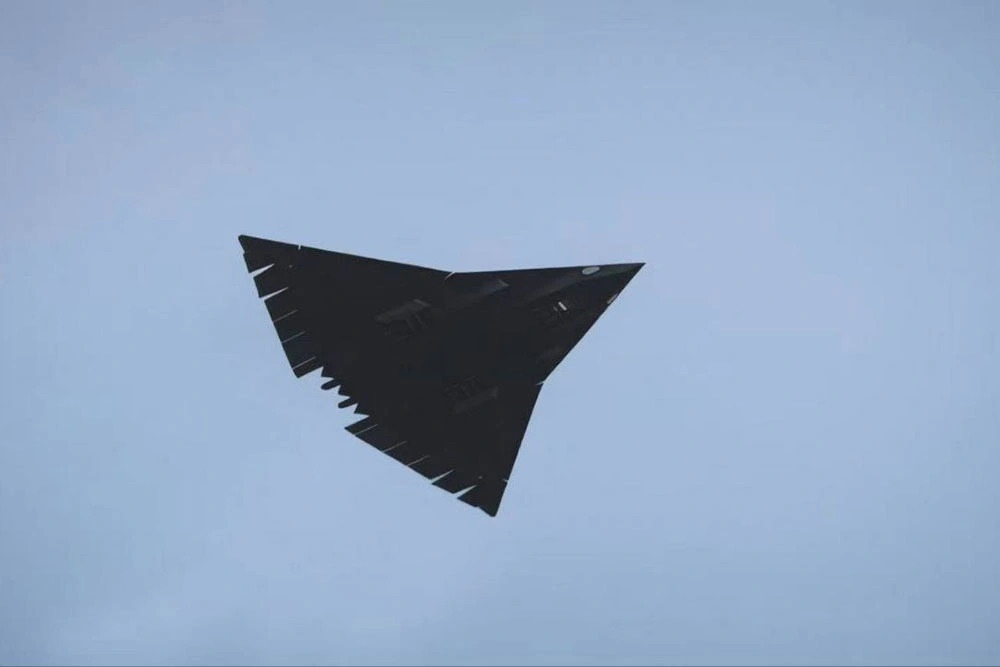
The J-36 appears to be equipped with this type of radar.
2 Likes