Russian tech in the 80s was ahead of US tech at the time, China didn’t even have a domestic fighter. Existing Chinese airframes are modernized, Russia is not behind in the material sciences as far as I can tell… but they do not have the $$$ to mass produce anything hyper modern yet. Neither does China, that’s why they’re flashing around their prototypes for 6th gen.
Regardless, no improvements in material sciences suddenly make the J-11’s lighter with the composites and radar absorbent materials. They have already shown that moving towards these composites made the J-10C heavier than the J-10A. This conversation has been had many times already. The WS-10’s are generally heavier than the Russian counterparts currently and the use of composites is not nearly as widespread as claimed. The vast majority (98-99%) of the frame is still original with minor modifications. Major sections are not being replaced with lighter composites.
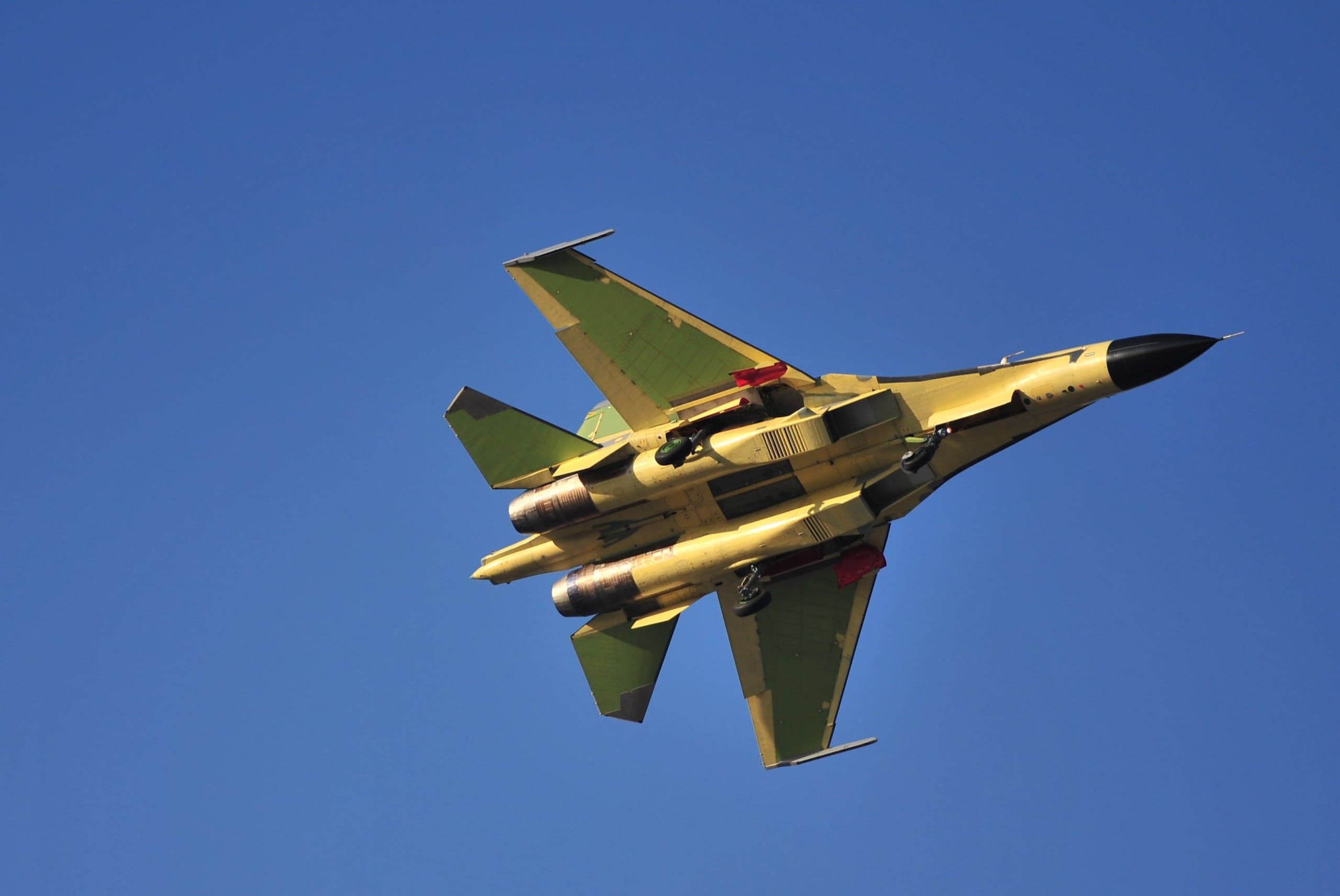
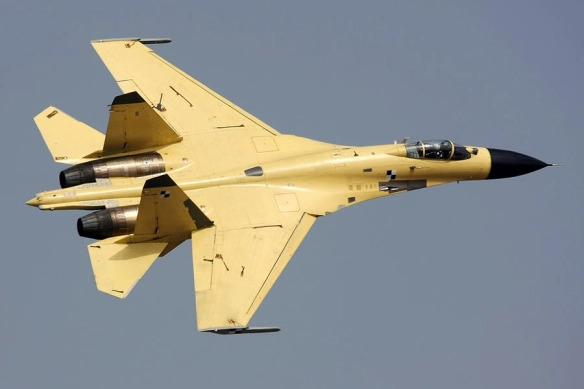
These are composite panels, look at the pictures with exposed airframe
These panels are also likely heavier, incorporating more radar absorbent materials and cheaper / stronger ones as well.
I already told you the source of the argument is literal photos of the airframes in question. BBCRF is a mechanic, he works on Sukhois all day long and then comes home to run fluid dynamics simulations for the Su-33 DCS mod.
It was not me who claimed the J-11 weighs XYZ, it was someone else. I only cast my doubts. If you disagree, that is okay. Neither side has verifiable primary source data to make a claim. It is my opinion that it is not lighter than the Russian counterparts, and I’ve presented my case as to why.
I feel like the weight of modern electronics compared to 80’s equivalents is not a factor being discussed too much… No more vaccum tubes! Digitization is quite the weight saver.
BBCRF is a mechanic, he works on Sukhois all day long and then comes home to run fluid dynamics simulations for the Su-33 DCS mod
So he’s just a general mechanic operating on Russian aircraft… Unless he’s using primary sources for the J-11s (which there is none), his word is as reliable as a toddler - last time I checked the J-11 (or the later variants at least) are entirely domestic, me when source.
Technically yes, since the J-11 was a Su-27 kit. He may very well have worked on identical airframes. Owing to that knowledge, he has pointed out that they have made virtually no changes to the underlying structure and core of the airframe.
I believe the word of someone who helps build the aircraft over a keyboard warrior discounting his knowledge. He has pointed out (and provided photos of) the J-11 and Su-27’s frames being near identical with only minor modifications (that usually add weight) to fix Chinese replacements for some of the no longer produced parts of older Flankers.
Similarly, Iran had to develop their own parts for the F-14’s for example. Many of the hydraulics needed domestic replacements.
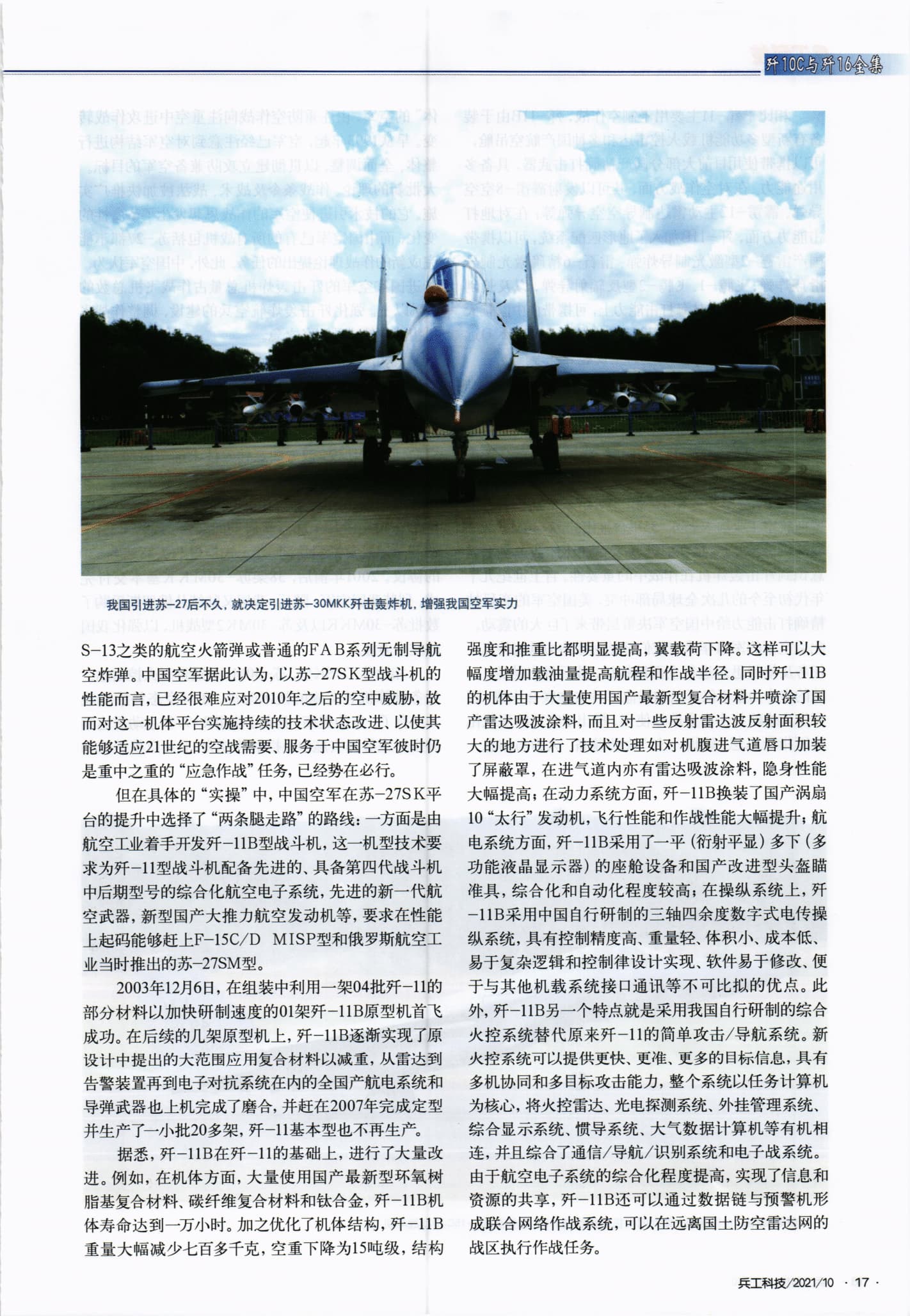
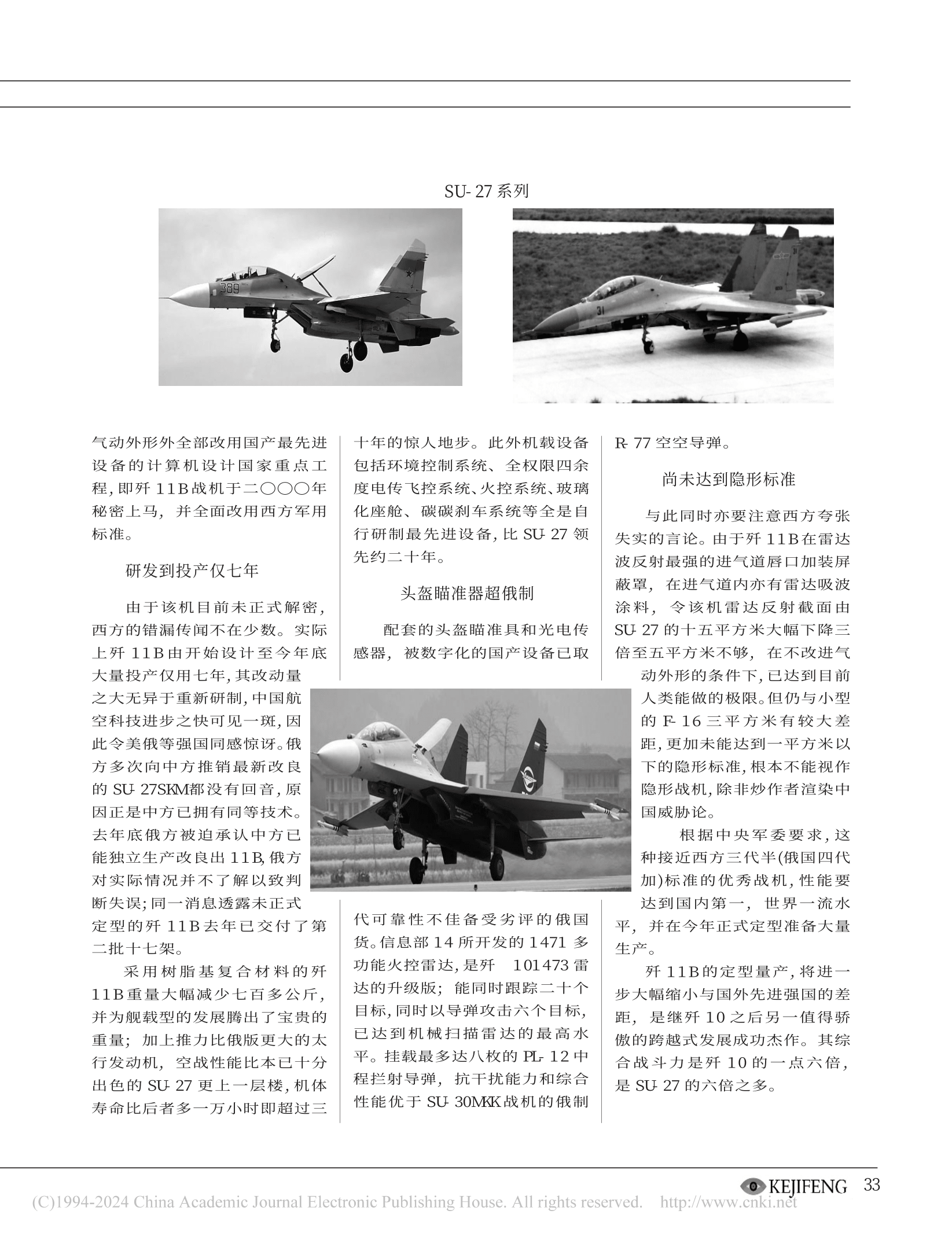
At least we have published secondary sources saying it’s 700kg reduction over the baseline J-11, over MIG_23M’s words from another guy who allegedly worked on the Russian airframes.
They claim the empty weight is 15 tons, or am I misreading this?
Sure, let us reduce the empty weight of the J-11B to 15 tons per this highly reputable source… let us ignore the fact that photos kind of debunk some of these claims…
It makes no sense that it would be claimed as 15 ton class if it barely falls under 16 tons completely empty airframe. That is highly dubious. It states clearly that there were attempts to lower RCS with radar absorbent materials and additive paint. These drastically increase the weight of an airframe as seen on J-10C and other aircraft.
It looks to me that they claim improvement in all areas and there is no reasonable evidence to support the information. There are no pictures, no real source.
Meanwhile you don’t have anything other than “words from a guy who worked on Sukhois” and “look at the pictures”. Show me a textbook page where they state radar absorbent materials are heavier.
You also talk like materials are the only factor involving weight while completely ignored J-11B had the whole radar and avionics package swapped*.
the weight increase on J-10C is mainly because the addition of electronic devices including EW devices. some sources suggest that J-10C is the PLA’s best nonspecialized EW 4th gen plane.
You mean… like… any actual scientific paper on radar absorbent materials available online? They are always heavier than the lighter composites that could be used instead due to the need to use, well, radar absorbent materials instead of the optimal ones for weight and strength.
There is no evidence to support that the modern Russian avionics aren’t equally lighter in weight and yet their weight still went up… Unless China has magic materials that somehow cost less and weigh less than the Russian ones while simultaneously offering the same level of radar absorbing capacity…
I don’t think that is true because the weight of the J-10B and other airframes without this was also equally heavier.
Speaking of, do we even have a Weight for j10b? We know weight of j10ce from Pakistani brochure and there is conflicting information on j10a empty weight (different sources give around a 500 kg range), but I don’t think there’s any info on j10b weight. To me it seems j10b and c weight should essentially be the same due to them being essentially the same air frame