
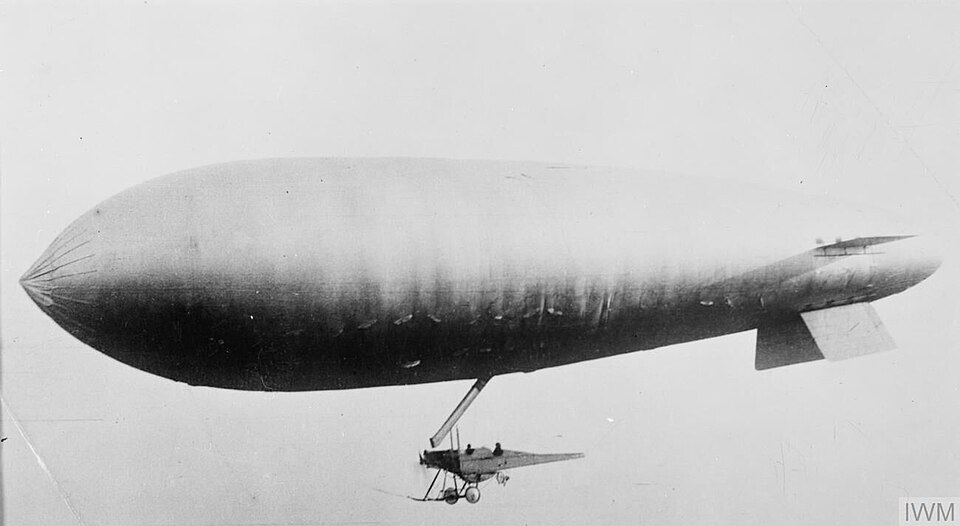
One of many Sea Scouts
- Yes
- No
History: As WW1 progressed for a few months, the Royal Navy came to realise the threats posed by German submarines as they claimed several vessels in the span of a few months. Things would escalate on February 4th when the German Admiralty would declare that all enemy merchant vessels within the waters surrounding Great Britain and Ireland would be destroyed from the 18th of February onwards.
Fortunately, the British did have an answer to this, airships. Thanks to thier ability to observe a fleet from a height, they would be able to spot the periscope of a submarine and alert the fleet. The main issue was at the time, the UK’s airship fleet was tiny with only 7 total airships (1 willows training airship, 2 continental and the remaining four belonging to the Royal Naval Air Service). On the 28th of February Edward Masterman, Admiral Fisher and representatives from Vickers and Airships limited to create a fleet of scouts.
The prototype would be made at Hoo peninsula, putting together the envelope of a willows training airship (HMA No.2) with a B.E.2c fuselage. After evaluation trials (and Fisher’s comment of “Now I must have forty”), the first of the Sea scout (or
Submarine scouts) had entered service on the 18th of March 1915.
Over the remainder of the war, the Sea scouts of all variants (later Sea Scouts included the SS Maurice Farman and SS Armstrong Whitworth which had different cars and in some cases engine) flew around 10,000 sorties and 1.5 million miles between the 60 scouts assembled. The scouts are also credited with of sighting 49 U-boats, leading to 27 being attacked via landline/air. There was only one instance of a ship being escorted by Sea scout being sunk.
The Sea Scout B.E.2c would go on to achieve a record for British Airships by climbing to 3,100m altitude in the Summer of 1916.
With the class design being successful, it was developed into newer versions including the SSP, SST, SSE and SSZ. They also saw service with the USA, Italy and France.
The scouts would end up being decommissioned after WW1. These venerable patrol airships would be used to design new classes such as the Coastal, C* and North Sea classes.
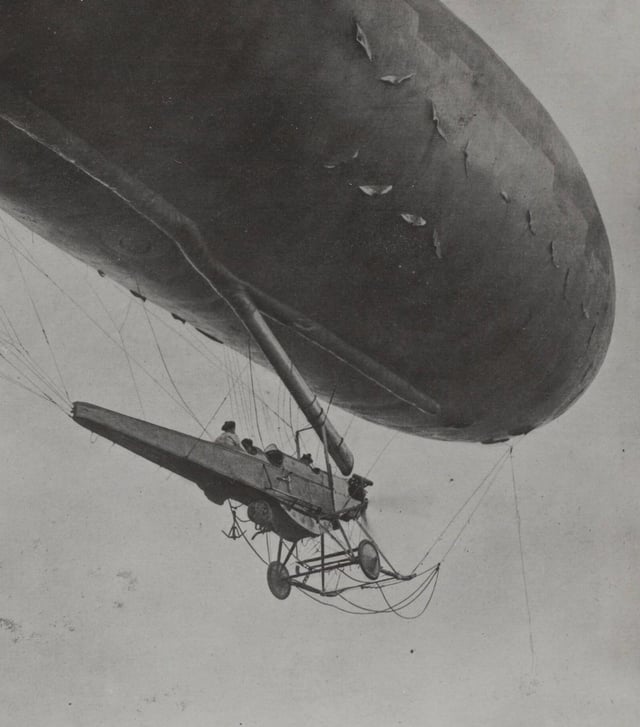
Specifications:
Armament: 1x 7.7mm machine gun and 73Kg of bombs
Crew: 2
Max speed: 80km/h
Engine: Renault (75hp)
Car length: 7.3m
Overall length: 43.71m
Height: 13.23m
Width:8.5m
Sources:
https://www.usbornefamilytree.com/neville1883.htm
Whale, George (2008). British Airships: Past Present and Future.