- Yes
- No
Hello everyone, and welcome to this new suggestion.
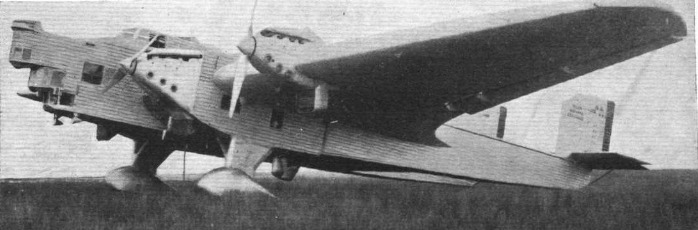
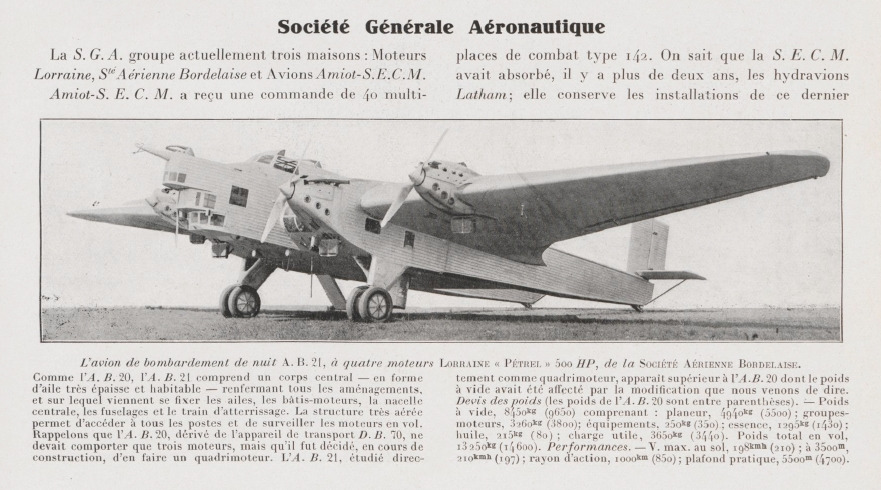
Today, I am presenting the second aircraft produced by SAB (Société d’Aviation Bordelaise): the SAB A.B.21.
In the early 1930s, military aviation was undergoing a period of rapid transformation. As the concept of strategic bombing gained importance, air forces around the world were looking for aircraft capable of carrying increasingly heavy bomb loads over long distances. France was no exception, and manufacturers were encouraged to explore new concepts that could provide the Armée de l’Air with a modern long-range bomber.
Among the companies taking part was the Société d’Aviation Bordelaise (SAB), founded using the facilities and expertise inherited from the former Dyle et Bacalan company. SAB had already experimented with an unusual “lifting-body” concept through the DB-30, which subsequently served as the basis for the A.B.20.
Following the A.B.20, SAB decided to develop an improved aircraft designated A.B.21. The new design retained the unusual general configuration of its predecessor but was extensively revised. The aircraft was made lighter, while more efficient engines were installed to improve both its performance and its range. These changes were intended to make the aircraft considerably more attractive to the French military.
The A.B.21 made its maiden flight in the early 1930s and initially appeared to offer several interesting characteristics. Its armament was particularly impressive for an aircraft of its time, while its increased range gave it the ability to operate over considerable distances.
Unfortunately, the aircraft’s biggest weakness was also its most important one: speed. Despite the improvements made over the A.B.20, the A.B.21 remained extremely slow compared with the fighters that were beginning to enter service. Its poor aerodynamic performance meant that, in the event of an interception, the bomber would have had virtually no chance of escaping an enemy fighter.
The rapid evolution of military aviation throughout the 1930s only made this problem more apparent. New generations of fighters were becoming faster and more heavily armed, while the A.B.21 remained tied to an outdated design philosophy. As a result, the French military showed little interest in adopting the aircraft, and no production order was placed.
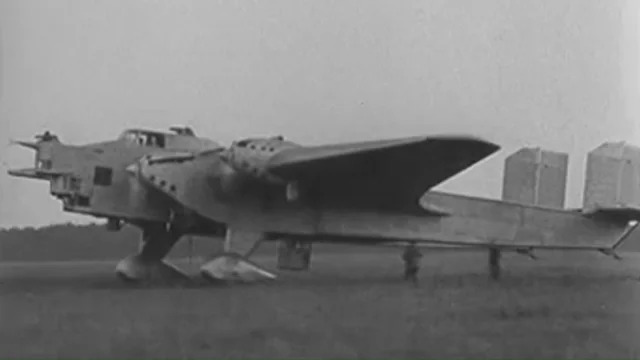
Characteristics
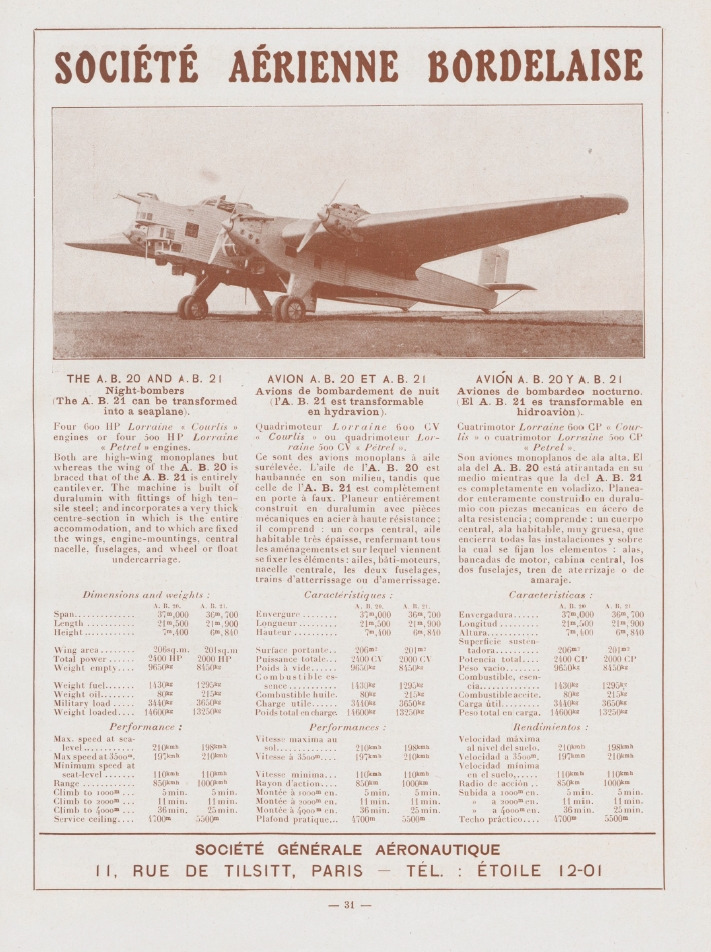
Length : 21.90 m
Width : 36.70 m
Height : 6.84 m
Mass :
- Empty : 8,450 kg
- Full : 13,250 kg
The aircraft is powered by four 500 hp Lorraine engines. This substantial power allows it to take off within 250 meters, though its aerodynamics limit its top speed to 210 km/h and its ceiling to 5,500 meters (an altitude that takes nearly an hour to reach). It has a range of 1000 km at a cruising speed of 180 km/h.
Its crew consists of a pilot, a co-pilot, an observer/bombardier, a flight engineer, and three gunners.
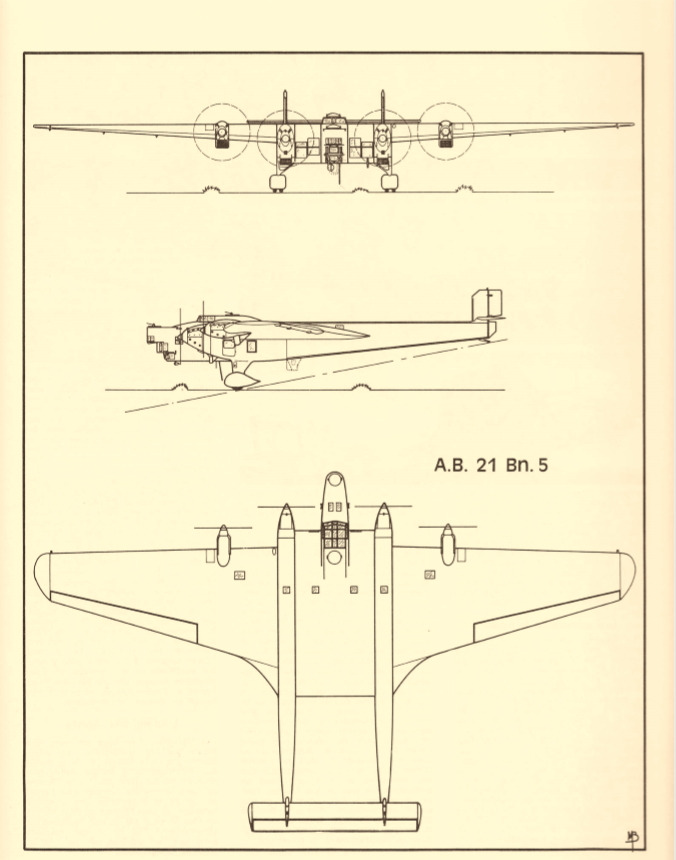
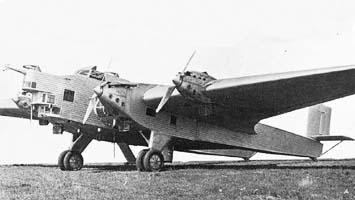
Weapons
The aircraft’s armament is exactly the same as the A.B.20. It boasts solid defensive weaponry paired with an excellent bomb-carrying capacity:
Defensive armament:
- 2 x 7.7mm Vickers machine guns (dorsal T.O.7 turret)
- 2 x 7.7mm Vickers machine guns (nose T.O.7 turret)
- 2 x 7.7mm Vickers machine guns (ventral T.O.7 turret)
Offensive armament:
- 2,500 kg of bombs (using 100 kg, 200 kg, or 500 kg bombs)
Pictures