This guided missile… I don’t know,
apparently it was an unfinished semi-finished product at the time of the end of its development…
I tested it in a flight test on the F8 and of course it was a clear debacle…
It might have some success against ground-based targets, but even then the Germans understood that it was for a crew of at least two - the pilot and his WSO and the project was directed at testing the Ju-88 aircraft…
Even earlier, but the USAF destroyed the missile engine factory and that was the end of it…
I wonder what the launch procedure was like…
Somewhere there was a report that after the launch it did fall for a while, but the gyroscope was supposedly set to “push” the missile upwards…
Even so, for it to make sense, the attacking aircraft had to be below the target aircraft, at an angle of about 30-45 degrees upwards…?
Or above the target aircraft, at the same downward angle?
Surely the attack aircraft could not have been flying at the same altitude as the target aircraft…
Mhm, I have no idea…
the accoustic system is not guidance,… it’s the fuze (basically using soundwaves to trigger the explosion)
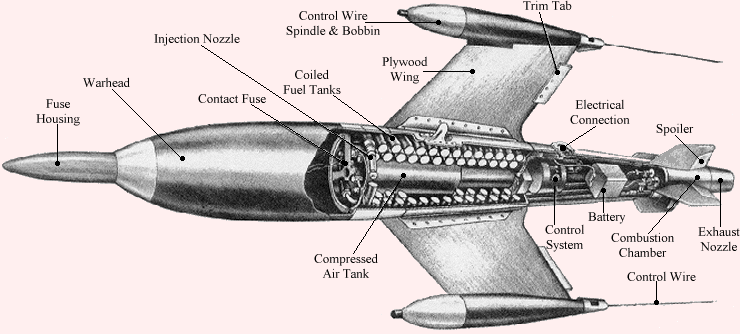
“Due to the complexity and cost of other options, the X-4 rocket received a wired FuG 510 / 238 remote control system. At the ends of the two wings there were end fairings, inside of which there were reels with wires. After the launch of the rocket, the wires were unwound and ensured the transmission of the signal from the control panel to the rocket equipment. For control of roll and pitch used steering wheels located on the tail stabilizer. The pilot of the carrier, using his control panel, had to direct the rocket using the three-point method. The task of the pilot was to remove the rocket to the minimum distance from the target. After the distance was reduced to a minimum, the automatic rocket independently produced undermining the warhead.”
where is the component able to track?
Meise (or Kranich accoustic fuze) were hard to deliver in your source (and that’s the tip of the missile)
Dogge seems to be an electro-optical system (non IR) - which are not present within the 3D model in game or the scheme i presented to you.
now let’s imagine that it was there, on tip of the fuze,…
the seekers of that time would have been clearly sensible to sunlight in most situations,…
the systems described in your source, works on the lack of sunlight percieved in it’s sensor, this would mean, it’s unoperationnal within :
- clouds/fog days, and other kind of low light amount exposure
- night time
now, the fact that it works on the created “shadow” of it’s target, also means that any shot not going in sun direction would be useless, which means:
180° angle where it’s unable to operate whatever the meteo conditions,… as it would track it’s own shadow (at best), or can’t find any “shadow” from it’s target
at about 30° when facing sun directly (as the sun would clearly blind the seeker)
that’s lefts you with 2 potential area that are quite thin and limited.
and finally, for it to works fine and guide on target correctly, this would mean that the FOV of such seeker would be extremly low, as deviation/derivation systems for Air-Air missiles were not yet invented.
so if you want to get that installed and thinks that it will work on most situation,… then you’re both wrong (because Dogge seems to not be installed on current model) and dellusionnal (because you seem to thinks it will make the X-4 use much more easier).
now,… MCLOS is not the best guidance system,… but X-4 is made to destroy bombers which are not really maneuvrable,… so you’ll figure out a way to use it, with trainning:
back in the days, i remember shooting a T-2(k) with an AGM-12B “Bullpup” at 9km (after the missile camera was disabled from it)
Holy paragragh guy…
my bruthaa
you misunderstood the whole thing so harddd
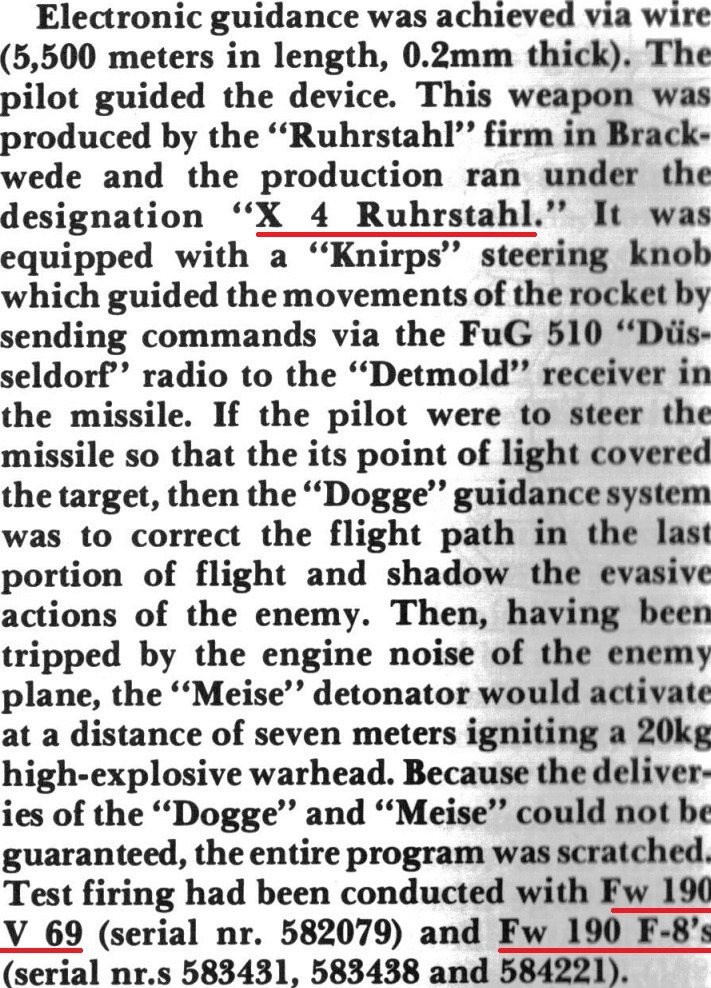
- the Meise and Dogge are part of the systems of the missile
- Meise is the acoustic fuse that triggers the explosives in the missile
- Dogge is the late stage guidance system
- Dogge works on acoustic emittance amplitude comparisons.
Acoustic fuse AND acoustic homing
not light or shadow or wtv
for you, what means :
“if the pilot were to steer the missile so that the it’s point of light covered the target , then the ‘Dogge’ guidance system was to correct the flight path in the last portion of flight”
i read your goddam text,… and this means that there is an EO involved to trigger Dogge
but most of all:
https://airandspace.si.edu/collection-objects/missile-air-air-ruhrstahl-x-4/nasm_A19510067000?utm_source=chatgpt.com
"Construction
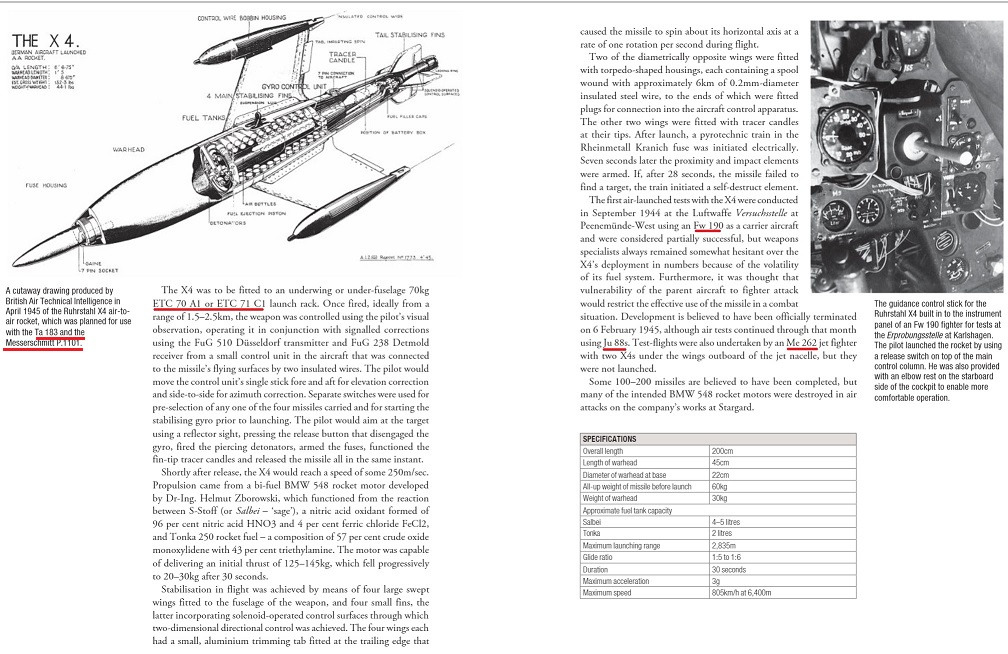
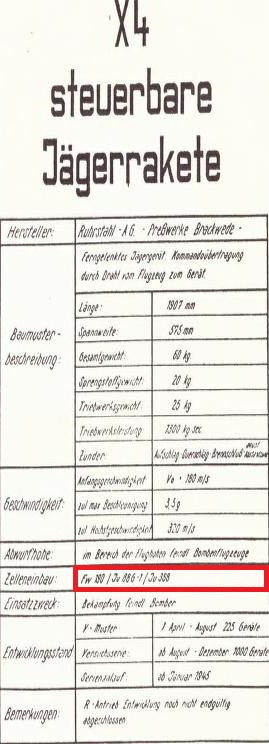
The X-4 has a small, ogival body made of aluminum, with four wooden mid-body wings and four metal tail fins set at 45 degrees to the wings. Trim tabs on the wings rolled the missile slowly at about 1-1.5 revolutions per second (rps) for stabilization. Control was effected by the four spoilers on the tail fins, commanded by the pilot of the launch aircraft, who used a joystick to keep the missile heading directly for the target. Launch would take place on a level altitude with the target and preferably astern. The spoilers vibrated at a velocity of 5-20 rps (the secondary sources used in this essay vary), and commands altered the rate of movement of each of the two pairs of spoilers. A single gyro and a commutator sent the commands to the right pair of spoilers on the spinning missile to pitch it up or down, or yaw it right or left, according to the pilot input. The gyro was spun up before launch by electric power from the aircraft, but was not powered in flight. The wire bobbins for the command wires were contained within two ogival fairings on two of the four wings; the pilot’s commands were sent by a Duesseldorf (FuG 510) transmitter and received by Detmold (FuG 238) receiver in the missile. There was 5500-6000 meters of wire, i.e., the maximum controlled range would have been 6 km (3.7 miles).
Two unique spiral tanks contained the Salbei, which was nitric acid with additives, and Tonka 250, a mixture usually of 57% m-xylidine and 43% triethylamine. The outer tank contained the Salbei, the inner one the Tonka 250. The propellants were expelled with pistons that travelled down the spiral tubes pushed by compressed air from bottles that were opened when small charges broke membranes. The propellants were hypergolic, that is, they ignited on contact in the combustion chamber.
The nose has a 270 mm acoustic proximity fuze extension connected to a 450 mm steel or plastic-case warhead, which was to contain 20 kg (44 lb.) of high explosive. The “Kranich” or “Meise” acoustic proximity fuzes, for the detection of the engine and propeller noise of Anglo-American four-engine bombers, were to be fitted to operational missiles. There was also to be an impact, a graze, and a self-destruct fuze; the latter would operate after 35 seconds. The warhead would have been very effective at ranges of 6-7 m (c. 20 ft), but not very effective at 15 m (50 ft.). Some experimental work was done on an acoustic homing system to improve effectiveness. "
which means that Dogge was only an experimental system that was worked on for further variant, that never seen light,…
Dogge system isn’t an X-4 part - as the scheme demonstrate no Dogge system, or homing device (on the previous missile scheme).
theres a thing called flares… which the X-4 had behind it to allow the pilot to track and steer it. like on the roland missiles for example
the sources disagree with you
i got news for ya, the entire X-4 was experimental
so yes, i want the entirity of the X-4 modelled
WITH the Dogge that was planned for it and even produced in very small numbers
do you see any “homing housing/system” or “dogge”?
that’s the current state of the missile when the X-4 was ended,…
can you at least found any documentation of Dogge system itself?
let’s make it this way:
i’ll agree on Dogge being a “X-4(v2)” component, the day you’ll present me the full technical concept, through sources, and the experimental results
as off today: Dogge never was used for X-4, it was at best a feasability project that ended up before it could achieve any operationnal results.
I don’t owe you anything. The Germans made their own stuff.
The source also lists meise right after dogge.
I assume you want to remove that too?
Make it a purely impact fuse air to air missile?
Many things arent listed in here
Idk why ur trippin out over a wwii missile having a rudimentary acoustic homing system.
As of dogge is impossible but meise which is also listed as delivery not guaranteed is possible?
Double standards man… they make me lose faith
don’t you see “Fuze housing” on the scheme? the Meise got into production,… and was even given some performances that are currently used within the game,…
you don’t wanna make sense,… but that’s your job i guess…
can’t have Dogge implemented, because it never was created fully,… we have no performances knowledge of it,…
so it was an experimental feasibility project, that never went onto the X-4.
but the dogge didnt?
double standards man
your diagram isnt the end all be all
it misses a lot of things
THEN SHOW ME DOCUMENTATION?
if it went to production,… we should have scheme,… we should have experimental results,…
but we have none of that,… and the existing IRL missiles that exists showed no Dogge systems in them.
both reports and schemes indicates nothing over those systems.
you miss a lot of common sense,… but that’s normal when one believe something he has no clues on,…
do your job,… search docs. (your the one asking for it to be implemented,… but based on nothing,… they can’t do implementation, IF it ever was made, last of which i doubt seriously)
I did.
The source that the op attached.
It is documentation
I don’t recall you asking me for documentation for meise.
The dogge system isn’t a separate peice of equipment.
It is a set of micro phones JUST like meise.
Look it up yourself instead of barking at me
All i see is someone wanting to declare his opinion as fact without actually proving anything.
You thought it was an electro optical seeker ffs lmao
no you didn’t,…
you didn’t showed anything except a text talking about a possibility that a system should trigger, and in certain conditions only,…
there is no information on how it have been made, what performances it should have
- terminal guidance over how many hundreds/thousands meters? unknown
- searching for which soundwave band? unknown
- precision? unknown
neither did you get any clue on how that accoustic device is made to localize the target sound (what physical effect does it use?)
meanwhile for the Meise, we have most of the technical details that allows it’s implementation,…
Looking back at the thread, i’ve found nothing else than your text you’re so proud to give and spam,…
@BabelsApprentice have missread his source,…
Kranich accoustic device, is the “Meise” fuze
as described by :
1999 - “German Secret Weapons of the Second World War” by Hogg, Ian at pages. 120–122.
ISBN 978-1-8483-2781-8
+
2019 - “German Guided Missiles of World War II” by Zaloga, Steven
ISBN 978-1-4728-3179-8
Those doesn’t even mention your “Dogge”
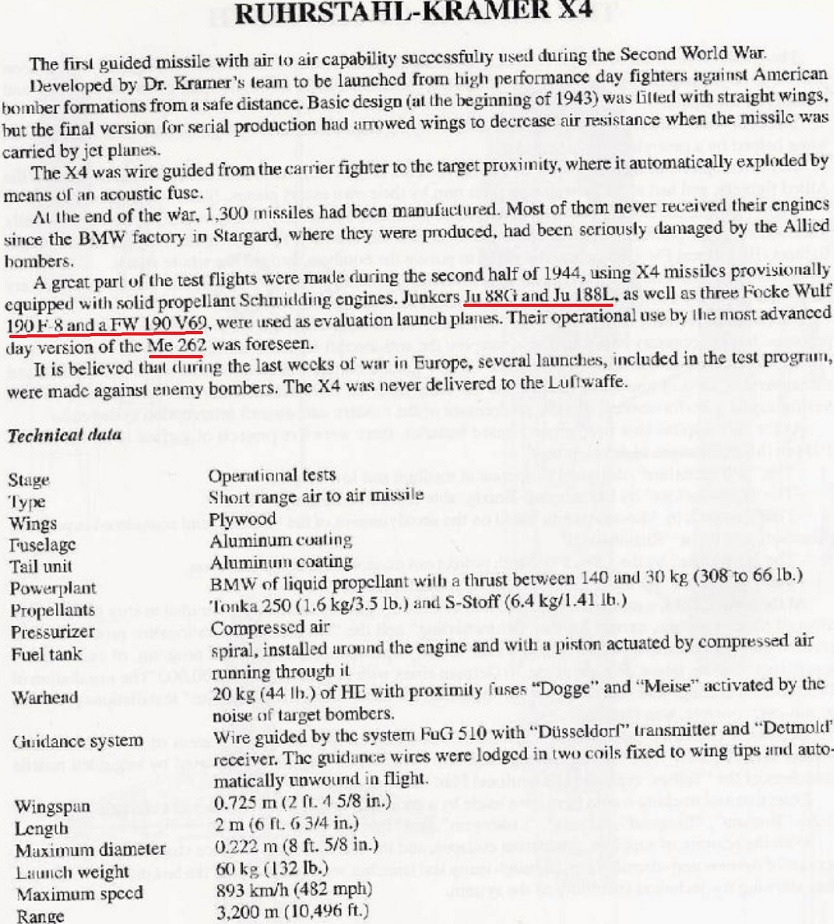
Where is the asked documentation about technical performances or even physical effects used to guide yourself onto something?
the “Meise” is a Fuze, using the Kranich accoustic device, which only detects a specific soundwave in order to trigger a fuze,… it’s way too simple to be an auto-directive system
So you’re the only one believing at some “experiemental pre-project” to be already “implemented” to a missile that have been checked by professionnals after the war, and which never demonstrated to get any kind of auto-homing systems (Over more than 1000 missiles produced including the Ground-Ground variant it come from) - from a Program that even germans stopped before the end of the war (believed to be stopped in early February 1945)
and i believe that if such a system would have been made and found by US and Russian scientists, then the 1st homing missile that USA ever made GAR-4 and GAR-8 [both in 1956] or Russian K-5 [1957], would have been serviced way earlier (because adding that to any HVAR is easy) by using an accoustic self-homing device, instead of the actual IR device (or in the case of AIM-7 from 1958, SARH guidance)
So now, that i made it clear (again, huh!), i’ll wait up your technical documentation about the “Dogge”
but i’m 100% certain that it’s only an “experiemental pre-project”, that you’re fanboying about.
that trigger the start of Dogge systems : yes
that is used to guide the missile : no
not required
very clearly stated to be terminal, considering the maximum range of the X-4 AAM being 3.5km… i doubt it would be higher than 3-500meters
We know the proximity fuse was designed to explode at 6m or so
so a system designed to work in tandem with that would need at least that much precision
you assume i had no idea while i already stated that by comparing acoustic emitter strength, it would determine the direction to rotate into. and since the missile constantly spun about its axis, Dogge would receive a constantly updated acoustic input and be able to compare highs and lows to guide the control surfaces to chase that input source (in the direction that increases the input amplitude)
your aggressiveness hints towards a deeper issue not related to this discussion. are you okay irl?
wrong. Meise and Kranich/kranch (multiple interpretations of pronounciation exist) were 2 seperate use systems that were proposed for the X-4 and both were trialled across the prototyping phase
so some sources dont mention it. it must not exist!!
and you say
your “Dogge”
as if i made it lmao
are you missing the point?
i already stated waay before hand, Dogge and meise are NOT the same thing. theyre different equipments. OFCOURSE a simple acoustic proximity fuse wont be used for automatic guidance
correction: YOU are the only one believing that it was
- a pre-project development
- that i believe it was implemented, (maybe you even think that i think it was installed on all X-4s lol)
dont even mention the X-7. it was a completely different missile only using a similar body. the guidance system for it was Radio MCLOS and it had a HEAT warhead with only a contact fuse. no Dogge, no meise, no kranich
made nothing clear except you had an opinion based on faulty understandings of sources and missiles and have a profound disbeleif that the germans could ahve invented and/or tested such an automatic guidance device… however rudimentary
DR. RUNGE’S REPORT ON HOMING DEVICES
The development “Dogge” (acoustic) was undertaken for the X-4 missile. It is planned
to cut off the propulsion after a certain time of flight. Dr. Benecke showed a microphone with a
built-in amplifier. For X-4 (a missile with rotation) two such microphones are used which are
installed diametrically opposite each other. Telefunken-Messerscbmitt microphones are used.
It is hoped to obtain ranges of about 1000 m. In addition to “Dogge” there is a further development “Luchs.” The error signals are obtained by periodic switching. In this way there is a saving
of tubes. General measurements are in progress at Elac by Dr. Hecht. On this side there are
favorable results of measurements on microphones which, however, are subject to reservations.
Dipl. Ing. Muck is working on a third acoustic development.
…
In the discussion on homing devices Staff Engineer Bree called attention to the bad rotational characteristics of X-4 with regard to the “Dogge” device. According to the previous experiments the rotational frequency varies between 4 and 1 or finally even to 1/2. It has been determined that a rotational frequency of 4 is most desirable. To a question on power requirements Dr. Benecke gave the total consumption of the “Dogge” device as 25 w. A suitable battery is available.
Toward New Horizons, A multi-volume report prepared for the AAF Scientific Advisory Group
The X-4 AAM, being an experimental missile, was tested with the Dogge guidance system whether yo u like it or not. I hold the opinion that experimental systems/vehicles should be implemented in their best configuration, even if as seperate additions.
there is no EO module on X-4 missiles. only tracking flares for ease of targeting for the pilots eyes
the rest is upto u
at least, you’ve found things more interesting than simple claims you’ve made so far.
so what do we have here, in your source at page 62:
-
he “hoped to get 1000m range” (not even test values,…)
-
2 rotationnal microphones, with a “bad” rotationnal characteristic (seems to be going from 4 to 1 or 0.5 in term of frequency, as “4” is the one that should be the best)
still 2 microphones would make a missile being in the middle of 2 targets to be faulty (there is no discrimination of sound) so the missile would end up spinning (i agree there is a low amount of formation within WT,… excepted AI targets)
“It is planned to cut off the propulsion after a certain time of flight” also means that the sound made by the rocket interfere with the “Dogge”, so the missile could be ahead of the target in certain War thunder situation,… make the missile to miss entirely (unless piloted at impact by the pilot).
this would also confere another problem to the “Meise” - it can’t tricker unless the Rocket engine is out of service
so the current limitations would be to hit the target while the X-4 is rocket engine is burning, then use the accoustics devices once the missile rocket is out.
Using the same source as you:
"KRAMER’S LATER MISSILES, X-4 AND X-7
According to Kramer, the development of an air-to-air missile designated as
8-344 or X-4 was begun in June, 1943. This missile weighs 60 kg and is 1.9 m long.
It has four sharply swept-back wings near the center of gravity and four tail fins. Aerodynamic control is by means of spoilers on the tail fins. Tabs on the wings cause the
missile to spin. Two of the wings carry at the tips spools of fine wire 0.22 mm in
diameter and long enough to permit a range of 5 km while maintaining direct wire
connection to the control aircraft. A gyro-stabilized commutator in the missile and a
suitable filter system, permit direct electrical transmission of the control from the
operator to the spoilers on the control surfaces of the missile by means of the connecting wires, which can feed out at speeds of more than 200 m/ sec.
About 160 X-4 missiles were built and a document dated 11 January 1945 stated
that 130 trials had been made. It was stated that the missile was in the early testing stage to prove its fundamental correctness of functioning.
At one time the Air Ministry had a requirement for 5000 by the middle of 1945 but this was later reduced. In February. 1945. SS leader Kammler ordered a lower priority and the closing cut of the
project at the end of the development period.
Kramer designed an acoustic proximity fuse for this missile known as “Kranich.”
About 30 were built and some preliminary fly-over and fly-by tests were made. The
effective range was expected to be 45 ft. The tests which had been completed were
promising. Work was also under way to develop an acoustic homing device with a
hoped for range of 500-1000 m. " - Page 49/50
And:
"THE ANTIAIRCRAFT ROCKETS
At the end of the war a number of ground-to-air rockets were being developed in Germany and one air-to-air controlled missile, the X-4, had seen operational use. The major control problem for the AA missiles is that of tracking and correcting the trajectory to ensure a collision or near-collision with the enemy airplane. Several schemes were advanced in Germany. the one which was most nearly realized being known as Burgund. *
This envisaged an operator keeping the missile on the line of sight from control point to target. It was proposed to modify the system for use with radar instead of optical tracking. Such a trajectory is not the optimum collision course, but it involves a minimum of computing mechanisms. The details seem to have been thoroughly analyzed and most of the component parts of the system apparently exist.
*: Survey of facilities in Germany for development of Guided Missiles, Part IV Klemperer, Alsos
Report WBK/292. " - Pages 173/174
Both implicetly explainning that the under way “Dogge”, was still not in place in the missile at the end of program, because the preliminary work was not finished.
it gives away the current credibility of the accoustic device, and also facts that the Dogge or other Accoustic Homing weren’t operationnal by the end of the war.
Information on the “Dogge”, found so far:
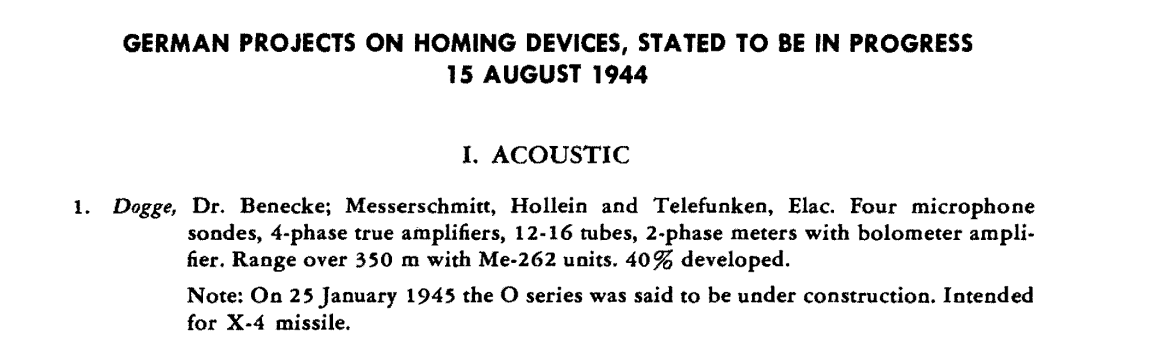
- effective range from 500-1000m (hoped) // 350m with Me-262
- need the rocket engine to be shut-down in order for the seeker to “hear” it’s “proposed target” (by the pilot, using MCLOS)
- the rotationnal frequency of the seeker is between 0.5 to 4
- the best frequency being at 4
- power consumption of the device is 25 Watts
However : in the whole discussion being registered, it is never stated that Dogge seen use on-board X-4.
It is even said that any Anti-Air homing devices weren’t ready (implicitly and not implicitly)
(dates of 25 january 1945, right before X-4 program got cancelled in following weeks)
Meise could also be looked at, in the situation of burning rocket engine.
But nice source! really, i have only compliments to give to you @Armen_Lozone
I simply wanted a terminal stage aim assist. Because with my skill issue of a laptop and wifi combo, ping 200 and 50fps i kinda rely on presteering.
U can deny such a novel guidance system peaks my d i mean my interest
Btw no hard feelings anymore i hope
This might not be true as the speed of the missile is mach 1.14 so it wouldnt hear the motor burn.
I suspect the wire cut off was their way of switching to terminal guidance by simply eliminating pilot control and handing it over to the onboard circuits