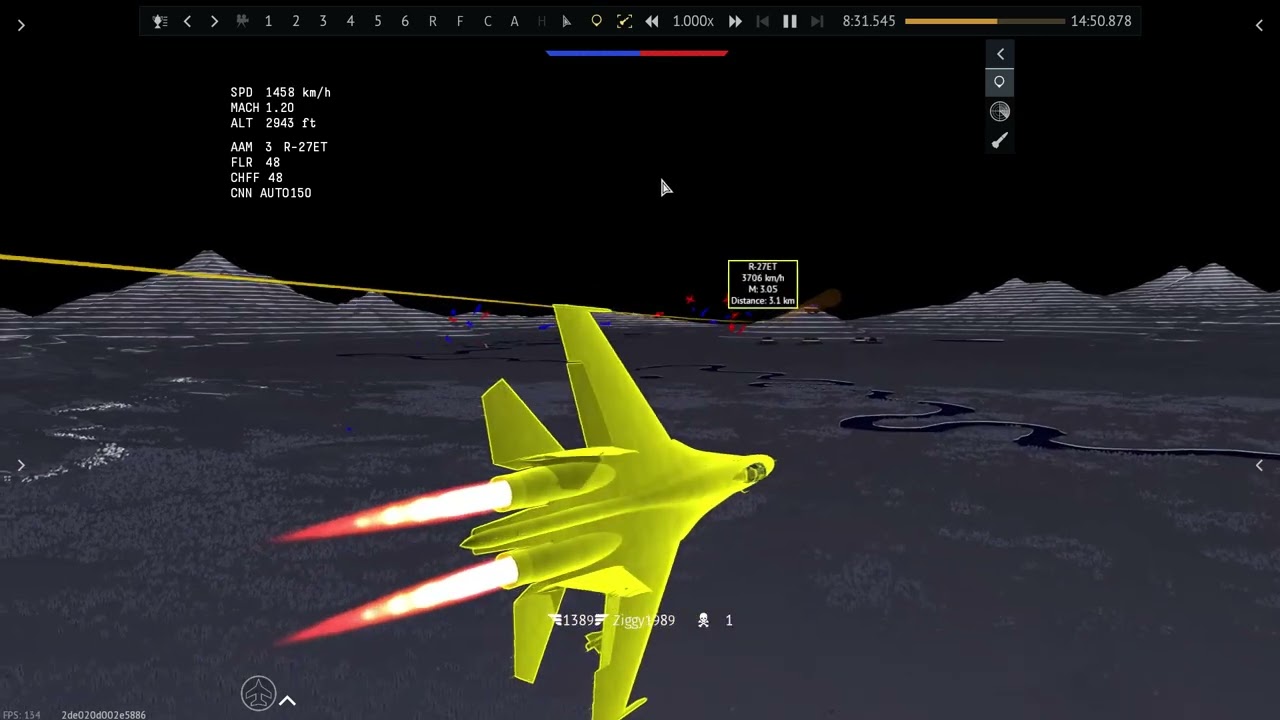
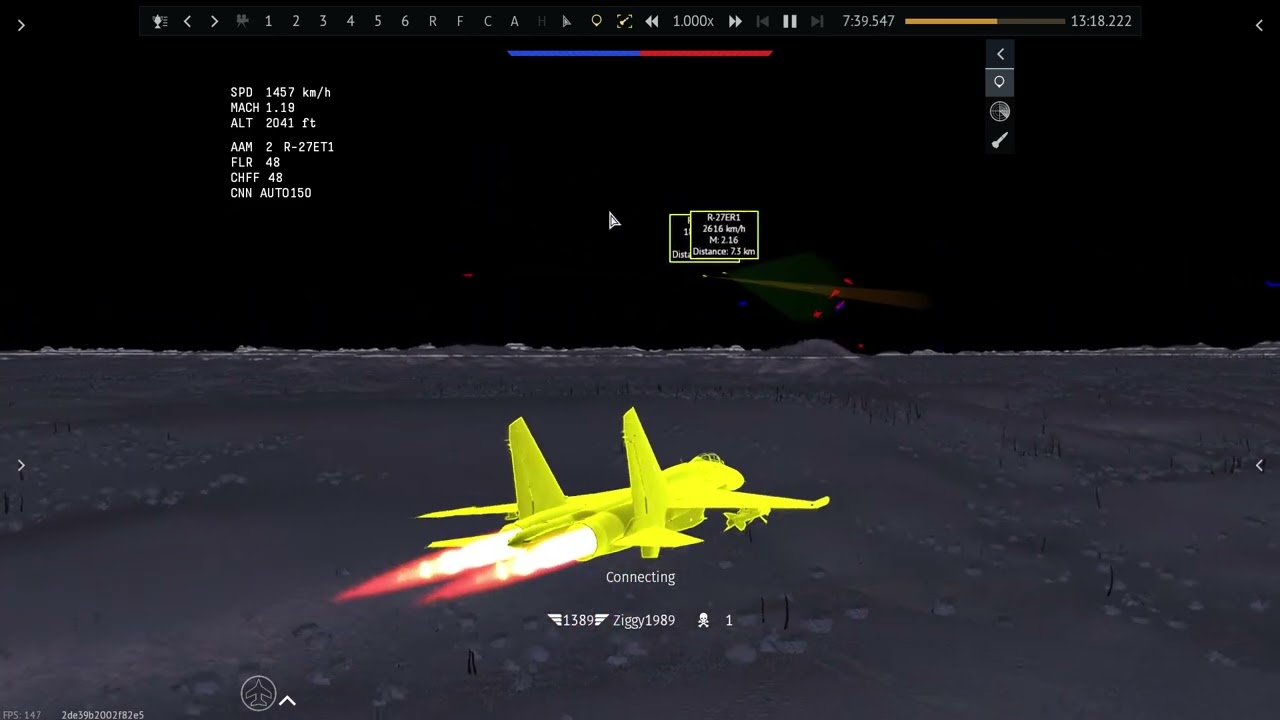
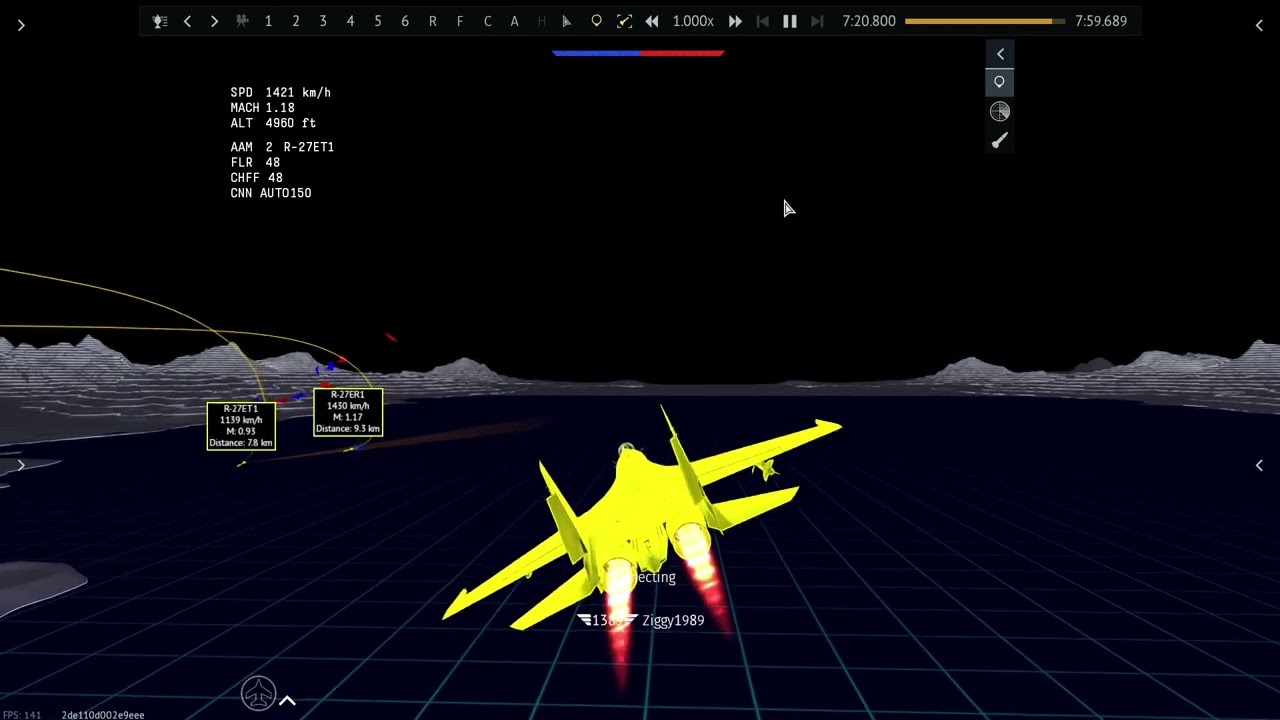
There is no Mig-29 in War Thunder besides the SMT that is technically capable of using the R-27ER.
GJ knows this & why the R27ER was not provided in the Mig-29’s release in Update: Apex Predators.
R-27ER (AA-10C Alamo C) – a modification of the R-27R missile with the installation of a new rocket engine, which has a larger supply of solid fuel, inside a modified rear part of the fuselage, characterized by a greater length and larger diameter. As a result, this model has a greater long-range range. The guidance system of the R-27ER missile cooperates with the N019M Topaz (‘mod. Slot Back I’) radar of the MiG-29S light front-line fighter and the N001 Mech (‘Slot Back II’) of the Su-27 heavy front-line fighter. This model, along with the R-27ET and R-27EP missiles, officially became operational in 1990.
Source: R-27 (AA-10 Alamo) :: Ruslet
The R-27R is the only variant that can be guided by N019 Rubin & is specifically differentiated by type & variant in the same source.
R-27R (AA-10A Alamo A) – a modification of the R-27 missile with the installation of a semi-active radar homing warhead of the RGS-27 type (9B1101K) inside the ogival tip of the fuselage made of dielectric material. The guidance system of this model cooperates with the on-board radar type N019 Rubin (‘Slot Back I’) of the MiG-29 light front-line fighter and N001 Mech (‘Slot Back II’) of the heavy front-line fighter of the Su-27 type. The R-27R missile, along with the R-27T and R-27P, officially became operational in 1987.
Source: R-27 (AA-10 Alamo) :: Ruslet
This is because the R-27ER does not operate by the same X-band channels that the N019 Rubin of the Mig-29 (9-12A), (9-12B) (9-12G) & even (9-13) use to guide its R-27R.
This is by intentional design on behalf of Phazotron-NIIR & Mikoyan.
Reason
The Soviet Union’s largest developer of military radars and avionics Phazotron-NIIR Chief designer Adolf Tolkachev, became an American spy and over the years between 1979 & 1985, supplied a great deal of information about such projects R-23, R-24, R-33, R-27, and R-60, S-300, as well as about air intercept radars used in the MiG-29, MiG-31, and Su-27 and other avionics directly to the CIA.
The United States Airforce & the entirety of NATO knew everything there is to ever know about the R-27R & the N019 Rubin that guides it. Everything down to the exact High & Medium PRFs used for detection & tracking as well as the specific X-band guidance channels of the R-27R.
The Americans were also given the entire State Recognition system of the USSR that was put into service in 1982.
To undo the damage done, the Soviet Union ordered Phazotron & Mikoyan to perform massive upgrades to existing fighters & weapon systems. Newer weapon systems such as the R27ER would not be NATO corrupted & by compatibility with the N019 Rubin. Thus, the N019M was born.
That is why there is not a single NATO country (yet) has the R-27ER & why you will never find an original Product 9-12 or 9-13 with R-27ER unless upgraded to the N019M Topaz standard either.
Details
MiG-29S (“product 9-13S”, Fulcrum-C)
Mig-29S (Product 9-13S) Reg: RF-92262 Code: 29 red
The appearance of the MiG-29S modification is associated with the betrayal to the West in 1985 of one of the leading specialists of NPO Phazotron. Adolf/Alexander Georgevich Tolkachev passed on detailed information on the radio-electronic equipment of the A-50, MiG-31 and MiG-29 planes to adversaries, repeating to a certain extent the “feat” of the traitor Belenko, who hijacked the MiG-25 to Japan. This event required the adoption of urgent measures to modernize a number of Soviet fighters, including the MiG-29.
Recruited by the Western secret service, for several years he passed overseas secret information on the weapons systems and equipment of the latest Soviet combat aircraft. Tolkachev sold 61 microfilms and 2,000 pages of printed text to the CIA for $ 1.2 million. Thus, the West received detailed information not only on radar equipment, but also on the State Recognition system, which was put into service quite recently - in 1982.
The information provided by Tolkachev saved the U.S. government billions of dollars in defense expenditures, a coup that prompted some intelligence historians to call him “the greatest spy since Penkovsky.” The primary value of the source’s reporting was that it provided detailed data on new Soviet weapon systems that would not be available from technical collection sources for many years, if ever. The complete documentation on these systems, which the agent provided even before the systems were fully operational, was described as “of incalculable value.”
“The SW messages contained useful intelligence on such subjects as a new Soviet airborne radar reconnaissance and guidance system, the results of performance tests of new Soviet aircraft radar systems, and the status of work on the weapons-aiming systems for various Soviet aircraft under development.”
An April 1980 internal CIA memorandum called Tolkachev’s information on jam-proofing tests for Soviet fighter aircraft radar systems “unique”—such data, sought for many years, was not obtainable by national technical means.
The arrest of Tolkachev and his wife took place on June 9, 1985. Once in the KGB detention facility in Lefortovo, Tolkachev confessed to espionage. During the announcement of the verdict, Tolkachev stood and held himself straight. The judge read out the verdict: “to be found guilty of treason in the form of espionage and subject to capital punishment - by shooting.” On Sept. 25, 1986, a TASS (Russia’s official news agency) news article announced that Tolkachev had been tried, convicted and executed the day before. Although initial suspicion for his arrest fell on former CIA employee and defector Edward Lee Howard, who had been slated to handle Tolkachev while stationed in Moscow, subsequent information revealed that Tolkachev was also betrayed by Aldrich Ames. During the investigation into the Tolkachev case, it was possible to establish what information could get to the West. In accordance with this, measures were developed to compensate for the damage caused to the country’s defense.
In particular, the MIG firm was instructed to create modifications of the MiG-31 interceptor and the MiG-29 fighter with improved weapons control systems, while it was assumed that according to their model, previously released combat vehicles will also be modified (in a similar way, in the early 80s, at aircraft repair plants, most of the MiG-25Ps were modernized into the MiG-25PDS version, and several hundred MiG-23ML - into the MiG-23MLD version).
The MiG-29S was an attempt to eliminate the consequences of betrayal. The modernization consisted in the refinement of the radar to the level of the N019M Topaz radar, the improvement of the Gardenia station, fuel tanks.
Modified radars allow missiles to fire at two air targets simultaneously, RVV-AE missiles are integrated into the weapon control system. The range of admissible angles of attack has been expanded to 30 degrees, the payload mass on the pylons has been increased from 2000 kg to 4000 kg. The range of outboard weapons has been expanded with guided air-to-surface weapons - anti-ship and anti-radar guided missiles, air-to-surface guided missiles with television and laser guidance. Most of the above modifications are associated with later versions of the MiG-29S. Thus, guided weapons of the air-to-surface class were introduced into the range of suspended weapons in 1995.

For well-known reasons, the wide modernization of the MiG-29 aircraft to the level of the MiG-29S failed.
In 1992, the Russian Ministry of Defense decided to stop purchasing MiG-29 fighters - in the conditions of the economic crisis, it was deemed inappropriate to build two types of front-line fighters simultaneously. As already noted, in the first half of the 70s. The concept of a promising fleet of fighter aircraft of the country’s Air Force was based on the principle of its construction on the basis of two types of aircraft: 70% - MiG-29 and 30% - Su-27. It was assumed that the cost of these types of fighters would be 1: 1.9.
In practice, it was not possible to make the MiG so cheap: its price was only 40-50% less than the Sukhoi (the cost of the Su-27 on the world market is estimated at 30-35 million, and the MiG-29 - 22-24 million). As for the quantitative ratio of these types of aircraft in the structure of the Russian Air Force, then, according to the data published in the press, it was even slightly exceeded in favor of the MiGs: by the end of 1990, at the time of the conclusion of the CFE Treaty, 648 MiG-29 aircraft (82%) and 138 Su-27 aircraft (18%) were based in the European part of the USSR, not counting the fighters of the Navy and air defense forces. After the collapse of the Soviet Union, the Russian Air Force transferred about four hundred MiG-29s (80%) and just over one hundred Su-27s (20%).

MiG-29S (9-13S) Reg: RF-92242 Code: 28 red
The following MiG-29S are known: board “404”, board “405” (later became the prototype of the MiG-29SM), board “406” (formerly the first prototype of “product 9-13), board” 407 “(previously prototype” product 9- fourteen). In general, estimates of the number of aircraft upgraded to the level of the MiG-29S range from two dozen machines to two full-fledged regiments of a three-squadron composition, that is, up to 70 - 80 aircraft. It is obvious that the combat regiments of the Russian Air Force are not armed with a single MiG-29S, modernized to the full “depth”.

MiG-29S (9-13S) Reg: 407 blue. Manufacturer Serial Number: 2960507682
Thus, 16 MiG-29S fighters produced at MAPO in 1991 became the last aircraft of this type to enter service with the Russian aviation. In this regard, 30 MiG-29S fighters that were not bought by the Russian Air Force were converted into an export version of the MiG-29SE.
Sources
MiG-29S FULCRUM (globalsecurity.org)
Tolkachev-Successor-Penkovsky.pdf (cia.gov)
Product Radar types
Product 9-12 (N019 Rubin)
Standard model of the Soviet Union (NATO Compromised).
East German Product 9-12A (N019EA)
Warsaw Pact Export N019EA. Lacks “SP” mode (NATO Compromised).
Hungarian Product 9-12B (N019EA)
Warsaw Pact Export N019EA. Lacks “SP” mode (NATO Compromised).
German Reunification Product 9-12G (N019EA)
Warsaw Pact Export. Lacks “SP” mode. Modified to NATO & ICAO standards (NATO Compromised).
Product 9-13 (N019 Rubin)
Standard Soviet Mig-29 radar (NATO compromised).
Fitted with a bulged and extended spine, which reportedly houses both fuel and avionics, and which may also be applied through retrofit. Internal fuel is increased by provision of larger No. 1 fuel tank.
The first ‘fatbacked’ MiG-29 was 9-13, the second pre-production aircraft, which first flew on 23 December 1980, in the hands of V.M. Gorbunov. At one time the ‘Fulcrum-C’ seemed to be slowly replacing the ‘Fulcrum-A’ in VVS service, but the two types continued in production alongside one another and often serve in the same units (occasionally with the very early ventral-finned MiG-29s). Pilots report that apart from endurance, there is no difference in flying/operating characteristics, although some sources suggest that the ‘Fulcrum-C’ has an enhanced ground attack capability and/or provision for an active jammer. Certainly the 9-13 has redesigned wingtips which appear to accommodate new RWR antennas. No ‘hunchbacked’ ‘Fulcrum-Cs’ have been exported yet, though Malaysia’s MiG-29s may prove to be based on the ‘Fulcrum-C’
Military Aviation (sirviper.com)
Product 9-13S (N019M)
The MiG-29S was an update of the original 9.13 model retaining the NATO reporting code “Fulcrum-C” and featured flight control system improvements; a total of four new computers provided better stability augmentation and controllability with an increase of 2° in angle of attack (AoA). An improved mechanical-hydraulic flight control system allowed for greater control surface deflections. The MiG-29S can carry 1,150 L (250 imp gal; 300 U.S. gal) under wing drop tanks and a centerline tank. The inboard underwing hardpoints allow a tandem pylon arrangement for carrying a larger payload of 4,000 kg (8,800 lb). Overall maximum gross weight was raised to 20,000 kg (44,000 lb). This version also included new avionics and the new Phazotron N019M radar and Built-In Test Equipment (BITE) to reduce dependence on ground support equipment. Development of this version was initiated due to multiple systems being compromised to the West by Phazotron engineer Adolf Tolkachev. This was the final version of the MiG-29 produced before the collapse of the Soviet Union and only limited numbers were produced.
The N019M Topaz is an updated version, developed as a response to the compromise of the N019 radar by a US spy. Tested from 1986, it entered limited production in 1991. Slightly lighter than the N019 at 350kg. Topaz has increased ECM resistance, new software, and a more advanced built-in monitoring system. A new Ts101M computer eliminates the processor overload problems of the N019, more than doubling capacity to 400,000 operations per second whilst weighing less, just 19kg, and with doubled MTBF of 1000h compared to the 500h of the Ts100. N019M allows two targets to be engaged by active radar homing missiles simultaneously. Range increased slightly to 80km. Originally intended to be fitted to the existing MiG-29 fleet as an upgrade, about 22 aircraft with N019M are thought to have entered service with the VVS.
N019 Radar | MiG Alley Military Aviation News
The MiG-29S introduces revised radar/weapons system algorithms and software (and it is believed that processing capacity has been increased) to allow for the simultaneous tracking and engagement of multiple targets. The modified radar is redesignated N-019M. Operational capability has been enhanced by fitting a new sighting system, and more recently by making provision for the active homing AAM-AE ‘AMRAAMski’. The first MiG-29S made its maiden flight during 1984, and three prototypes were followed by new production aircraft and conversions. Two polk (squadrons) are in service.
Military Aviation (sirviper.com)
The only Soviet Mig-29 Products 9-12 & 9-13 that are upgraded to N019M standard can equip R27ERs & R77s.
No NATO country has the technical ability to guide the R-27ER. It is a great disrespect to the Soviet Union & a slap in the face to the Russian Federation to give any NATO aircraft the R-27ER.
Serbian 9-12A upgraded to Product 9-13SE standard & N019ME radar. A LEGITIMATE Product 9-12A with R-27ER capability.