I wanted to add something to this suggestion, because I think it has actually become more relevant since it was originally posted.
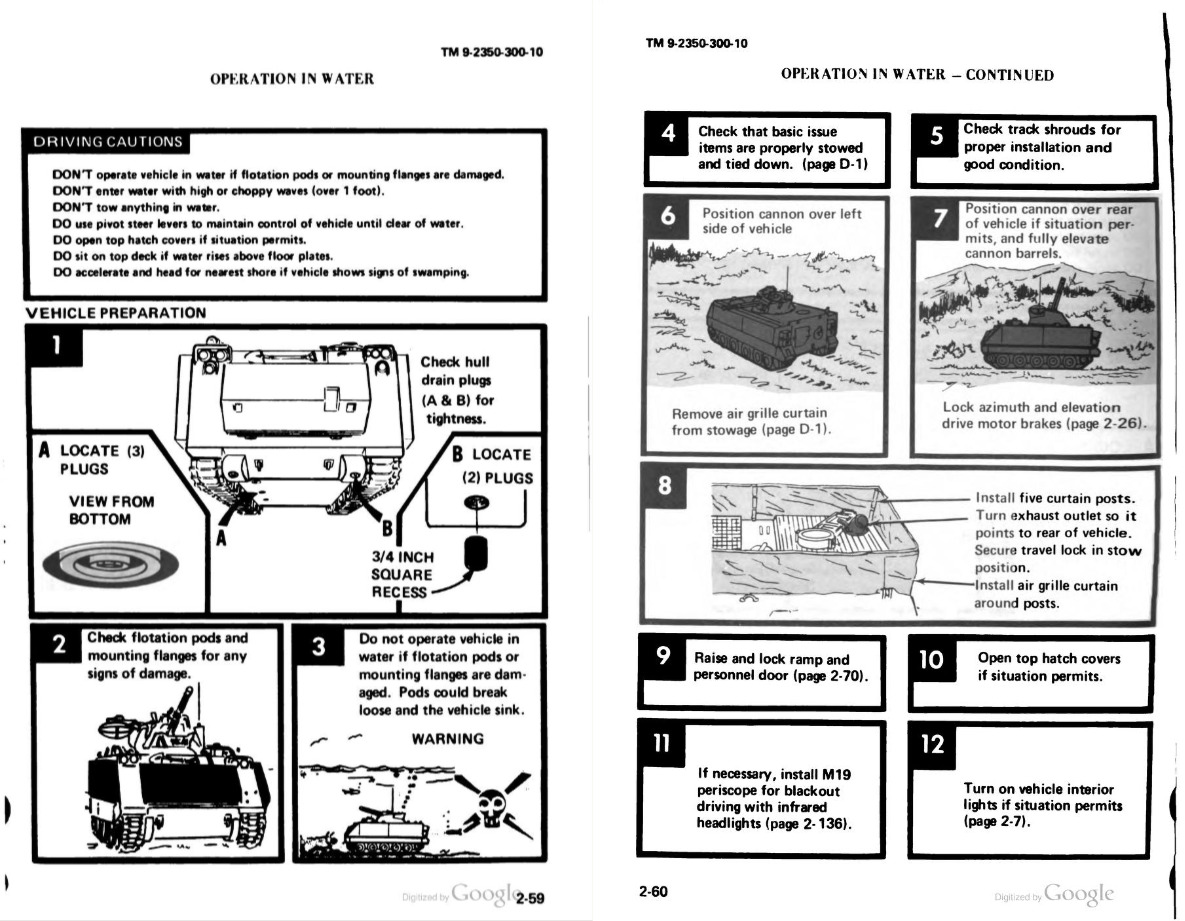
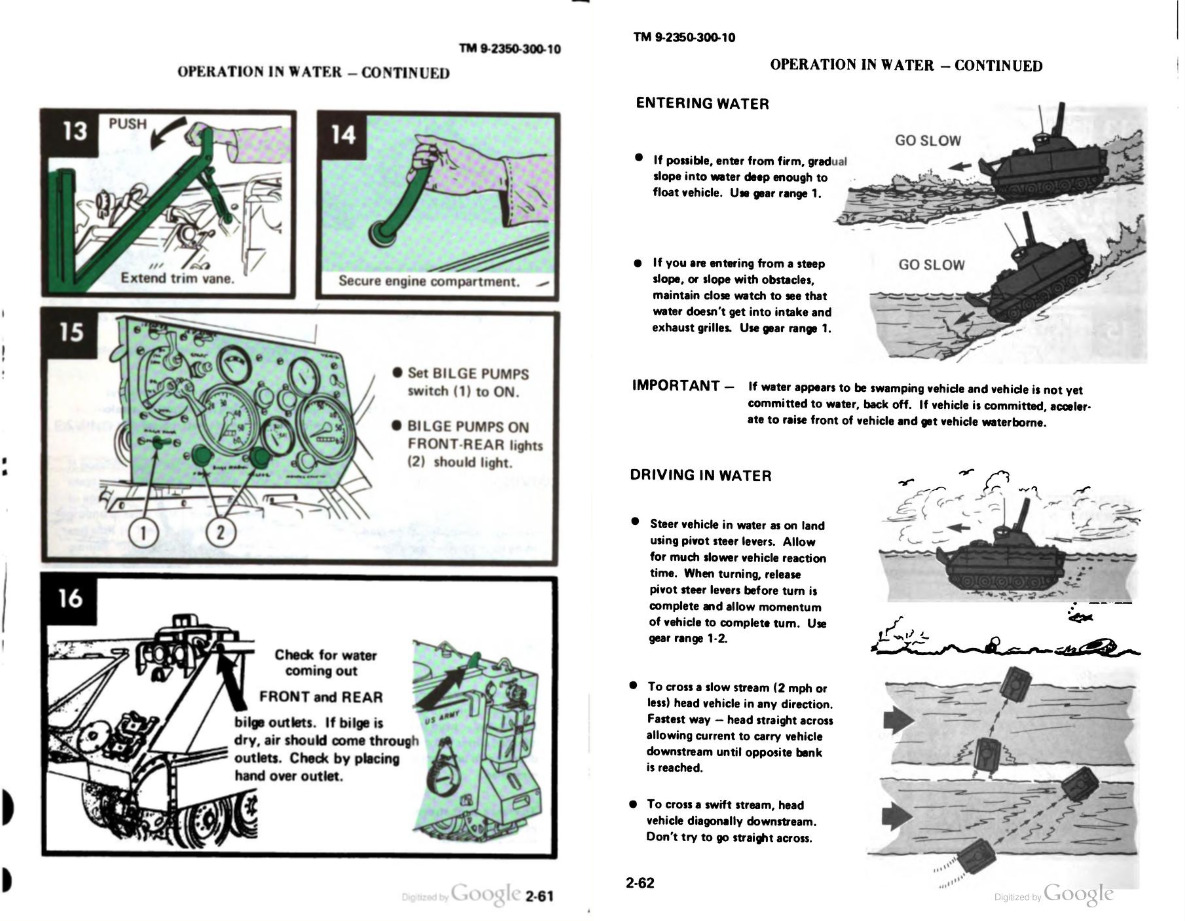
In March 2022, as part of the Wind of Change update, Gaijin removed the M163’s amphibious capability on the grounds that it “requires preparation before entering water” (see Fig. 1.1). For this change, Gaijin specifically cited TM 9-2350-300-10, the U.S. Army operator’s manual for the M163 (see Fig. 1.2 and Fig. 1.3).
However, while the manual does show that the M163 required preparation before entering the water, it also makes clear that the vehicle was, in fact, amphibious.
Figure 1.1 - Wind of Change Update Changelog
Figure 1.2 - TM 9-2350-300-10, pp. 2-59—2-60
Figure 1.3 - TM 9-2350-300-10, pp. 2-61—2-62
The manual absolutely does show that the M163 required preparation before entering the water. However, it also makes equally clear that the M163 itself possessed amphibious capability. TM 9-2350-300-10 gives the combat-loaded M163 a maximum water speed of 4 mph (6.4 km/h) and 11 inches (279.4 mm) of freeboard. It contains a dedicated “Operation in Water” section covering preparation, water entry, maneuvering while afloat, leaving the water, and restoring the vehicle afterward.
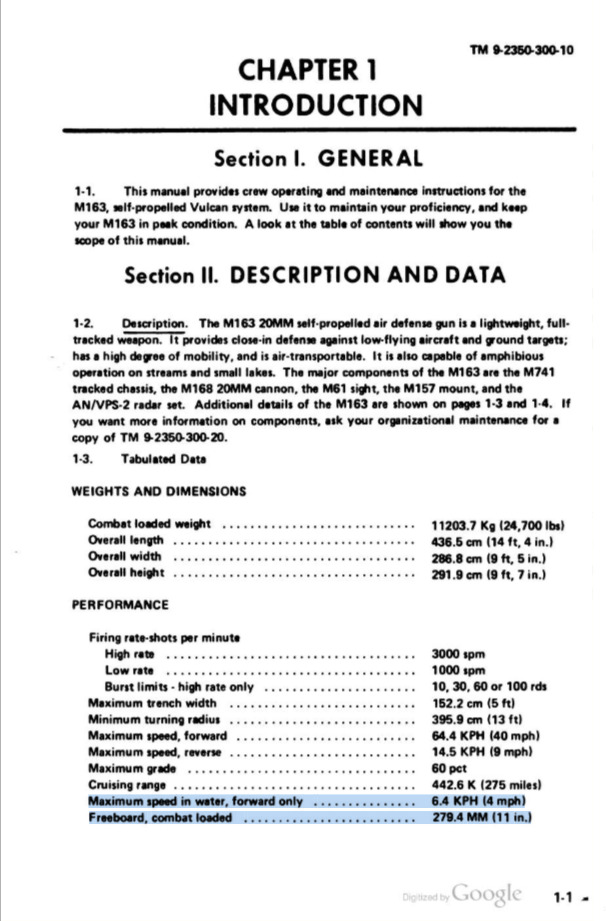
Figure 1.4 - TM 9-2350-300-10 performance specifications, including maximum water speed and combat-loaded freeboard, p. 1-1
The M163’s air-grille curtain
I think an important distinction has been lost in discussions surrounding the M163: the air-grille curtain was not the equipment fitted to retain the vehicle’s basic swimming capability.
As part of preparation, TM 9-2350-300-10 instructs the crew to remove the air-grille curtain from stowage, install five curtain posts, install the curtain around the engine grilles, reposition the exhaust outlet, secure the vehicle, and prepare the bilge pumps.
However, immediately before those instructions, the manual separately warns against entering the water if the side flotation pods or their mounting flanges are damaged, because a flotation pod could break loose and cause the vehicle to sink.
That distinction is reinforced by R. P. Hunnicutt’s Bradley: A History of American Fighting and Support Vehicles. When discussing the additional weight imposed by the Vulcan weapon system on the M741 chassis, Hunnicutt states:
“To retain its swimming capability, flotation cells were installed on each side of the M741 and a high displacement trim vane was fitted.”
In other words, the side flotation cells and high-displacement trim vane were installed specifically to retain the M741’s swimming capability after the Vulcan system reduced its available freeboard.
The air-grille curtain served a different function: protecting the extremely low engine-grille area from water ingress during amphibious operation. This was particularly important because the combat-loaded M163 had only 11 inches of freeboard.
I am not arguing that the Army considered the curtain unnecessary, nor that crews were supposed to ignore the prescribed preparation procedure. The point is simply one of capability: requiring protective equipment to be configured before proper water operation is not the same thing as the underlying vehicle being incapable of floating or performing amphibious operation. In fact, there are numerous examples of vehicles entering water that visibly covers the engine deck and continuing operation afterward.
The curtain and its associated equipment were also carried aboard the M163. TM 9-2350-300-10’s Basic Issue Items List identifies five air-grille curtain posts, stored in the air-grille curtain pocket.
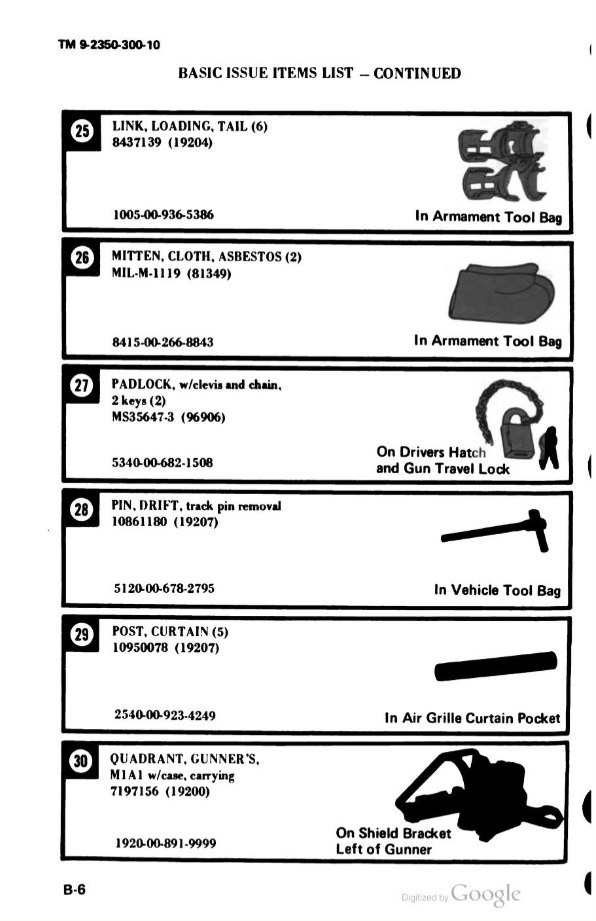
Figure 1.5 - TM 9-2350-300-10 Basic Issue Items List showing five air-grille curtain posts carried aboard the vehicle, item 29, p. B-6
So, to summarize the M163 itself:
- It had a documented maximum water speed.
- It had documented combat-loaded freeboard.
- It had dedicated side flotation pods pre-installed on the chassis.
- It had a high-displacement trim vane.
- Its amphibious preparation equipment was carried aboard the vehicle.
- Its Army operator’s manual contains detailed instructions for entering, maneuvering in, and leaving the water.
The M163 was unquestionably an amphibious vehicle. In-game, the trim vane still lowers when entering water. The problem, therefore, is, in my opinion, how War Thunder chooses to abstract the preparation necessary to use that capability. Which brings me to where the current implementation becomes inconsistent.
Other amphibious vehicles requiring preparation
The M163 is far from unique in requiring preparation before water entry. War Thunder currently models vehicles from multiple nations as immediately amphibious despite documented procedures or equipment that had to be configured before entering the water. Gaijin’s own current Amphibious vehicle collection includes the vehicles discussed below.
T86 — USA
Perhaps the most directly comparable example is the T86, particularly because it is another American vehicle.
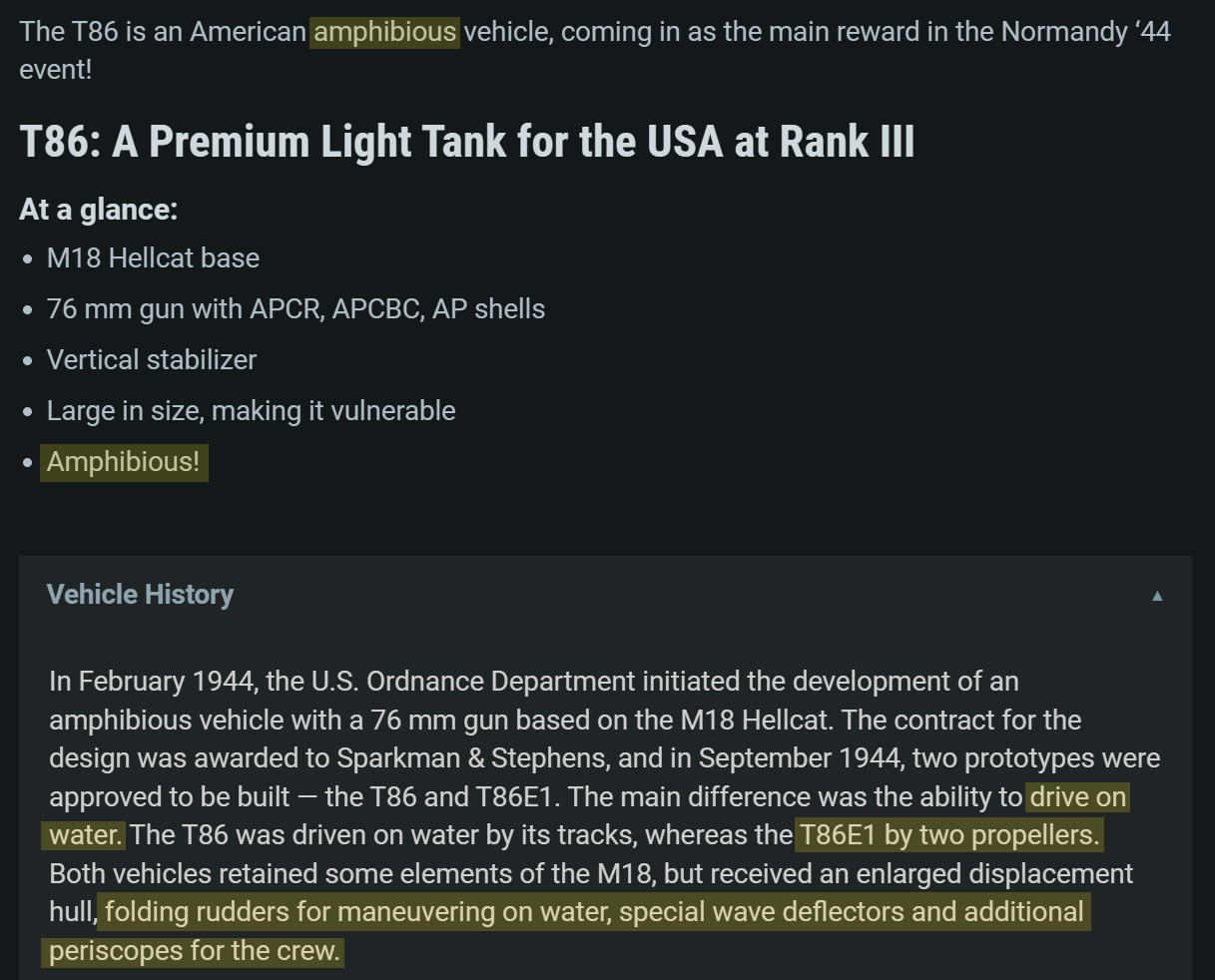
When Gaijin introduced the T86 in 2025, its development blog explicitly advertised:
“Amphibious!”
Gaijin’s own description also discusses the T86’s folding rudders for maneuvering in water and its special wave-deflection equipment.
Period U.S. documentation preserved by the Library of Congress further documents the T86’s amphibious equipment, testing, and configuration:
Figure 2.1 - Gaijin’s T86 development blog describing its amphibious capability and folding rudders.
Yet the T86 requires no player-controlled preparation in War Thunder. It simply enters the water and floats. Thus, I present an immediate comparison with the M163:
M163: historically amphibious and “requires preparation.” Its amphibious capability was removed despite having the ability to maintain buoyancy as long as the flotation pods were intact.
T86: historically amphibious and possesses deployable and/or configurable water equipment. Amphibious capability retained and “preparation” abstracted.
Furthermore, this is not merely a one-off exception. There are several foreign examples of vehicles that should or should not be permitted to have amphibious capability based on the same criteria. I’ll talk about those next, starting with the BMP-2.
BMP-2 — USSR
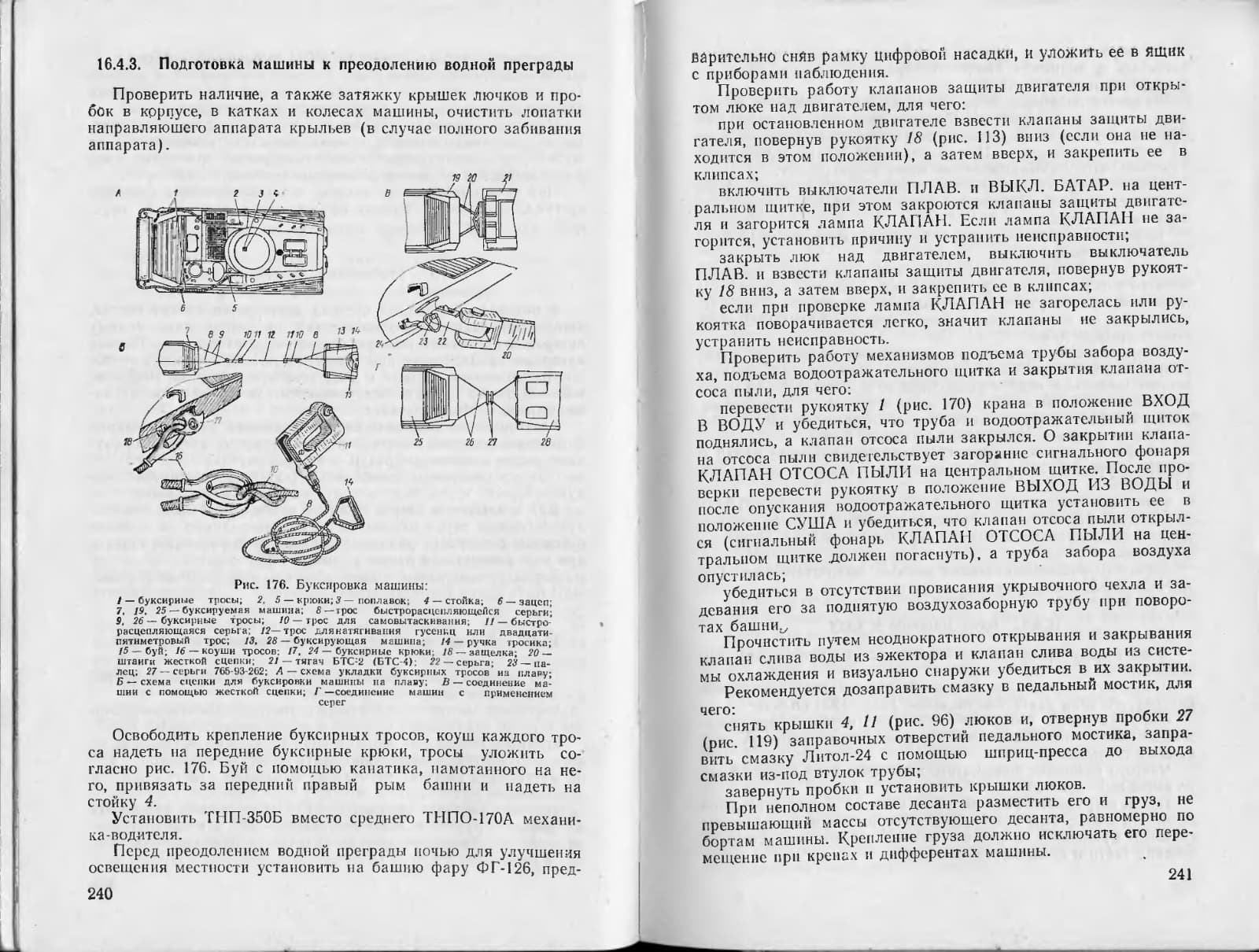
The BMP-2 is arguably the strongest foreign example because an original Soviet operating manual is available online. The 1988 BMP-2 Technical Description and Operating Instructions contains an entire section numbered 16.4.3, titled:
“Preparation of the Vehicle for Overcoming a Water Obstacle.”
The procedure requires the crew to perform several actions before amphibious operation, including checking covers and plugs in the hull and running gear, preparing towing equipment, installing the driver’s swimming observation device, checking components of the engine water-protection system, and configuring the vehicle for water operation.
The manual then has separate sections for:
- entering the water;
- movement while afloat;
- leaving the water; and
- preparing the vehicle for movement after completing the crossing.
Source:
1988 BMP-2 Technical Description and Operating Instructions
Figure 3.1 - 1988 BMP-2 operating manual, §16.4.3, “Preparation of the Vehicle for Overcoming a Water Obstacle.” pp. 240—241
Nevertheless, the BMP-2 is currently listed by Gaijin as Amphibious and requires no comparable player preparation before entering water. This seems especially relevant when the stated reason for removing the M163 was simply that it:
“requires preparation before entering water.”
The Soviet BMP-2 manual quite literally contains a section called “Preparation of the Vehicle for Overcoming a Water Obstacle,” yet the existence of that preparation has not resulted in its amphibious capability being removed.
Type 63 — China
The Chinese Type 63 provides another particularly straightforward example. U.S. Army training material preserved by GlobalSecurity describes the Type 63 as possessing fully amphibious capability and describes its trim board as normally folded against the glacis. The same material states that the trim board is erected at the front of the hull before entering the water.
Source:
U.S. Army ACCP IN0534 — Threat Heavy Armored Vehicles, Type 63
The material identifies itself as derived from FM 100-2-3, Jane’s Armour and Artillery 1989–1990, and the Soviet and Warsaw Pact Equipment Handbook. A second reference reproduces the same description:
INETRES — Type 63 Light Amphibious Tank
Figure 4.1 - U.S. Army training material describing the Type 63’s amphibious capability and deployment of its trim board before water entry.
Despite this physical preparation requirement, the Type 63 is immediately amphibious in War Thunder.
AMX-10RC — France
The French AMX-10RC is another clear example. Army Guide describes the AMX-10RC as fully amphibious, propelled through the water by two rear waterjets, but also states that before entering the water, a trim vane is erected at the front of the vehicle. Its hydropneumatic suspension also has an amphibious configuration: Army Guide lists a normal road clearance of 350 mm, 470 mm for cross-country operation, and 600 mm for amphibious operation.
Source:
Army Guide — AMX-10RC

Figure 5.1 - AMX-10RC technical description identifying its pre-water trim-vane deployment and amphibious suspension setting.
This is independently corroborated by a Forecast International technical report, which describes the AMX-10RC as fully amphibious, gives it amphibious fording capability, and identifies its twin waterjets and hydropneumatic suspension.
Source:
Forecast International — AMX-10P/AMX-10RC Archived Report
Yet the AMX-10RC is immediately amphibious in War Thunder. The player is not required to erect the trim vane or place the suspension into its documented amphibious configuration.
Pbv 302 — Sweden
The Swedish Pbv 302 is another good example. Army Recognition describes the Pbv 302 as fully amphibious, propelled through water by its tracks. The same description states that before entering water, the vehicle’s two-part front trim vane is deployed and its bilge pumps are engaged.
Source:
Army Recognition — Pbv 302
Figure 6.1 - Pbv 302 description identifying deployment of its trim vane and activation of its bilge pumps before entering water.
Nevertheless, the Pbv 302 (BILL), which uses this chassis, is currently listed as Amphibious in War Thunder. Again, the real-world preparation is simply abstracted.
LAV-AD — USA
The LAV-AD provides another useful American example. U.S. reference material describes the LAV-AD as capable of crossing streams, rivers, and inland waterways with minimal preparation.
Source:
FAS — LAV-AD
Gaijin itself advertised the LAV-AD as possessing amphibious capabilities when introducing it: Gaijin — LAV-AD: Revolving Firepower. The LAV-AD remains included in Gaijin’s Amphibious collection. Again, the existence of preparation does not prevent the vehicle from being modeled as amphibious.
My issue is with consistency, not whether preparation existed!
To be clear, I am not arguing that all of these vehicles required identical preparation, since they obviously did not. Some procedures involved little more than erecting a trim vane, while others involved bilge pumps, valves, observation equipment, suspension adjustment, rudders, protective equipment, or several separate crew tasks. The point I’m trying to make is: War Thunder does not normally treat the mere existence of pre-water preparation as proof that a vehicle lacks amphibious capability. That standard is already demonstrated by vehicles from the:
- USA;
- USSR;
- China;
- France; and
- Sweden.
Yet the M163’s amphibious capability was explicitly removed because it “requires preparation before entering water.” That leaves us with two possible standards. If War Thunder’s standard is based primarily on a vehicle’s physical ability to float and propel itself through water, the M163 qualifies. Its Army manual documents its water speed, freeboard, flotation pods, amphibious equipment, and water-operation procedures. If War Thunder’s standard instead requires every vehicle to be in its prescribed operational swimming configuration before it can float in-game, then the same principle would need to be applied to vehicles such as the BMP-2, Type 63, AMX-10RC, Pbv 302, T86, LAV-AD, and many others.
This brings me to why I think the Preparation for Swimming mechanic proposed in this thread is preferable to simply removing amphibious capability. War Thunder already has some precedent for representing the deployment time of amphibious equipment. For example, in Update 2.15.1.133, Gaijin specifically changed the:
“Trim vane folding time for amphibious tanks…”
So the game already recognizes, at least to some degree, that amphibious equipment has a deployment/stowage state rather than simply being in the correct configuration at all times. A broader preparation mechanic could build on that idea. Depending on the individual vehicle, preparation could represent such things as:
- raising trim vanes;
- deploying flotation screens;
- erecting protective curtains;
- deploying rudders;
- raising air intakes;
- changing hydropneumatic suspension height;
- activating bilge pumps;
- closing or configuring water-protection valves;
- or completing other vehicle-specific amphibious preparations.
The time required may vary depending on the actual vehicle. That would allow War Thunder to recognize both historical facts at once:
- The vehicle really was amphibious.
- The crew really did have to prepare it before using that capability properly.
And this distinction is, in my opinion, particularly important for the M163. The M163 did not cease to be an amphibious vehicle because its crew had to install an air-grille curtain before prescribed swimming operations. The M741 chassis was specifically fitted with flotation cells and a high-displacement trim vane to retain its swimming capability; the Army gave it a documented water speed and freeboard; and the operator’s manual explains how to drive it while afloat.
If War Thunder is going to abstract comparable preparation for amphibious vehicles from numerous other nations, then I believe either the M163 should receive the same abstraction or it should be an ideal candidate for the preparation mechanic proposed in this thread. At minimum, the addition of vehicles such as the T86 since this suggestion was originally written, together with the continued amphibious modeling of the BMP-2, Type 63, AMX-10RC, Pbv 302, LAV-AD, and others, makes the reasoning behind the M163’s 2022 removal worth revisiting.
Here are my sources
M163 / M741
Gaijin — Wind of Change changelog, 24 March 2022
U.S. Department of the Army — TM 9-2350-300-10, Operator’s Manual (Crew), M163 VADS
R. P. Hunnicutt, Bradley: A History of American Fighting and Support Vehicles , M741/M163 section, particularly p. 190.
AFV Database — M163 photographs and technical diagrams
T86
Gaijin — Normandy '44: T86
Library of Congress — Amphibian based on 76mm Gun Motor Carriage M-18
Library of Congress — Report on tests and modifications of the amphibious 76mm GMC
Library of Congress — T86 Landing Vehicle Board report
BMP-2
1988 BMP-2 Technical Description and Operating Instructions, Part 2
Type 63
U.S. Army ACCP IN0534 — Threat Heavy Armored Vehicles
INETRES — Type 63 Light Amphibious Tank
AMX-10RC
Army Guide — AMX-10RC
Forecast International — AMX-10P/AMX-10RC Archived Report
Pbv 302
Army Recognition — Pbv 302
LAV-AD
FAS — LAV-AD
Gaijin — LAV-AD: Revolving Firepower
Current War Thunder implementation
War Thunder Wiki — Amphibious vehicle collection
[Gaijin — Update 2.15.1.133, 30 May 2022](Update 2.15.1.133 - Updates - Game - War Thunder
Thank you for attending my TED Talk, I’ll be here all week.