- Yes
- No
Hello everyone, and welcome to this new suggestion.
Today, I am presenting a new French fighter aircraft prototype: the Potez 670.
In the early 1930s, the French Air Force issued an unusual requirement for a new type of aircraft intended to serve as an airborne command post for fighter formations. Rather than engaging directly in combat, this aircraft was envisioned as a flying headquarters capable of accompanying fighter units, coordinating their movements, and relaying tactical orders by radio during aerial engagements. To fulfill this role, the aircraft featured an unconventional three-man crew consisting of a pilot, a rear gunner, and a liaison officer seated in a raised position within the fuselage. From this elevated station, the liaison officer would have an excellent field of view, allowing him to observe the battle and direct friendly fighters in real time.
Several French manufacturers responded to this requirement with a variety of designs. Potez based its proposal on the successful Potez 63 family, resulting in the Potez 670. Although clearly derived from its predecessor, the aircraft incorporated several significant improvements. The airframe was aerodynamically refined, most notably through the adoption of fully retractable landing gear that no longer protruded beneath the engine nacelles, reducing drag and improving overall performance. The wing was also redesigned with a more efficient airfoil, while the aircraft retained the twin-engine configuration and three-seat layout required by the Air Force.
The first and only prototype completed its maiden flight in 1939 and entered the evaluation phase shortly afterward. Although the aircraft handled satisfactorily, flight testing quickly revealed that it was significantly underpowered for the demanding role expected of it. Its performance was insufficient to keep pace with the latest generation of French fighters, making it unsuitable as an escort and command aircraft during fast-moving aerial engagements.
At the same time, the entire airborne command aircraft concept was proving increasingly impractical. Any attempt by enemy fighters to intercept the aircraft would immediately force it into evasive maneuvers, preventing the liaison officer from effectively observing the battle and directing friendly formations. Recognizing these limitations, the French Air Force abandoned the requirement before any production order could be placed. Rather than abandoning the airframe altogether, Potez attempted to salvage the project by redesigning the aircraft as a reconnaissance and escort platform. This revised version, designated the Potez 671, featured more powerful engines and was intended to fulfill a more conventional operational role. However, the German invasion of France in 1940 brought the program to an abrupt end before the aircraft could progress beyond the prototype stage.
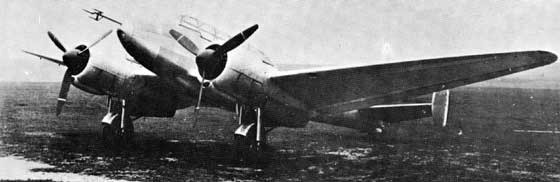
Characteristics
Length : 10.80 m
Width : 15.10 m
Height : 3.27 m
Mass :
- Empty : 3 186 kg
- Max : 4 726 kg
The aircraft is powered by two 670 hp Gnôme & Rhône 14M-3 engines, enabling it to reach a top speed of 450 or 460 km/h (similar to the standard bomber versions) and a ceiling of 10,000 m. Its range is estimated at 2,000 km.
Its crew therefore consists of three people: a pilot, a gunner, and a liaison officer positioned in the middle.
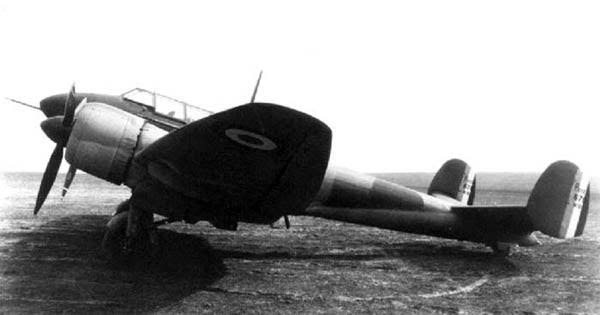
Weapons
The armament of the fighter version is exactly the same as that of the bomber version found in the game, except that it cannot carry secondary armament intended for destroying ground targets.
Offensive armament:
-
2 x 20mm HS 404 Hispano cannons
-
2 x 7.5mm Mac 34 machine guns
Defensive armament:
- 1 x 7.5mm Mac 34 machine gun (The machine gun was reportedly replaced during testing by a 20mm HS404 cannon; however, I have not yet found an image confirming this.)
In the game, this aircraft would be an interesting addition as a heavy fighter for the French tree, offering a fighter capable of inflicting significant damage on enemy aircraft with its main cannons, yet limited in flight performance by underpowered engines.
Sources
- L’Aéronautique | 1937-12-01 | Gallica
- L’Aéronautique | 1938-12-01 | Gallica
- Potez 670 ::: http://fandavion.free.fr
- Potez 670 - Chasseur - Un siècle d’aviation française
- Potez-670
- Chantiers Aéronavals Romano R-120 medium bomber prototype… | Secret Projects Forum
- LES PIONNIERS DE L’AVIATION - HENRY POTEZ - Air France - une Histoire d’Amour
- Le 30 mars 1939, un chasseur d’escorte expérimental nommé Potez 670 a effectué son vol inaugural. Cependant, ses caractéristiques de vol ne convenaient pas pour l’armée de l’air et Potez a décidé de moderniser son avion. Equipé avec de nouveaux moteurs radiaux Hispano-Suiza 14AC de 800 CV chacun, mais en conservant l’armement d’origine de deux canons à tir avant Hispano-Suiza HS-404 de 20 mm, deux mitrailleuses MAC 1934 de 7,5 mm et un canon Hispano-Suiza HS -404 en défense arrière, il fut rebaptisé Potez 671.01. Lors des essais en vol, qui ont eu lieu à partir de juillet 1939, il a démontré une vitesse maximale de 500 km / h. Le programme a été changé pour une configuration à deux places. Une commande en série de 40 chasseurs Potez 671 a été lancée mais aucun exemplaire n’a été produit en raison de la défaite de la… - Avions moches, bizarres, ratés, projets abandonnés et aviation insolite. | Facebook