Just like the good ol’ days
Vehicle: Type 87 RCV
Gamemode: Ground Realistic
BR Change: 9.0—> 9.0 (don’t move it up)
Reason: This vehicle lacks a thermal sight, ragefinder and a stabilizer, and its damage output is mediocre at best. Just one BR step higher sits the VBCI, which features 3rd-generation thermal sights for both the gunner and commander, a stabilizer, a laser rangefinder, a laser warning system (LWS), and even an active protection system (APS)! It’s simply ridiculous that all of this only amounts to a one-step difference in BR. There is no justification for increasing the BR of this vehicle; it has absolutely nothing that would make it suitable for 9.3.
5 Likes
The VBCI is being moved to 9.7
Almost all ground vehicles above 9.0 are getting a 0.3 increase minimum
This is honestly a positive change. Good work Dev team!
Vehicle: M41D
Gamemode: Ground Realistic
BR Change: 8.3—> 8.3 (don’t move it up)
Reason: This tank lacks any decent armor, has no stabilizer, and suffers from atrocious gun swinging; the gun itself is also weak—it suffers from a catastrophic lack of post-penetration damage due to its small caliber. Apparently, someone considers this tank a worthy rival to the T-62, which, for the time being, has not been moved up in proposed list of new Battle Ratings. This tank has no business being at 8.7; its appropriate BR is 8.0. The Israeli Magach 5 also has APFSDS (of an even larger caliber, no less) and performs just fine at 8.0. At the very least, set M41D to 8.3!
4 Likes
I think they forgot to ask you and right thing they did. Complaining about these tanks all of sudden
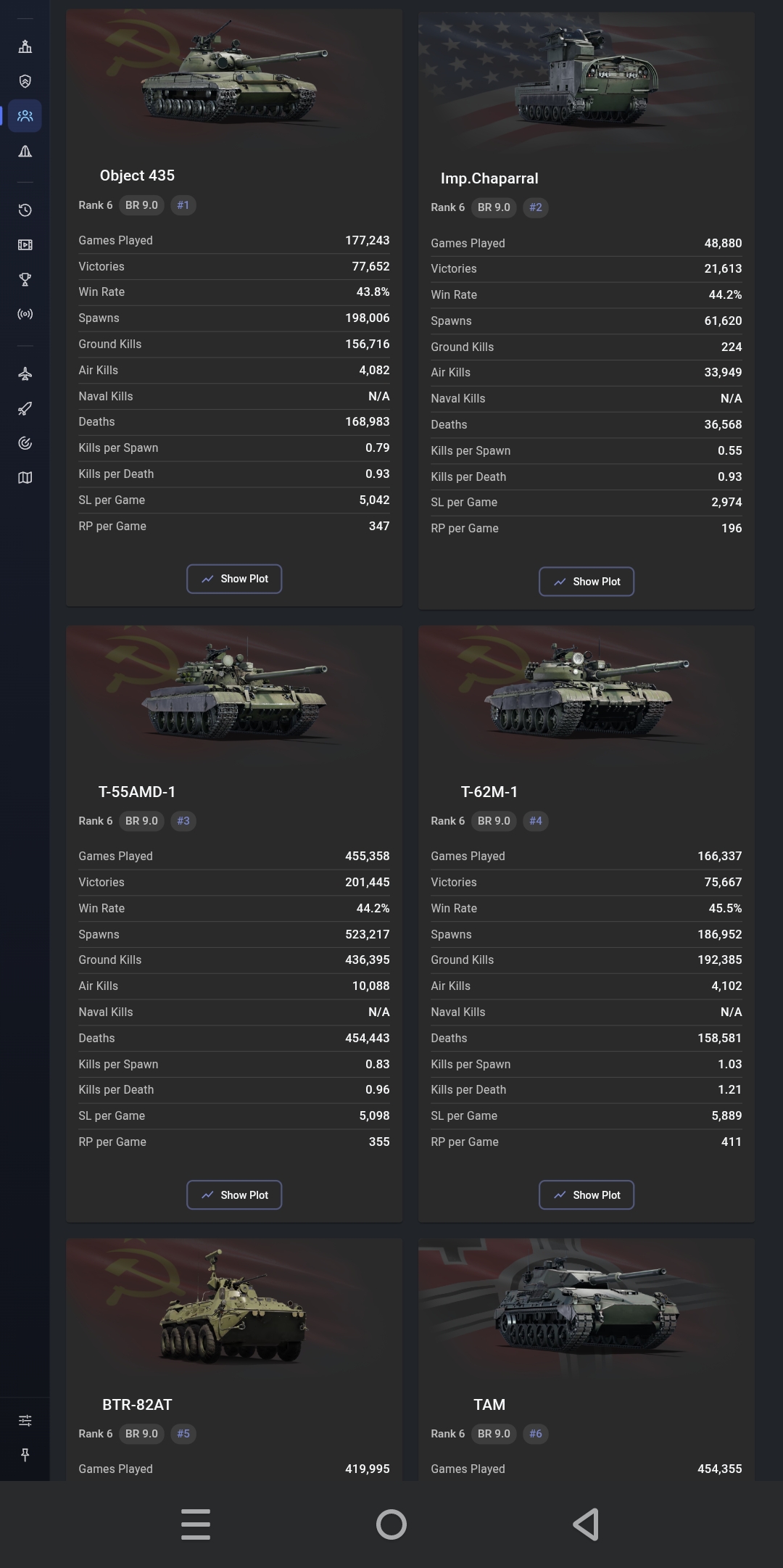
Imp fighting mighty Russian bias for the lowest WR
Despite XM803 having these stats also doesn’t move higher. “Russian” Bias at its finest
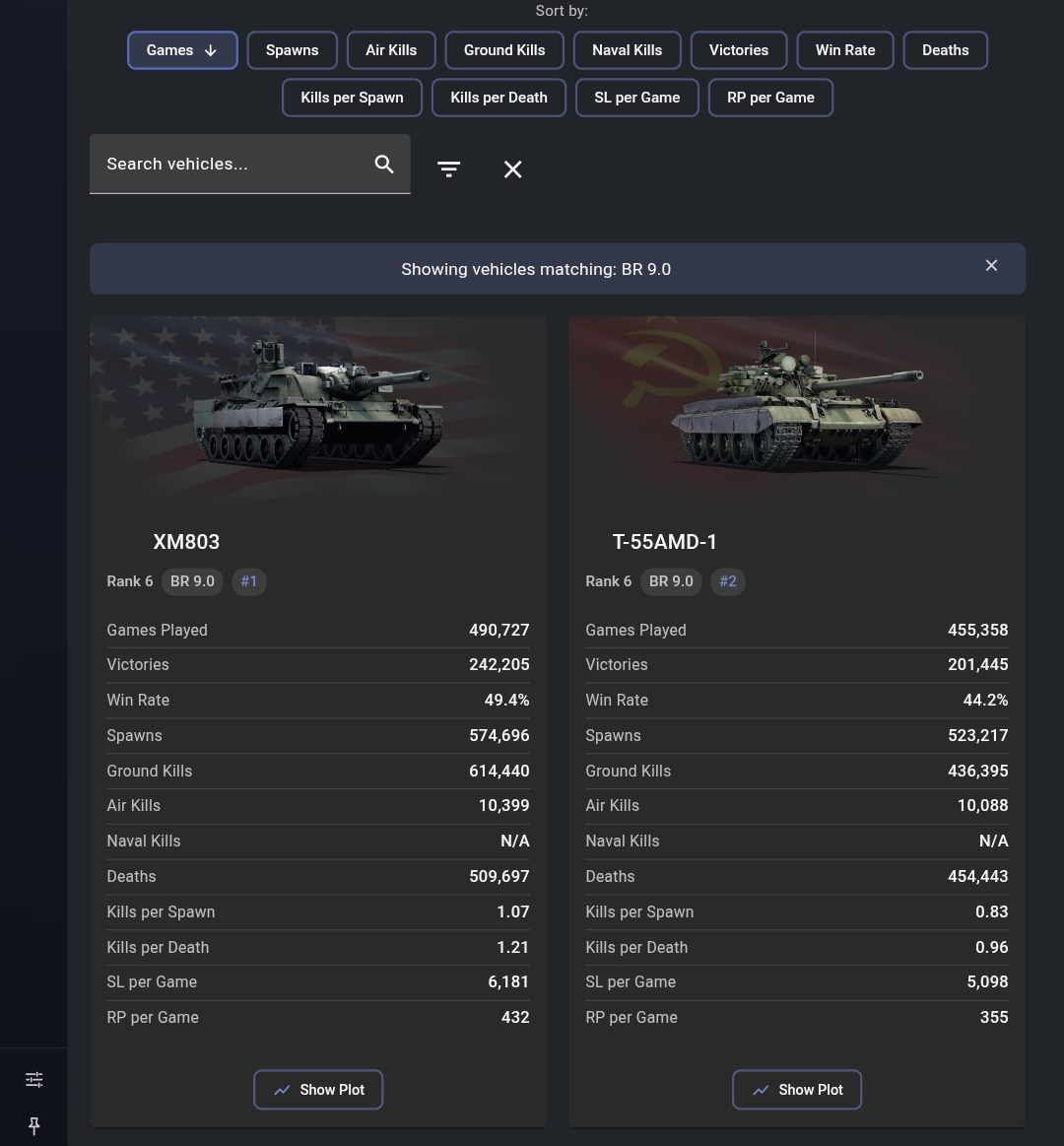
Yes, and Type 87 RCV is being moved to 9.3 while being worse at every single aspect (in some - dramatically). My point - it’ll be completely fine for Type 87 RCV stay at 9.0. It’s hilarious VBCI is only 1 step higher than RCV, it can be changed now.
Also, many soviet tanks won’t move in BR - seems to me dev “forgot” them.
Nice try using WR. You can make it better
At least I’m using something unlike you. And unlike you I actually played those vehicles and lineups and I know how it goes for Soviet teams. It was no surprise for me that devs don’t move them up.
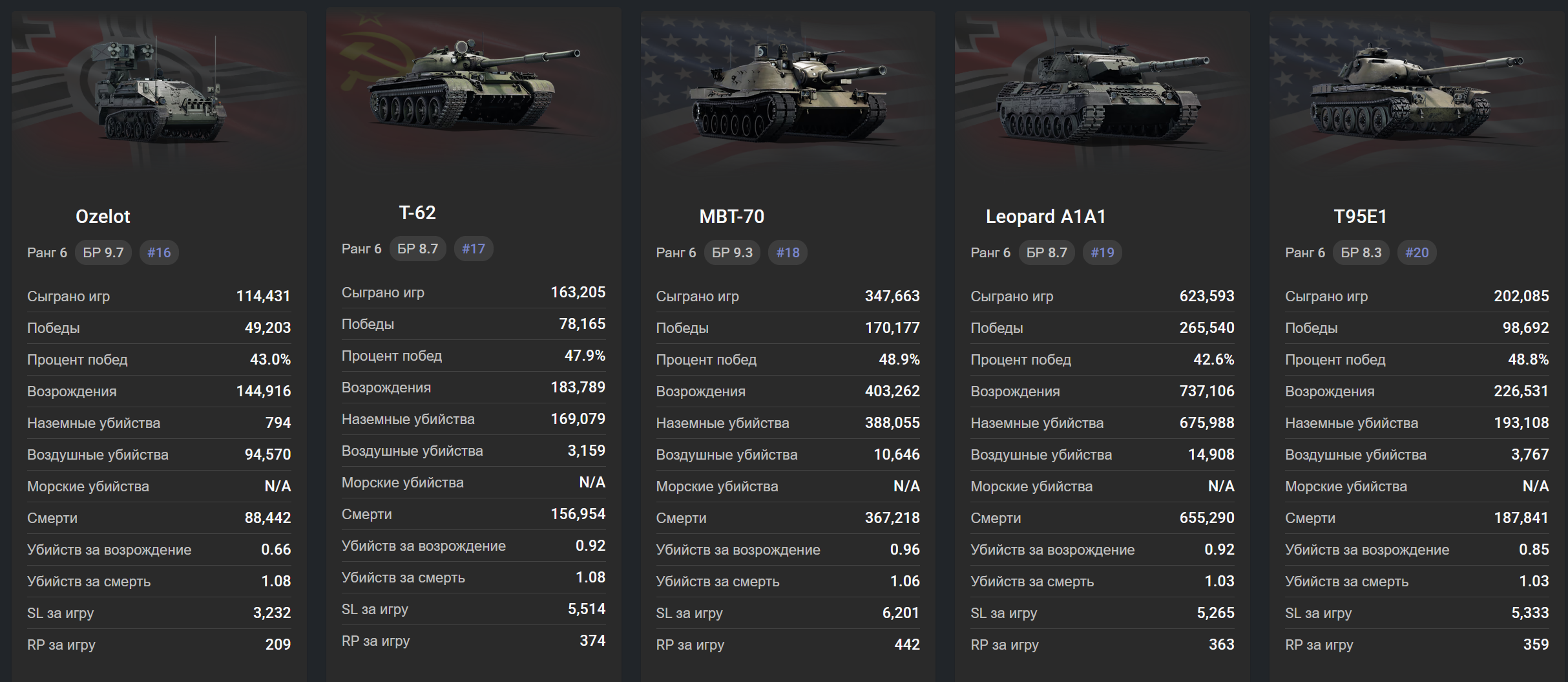
At least you could use info of the last month, not from Mesozoic Era.
Next time try better.
1 Like
It’s getting ridiculous. T-62M is direct upgrade of t-62. Now take a guess why t-62(8.7) doesn’t move to T-62M(9.0).
1+1=?
1 Like
Really, 1+1
It has better stats (k/d) and not going up like MBT with worse stat. Try to learn calculus before making some shitty jokes.
1 Like
It’s September stats dude. What are you talking about?
OK, pal. Maybe someone other gonna take their time and explain why bringing worse version of the same tank to the places where even upgraded version underperfoms is not exactly good idea
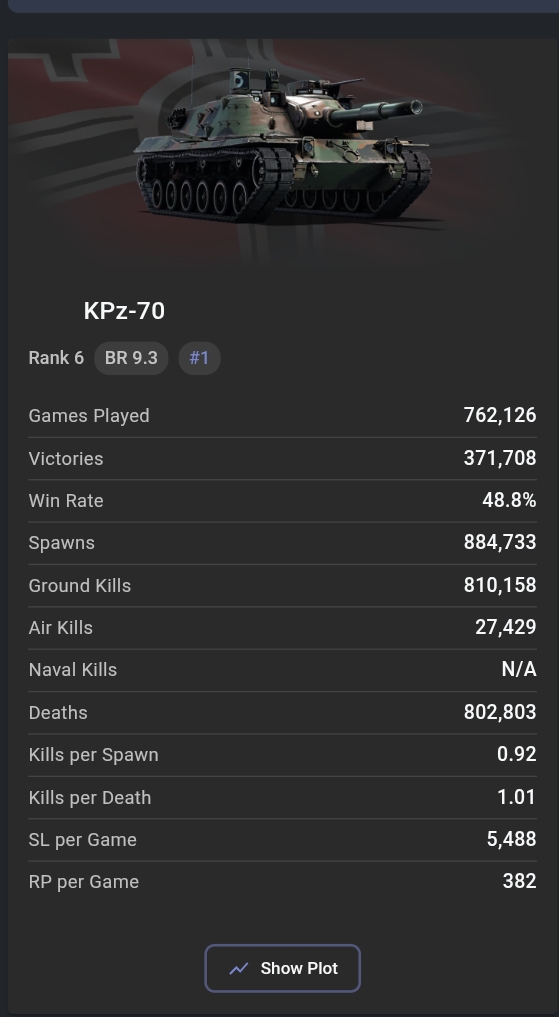
Maybe. You tried use stats and stats says, that if KPZ goes up with even worse stat, then T-62 should do that also.
Russia does not export 3BM60
Then so was the F-15C GE, Su-30SM2, Rafale, Gripen E, J-10C and J-15T
The idea that the M-Scan Typhoons vs literally anything else at top tier would be “balanced” is just hilarious.
The moment everyone else got AESA aircraft, the CAPTOR-E Typhoons were innevetiable, and perfectly acceptable
So, not much has changed in simulated battles.
You still get thrashed by French AMX models—which date from the early post-war period (the 1950s) and feature auto-loaders and ultra-fast turret traverse speeds—while you’re stuck in clunky Tiger IIs and Panthers. Then again, since I play the Ju 288, it’s the ground units that end up taking the beating.
Let’s take a look at airplanes, too.
The He 100? It’s got good speed, but that’s about it. I’d suggest looking at the Hurricane, the Swedish tech tree, the P-400, or those Soviet biplane contraptions. They’ve really captured the “German character” in the He 100, though—the Bf 109 E-1 is even worse.
The Bf 109 E-3 (late 1939) is “very strong” at its BR? Are you joking? The Yak-1 (1941) entered service in late 1941; its performance and armament are quite solid—a typical Soviet aircraft. Then there’s the P-40F-10 (late 1942), the Buffalo F2A-3 (late 1941), the A-36 Apache (1943), the Ki-43-II (December 1942), and various Italian machines (too many to list). I’ve also spotted a few decent things in the Swedish tree. And honestly, those FF/M cannons are such a curse—you practically have to shove your plane right into the enemy’s face to land a hit.
Let’s look at the models that face the Bf 109 E-4 (June–July 1940), which has a 3.0 Battle Rating: >Soviet tree< La-5 (1942), Yak-9 (October 1942), P-39N-0 (1942), P-39K-1 (August 1942), Hurricane Mk IIB (October 1941); >American tree< F4F-4 (November 1941) — well, at least that’s somewhat close; the British tree is relatively balanced; >Japanese tree< Ki-44-II Hei (1943); >Italian tree< C.202EC (1943).
Now, let’s consider the Bf 109 F-1 (February 1941), which has a 3.3 Battle Rating, and its counterparts: >Soviet tree< La-5F (1943), Yak-1B (October 1942); >American tree< P-39Q-5 (June 1943), F4U-1A (August 1943); >Japanese tree< Ki-61-I Otsu (September 1943); >Italian tree< Re.2001 CN (1942); >British tree< Spitfire VB Trop (spring/summer 1942); >French tree< P-39Q-25 (1943); >Swedish tree< J21A-1 (1945, equipped with a DB 605 engine).
Of course, at 3.3, we also have that beast, the Fw 190 A-1, which entered service in June 1941. Although its “FFM” cannons—those absolute monstrosities—are enough to make you tear your hair out, the aircraft’s speed seems to compensate for them.
3.7 BR: Bf 109 F-2 (March 1941) and its equivalents — American tree: P-63 A-5 (1944), P-38 G-1 (June 1942); Japanese tree: A6M3 (spring/summer 1942), J2M2 (October 1942); Italian tree: C.205 Serie 1 (February 1943), P-47 D-30 (October 1944 — hahahahah)
You mentioned the G-2 at 4.3 BR; well, it faces the P-51 C-10 at 4.0 BR—a plane from late 1943 (or even 1944) that outperforms the G-2 in every single category. Then there’s the Yak-3 at 4.3 BR (mid-to-late 1944). Frankly, most Soviet aircraft turn better than the F-4 or G-2 and are better at energy retention. The P-38J-15 (early 1944) sits at 4.0, the F6F-5N (1944) at 4.3, and the FR-1 Fireball (1945) is also present. There’s the Italian C.205 (August 1943), and the French F6F-5 at 3.7 BR—a truly nasty machine (mid-1944) that turns better than the Japanese planes while retaining all its energy.
Against the G-6, you have the Yak-3 (July 1944)—an absolute beast. The British P-38L-5-LO (June 1944) feels like an unfair inclusion. The Japanese ‘A’ series seems relatively balanced, though their ‘Ki’ series planes have remained at low BRs despite being produced later and performing exceptionally well.
The G-14 is somewhat balanced, but it faces the D-10 and that monster known as the Spitfire LF. It’s fair to say the Germans were on the decline during that period, though it feels like the British were treated a bit unfairly—though the “LF” beast more than makes up for it.
The G-14’s counterpart, the G-10, is the plane I hate the most; it’s neither fast nor particularly maneuverable—I wish it didn’t even exist. It faces the P-51D-30 (April/July 1945) and the P-38K (currently on sale—a real beast, though I’m not sure when it would have actually entered service; it would have likely been produced around the same time as the G-14). The Spitfire series has opened up an incredible performance gap—they seem completely overpowered. In terms of the timeline, things seem okay, though. There’s the Yak-9P (1946); I didn’t bother looking into the Japanese lineup, and the Italian tree has a new VDM-prop model—something a bit different. On paper, it looks good, and its production year would have roughly aligned with the G-14.
If we look at the K-4, D-9, and Ta 152, some aircraft that stand out to me are the Corsair F4U-4B (with a 1948 engine!)—and while the British models might not look out of place chronologically, they are far too advanced—as well as the French Sea Fury FB 51 at 5.7 BR (from 1952!). I haven’t even checked the Japanese tech tree; there might be some other odd additions there, too.
Let’s add this as well: American aircraft produced after 1943—with the exception of the Corsair and the P-47 (which is on par with the Fw 190)—possess incredible turn rates at high speeds. Furthermore, unlike the models I mentioned in parentheses, they don’t lose energy during these maneuvers. Because they are capable of such high speeds, they can easily compensate for any disadvantage in climb rate. Models like the F5F and F6F are quite unique—they are more agile than Zeros, yet they retain energy better and are faster, too.
In these assessments, the G-14 seems historically balanced, and the G-10 appears balanced as well. However, the earlier models—specifically the E-3, F-4, G-2, and G-6—suffer from a disastrous lack of balance.
The 2.7 to 3.7 BR (Battle Rating) range is a disaster—you could even extend that up to 4.7. The counterparts mentioned were all produced in later years; whether in terms of armament, speed, or maneuverability—or a combination of all three—they are vastly superior to their rivals.
I’m not sure what the situation is like in Arcade or Realistic battles, but in Simulation battles, even the slightest differences can have a massive impact.
The results speak for themselves—may God help those playing the German tech tree.
I won’t get into the tank tech tree for now; I’ll organize that and add it here when I have some time.