Ho-Ri (prototype) - GRB 6.7->6.0 - the vehicle is equal in protection to, and in some ways inferior to, both the Jagdpanther and the Su-100 at lower BRs. However, it is definitely inferior in mobility. The gun also doesn’t have outstanding characteristics - better in some ways, worse in others, but is roughly on par with the faster-firing and more penetrating German 8.8cm with less damage and the higher-penetration Soviet 100mm.
7 Likes
Ho-Ri Production - GRB 7.3->7.0 - the vehicle is equal to the Ferdinand in all stats except mobility. Mobility alone adds 0.3 BR. Another 0.3 is added purely for the stats gained from enemies shooting at the upper frontal plate, its strongest point.
7 Likes
F9F-2 Panther decrease battle rating for Air AB, Air RB, Air SB
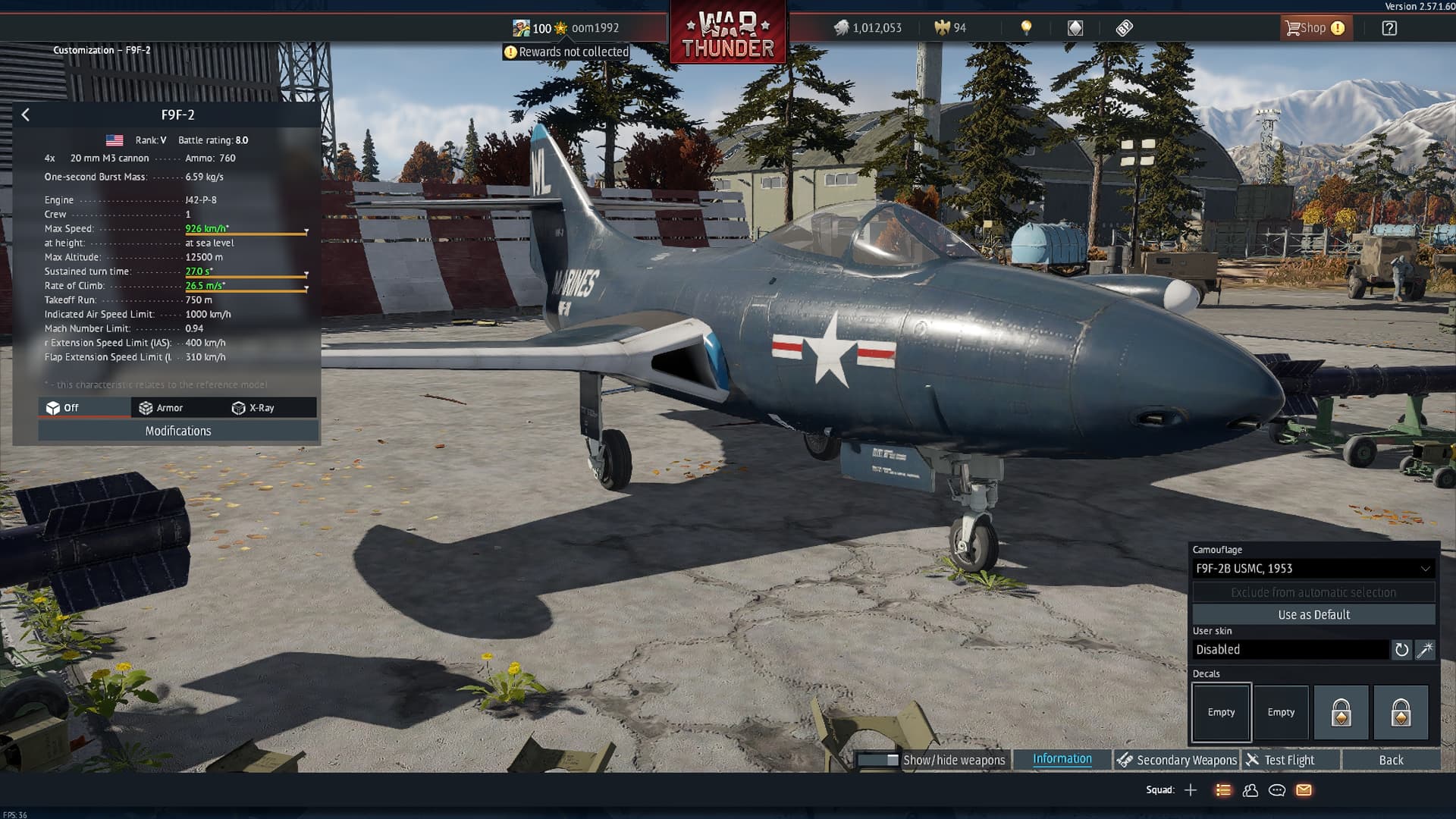
Air Arcade battle
8.3 → 8.0

Air Realistic battle
8.0 → 7.7

Air Simulator battle
8.3 → 8.0

Mode: Air RB
Vehicle: Bf 110 G-4 night fighter (plus premium in Italian TT)
Recommendation: BR 3.7 (keep BR but give it an air superiority fighter spawn)
Reasoning:
Short:
Severe disadvantage vs night fighters from the UK/SWE/US due to way lower spawn altitude results in significantly lower combat effectiveness by design and not by player skill.
Long:
Upfront:
- Air superiority fighter air spawn: 2 km altitude
- Interceptor air spawn: 1 km altitude
- Strike aircraft air spawn: 1 km altitude
Current spawn altitudes for all prop night fighters for Rank III:
- 2 km: Mosquito NF.Mk. II and J30 (3.7), US prem P-61 (3.7), P-61 TT (4.0)
- 1 km: Bf-110 G-4 (3.7), Ta 154, Ju 388L, He 219 (all 4.3)
Impact on combat effectiveness of higher spawn altitudes:
- As all of the mentioned night fighters have similar climb rates is seems logical than when a UK/SWE/US night fighter meets an GER/IT night fighter the 1st group has always (in case all climbed at optimal speeds) the initiative in a fight as he has the higher altitude / energy state - whilst the 2nd group can just react.
- Higher spawn altitudes makes planes more effective - that’s why the Mosqito NF.Mk.II was in May 2026 the most successful British fighter regarding Kills per Spawn - and way ahead of any Spitfire at any BR - whilst the 4 German night fighters produced very poor A2A combat results.
Reasoning for special “treatment” of night fighters:
- A night fighter carries a lot of additional equipment which affects the flight characteristics and somehow justifies a higher spawn altitude compared to twin engine day fighters which have due to less weight (and often drag) without this radar equipment at least in theory a way better performance.
Current “as it is” situation:
If you play Air RB frequently at this BR and invest some time on StatShark analyzing the factors:
- Kills per Spawn
- Kills per Death
- SL & RP income
you find out that night fighters with the 2 km air spawn severely outperform those with 1 km air spawn - quite logical due to energy advantage and significantly more success intercepting medium / heavy bombers.
Therefore it seems logical that the systemic disadvantage needs to go.
2 Likes
Mode: Air RB
Vehicle: Ta 154 night fighter
Recommendation: BR 4.3 (keep BR but give it an air superiority fighter spawn)
Reasoning:
Short:
Severe disadvantage vs night fighters from the UK/SWE/US due to way lower spawn altitude results in significantly lower combat effectiveness by design and not by player skill.
Long:
Upfront:
- Air superiority fighter air spawn: 2 km altitude
- Interceptor air spawn: 1 km altitude
- Strike aircraft air spawn: 1 km altitude
Current spawn altitudes for all prop night fighters for Rank III:
- 2 km: Mosquito NF.Mk. II and J30 (3.7), US prem P-61 (3.7), P-61 TT (4.0)
- 1 km: Bf-110 G-4 (3.7), Ta 154, Ju 388L, He 219 (all 4.3)
Impact on combat effectiveness of higher spawn altitudes:
- As all of the mentioned night fighters have similar climb rates is seems logical than when a UK/SWE/US night fighter meets an GER/IT night fighter the 1st group has always (in case all climbed at optimal speeds) the initiative in a fight as he has the higher altitude / energy state - whilst the 2nd group can just react.
- Higher spawn altitudes makes planes more effective - that’s why the Mosqito NF.Mk.II was in May 2026 the most successful British fighter regarding Kills per Spawn - and way ahead of any Spitfire at any BR - whilst the 4 German night fighters produced very poor A2A combat results.
Reasoning for special “treatment” of night fighters:
- A night fighter carries a lot of additional equipment which affects the flight characteristics and somehow justifies a higher spawn altitude compared to twin engine day fighters which have due to less weight (and often drag) without this radar equipment at least in theory a way better performance.
Current “as it is” situation:
If you play Air RB frequently at this BR and invest some time on StatShark analyzing the factors:
- Kills per Spawn
- Kills per Death
- SL & RP income
you find out that night fighters with the 2 km air spawn severely outperform those with 1 km air spawn - quite logical due to energy advantage and significantly more success intercepting medium / heavy bombers.
Therefore it seems logical that the systemic disadvantage needs to go.
5 Likes
Mode: Air RB
Vehicle: He 219 night fighter
Recommendation: BR 4.3 (keep BR but give it an air superiority fighter spawn)
Reasoning:
Short:
Severe disadvantage vs night fighters from the UK/SWE/US due to way lower spawn altitude results in significantly lower combat effectiveness by design and not by player skill.
Long:
Upfront:
- Air superioriry fighter air spawn: 2 km altitude
- Interceptor air spawn: 1 km altitude
- Strike aircraft air spawn: 1 km altitude
Current spawn altitudes for all prop night fighters for Rank III:
- 2 km: Mosquito NF.Mk. II and J30 (3.7), US prem P-61 (3.7), P-61 TT (4.0)
- 1 km: Bf-110 G-4 (3.7), Ta 154, Ju 388L, He 219 (all 4.3)
Impact on combat effectiveness of higher spawn altitudes:
- As all of the mentioned night fighters have similar climb rates is seems logical than when a UK/SWE/US night fighter meets an GER/IT night fighter the 1st group has always (in case all climbed at optimal speeds) the initiative in a fight as he has the higher altitude / energy state - whilst the 2nd group can just react.
- Higher spawn altitudes makes planes more effective - that’s why the Mosqito NF.Mk.II was in May 2026 the most successful British fighter regarding Kills per Spawn - and way ahead of any Spitfire at any BR - whilst the 4 German night fighters produced very poor A2A combat results.
Reasoning for special “treatment” of night fighters:
- A night fighter carries a lot of additional equipment which affects the flight characteristics and somehow justifies a higher spawn altitude compared to twin engine day fighters which have due to less weight (and often drag) without this radar equipment at least in theory a way better performance.
Current “as it is” situation:
If you play Air RB frequently at this BR and invest some time on StatShark analyzing the factors:
- Kills per Spawn
- Kills per Death
- SL & RP income
you find out that night fighters with the 2 km air spawn severely outperform those with 1 km air spawn - quite logical due to energy advantage and significantly more success intercepting medium / heavy bombers.
This premium aircraft is (like the Ta 154) a very rare view in Air RB - and the way lower spawn altitude and resulting reduced combat effectiveness explains why. With a 2 km Air Superiority fighter spawn the plane could overcome this systemic disadvantage and it might be able to push sales too.
Therefore it seems logical that the systemic disadvantage needs to go.
3 Likes
Suggestion:
Naval
KM-5
1.7>1.3
It is essentially just a bigger LS3 but unjustifiably 0.7 higher.
The twin 7.92mm MGs are almost worthless having very poor chance of causing any type of notable damage unless at point blank range. That leaves the single 15mm MG151 (same as LS3) , meanwhile most opponents at 1.7 will boast something like a 20mm and twin 12.7mms, with some upping the game to a 40mm (or even large low velocity guns)…
Additionally being larger, slower and less manouverable makes it a much easier target than the LS3. The increase in hull strength is OK but as your likely to be taking more and heavier hits in reality it adds little to survivability.
1 Like
R2Y2 should imo go to 7.3 or 7.7 in Air RB, you removed the airspawn and the guns are slightly weaker than they used to be, so moving it down wouldnt really be an issue. I know it isn’t in the tech tree anymore, but if you are willing to alter the BR of the 341 despite it not being in the game either for a bit, then you certainly can do the same for the R2Y2
6 Likes
I can’t speak about air, as I know nothing about it.
The Leopard BR reduction isn’t necessary. It’s a very good tank and does very well at its BR.
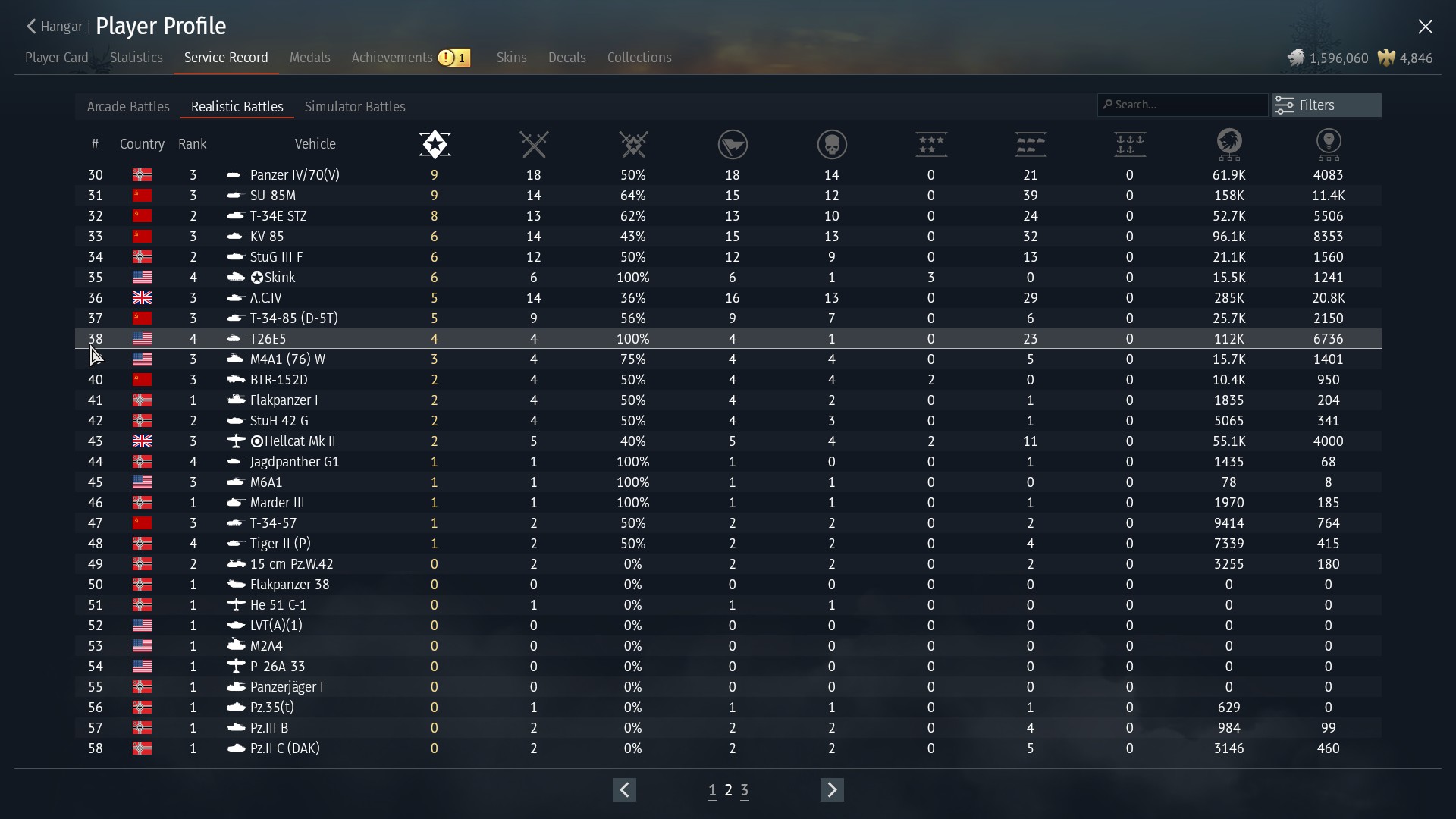
The T26E5 is barely functional as a “heavy” at 6.7 due to its spotty volumetric reliance. You can die just as easily as you can bounce, from being hit almost anywhere by a German 88. Putting it at 7.0 where it will encounter 8.0s is a death sentence, especially with its mediocre gun. It won’t be able to function outside of downtiers. This is probably the most offensive BR change in the whole list, and needs to not be implemented, at all.
The Super Hellcat BR going up is baffling. It’s not that good.
The IS-2 dropping makes sense, although combined with all the M61 British tanks going up is especially offensive. Those UK tanks need to stay where they are.
All the M109a1 types going down is fine. They’re pretty trash, and people overstate the gun. The platforms are massive and slow.
The FV4005 just needs its gun to do what it would actually do: kill anything it hits. Its turret could also rotate anywhere; it just had a recommended rotation vector. In other words, fix it instead of trying to move it.
The M44s and M55s are a bit odd, but not a big deal. They honestly may have more trouble in lower BRs, where enemies are faster and more aggressive.
And lastly, leave the T20 alone. Its stats are high because veterans play it. You never see them on the battlefield, otherwise, so they’re never a problem. Also, either revert the mistakes you made with the T25 or change its BR, if you want to do something productive.
1 Like
HAHAHAHA

Well deserve change.
I hope Gaijin dont fall again in the trap of massive allies fanboys cry and all changes are implemented.
Mode: Ground Realistic Battles
Aircraft: Sagittario 2
Change: 9.3 → 9.0
Reasoning: The Sagittario 2 is one of the clearest examples of an aircraft whose Ground RB battle rating should be separated from its performance in Air RB.
In Ground RB, it is essentially a pure CAP aircraft. It has no suspended armament whatsoever: no bombs, rockets, guided weapons or air-to-air missiles. Its only weapons are two 30 mm cannons, whose AP ammunition penetrates only 39 mm at point-blank range and 24 mm at 500 metres. It can attack exposed SPAAs and lightly armoured vehicles, but it has no meaningful CAS capability.
It also has no radar, no RWR, no countermeasures, no missiles and no ballistic computer. Its manoeuvrability makes it a capable dogfighter, but good handling alone cannot fully compensate for the complete absence of defensive electronics and secondary armament in combined battles.
The planned changes make this inconsistency particularly clear. The Su-17M2, which is 10.0 in Air RB, and the MiG-23BN, Jaguar GR.1 and AV-8A, which are all 9.7 in Air RB, are being reduced from 9.7 to 9.3 in Ground RB. All of them have an Air RB battle rating higher than the Sagittario 2’s 9.3, while also possessing actual ground-attack loadouts, ballistic computers, missiles, bombs or rockets.
An even more direct comparison is the MiG-21 SPS-K. It is 9.7 in Air RB, yet it is being reduced from 9.3 to 9.0 in Ground RB. It can carry R-60, R-13M1 and radar-guided R-3R missiles, has radar and RWR, and can equip a countermeasure pod. The Yak-38 is also being reduced from 9.3 to 9.0 despite carrying R-60 missiles, bombs, rockets and the Kh-23M guided air-to-ground missile.
The Sagittario 2 does not need to be lowered in Air RB, where its manoeuvrability remains important. However, reducing it to 9.0 specifically in Ground RB would simply recognise its extremely limited role: it can perform CAP, but it has no real CAS capability and none of the electronic or defensive equipment available to many aircraft receiving the same or even larger reductions.
A Ground RB rating of 9.0 would therefore be consistent with the logic applied throughout the proposed BR changes, without making the aircraft overpowered.
2 Likes
Aircraft: G.91 pre-serie
Change: 8.3 → 7.7/8.0
Reasoning: If the G.91 R/1 is being reduced from 8.7 to 8.3 in Ground RB, the G.91 pre-serie cannot reasonably remain at 8.3.
The two aircraft have very similar basic flight characteristics and manoeuvrability, but the R/1 is the clearly superior version. It has the more powerful Orpheus Mk.803 engine and, most importantly for Ground RB, access to both AS-20 Nord guided air-to-ground missiles and AA-20 air-to-air missiles. The pre-serie has neither.
The pre-serie is limited to 12.7 mm machine guns, unguided FFAR rockets and a maximum of two 500 lb bombs. Its guns are practically irrelevant against normal ground vehicles, its rockets are inaccurate, and its two bombs require the aircraft to fly directly over the battlefield without any ballistic computer or guided delivery system. It has no meaningful stand-off capability and no air-to-air missiles.
Saying that the aircraft is manoeuvrable does not justify keeping it at 8.3 in Ground RB. Manoeuvrability is primarily an Air RB advantage, and this is already reflected in the separate Air RB ratings: the pre-serie is 8.3 in Air RB, while the superior R/1 is 8.7. If Air RB performance and Ground RB effectiveness are being evaluated separately, then the pre-serie must be placed below the R/1 in Ground RB as well.
Leaving both aircraft at 8.3 would mean giving the same Ground RB rating to two almost equally manoeuvrable aircraft, while one of them has guided anti-tank missiles and the other has only basic unguided ordnance comparable to aircraft found around 7.7.
The G.91 pre-serie is a capable light fighter, but in Ground RB its armament is completely inadequate for 8.3. A reduction to 7.7/8.0 would correctly reflect its extremely limited ground-attack capability and maintain a logical separation from the much more capable G.91 R/1.
2 Likes
Mode: Ground Realistic Battles
Aircraft: Ariete
Change: 9.3 → 9.0
Reasoning: The Ariete is an exceptionally manoeuvrable and capable dogfighter. However, this strength is already reflected in its 9.3 Air RB battle rating. This proposal is not asking for any reduction in Air RB, but for its extremely limited usefulness in Ground RB to be properly recognised.
In Ground RB, the Ariete is exclusively a CAP aircraft. It has no bombs, rockets, air-to-ground weapons or air-to-air missiles. It also has no countermeasures, no RWR and no defensive electronics. Its entire armament consists of two 30 mm cannons with only 240 rounds and a maximum penetration of 39 mm at point-blank range, falling to 24 mm at 500 metres. They are useful against aircraft, exposed SPAAs and light vehicles, but they provide no meaningful CAS capability against normal ground targets.
The obvious response will be that the Ariete is extremely manoeuvrable. That is true, but manoeuvrability is primarily an Air RB advantage, and this is exactly why the Ariete is rated at 9.3 in Air RB. If manoeuvrability alone were sufficient to determine the Ground RB rating, there would be little purpose in having separate Air and Ground battle ratings.
The proposed changes make the inconsistency particularly clear. The MiG-21 SPS-K is rated higher than the Ariete in Air RB at 9.7, yet it is being reduced from 9.3 to 9.0 in Ground RB. In addition to its supersonic performance, it has radar, RWR, an optional countermeasure pod, R-60, R-13M1 and radar-guided R-3R air-to-air missiles, as well as bombs and rockets. The Ariete possesses none of these capabilities.
The Yak-38 is also being reduced from 9.3 to 9.0 in Ground RB despite having R-60 air-to-air missiles, bombs, several types of rockets, the Kh-23M guided air-to-ground missile, RWR and a ballistic computer. Its flight performance is clearly inferior to the Ariete’s, but that difference is already represented by their Air RB performance. In Ground RB, the Yak-38 offers a complete selection of weapons for both CAS and air defence, while the Ariete can only perform CAP with its cannons.
Therefore, the Ariete can reasonably remain at 9.3 in Air RB, where its manoeuvrability makes it a highly capable fighter, while being reduced to 9.0 in Ground RB, where it has no CAS capability, no missiles and no defensive electronics.
Keeping it at 9.3 in Ground RB solely because it is manoeuvrable, while aircraft with higher Air RB ratings and vastly superior weapon systems are moved to 9.0, would be inconsistent with the entire purpose of separate Ground RB battle ratings.
Rear aspect only.
G.91 R/4 Italy and Germany — Add the missing historical armament or reduce the Ground RB BR
Mode: Ground Realistic Battles
Aircraft: G.91 R/4 — Italy and Germany
Proposal:
- Option A: Keep both aircraft at 8.7 and add their missing historical armament.
- Option B: If the armament remains unchanged, reduce both aircraft from 8.7 to 8.3 in Ground RB.
Reasoning: The proposed BR changes reduce the G.91 R/1 from 8.7 to 8.3 in Ground RB, while both the Italian and German G.91 R/4 remain unchanged at 8.7.
The R/4 uses essentially the same airframe and retains the same weak primary armament of four 12.7 mm M3 machine guns. Its main additional air-to-air advantage consists of four AIM-9B Sidewinders, but these early rear-aspect missiles have very limited value in Ground RB. Low-altitude engagements are generally short, targets are frequently manoeuvring, and an AIM-9B can be defeated without requiring modern countermeasures.
The AIM-9Bs may justify a difference in Air RB, where dedicated air combat is the aircraft’s main purpose, but they should not automatically justify a 0.4 BR difference in Ground RB. They provide no CAS capability and do not compensate for the R/4’s inadequate machine-gun armament.
The R/4 admittedly carries four AS-20 Nord missiles instead of the R/1’s two, but its remaining ground-attack options are still very limited. Once the Nords have been used, the aircraft is left with four .50 calibre machine guns, two bombs or a small number of unguided rockets.
There is already a documented historical armament report covering both aircraft. According to it, both the Italian and German R/4 could receive:
- 12 RP-3 rockets, six on each pylon;
- the historically correct load of up to 100 two-inch rockets, with 62 on the inner pylons and 38 on the outer pylons.
The Portuguese G.91 R/4 represented in the Italian tree could additionally receive its historical custom four-tube and six-tube launchers for 2.75-inch FFAR rockets.
Historical armament report:Community Bug Reporting System
Adding these missing weapons would improve the aircraft’s flexibility and provide a reasonable justification for retaining the current 8.7 Ground RB rating.
However, if these historically documented weapons are not added, both G.91 R/4s should be reduced to 8.3 in Ground RB, together with the G.91 R/1. Four AIM-9Bs, which are highly situational in combined battles, are not sufficient to justify keeping the R/4 at a higher Ground RB rating.
The current official vehicle pages confirm that both R/4s remain dependent on four 12.7 mm machine guns and a limited selection of bombs, FFARs and Nord missiles.
Suggestion
Naval
Japan Coastal Type T-38
1.7>1.0
The Type 38 offers no advantage over Type T-14 (mod 2) that is the current 1.0 reserve boat.
Same 25mmType 96 with 360deg coverage, same Type 2 torpedos, same crew, same armour, but is heavier and slower. Nothing I see or feel during testing or play justifies the BR and repair cost/time increase.
- Alternatively, unless the T-38 has some magic hidden advantage I am unaware of they should be swapped around. T-38 being the reserve and the T-14(mod 2) going to it’s slot but at 1.3.
3 Likes
Suggestion:
Italian Coastal - Stefano Turr
1.7>1.3
Positives - steel structure, 4 (mediocre) torpedos
Negatives - Gun armament is bad…very bad for its BR. 3x 13.2mm sounds sort of OK but their arcs are terrible with only the forward one being unimpeded by the other pair. The stern mounted 6.5mm is useless, both in calibre and ammo (ball, tracer mix only), plus is no longer classed as a secondary so can’t even be used as an independent tail warning signal. Speed and manouverability are OK but nothing spectacular to make up for the shortfall in combat capabilities.
In play you won’t be first to a cap where the hull armour will make you more difficult to shoot out. You also won’t be able to dig out enemies from those same caps due to your own weak armament. Neither can you sit further back and act as a support boat as you lack the range and firepower.
Overall a very poor boat that in many ways I feel is inferior even to it’s Tech Tree predecessor the MS-15 at 1.3. Currently a boat without a purpose.
4 Likes
Would you play the T26E5 in battles at BR 7.3–7.7? BUT German continue to play the Tiger II under such circumstances.
If you use the Tiger II in battles at BR 5.7–7.0 just like you use the T26E5, your experience will be equally good.
However, the 88 mm gun gives the Tiger II the ability to engage tanks at BR 7.3–7.7, while the T26E5’s 90 mm gun does not have enough performance to penetrate them frontally. Therefore, very few people would continue to play the T26E5 in such high‑BR matches.
Vehicle: KV-220
Change reloading time 7.4 to 7.0 s.
reason: like on othere 85mm barels
(ARB) 6.3 → 6.0
2 Likes
Seconded. Its selling point is the number of torpedoes but it’s at the wrong BR to make real use of those.
One of the roughest spading experiences I’ve had in this game.