- Yes
- No
- Yes
- No

Introduction
The Pansarband 302 (Pbv 302) would be the first serial-produced tracked APC for the Swedish Army. The Pansarbandvagn 301 (Pbv 301) had only been a stopgap solution while a design was being developed for a more successful vehicle. The Pbv 301 also relied on the older chassis of the Strv m/41, which is a derived variant of the Czech Praga TNH. Thus, only 220 Pbv 301s would ever be built in the early 60s, with prototyping for the program dubbed Pbv m/ny being commenced around the same time. Two companies would try to get the approval to create the first prototype, Landsverk and Hägglunds & Söner. Hägglunds would ultimately win the contract and was approved to create two prototypes. After testing, a pre-production batch of around 20 vehicles was ordered for quality control in 1966, and serial production began after these were completed. Serial production would continue to 1972 with 644 Pbv 302 produced across all different variants, 647 vehicles were produced if prototypes are included. Out of these, 518 were Pbv 302, while the rest were specialised variants like artillery observation vehicles. Initially, the vehicle would only be known as the Pbv 302, but as 50 vehicles later would be upgraded, the letter A was added to the non-upgraded ones, while the upgraded ones became the B variant.
History
In the early 1960s, the directives for a new APC were given, and the contract to build the new APC for Sweden was given to Landsverk and Hägglunds & Söner. But a stopgap solution was also needed, so it was decided to reuse the chassis of the Strv m/41, the Swedish-built version of the Czech Praga TNH. This stopgap APC was the Pansarbandvagn 301 (Pbv 301) and would start production in 1962. Landsverk and Hägglunds fought over this contract as well, but Hägglunds’ prototype won. The program would be named Pbv m/ny, and Landsverk and Hägglunds would be asked to draw up their own proposals for the program. Meanwhile, importing a foreign model was also on the table. The M113 was high up on the list of interesting vehicles, so it was decided to acquire one example for testing.
Landsverk would present one variant, while Hägglunds presented two options; the difference between them was the gearbox used. Hägglunds won the deal and was granted funds to build two prototypes. One of which would feature the Volvo PENTA R-60 gearbox, which is the same as used in serial production; meanwhile, the other prototype featured a gearbox that had 6 forward gears and 3 reverse gears. It also had a high and low range, which meant it had 12 forward gears and 6 reverse gears in total. These two prototypes would be numbered Nr. 925 and Nr. 926. The first prototype: Nr. 925 would be completed in 1962 with Nr. 926 in 1963, and testing of the vehicles commenced in 1963. While testing the two prototypes, it was noted that 12 forward gears in the second prototype were excessive, and the driver would frequently skip every other gear. Nr. 926 also featured a ramp for the troops in the back to get out of the vehicle, just like on the M113. But once again, this was deemed not necessary, and the option of the two rear doors on the Nr. 925 prototype was deemed good enough. When the prototypes were delivered, they also featured a different turret than what would be found on the production series. When the basis for the new APC became Nr. 925, it was ordered to be fitted with a new turret. This is the same one as found on the production Pbv 302. The armament chosen was the akan m/47, which is the same cannon found on some aircraft used by the Swedish Air Force. Some modification was done for it to work in the Pbv 302, and this version became the akan m/47D.
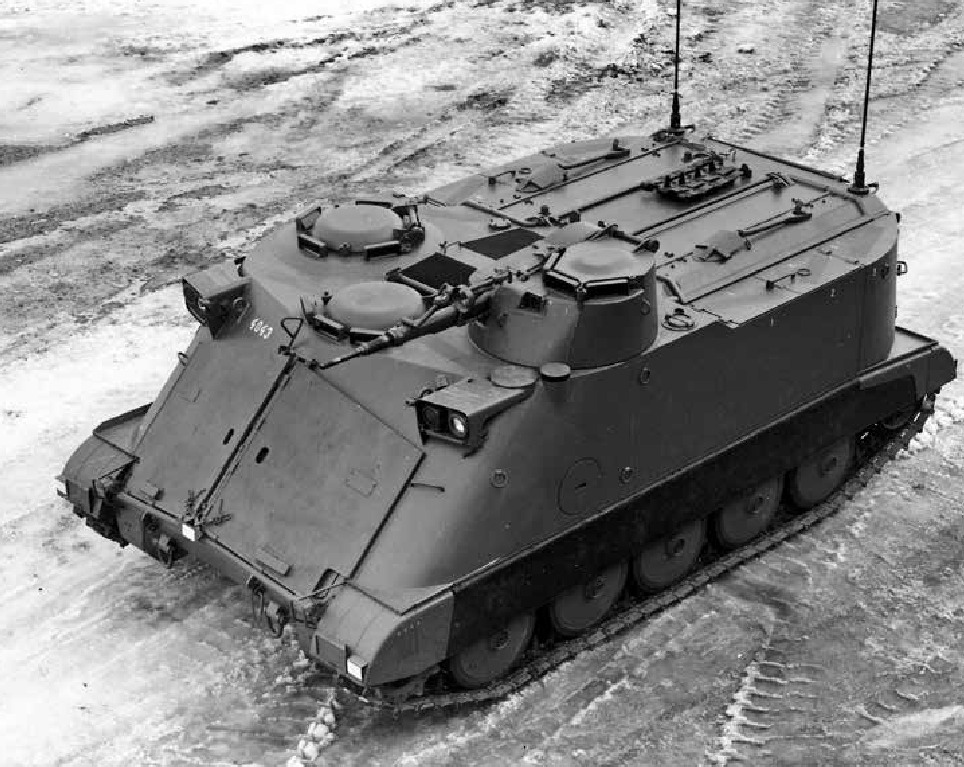
One of the pre-production Pbv 302s
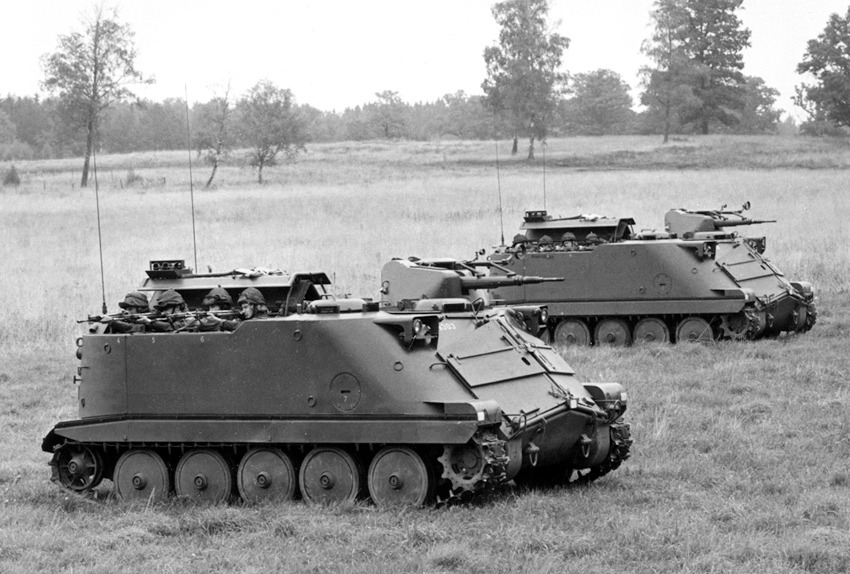
Two serial production Pbv 302s under training excercise
Production began in 1966 with a pre-production batch of 26 vehicles. These can be distinguished from the later serial version by the larger rubber side skirts, which would later, under testing, be found to be torn to bits while going through rugged terrain. Smaller metal side skirts would be fitted instead, but even these were not always present either. Weirdly enough, smoke launchers seem to have been omitted on these 26 vehicles; the two prototypes had launchers hidden under a hatch in each rear corner on them. Serial production vehicles had external launchers mounted on the folding roof for the infantry. The splash board would receive an extension. Pre-production vehicles also featured IR headlights mounted next to the regular headlights. Full serial production would begin in 1967 and continue to 1969, with the last Pbv 302 being delivered in 1972. In 1979, prototyping for upgrading the Pbv 302 began, and three Pbv 302s received various modifications; meanwhile, Hägglund had also rebuilt another Pbv 302 to Pbv 302 H, more commonly known as UDES 08. This modernisation program was called REMO, and in the end, it resulted in the vehicles getting the smoke launchers moved from the roof of the troop compartment to the turret. The internal layout of the turret was rearranged, and this allowed a 30-round magazine instead of the previous 10-round magazine. Full modification of the fleet of Pbv 302 commenced in 1984 and lasted until 1997. Under REMO, 50 Pbv 302 would be fitted with spall liners, and testing with ceramic appliqué armor was also conducted. These vehicles would be used for peacekeeping and would be designated Pbv 302B, and the stock Pbv 302 became the A model. It is also worth noting that the Pbv 302 would initially receive tracks of the M113 alongside a sprocket compatible with these tracks. Later, all vehicles would be fitted with M70 tracks and thus the M70 Sprocket.
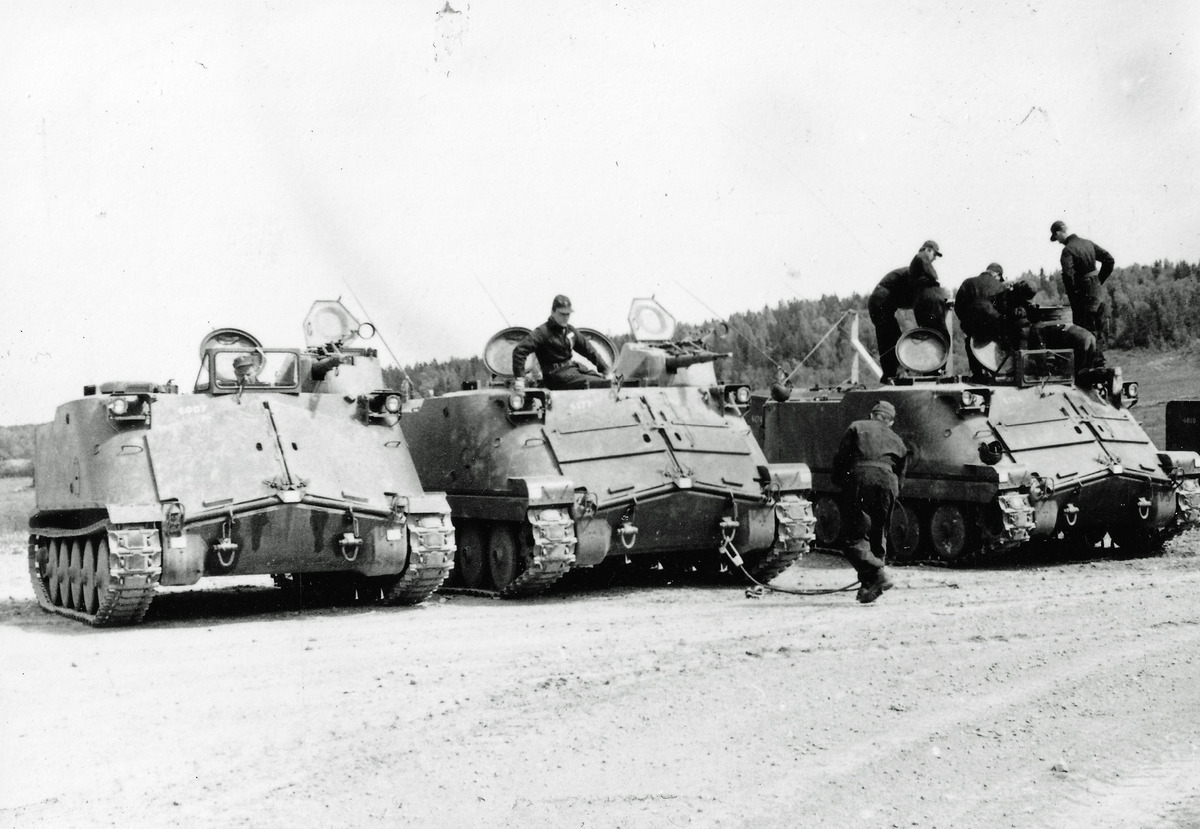
Above, we can see to the left one of the pre-production Pbv 302, while the one in the middle and the one to the right are serial production vehicles
Sadly. Some of these renovated APCs would not last long in the Swedish army as demilitarization was in full swing and the procurement of Stridsfordon 90 meant that the Pbv 302s time in service was numbered. In 2005, it was decided that 160 Pbv 302s would be scrapped, not only due to the procurement of the Strf 90 but also because the SEP program was looking very promising at the time. By 2010, 181 Pbv 302A remained in service, but decommissioning of them began in 2014, and the last Pbv 302s were taken out of service in 2018. These would be put into storage instead of being scrapped, and when the Russo-Ukrainian war broke out, they would subsequently, in 2024, be sent to Ukraine, where they are still in active use as the war is currently still ongoing.
Specifications
Protection
Chassis
- Front: 25 mm
- Sides: 10 mm
- Rear: 5 mm
Turret
- Front: 23 mm
- Sides: 20 mm
- Rear: 20 mm
Armaments
Main armament
- 20 mm akan m/47D
- Horizontal guidance: ±180°
- Traverse rate: 1st speed: 4°/rev, 2nd speed: 12°/rev
- Vertical guidance: +50° / -10°
- Amount of rounds: 505 rounds
- 3 × 135-round belts (HE or HEI-T)
- 5 × 10-round magazines in the turret + 5 × 10-round magazines in the hull (HVAP-T or SAPHEI-T)
- sgr m/47 (HE)
- slsgr m/71 (HEI-T)
- slpprj m/68 (HVAP-T)
- slhpbrgr m/47 (SAPHEI-T)
- Horizontal guidance: ±180°
Secondary armaments
- 6 × smoke grenade launchers
- 3 × on each roof hatch over the infantry compartment
Crew
- Commander / Gunner
- Periscopic sight
- Magnification: 4.0× to 8.0×
- NVD
- Periscopic sight
- Driver
- NVD
Mobility
Engine
- Volvo-PENTA THD 100 B
- 270 hp @ 2200 rpm
Transmission
- Volvo-PENTA R-60
- Has both high and low range
- Gears forward: 8
- Gears backward: 2
- Has both high and low range
Speed
- Forward: 65 km/h
- Forward while swimming: 7,2 km/h
- Backward: 11 km/h
- Backwards while swimming: Unknown
Weight
- Combat weight: 13.5 tons
Power-to-Weight
270 hp ÷ 13.5 tons = 20
Dimensions
- Lenght: 5350 mm
- Width: 2860 mm
- Height: 2500 mm
Sources
KAF Maj 1968. Pansarbandvagn 302A MT. Mtrlugrp Tp Stridsfordon, Förrådsbeteckning M5370-302011
Jane’s Armour and Artillery 1979-80
Pansarbandvagn 302 – Wikipedia
Pansarbandvagn 302 - Wikipedia
Pansarbandvagn 301 – Wikipedia
Pbv 302
Pbv 302 (fordonsfamilj) | SPHF
Pbv 302-uppropet! | SPHF
pbv 302
pbv302 | gotlandsforsvarsmuseum.se
Hispano-Suiza HS 404 – Wikipedia
Pansarbandvagn 302 (PBV 302) - Pebban | SoldF
Pbv 302 (BILL) | War Thunder Wiki