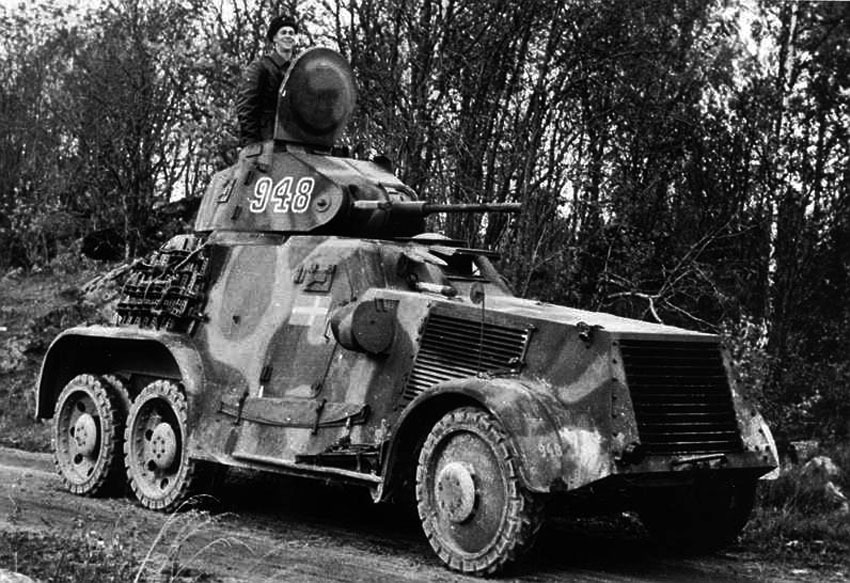
Pbil m/41(Landsverk “L-180/S”)
History
Sammanfattning
The first order for the earlier L-181 model came from Lithuania in 1933. A few years later, the Netherlands also placed an order. Denmark later inspected the vehicle during a visit and suggested several modifications. These included extending and widening the chassis and adjusting the angle of the side armour plates to create more interior space.
After these modifications were incorporated, the improved model received the designation L-180 when Denmark placed its order in May 1935.
Adaptation for Swedish Service
In the summer of 1941, the vehicles underwent testing in Landskrona. Discussions focused on how the armoured cars should be adapted to Swedish conditions, particularly regarding their armament.
The Irish turrets originally mounted on the vehicles were equipped with a 20 mm Madsen automatic cannon and a coaxial 8 mm Madsen machine gun. Landsverk proposed four different options for Swedish armament configurations.
Ultimately, the decision was made to replace the Irish turrets with the same turret type used on the Lynx armoured cars already in Swedish service (models m/39–40). These turrets were armed with a 20 mm Bofors automatic cannon (m/40B L/70 (20mm)) and a coaxial “8 mm Ksp m/36 (Strv)”. Another machine gun of the same type was mounted in the hull. In Swedish service, the vehicles were designated Pansarbil m/41.
Before delivery, Landsverk painted the five armoured cars in camouflage. The base colour was medium grey, with stripes of brown, green, and sand tones applied on top. Each vehicle had a unique camouflage pattern.
The vehicles were delivered in April 1943. Three were sent to the P3 regiment in Strängnäs, while the remaining two were delivered to I18 in Visby.
Later, all five vehicles were transferred to Gotland, where they became part of P1G, the Göta Life Guards armoured company stationed on the island. They remained in service there until they were removed from active organization in 1956 and eventually scrapped.
Basic training on the vehicles ended in 1949, and the final service with conscript soldiers likely took place around 1951.
The Pansarbil m/41 developed a reputation as a reliable vehicle. It experienced very few mechanical issues, and its engine, transmission, and other systems were generally dependable.
The crews also appreciated the vehicle’s design, particularly because its weapons could be easily removed and used for combat on foot if necessary. However, over time the shortage of spare parts became a significant issue. The rubber rings fitted onto the wheels, produced by Overman, wore out heavily during use, and replacement wheels were difficult to obtain.
Surviving Vehicles
None of the original Swedish Pansarbil m/41 vehicles survive today. The only known remaining component is the rear section of a chassis, whose bogie was later converted into a trailer.
It is believed that the vehicles may have eventually been used as target practice at the Tofta firing range.
However, in the late 1990s Sweden acquired a similar armoured car from Ireland in exchange for a KP vehicle. Ireland had previously used comparable vehicles during the Congo Crisis. After being displayed at the Armor Museum in Axvall, the vehicle was later transferred to the Swedish Military Vehicle Museum Arsenalen in Strängnäs.
This example differs slightly from the Swedish version, as it has a different turret and its original cast wheels have been replaced with wheels from a standard truck.
Specifications
Crew:
Sammanfattning
Tank Commander (1)
Driver (2)
Gunner (2)
The Tank Commander and gunner were located in the turret operating both the 20mm Akan m/40B and Ksp m/36 (strv), While The forwards facing and backwards facing driver sat in the hull, and a Gunner handling the Hull mounted Ksp m/36 (strv)
Armament:
Sammanfattning
Turret Type: Landsverk “Lynx”
-
Main Armament: Akan m/40B (1) (Turret, Front)
– (AP - T) Slprg m/42
– (HE-F-I-T) Slsgr m/42 -
Coaxial Armament: Ksp m/36 (Strv) (1) (Turret, Front)
– Prj m/32 (FMJ) 750 m/s, 14.2 g
– Pprj m/39 (AP - “Tungsten Core”) 810 m/s, 11.8 g
– Slprj m/39 (Tracer) 780 m/s, 11.0 g
– Brandprj m/41 (Incendiary) 835 m/s, 9.8 g
Hull Armament:
- Ksp m/36 (Strv) (1) (Hull, Front)
– Prj m/32 (FMJ) 750 m/s, 14.2 g
– Pprj m/39 (AP - “Tungsten Core”) 810 m/s, 11.8 g
– Slprj m/39 (Tracer) 780 m/s, 11.0 g
– Brandprj m/41 (Incendiary) 835 m/s, 9.8 g
Ammunition capacity:
20mm Akan m/30B: 825 Rounds.
8mm Ksp m/36 (Strv): 3500 Rounds.
Engine & Performance
Sammanfattning
Engine: 7.9 l - 8-cylinder “Büssing-Nag L8V/Kla”
Engine Output: 150 hp at 3200 rpm (18 Hk/t)
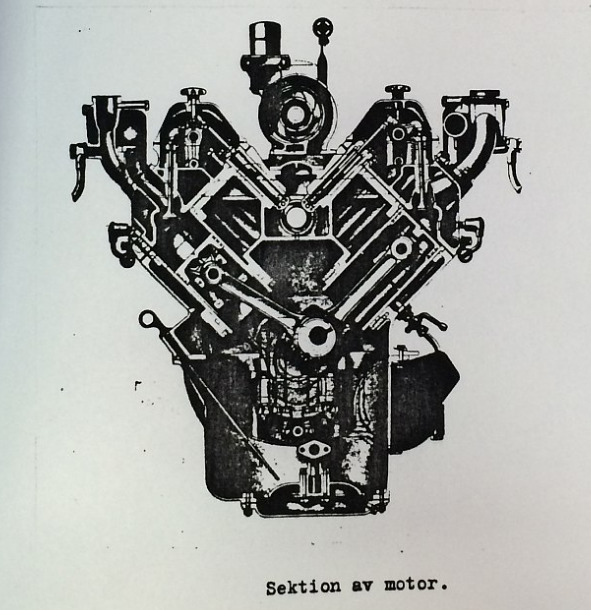
Transmission Type: Manual Mechanical (5-Forwards) (2-Rearwards)
Speed: 75 km/h (Forwards) 10 - 15 ? km/h (Backwards)
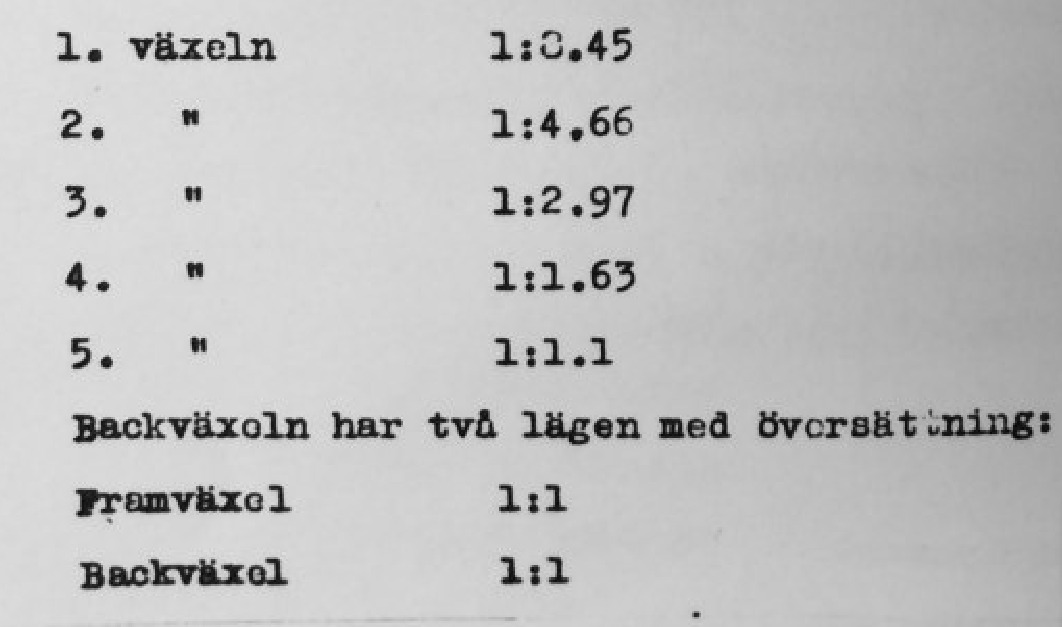
The Pbil m/41 has a Turning Radius of 8 meters and Can cross a body of water 0.41 m Deep
Armour:
Sammanfattning
“Armour Varies between 5 - 13mm”
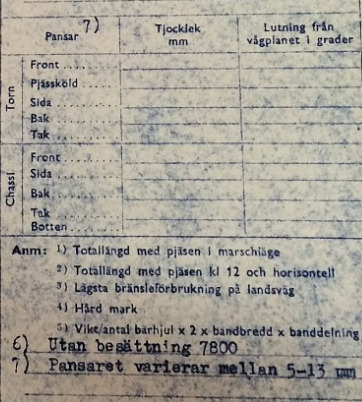
Dimensions / Weight:
Sammanfattning
Combat Weight: 8200 kg
Length: 5860 mm
Width: 2240 mm
Height: 2285 mm
- Yes!
- No
- 1.0
- 1.3
- 1.7
- 2.0
- 2.3
- I said no in previous poll.
Sources:
https://www.ointres.se/pansarbil_m_41.htm
https://gotlandsforsvarsmuseum.se/fordon/pansrade-fordon-vid-gfm/pansarbil-m-41.html