Pansarvärnskanonvagn II (Late) "The Final Configuration"

image

History:

By the 1950s, the Strv m/41 S-II was becoming increasingly obsolete as a combat tank. Although its 37 mm gun was no longer capable of dealing effectively with modern armour, the S-II variant retained some development potential thanks to its more powerful engine and improved mechanical components compared to the earlier S-I series.

To investigate whether the platform could be given a renewed anti-tank role, on orders of KAF development of a Up-gunned variant of the Strv m/41 S-II using the existing “75 mm Lvkan m/36 A” “75 mm Lvkan m/37” or “75mm Pvkan m/43”. The result was the Pvkv II, a tank destroyer proposal that replaced the original turret with an open-topped fighting compartment armed with the 75 mm Lvkan m/37.

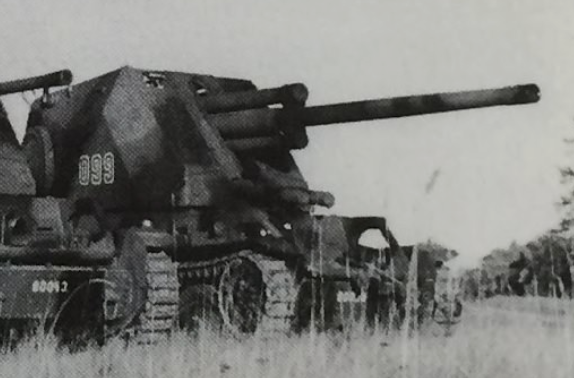
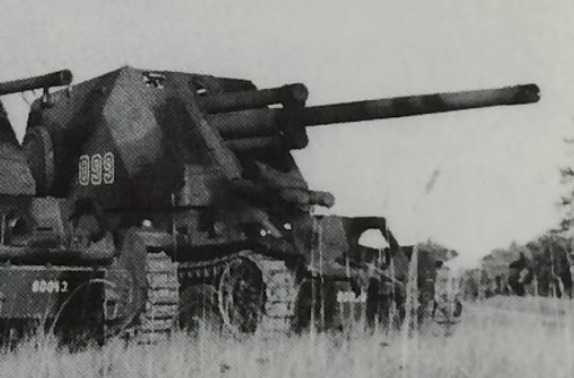
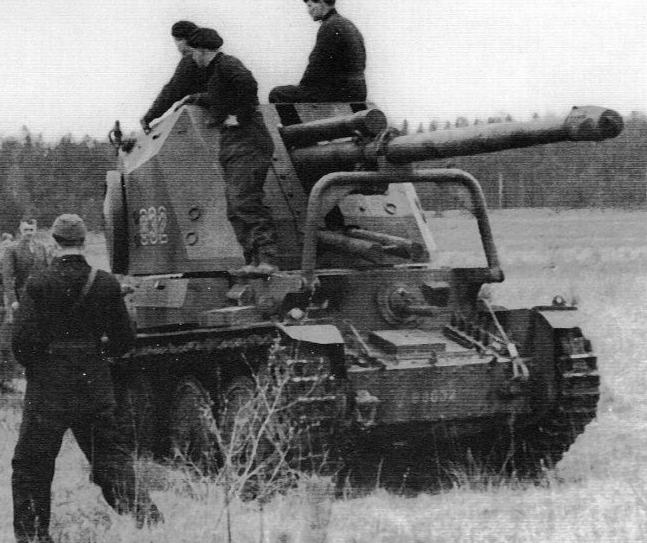
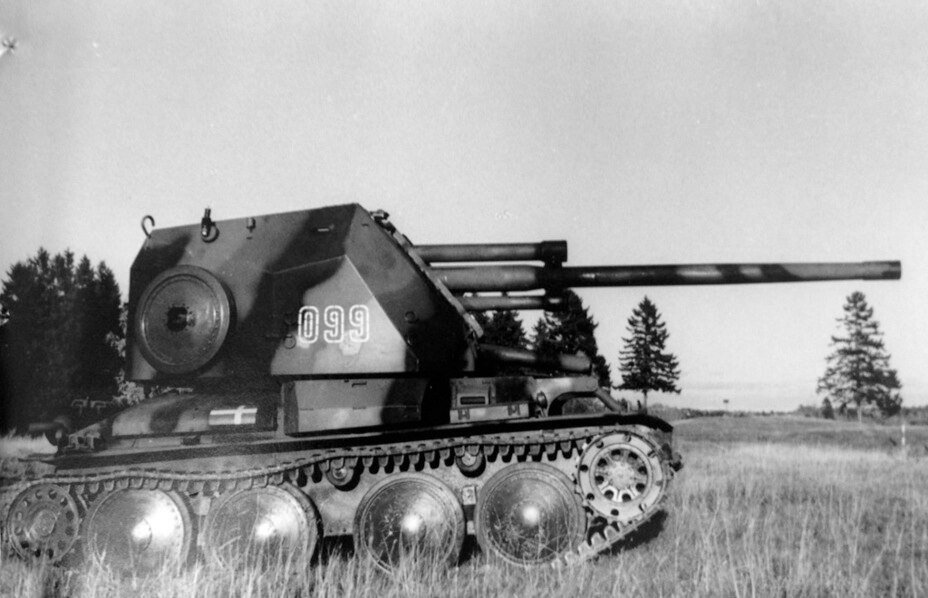
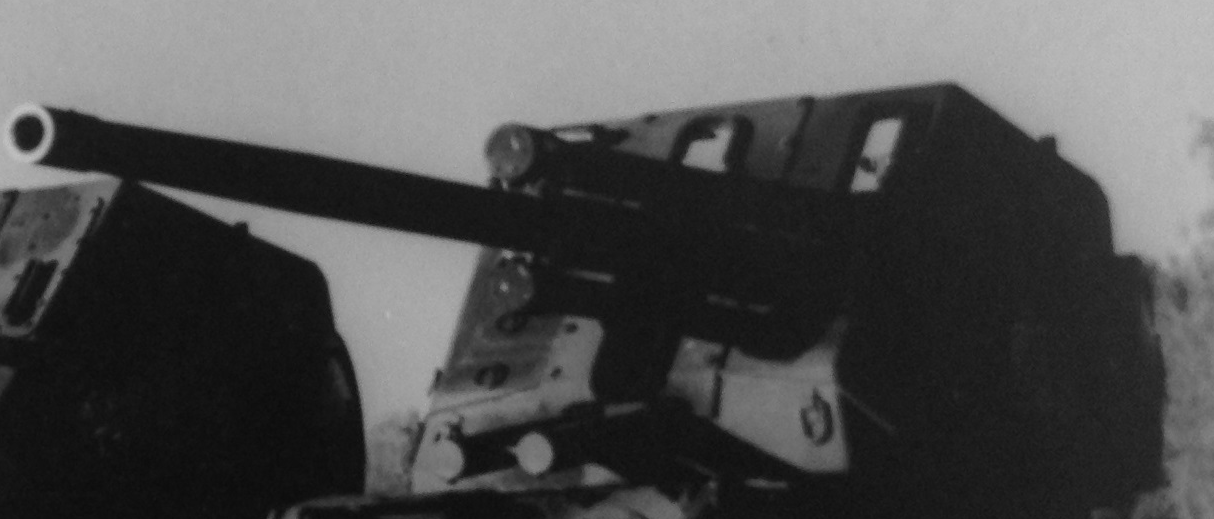
The project sought to create a mobile Tank destroyer using the Strv m/41 S-II. During testing, the prototype underwent several modifications and refinements. Early configurations featured a relatively simple gun shield arrangement, while later development introduced additional armour around the gun mantlet and sight opening to provide greater protection for the crew. This final configuration is represented by the vehicle in its later appearance, numbered “099”, whereas earlier photographs show the same prototype in its initial configuration as Nr. “032”.

Pvkv II EarlyPvkv II Late 2.PNG

Testing demonstrated that the concept significantly increased the firepower of the Strv m/41 platform. Continued development also tested newer ammunition types, including the Spårljuspansarprojektil m/49 APDS round, giving the vehicle a level of anti-armour performance far beyond that of the original Strv m/41.
Notable difference between the In-game variant:

This version would be the final design of the Pvkv II and would have a improved turret shielding around the gun mantlet, sight mantlet and would increase protection for the crew slightly.

And it would recieve the 75mm (“50mm Slpprj m/49”) the Strv 74 currently uses.

Armament

(Turret) 1x 75mm Lvkan m/37 A (x32, Turret + Hull Storage)

(Hull) 1x 8mm Ksp m/36 Strv (x1,000 (x250) in Hull Storage)

During The firing tests with the Lvkan m/37 it was noted that the following rounds were tested:

Source material for "75mm Lvkan m/37" performance

Gun tests

“The test was done with the “Lvkan m/36”, “Lvkan m/37” firing at a target 1000m away with a 60 degree angled plate:”

Slpprj m/41 (AP)
(Developed 1941 By Bofors AB for the 75mm Lvkan m/36, 75mm Lvkan m/37 and 75mm Pvkan m/43)
• Penetration: 75 mm at 1,000 m with an Impact angle of: 60°

Slpgr m/43 (APHE‑BC)
(Developed 1943 By Bofors AB for the 75mm Lvkan m/36, 75mm Lvkan m/37 and 75mm Pvkan m/43)
• Penetration: 60 mm at 1,000 m with an Impact angle of: 60°

Spårljuspansarprojektil m/49 (Underkallibrig, 50mm) (APDS / Sabot)
(Developed 1949 By Bofors AB for the 75mm Lvkan m/36, 75mm Lvkan m/37 and Pvkan m/43)
• Penetration: 150 mm at 1,000 m with an Impact angle of: 60°

Spräng granat m/38 (HE)
(Developed 1938 By Bofors AB for the 75mm Lvkan m/36, 75mm Lvkan m/37 and 75mm Pvkan m/43)
(Already in-game with the Same performance as the (Currently: Pvkv II)


  • General characteristics:
    Same as the current Pvkv II, Except the different Mantlet shielding-


Implementation in War Thunder
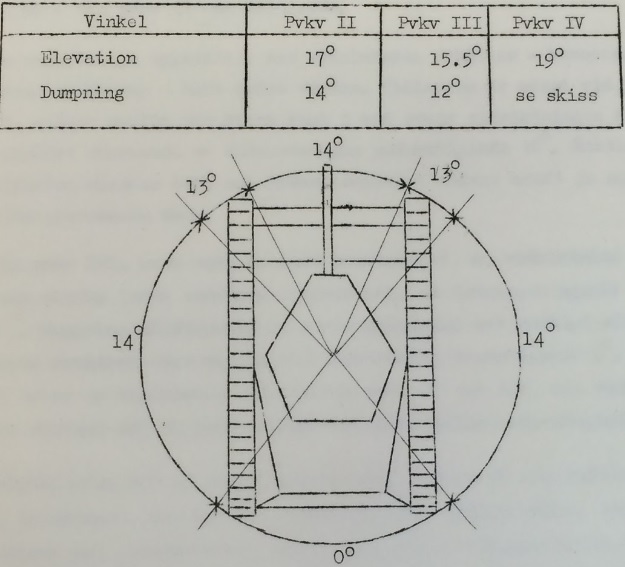
elevation

The Pvkv II (Late) would play similarly except that it could get the option to also have 75mm (50mm core) Slpprj m/49 APDS that the Strv 74 has, And would offer a lighter TD for swedens 4.7-5.0 Lineup with a more capable round against heavier tanks like The Tiger I, IS-II aswell as Jumbo’s, Since the Pvkv II has a High Zoom scope it would perform excelently against tanks at a distance. It would become swedens own Waffenträger but taller and more mobile.

If the Pvkv II (Late) is added to the game, the current vehicle labeled simply as “Pvkv II” should be renamed to Pvkv II (Early). Due to the earlier construction

Either:

  • Foldered with the Pvkv II hopefully renamed “Pvkv II (Early)” in Rank III
  • Placed in front of the Pbv 501 in Rank IV
  • Folder it with the Pvkv II at Rank III (And Rename the Current Pvkv II → Pvkv II (Early))
  • Place it before the Pbv 501 at Rank IV
  • Premium
  • I dont want it added
0 voters

Sources:
(This vehicles sources are the very same as the regular Pvkv II as this is just the later variant so i will provide the images and gun sources:)
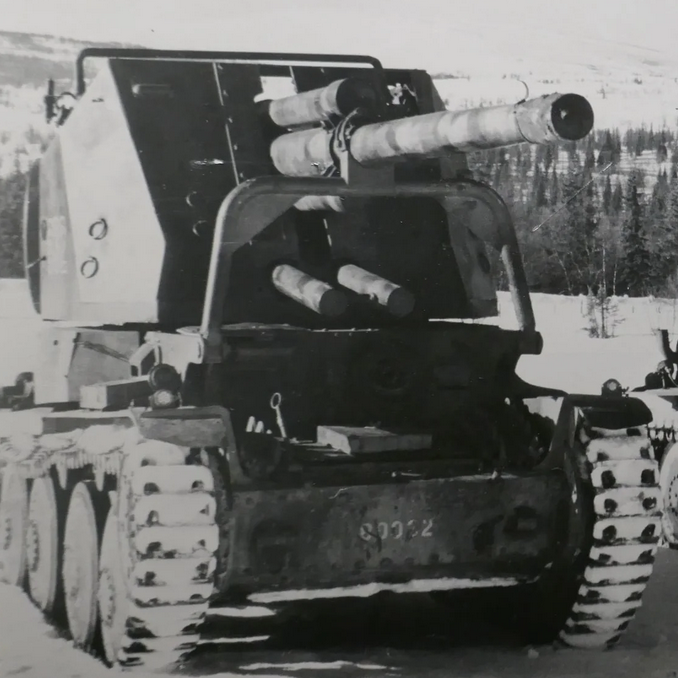
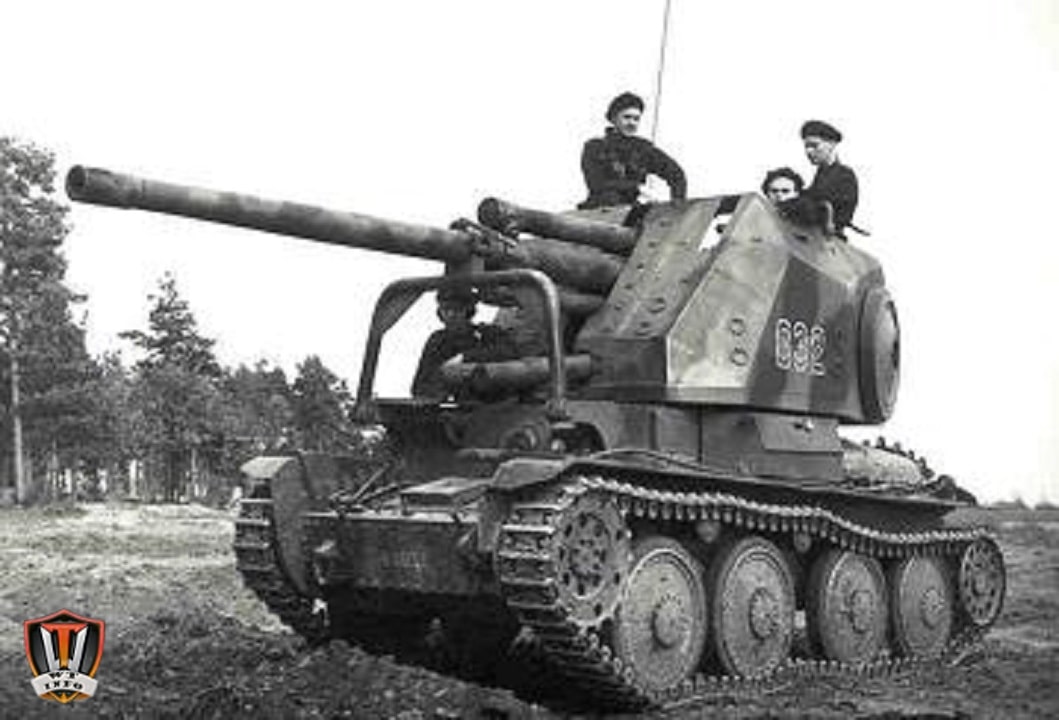
Pvkv II (Early) or the current in-game "Pvkv II"

Pvkv II Early
Pvkv II Early 2

Pvkv II (Late)


Pvkv II Late 2.PNG
Pvkv II Late

Remaining images

Reports 2
Reports 3
Reports beginning
Reports
elevation
Gun tests snippet
Gun tests

3 Likes

Good suggestion, +1 from me!
Do note for other suggestions that simply stating “this vehicle’s sources are the very same as the regular Pvkv II” is not sufficient on its own: each suggestion needs to stand on its own with its sources listed directly in the post and one should not have to go to another suggestion for sources. The primary document images you uploaded here covered it this time, but could you please upload the other sources as well?

Sadly, there are very few additional sources available for this specific version, as it was a very short-lived stage of the project. The vehicle itself is essentially the Pvkv II (Early) that is currently represented in War Thunder. After this final phase of testing, the project was shelved and ultimately discontinued.

As a result, I do not have access to many dedicated sources covering this exact late-test configuration. However, since it was fundamentally the same vehicle as the current Pvkv II, just in the final stages of its evaluation, there is not a great deal of material that can be shown beyond what is already documented and represented for the existing Pvkv II. This variant is just suggested to use the APDS as it was tested along with the minor changes in its design to the gun sight and gun shield.

Also, these images are valid to both vehicles as its the same vehicle just later down the line

Yes, I read those, they were great.

1 Like

Great, so does that answer the question of sufficient sources?

It does, I was just curious where your line of additional sources came from.

I had translated your sources.

For those interested:

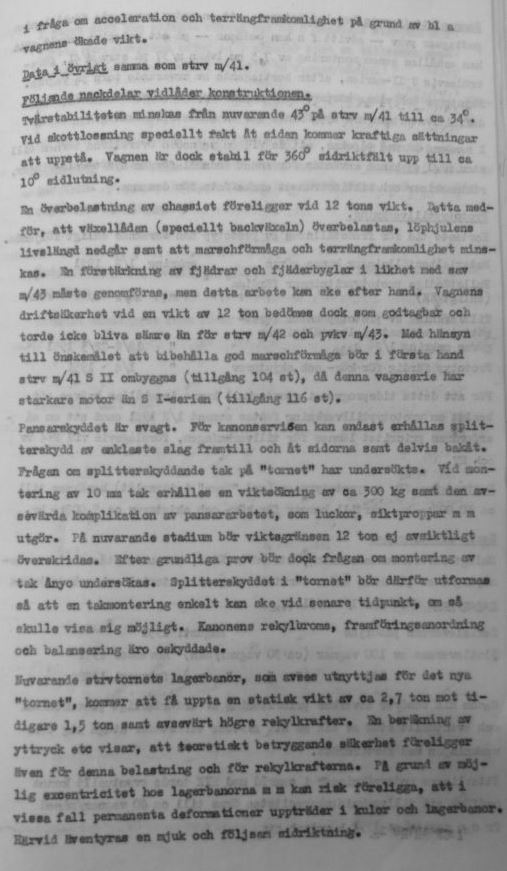
Questions concerning acceleration and cross-country mobility

Spoiler

Questions have been raised concerning acceleration and cross-country mobility due, among other things, to the vehicle’s increased weight.

Data: Essentially the same as for the Strv m/41.

Disadvantages of the proposed construction:

Stability is reduced from the current approximately 43° on the Strv m/41 to approximately 34°. During firing, especially when firing to the side, substantial oscillations will occur. The vehicle is, however, stable for 360° traverse up to a certain slope.

With a weight of 12 tons, the chassis becomes overloaded. This results in overloading of the gearbox (especially reverse gear), reduced service life of the road wheels, and decreased marching ability and cross-country mobility. Reinforcement of springs and spring brackets similar to that on the m/43 would have to be carried out, but this work can be performed gradually.

The operational reliability of the vehicle at a weight of 12 tons is nevertheless judged acceptable and is not expected to be poorer than that of the Strv m/42 and the Pvkv m/43. In view of the desire to maintain good marching performance, the Strv m/41 S II series should be converted first (104 vehicles available), since this series has a more powerful engine than the SI series (116 vehicles available).

Armor protection: The armor protection is weak. For the gun crew, only basic splinter protection can be provided at the front and sides, and partially at the rear.

The question of a splinter-protective roof on the “turret” has been investigated. Installing a 10 mm roof would increase weight by approximately 300 kg and considerably complicate the armor work because of hatches, sight openings, etc. At the present stage, the 12-ton weight limit should not intentionally be exceeded. After thorough trials, the question of installing a roof should be re-examined.

Therefore, the splinter protection in the “turret” should be designed so that a roof can easily be fitted later if this proves feasible. The gun’s recoil brake, recuperator, and balancing mechanism are unprotected.

The current turret race, intended to be reused for the new “turret,” will have to carry a static load of about 2.7 tons instead of the previous 1.5 tons, as well as considerably higher recoil forces. Calculations of surface pressure indicate theoretically satisfactory safety margins for both the load and the recoil forces. However, due to possible eccentricity in the bearing races, there is a risk that permanent deformation may occur in the balls and races in some cases, jeopardizing smooth and precise traverse.

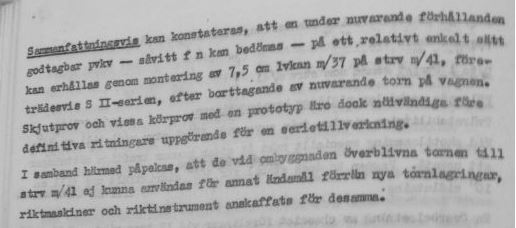
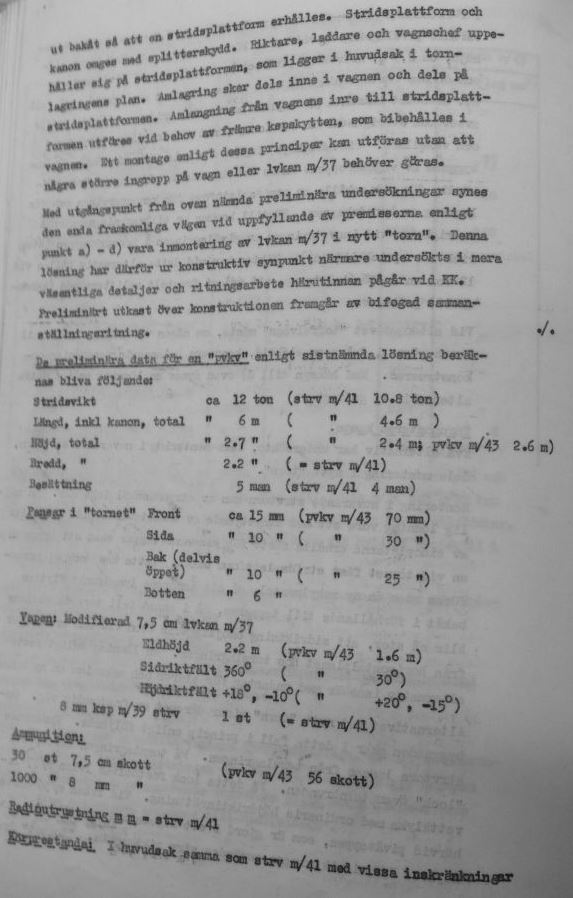
Summary: It may be concluded that, under present conditions and as far as can presently be judged, a relatively simple and acceptable anti-tank vehicle can be obtained by mounting a 7.5 cm lvkan m/37 on the Strv m/41, preferably the S II series, after removal of the existing turret. Firing trials and certain driving trials with a prototype are nevertheless necessary before final production drawings for series manufacture are prepared.

In this connection it is noted that the turrets removed during conversion of the Strv m/41 cannot be used for other purposes until new turret bearings, traverse mechanisms, and sighting equipment have been procured for them.


Royal Army Administration – Ordnance Department – Vehicle Bureau

Spoiler

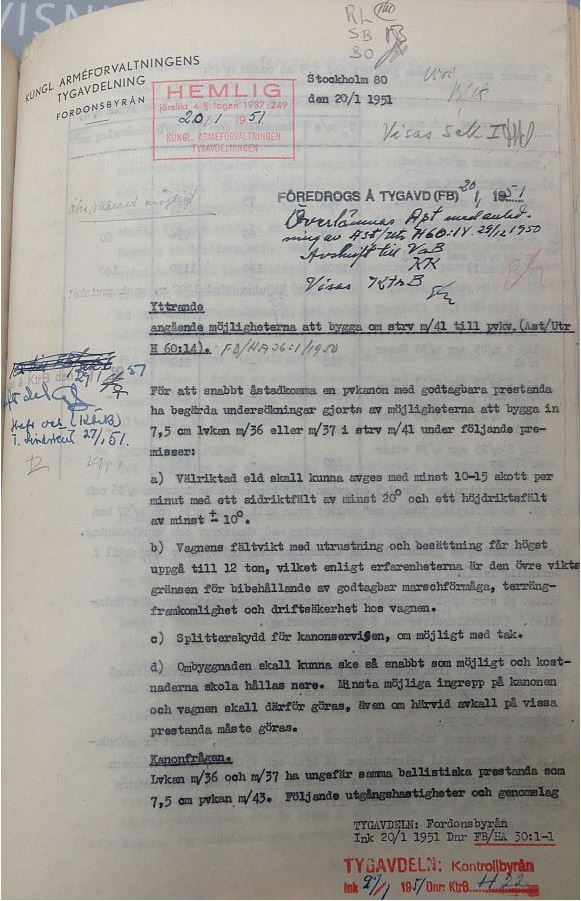
SECRET according to Appendix 1937:249, 20 January 1951.

Statement concerning the possibilities of converting the Strv m/41 into an anti-tank vehicle (Pvkv).

To rapidly obtain an anti-tank vehicle with acceptable performance, investigations have been conducted into the possibility of installing a 7.5 cm lvkan m/36 or m/37 in the Strv m/41 under the following premises:

  1. Accurate fire shall be possible at a rate of at least 10–15 rounds per minute, with a traverse field of at least 20° and an elevation/depression field of at least 10°.

  2. The vehicle’s combat weight with equipment and crew may not exceed 12 tons, which experience indicates is the upper weight limit for maintaining acceptable road marching performance, cross-country mobility, and operational reliability.

  3. Splinter protection for the gun crew, preferably including a roof if possible.

  4. The conversion shall be accomplished as quickly as possible and at low cost. Only the absolutely necessary modifications to the gun and vehicle should be made, even if this requires sacrificing some performance.


Installation of the gun in the Strv m/41

Spoiler

Two alternatives were examined: hull-mounted gun and turret-mounted gun.

To maintain the vehicle’s center of gravity, which is necessary to avoid excessive loads on wheels and suspension, the gun must either be mounted over the existing turret ring or the engine must be moved. The practical solution investigated was to remove the original turret and install a new open-topped armored fighting compartment (“turret”) carrying the 7.5 cm lvkan m/37.

The fighting platform and gun would be provided with splinter protection. The gunner, loader, and commander would stand on the fighting platform, which would lie approximately at the level of the turret ring. Ammunition handling would take place partly inside the vehicle and partly on the fighting platform. Ammunition transfer from the vehicle interior to the platform would be carried out as needed by the front machine-gunner, who would remain in the hull.

A mounting according to these principles can be executed without major modifications to either the vehicle or the lvkan m/37. Based on the preliminary investigations, this appears to be the only feasible solution for meeting the stated requirements.


The gun question

Spoiler

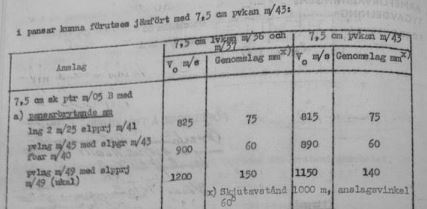
The lvkan m/36 and m/37 have approximately the same ballistic performance as the 7.5 cm anti-tank gun m/43. The following muzzle velocities and armor penetration can be expected compared with the 7.5 cm pvkan m/43:

Ammunition lvkan m/36 & m/37 pvkan m/43
Armor-piercing projectile m/25 for Strv m/41 V = 825 m/s, penetration ≈ 75 mm V = 815 m/s
Armor-piercing projectile m/40 V = 900 m/s, penetration ≈ 60 mm V = 890 m/s
Projectile m/49 with sub-caliber penetrator V = 1200 m/s, penetration ≈ 150 mm V = 1150 m/s, penetration ≈ 140 mm

Preliminary data for the proposed anti-tank vehicle

Spoiler
Specification Proposed vehicle Reference
Combat weight approximately 12 tons Strv m/41: 10.8 tons
Length (including gun) approximately 6 m
Height approximately 2.7 m Strv m/41: 2.4 m; Pvkv m/43: 2.6 m
Width approximately 2.2 m
Crew 5 men Strv m/41: 4 men

Armor in the new “turret”

Area Thickness Reference (Pvkv m/43)
Front approximately 15 mm 70 mm
Sides approximately 10 mm 30 mm
Rear (partly open) approximately 10 mm 25 mm
Bottom approximately 6 mm

Armament

  • Modified 7.5 cm lvkan m/37

  • 8 mm machine gun m/39 Strv

Ammunition stowage

  • 30 rounds of 7.5 cm ammunition

  • 1,000 rounds of 8 mm ammunition

Radio equipment

Same as Strv m/41.

Performance

In general, performance would be similar to that of the Strv m/41, with certain reductions due to increased weight and altered configuration.

1 Like

Thank you thomas^^

Although this is results at 1000m and at a 60* angle

-1 IMHO, you say the differences are only slight mantlet changes, so this is really just filler. The 4.0/4.3 lineup for Sweden is packed enough, so I don’t think a slight variant like this is necessary.

Altough this version would include APDS so it would also expand what you can Target and give you a more capable vehicle,

I stand corrected, I think I’ll change my vote. That would make it special.

1 Like