
- Yes
- No
History:
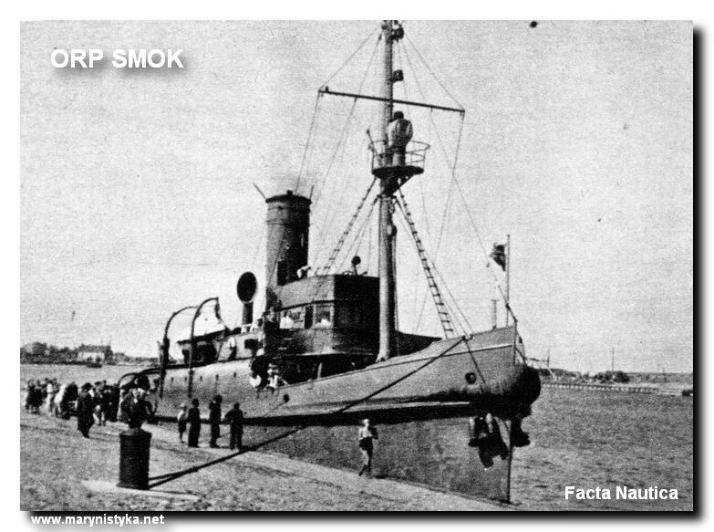
ORP Smok is a sea going tugboat built in 1922 in La Rochelle, France. She was acquired by Poland on the 15th of November 1932 as Poland wanted a tugboat to ensure Naval Port Gdynia would be running in good efficiency while doubling as a search and rescue vessel.
Before her Polish service, she was a civilian French vessel Le Boxeur who had a quiet career. In 1926, she was sold to the private company Ateliers & Chantiers Martimes du Sud Ouest. In 1929, the vessel was purchased again by the French company Enterprise Generale de Travaux Martime. In 1930, Le Boxer would be purchased again, this time by Belgium company Remarquage Letzer Ltd who renamed her Leopold before putting her up for sale once more which resulted in Poland buying her for the navy.
Now named Smok (though initially called Piast), the boat recived her Maxim Mk.08s in February 1933.
Seeing as 4 FM class minesweepers were decommissioned in 1931, Polish fleet command secured to form the mine department, comprising of ORP Smok, KM 111, KM 112, and KM 113. In1935, to perform her new duties, the ship was partially rebuilt: the old mast and boom were replaced with a new steel one with a searchlight and boom, with a lifting capacity of up to 3 tons. She would also help train cadets in the summer of 1935.
Until 1937, she would also tow large targets during firing exercises. The numerous modifications to the ship eventually started to cause stability issues, leading to yet another modification to help improve stability.
In the spring of 1937, tensions between Germany and Poland begun to rise, prompting Smok to transport workshop equipment from Oksywie to Hel.
The boat would take part in the September campaign, deploying to Hel and gaining 2x wz.85 guns on each side of the superstructure (though it’s ammo was never received). On September 1st 1939 before 7:00, three German seaplanes were spotted over the port. Despite the efforts of the AA, the planes returned to Germany. Sensing the imminent attack approaching, crates of documents and equipment was loaded on Smok. However by the time the crates were loaded (14:00) 32 Ju-87Bs attacked Hel. Fortunately, Smok survived with no serious damage by repelling her assailants. From the next day, Smok would aid in defending Hel from German bombers. One day, she would carry multiple 40mm Bofors to Hel, boosting the defense. Over the course of the defense, 7 crew members would be injured.
Before Hel capitulated, Smok would be scuttled to block the entrance to the port, ending her Polish service. Germany would later refloat, repair and service Smok in 1940, renaming her to Rixhöft. She would carry out rescue duties like towing U-3519 and former Polish Jaskółka-class Rybitwa ( also named Rixhöft) while trying to save U-3519, Rixhöft would strike a mine and sink, losing 21 crew members. This marked the final time Smok was operational as she was later raised and finally removed by East German Authorities.
Specifications:
Crew- 30
Armament- 2x 37mm wz.85 guns and 2 x 7.92 mm Maxim Mk. 08 machine guns
Displacement- 711t
Length- 40.3m
Width- 9.1m
Draught- 3.45m
Max speed- 23.15km/h (1 engine with 1200hp)
Sources:
https://www.graptolite.net/Facta_Nautica/PMW/Smok.html
Stanisław M. Piaskowski: Ships of the Republic of Poland 1920-1946 .
Maciej Neumann: The Fleet of the Second Polish Republic and its ships .
Mieczysław Kuligiewicz. ORP “Smok” brave fleet helper .
Erich Gröner, Dieter Jung, Martin Maass: Die deutschen Kriegsschiffe 1815-1945.