
- Yes
- No
History:
In 1941 both Northrop and Consolidated Vultee received contracts for a prototype bomber able to carry 4,500kg of bombs for a round-trip of 16,000km at a max speed of 720km/h, cruising speed of 443km/h and service ceiling of 14,000m. All of this was in case the UK fell as a bomber of these specifications was deemed necessary to attack occupied Europe from mainland America.
While Consolidated Aircraft company would go on mak the B-36, Northrop decided to use a design it was already developing. Northrop was already wanted to make a flying wing bomber so this would provide a opportunity to do so. This would see the experimental flying wing aircraft N-9M having it’s first flight in December 27th 1942, providing useful flight data.
In early 1942, design work on the prototype of the YB-35 (the XB-35) had begun. The U.S army air fos originally had an order of 200 serial production aircraft (designated B-35) although in the end, Northrop never even got close to that number. This was due to multiple factors including most Northrop workers being drafted in 1944 and development problems, pushing the first delivery date all the way to 1947.
Some problems encountered when test flying the XB-35 included contra-rotating props causing constant heavy drive-shaft vibration (which was fixed with the YB-35 changing to single-rotation propellers), engines having metal fatigue after 2 years and gearboxes malfunctioning. After 19 flights, the first YB-35 was grounded, followed by a second aircraft grounded after just 8 flights.
Combining the technical issues, maintenance being difficult and being severely behind schedule + over budget, the program was terminated with only 14 total airframes. While the B-36 had its own suite of issues, the USA had more faith in it being able to overcome it’s problems than the YB-35. The B-36 would then go one to have 380 airframes built.
One the 22nd of October 1947 the YB-49, a jet powered variant converted from a YB-35 airframe took it’s first flight. The YB-49 would also never see service with only 2 made.
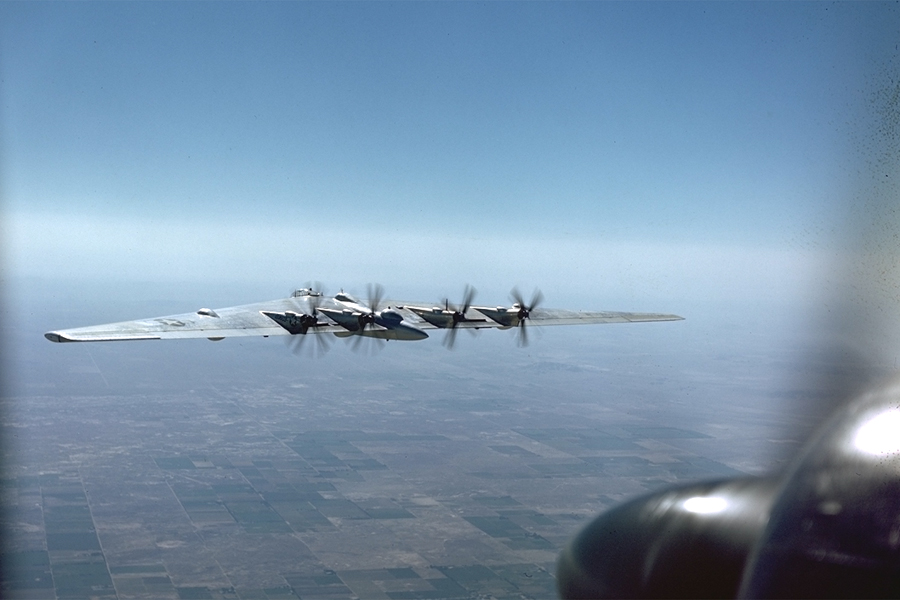
Specifications:
Armament: 20x M3 brownings in one tail stinger and six remote controlled turrets + 27,678 kg of bombs (max load)
Crew: 9 (3 gunners, pilot, copilot, navigator, engineer a radio operator)
Wingspan: 52.43m
Propellers: 4-bladed Hamilton Standard HSP24F60-344, 15 ft 3 in (4.65 m) diameter constant-speed fully-feathering pusher propellers
Engines: 2 × Pratt & Whitney R-4360-47 Wasp Major 28-cylinder air-cooled radial piston engines (3000hp) and 2 × Pratt & Whitney R-4360-45 Wasp Major 28-cylinder air-cooled radial piston engines (3000hp)
Max speed: Approximately 632km/h
Length: 16.18m
Height: 6.15m
(Pretty much just a slightly faster XB-35) Northrop XB-35 | A Answer to the United States Dilemma
Sources:
Pape, Garry R.; Campbell, John M. (1995). Northrop Flying Wings : a history of Jack Northrop’s visionary aircraft (1st ed.)
Parker, Dana T. Building Victory: Aircraft Manufacturing in the Los Angeles Area in World War II
Wooldridge, E. T. Winged Wonders: The Story of the Flying Wings
https://web.archive.org/web/20141219132534/http://www.nationalmuseum.af.mil/factsheets/factsheet.asp?id=2594
https://www.thisdayinaviation.com/25-june-1946/
Pilot's Post Online Aviation)%20each-,Performance,:%2051%2C070%20lb%20(23%2C210%20kg)
 ?
?