History
Beginning of the LRI-X Program, Consequence of the XF-103’s Demise
By 20 July 1955, the XF-103 program was facing serious developmental issues with its powerplant and had received very little funding, which significantly slowed progress and ultimately led to the program’s cancellation in 1957. However, the USAF’s requirement for a long-range interceptor had evolved, prompting the release of General Operational Requirement (GOR) No. 114 on 6 October 1955 for the Long-Range Interceptor, Experimental (LRI-X) program. The program sought an aircraft capable of countering the growing anticipated threat posed by advanced, nuclear-armed Soviet bombers expected to operate in large numbers over the Arctic or on intercontinental missions.
The requirement was issued by the USAF’s Air Research and Development Command (ARDC), which sought an advanced interceptor capable of flying at Mach 1.7 at 40,000 feet, with a service ceiling of 60,000 feet and a combat radius of 1,000 nautical miles. The aircraft was to accommodate a two-man crew, be powered by at least two engines, incorporate an integrated fire-control system capable of detecting a B-47-sized target at 60 nautical miles, and possess the ability to destroy three bombers during a single mission. It was intended to equip Air Defense Command (ADC) units.
North America’s original Long-Range Interceptor, Experimental design in 1955-1956. (Tony Landis Collection)
On 11 October 1955, after evaluating each competitor’s proposal, the ARDC awarded preliminary study contracts to Lockheed, North American, and Northrop, which included constructing wooden mockups of their proposed designs. By early 1956, each company had completed its preliminary study, and the results were under evaluation by the Air Force. The USAF intended to select a single contractor before full-scale mockups for the LRI-X were built, and North American’s NA-236 design attracted considerable interest from USAF officials, leading them to recommend that North American proceed with further development.
In the meantime, however, the ADC requested that the Pentagon cancel the long-range interceptor program and replace it with a medium-range interceptor having a combat radius of 350 nautical miles. As a result, North American’s selection was placed on hold, and on 9 May 1956 the Pentagon formally cancelled the LRI-X program.
Reaffirmation and Green Light
The USAF still required a new interceptor but remained undecided on its exact requirements. During the summer of 1956, the ADC proposed a revised set of specifications. This time, it called for a Mach 2.5 interceptor capable of operating at 70,000 feet with a 300-nautical-mile combat radius, flown by a single pilot using a modified MX-1179 fire-control system derived from the Convair F-102B.
These revised requirements created considerable confusion within the Pentagon. Ultimately, it concluded that the original long-range interceptor concept better suited the Air Force’s future needs and that it should instead be equipped with a new fire-control system and advanced air-to-air missiles. The revised requirement called for an interceptor capable of reaching Mach 3, operating above 70,000 feet, and possessing a combat radius of approximately 1,000 miles.
North America’s new Long-Range Interceptor, Experimental design after the LRI-X program was restarted in 1958. (Tony Landis Collection)
Upon reaching this conclusion, the Pentagon reinstated the LRI-X program on 11 April 1957. Rather than requesting new proposals, it reaffirmed the results of the previous competition, and on 6 June 1957, North American was awarded a contract for two prototype interceptors under Weapon System 202A. This was followed by a planned order for 31 pre-production aircraft and eventually 480 production aircraft. North American adapted its earlier NA-236 design into the updated NA-257, which remained largely identical to its predecessor.
Meanwhile, Republic proposed a revised version of the XF-103 as a high-speed research aircraft to support the program. Consequently, the XF-103 program was reduced to a single prototype in 1957, but the project never progressed further and was formally cancelled in August of that year.
The NA-257 featured a delta wing and a large canard mounted well forward above the cockpit. Its two crew members were seated in tandem within individual ejection capsules. Three GAR-X missiles were housed on a rotary launcher and fired through doors in the underside of the fuselage, guided by the new Hughes XY-1 fire-control system. Power was to come from two General Electric J93-GE-1 engines, each producing 22,500 lbf with afterburner and 14,100 lbf at military power. A total of 7,100 gallons of fuel was distributed among two wing tanks and five fuselage tanks.
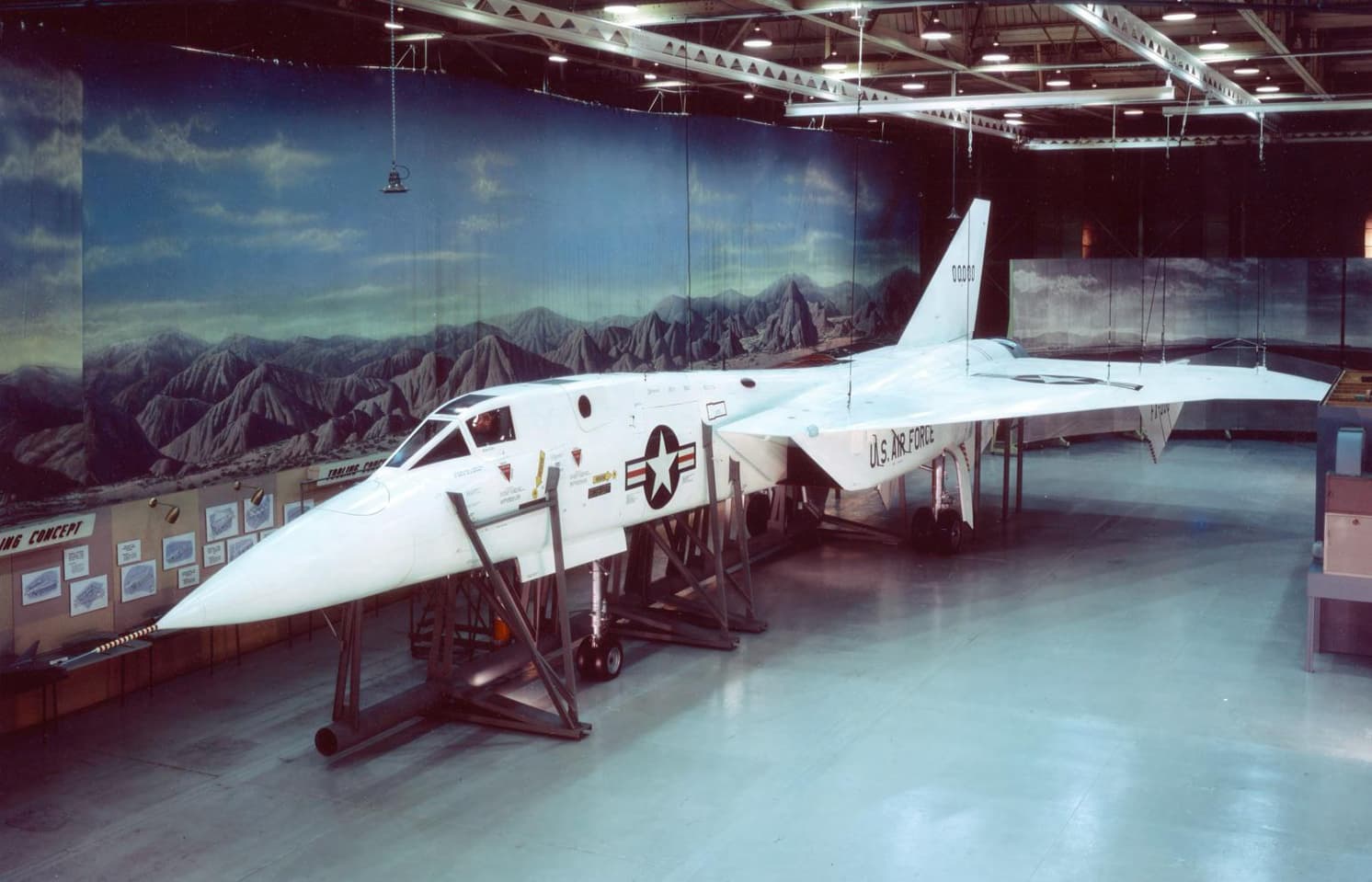
GAR-9, now AIM-47, Falcon missile under the fuselage of the XF-108 Mock-up
The mockup inspection of the radar and missile systems took place at Hughes’ facility in Culver City, California, between 15 and 17 April 1958. During this period, the XY-1 was redesignated as the AN/ASG-18 pulse-Doppler radar, while the GAR-X missile became the GAR-9. At the same time, Hughes was selected to provide an infrared search and track (IRST) system offering a 70 x 140-degree field of view and an angular accuracy of one degree. The system was expected to detect a B-47-sized target from the rear at a range of 34.8 nautical miles at 45,000 feet. From a head-on aspect, the detection range was estimated at 10.3 nautical miles.
Initially, the IRST employed a pair of 7-inch hemispherical IR domes mounted on the leading edge of each wing root near the air intakes. Wind-tunnel testing later demonstrated that replacing them with 6-inch elliptical (ogive-shaped) domes at the same locations greatly reduced aerodynamic drag while sacrificing only a few miles of detection range.
In May 1958, the aircraft officially received the F-108 designation. On 15 May 1959, it was given the name Rapier, continuing North American’s brief tradition of naming fighters after swords.
Before December 1958, the F-108 design was little similar to the design of the LRI-X competition, with the wing shape remaining nearly identical and deletion of canard. (Tony Landis Collection)
By October 1958, the F-108’s design had undergone significant refinement. The canards were eliminated entirely, while the vertical fins above the wings were removed and their surface area redistributed into the ventral stabilizers beneath the wings. These changes improved low-speed handling, stall characteristics, and directional stability at high angles of attack. The wing planform was also slightly revised, the fuselage was lengthened, and total internal fuel capacity increased to 7,200 gallons. The J93 engines were also uprated to produce 24,800 lbf in afterburner and 16,900 lbf at military power.
Developmental Works Began and Budgetary Restrictions
The first half of 1958 introduced another complication to the F-108 program. As part of its proposal for the WS-110A (B-70 Valkyrie), North American suggested sharing components between the F-108 and the B-70 development programs. In theory, this commonality would reduce development costs for both aircraft, much like the planned sharing of subsystems between the WS-110A and the WS-125A atomic-powered bomber. In practice, however, it meant North American’s engineering resources had to be divided between multiple major projects.
As a result, on 19 November 1958, the projected operational date slipped to mid-1963 because much of the company’s effort was devoted to testing new materials and developing advanced manufacturing techniques, particularly those associated with high-temperature airframe construction.
On 30 December 1958, the planned prototype fleet was reduced from 31 aircraft to 20, while the projected first flight slipped to April 1961. This marked a significant shift in the program’s direction.
The F-108 mockup under construction, sometime in December 1958 before inspection (Boeing Historical Archive Collection)
A full-scale F-108 mockup was completed and inspected on 26 January 1959. At that time, first flight was still expected in March 1961, and the Air Force continued to state a requirement for 480 production aircraft. During the inspection, it was recommended that the original J93-GE-1 engines be replaced by the improved J93-GE-3R series. The final configuration settled on a pair of J93-GE-3AR engines, each rated at 29,300 lbf with afterburner and 20,900 lbf at military power.
This is the final “official” configuration of F-108 released on 12 June 1959, showing a different wing shape, larger ventral stabilizers, and a refueling receptacle. (Artwork by Tony Landis)
A final major revision to the design was completed before the program entered formal cancellation proceedings on 12 June 1959. Although the aircraft’s overall appearance remained largely unchanged, the wing had taken on a “cranked arrow” shape, and the wing leading edge was redesigned from a rounded profile to a sharper airfoil. Wind-tunnel testing had revealed directional stability issues, prompting several aerodynamic refinements. The forward fuselage was reshaped by reducing forebody camber, decreasing supersonic drag while providing a modest increase in range that helped offset projected weight growth. The vertical surfaces under the wing were enlarged and canted all the way to
the fuselage. Aerial refueling capability was incorporated into the baseline design by installing a standard refueling receptacle on the upper fuselage immediately behind the rear cockpit canopy.
Mockup J-93-GE-3R and thrust reverser demostration
The J93-GE-3AR engines were also scheduled to receive thrust reversers. Their feasibility had already been demonstrated during tests at Edwards Air Force Base beginning in January 1959, where a scaled-down reverser fitted to a J79 engine successfully met expectations.
NAA artist rendering of an F-108A depicting its cruising profile
During early 1959, the long-range interceptor gained considerable support because of its apparent technical progress. However, this optimism was overshadowed by mounting budgetary concerns. The ADC strongly opposed any further delays to the F-108’s operational schedule, while the Air Force Scientific Advisory Board also endorsed continuation of the program. The Joint Chiefs of Staff evaluated the F-108 against several alternatives, including a B-58 interceptor concept, and likewise supported its military value. Nevertheless, political concerns increasingly centered on the fact that the F-108 program was effectively financing the development of technologies that would also benefit the B-70 bomber. Despite these concerns, development continued for the time being.
Testing, Funding Cuts, and Cancellation
On 17 October 1958, two Convair B-58A aircraft were selected for modification to incorporate the ASG-18 fire-control system and GAR-9 missile intended for the F-108. However, funding shortages reduced the program to a single B-58A (55-665). Beginning on 23 February 1959, the forward fuselage of the aircraft was extensively modified to accommodate the ASG-18 radar and its 40-inch antenna. As a result, the aircraft received the nickname “Snoopy.”
The modified B-58 made its first flight on 11 March 1960. On 22 March, after the remaining bugs in the fire-control system had been resolved, it became the first aircraft to successfully operate the ASG-18 in subsequent flights. In August 1961, the first GAR-9 missile was launched from the ground to validate the performance of its Lockheed-built rocket motor. On 25 May 1962, the first airborne launch of the GAR-9 was conducted from Snoopy, with the missile passing within six feet of a QF-80 target drone approximately 15 nautical miles away.
ASG-18 and IRST installation in the B-58 “Snoopy” (Tony Landis Collection).
The original 7-inch-diameter IRST sensors were also installed on the B-58 testbed, mounted on either side of the forward fuselage in roughly the same relative position to the radar as they would later occupy on the Lockheed YF-12A. These infrared search-and-track units were designated the Hughes X-2. In 1962, the GAR-9 missile was redesignated as the AIM-47.
Those escape capsules were built by North American as Type-A capsules. They were the early, narrower units designed to accommodate and encapsulate USAF pilots wearing standard anti-G suits. These capsules were used for testing until the USAF determined that they should be widened by six inches, resulting in the new Type-B capsule design to accommodate B-70 bomber pilots wearing newer full-pressure suits when required. (Boeing Company Archives)
North American intended to develop separate escape capsule designs for both the F-108 and the B-70, resulting in the narrower Type-A capsule for the F-108. By January 1959, the first nine Type-A capsules had already been built and completed the initial series of aircraft drop tests. They were scheduled for high-speed sled tests between June and October 1959. An additional five capsules were under construction for further sled tests, aerial drop tests, water-landing trials, and pressure chamber evaluations. The first of these was scheduled for delivery in November 1959 to support a second series of high-speed sled tests.
The capsule development program got a setback when it was determined that the capsule needed to be six inches wider than originally planned to accommodate aircrew wearing the latest pressure suits. The enlarged design became the Type-B capsule, which was ultimately adopted and tested for the B-70 Valkyrie instead.
It eventually became apparent that the cost of the F-108 program outweighed the technical progress achieved by North American. In June 1959, the anticipated peak production rate was reduced, and on 21 August the program was placed under the “strictest austerity” category.
After the USAF exhausted the program’s remaining funding, the F-108 was officially cancelled on 23 September 1959. By that point, approximately $150 million (1959 dollars) had been spent on its development.
The artwork shows the F-108 in a maintenance scene operating from Arctic bases with a minimum of ground support equipment. (Terry Panopalis Collection)
The government estimated that procuring the planned F-108 interceptor force would cost approximately $4 billion (equivalent to roughly $44 billion today), and the justification for continuing the program largely disappeared, especially when the CIA concluded that the Soviet Union possessed far fewer strategic bombers than originally anticipated. At the same time, intercontinental ballistic missile (ICBM) technology had matured to the point where large-scale deployment became practical, fundamentally changing the nature of the strategic threat and reducing the need for a dedicated long-range interceptor such as the F-108.
The ASG-18 FCSnd AIM-47 missile would later equip the YF-12A, which entered limited service until 1968.
Nevertheless, the program’s technological legacy was significant. The Lockheed YF-12A already fulfilled part of the original objectives of the LRI-X program by successfully conducting fully guided launches of the AIM-47 beginning in 1963, although the YF-12A program itself was cancelled later on 1 February 1968. More importantly, the Hughes ASG-18 radar and AIM-47 missile provided the technological foundation and expertise that later evolved into the AN/AWG-9 radar and AIM-54 Phoenix missile carried by the Grumman F-14 Tomcat.