History
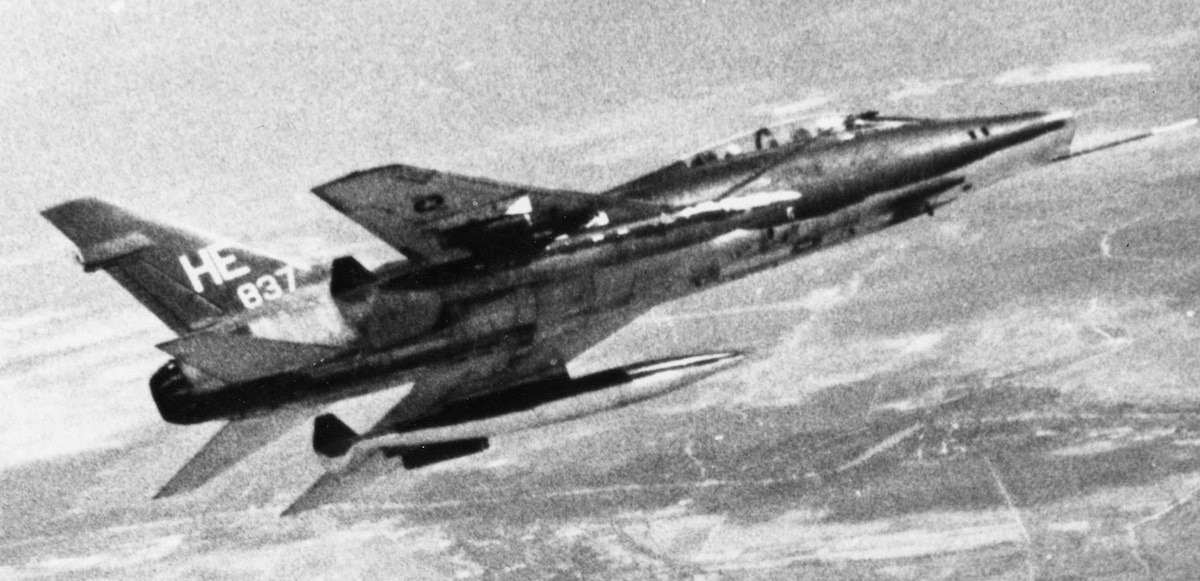
The F-100F Super Sabre was the final production variant of the Super Sabre family and the US Air Force’s first two-seat supersonic trainer until the introduction of the Northrop T-38 Talon in 1961.
In November 1955, North American proposed a two-seat version of the F-100 that would not only serve as a supersonic trainer but would also remain fully combat-capable, including the ability to deliver nuclear weapons. During the summer of 1956, an F-100C was selected for conversion into a two-seat trainer. To accommodate the instructor’s cockpit, the forward fuselage was lengthened by 2 feet 11 inches (0.9 m). The modified aircraft received the designation TF-100C and successfully completed its maiden flight on August 3, 1956.
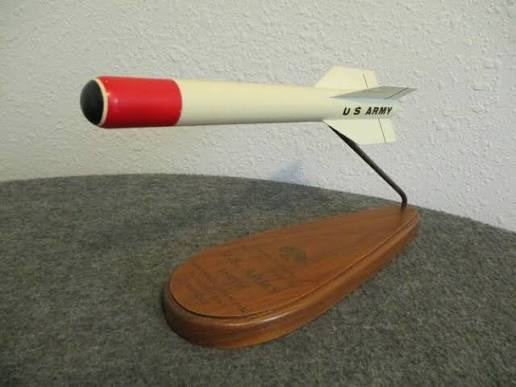
Production of the F-100F began in late 1956, with the first aircraft rolling off the assembly line in December of that year. The type made its first flight on March 7, 1957. The F-100F retained two of the F-100D’s four 20 mm M39 cannons, carrying 175 rounds per gun, 25 fewer rounds per weapon than the F-100D. It also retained the Low Altitude Bombing System (LABS), fire-control system, and AGM-12 Bullpup capability. Due to the increased weight, the F-100F’s maximum speed was approximately 35 mph lower than that of the F-100D.
Deliveries to the USAF began in May 1957, with the first aircraft assigned to the Fighter Weapons School at Nellis Air Force Base, Nevada. Beginning in May 1958, at least two F-100Fs were assigned to every F-100C and F-100D squadron. A total of 339 F-100Fs were produced, including 45 aircraft built for the Military Assistance Program (MAP) and supplied to France, Turkey, Denmark, and the Republic of China Air Force. Air National Guard F-100 units also began receiving F-100Fs in 1958. While the F-100 was withdrawn from frontline USAF service in 1972, approximately 100 F-100Fs remained in Air National Guard service until 1979.
Following the escalation of the Vietnam War in 1965, the USAF recognized the need for an aircraft capable of countering the growing threat posed by North Vietnam’s SA-2 surface-to-air missile system. In the fall of 1965, under Project Wild Weasel, ten F-100Fs were selected for modification. These aircraft were equipped with radar-warning and electronic-surveillance equipment that allowed the Electronic Warfare Officer (EWO) in the rear cockpit to detect, identify, and locate hostile radar emissions. Their mission was to warn strike aircraft of SAM threats and attack those threats using specialized ordnance, including the newly developed AGM-45 Shrike anti-radiation missile.
The modified F-100Fs received equipment such as the AN/APR-25 Radar Homing and Warning (RHAW) system, capable of detecting emissions from SA-2 guidance radars. Following testing at Eglin Air Force Base, Florida, the aircraft were deployed to the 6234th Tactical Fighter Wing and the 469th Tactical Fighter Squadron at Korat Royal Thai Air Base, Thailand, on Thanksgiving Day 1965, marking the beginning of the Wild Weasel I operational evaluation phase.
The first Wild Weasel combat mission was flown on December 1, 1965. Similar missions followed in the weeks afterward, destroying the first confirmed SAM site on December 22, 1965.
The following typical missions involved an F-100F Wild Weasel leading a strike package into North Vietnam. Flying ahead of the main force, the F-100F worked alongside escorting F-105 Thunderchiefs. Once a North Vietnamese SAM or AAA site was detected, the EWO would locate the emitter and direct the pilot to attack. Early in the campaign, the F-100F often marked or strafed the target using its cannons, FFAR rockets, or smoke rockets, while accompanying F-105s conducted the actual strike.
When AGM-45 Shrike missiles became available in March 1966, the F-100F gained a stand-off suppression capability. On April 17, 1966, three F-100F Wild Weasels carrying Shrike missiles conducted the first combat mission specifically intended to employ the weapon against a North Vietnamese SAM site.
The final Wild Weasel I mission was flown on July 11, 1966. During the program, the 6234th Tactical Fighter Wing lost three F-100Fs and suffered at least six personnel killed or captured. Despite these losses, Wild Weasel I was credited with destroying nine SAM sites and, more importantly, proving that radar-homing tactics were a viable method of suppressing enemy air defenses.
Operational experience revealed a significant limitation: the F-100F was more than 100 mph slower than the F-105 strike aircraft it escorted, forcing the strike package to reduce speed and increasing vulnerability to enemy defenses. As a result, the USAF transitioned the Wild Weasel mission to the two-seat F-105F Thunderchief, which evolved into the more capable Wild Weasel III, followed later by the F-4G Wild Weasel V.
In June 1967, other F-100Fs were assigned to the MISTY Forward Air Controller (FAC) program, replacing slower aircraft such as the Cessna O-1 and O-2. The F-100F proved highly effective in high-threat environments containing SAMs, AAA, and MiG fighters over North Vietnam and Laos. The MISTY program continued until 1971, when the last F-100s departed Southeast Asia.