- Yes
- No
- (independent) BeNeLux tree
- France: BeNeLux subtree
- Dutch (sub)tree
- Other
- I voted “No” in the previous poll
Hello all, today I’d like to suggest the Pantserwagen M.36, the Dutch designation for the Swedish-built Landsverk L-181 armored car. Introduced into service in 1936, the M.36 became the Netherlands’ first modern armored car and formed the backbone of the newly established Eskadrons Pantserwagens during the years leading up to the German invasion in May 1940. Although only twelve examples were acquired, the M.36 played a disproportionately important role during the Battle of the Netherlands. It served as the primary reconnaissance and security vehicle of the Dutch cavalry, fought around Ypenburg, Schiphol and the Grebbe Line and escorted Queen Wilhelmina during her evacuation to Hoek van Holland.
TL;DR: A fast reconnaissance vehicle armed with a 37 mm cannon, used extensively by the Dutch Army during the 1940 May campaign.

History
History
Development
During the early 1930s, the Dutch Army sought to modernize its cavalry arm. Although cavalry formations still relied heavily on horses and bicycles, military planners increasingly recognized the value of fast armored reconnaissance vehicles capable of screening advancing formations, conducting reconnaissance missions and delaying enemy forces. The existing armored cars in Dutch service had become obsolete, and foreign developments demonstrated that purpose-built armored cars offered a considerable improvement in both mobility and firepower.
At roughly the same time, the Swedish company AB Landsverk had become one of Europe’s leading manufacturers of armored vehicles. Throughout the early 1930s, Landsverk developed a family of six-wheeled armored cars intended primarily for export. These vehicles shared a common armored hull and turret but could be mounted on different commercial truck chassis depending on customer requirements. This resulted in three closely related variants: the Landsverk L-180, L-181 and L-182.
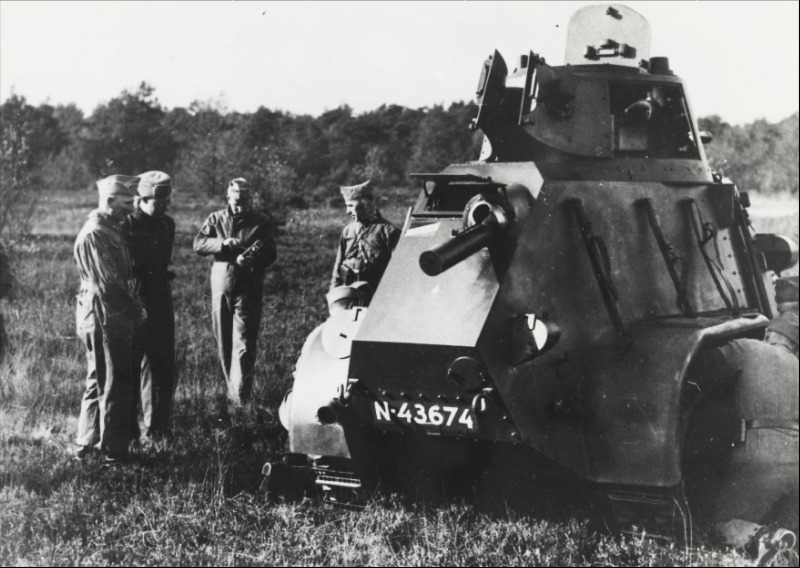
The Dutch government selected the Landsverk L-181, which was built on a German Daimler-Benz three-axle commercial truck chassis powered by an 80 hp six-cylinder petrol engine. Although relatively modest in power, the chassis was regarded as reliable and easy to maintain. An unusual feature of the design was the ability to fit removable track units over the tandem rear wheels. These auxiliary tracks could be installed by the crew when operating in particularly soft terrain, temporarily converting the vehicle into a half-track configuration and improving cross-country mobility.
In 1934 the Netherlands placed an order for twelve Landsverk L-181 armored cars. The purchase formed part of a broader modernization programme aimed at strengthening the reconnaissance capabilities of the Dutch Army without requiring the large financial investment associated with tanks. Construction took place in Sweden, after which the vehicles were delivered to the Netherlands during 1936. Upon entering Dutch service they received the official designation Pantserwagen M.36.
Dutch Service
The arrival of the new armored cars coincided with the establishment of the Eskadron Pantserwagens, a completely new cavalry formation created on 1 April 1936 and stationed at the Isabella Barracks in 's-Hertogenbosch. The twelve M.36 armored cars equipped the entire squadron, with each vehicle receiving both a provincial civilian registration number and a military registration. Initially the vehicles carried North Brabant civilian license plates ranging from N-43671 to N-43682 before these registrations were withdrawn in 1939, after which only the military vehicle numbers remained in use.
Organizationally, the squadron consisted of four platoons, each operating three armored cars supported by dispatch riders and motorcycle machine-gun sections. The vehicles were intended to perform reconnaissance, flank security, route patrols and delaying actions in support of larger cavalry formations. Rather than engaging enemy armor directly, the M.36 was expected to exploit its speed to gather intelligence, maintain contact with advancing or retreating enemy forces and provide mobile fire support whenever necessary.
The vehicle’s crew consisted of five men. Besides the driver, the crew included a commander, who also served as loader for the main gun, a gunner responsible for aiming and firing the turret weapons, a bow machine gunner and a rear driver who simultaneously operated the rear hull-mounted machine gun. The second driving position was particularly valuable, allowing the armored car to withdraw rapidly without turning around, an important tactical advantage during reconnaissance missions.
Despite its advanced design, the M.36 possessed several shortcomings. The relatively thin armor, varying between five and nine millimetres, protected only against rifle-calibre fire and shell fragments, while the commercial chassis limited cross-country performance despite the removable track system. Perhaps the greatest weakness, however, was the complete absence of radio equipment. Although wireless sets had been tested and ordered before the outbreak of the Second World War, they had not yet been delivered by May 1940. As a result, platoon commanders frequently relied on dispatch riders, written messages, signal lamps or flags to communicate, making coordinated operations considerably more difficult under combat conditions.
Combat during the German Invasion
When Germany invaded the Netherlands on 10 May 1940, the two Dutch armored car squadrons represented some of the most modern vehicles available to the Dutch Army. Although only twelve M.36s existed, they immediately became involved in some of the fiercest fighting of the campaign.
The 1st Eskadron Pantserwagens had been divided shortly before the invasion. Two platoons had already been detached to reinforce the defence of Ypenburg Airfield near The Hague, while the remainder of the squadron supported the defence of Schiphol. At Ypenburg, the armored cars played a crucial role in countering the German airborne assault. During the early morning bombardment several vehicles survived despite being caught in exposed positions. Once German transport aircraft began landing, the crews opened fire with both their 37 mm Bofors guns and machine guns, destroying or damaging multiple aircraft while engaging German paratroopers attempting to secure the airfield.
Several individual actions became particularly notable. One armored car, having become trapped inside a bomb crater, nevertheless continued engaging German troops until its crew was eventually forced to surrender after enemy soldiers approached with bundled hand grenades beneath the vehicle’s unarmoured floor. Other vehicles continued fighting throughout the day despite sustaining considerable damage, while several crews received Dutch decorations for their actions during the defence of the airfield. Although losses were significant, the determined resistance at Ypenburg contributed directly to the failure of the German airborne operation against The Hague.
Elsewhere, M.36 armored cars supported Dutch infantry during the defence of Schiphol and participated in numerous delaying actions as Dutch forces attempted to slow the German advance. On 13 May, surviving armored cars escorted Queen Wilhelmina, members of the Dutch government and the British diplomatic mission from The Hague to Hoek van Holland, ensuring their safe evacuation to the United Kingdom before the final collapse of Dutch resistance.
Throughout the five-day campaign the armored cars generally performed well. Their mobility and the effectiveness of the 37 mm Bofors gun allowed them to engage both infantry and lightly armored targets successfully. Contrary to popular belief, relatively few vehicles were actually destroyed by enemy fire. Most losses resulted from mechanical failures, accidental damage, air attacks or crews abandoning disabled vehicles when continued resistance became impossible.
German Service and Legacy
Following the Dutch capitulation on 15 May 1940, several surviving M.36 armored cars fell into German hands. After inspection and refurbishment, a number were incorporated into German service under the designation Pz.Sp.Wg. L 202 (h) (L-180), the “(h)” indicating their Dutch origin. These captured vehicles were primarily employed for occupation duties and security operations rather than frontline combat.
Although the M.36 remained in Dutch service for only four years, it represented a significant milestone in the modernization of the Royal Netherlands Army. Together with the later M.38, it formed the backbone of the Dutch armored reconnaissance arm immediately before the Second World War. During the May Campaign the vehicles demonstrated that well-trained crews operating modern reconnaissance vehicles could inflict considerable damage despite overwhelming numerical inferiority and the lack of adequate communications equipment.
Today, the Pantserwagen M.36 remains one of the most recognizable armored vehicles of the pre-war Dutch Army and stands as an important symbol of the cavalry units that fought during the defence of the Netherlands in May 1940.
Specifications
Category Details Crew 5 Weight Approximately 6.5 tonnes Dimensions L 5.35 m × W 2.20 m × H 2.56 m Main Armament 37 mm Bofors anti-tank gun Secondary Armament 3 × 7.92 mm Lewis machine guns (coaxial, front hull and rear hull) Ammunition AP, APHE and HE ammunition Engine Daimler-Benz M09 6-cylinder petrol engine Power 80 hp Power-to-weight Approximately 12.3 hp/t Transmission 6×4 drive with auxiliary removable tracks for the rear tandem wheels Maximum Speed 80 km/h (road) Operational Range Approximately 300 km Armour 5–9 mm riveted armour
Place in War Thunder
The Pantserwagen M.36 would be an excellent rank I reconnaissance vehicle for a future Dutch or BeNeLux ground forces tree. It combines excellent road mobility with a fully traversable turret mounting the proven 37 mm Bofors anti-tank gun, a weapon already familiar to many players through Swedish vehicles. Although its armour offers little more than protection against rifle-calibre fire and shell splinters, its mobility and firepower would make it an effective flanking and scouting vehicle.
The vehicle’s principal weaknesses would be its thin armour, modest engine power and relatively large silhouette. Its commercial truck chassis also limits cross-country mobility compared to tracked vehicles, despite the historical provision for removable auxiliary tracks over the rear wheels. Furthermore, the absence of advanced optics, stabilisation or radio equipment places the vehicle firmly within the technological standards of the late 1930s.
Pictures
Additional pictures are welcome in the comments!
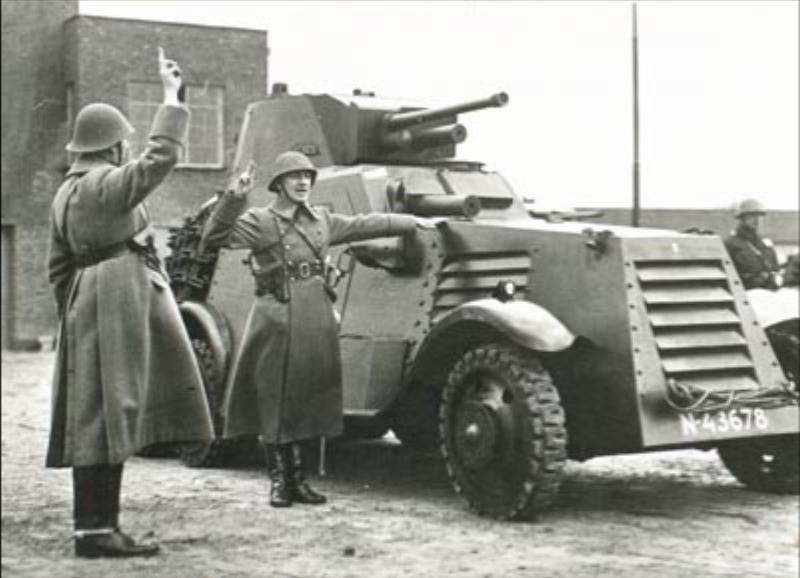
Dutch M.36
1937: The swearing-in ceremony of Second Lieutenant M.J. Aldenkamp at the 1st Armoured Car Squadron, conducted by Squadron Commander Captain H. Wilbrenninck.
Changing the additional tracks on a Landsverk L181 (M36 armored car) of the 1st Armored Car Squadron in the terrain during a visit by Prince Bernhard (2nd from left).
Sources
Sources
Main sources
Huismans, P. (2020, July 15). De Landverks van het Eerste Eskadron: Zweedse pantserwagens voor het Nederlandse leger. De Auto van M’n Opa. De Landverks van het Eerste Eskadron | De auto van m’n opa
Nederlands Instituut voor Militaire Historie. (n.d.). Landsverk M.36 pantserwagen nr. 10 met naar links gedraaide geschutkoepel (Objectnummer 00110874). Nationaal Militair Museum Collectie. Landsverk M.36 pantserwagen nr. 10 met naar links gedraaide geschutkoepel … - collectie - Nationaal Militair Museum
Van Dalen, H. (n.d.). 1e en 2e Eskadron Pantserwagens in mei 1940. Regiment Huzaren van Boreel. https://huzarenvanboreel.nl/index.php/eskadron-pantserwagens-in-mei-1940/
Ruys, S. (2021). Wiel en rups: Voertuigen van de Landmacht 1945–2015 (2nd ed.). Walburg Pers.
Supporting sources
De Auto van M’n Opa. (n.d.). Pantserwagen geïnspecteerd. Pantserwagen geïnspecteerd | De auto van m’n opa
Grebbeberg.nl. (n.d.). Landsverk M.36 / M.38 – Pantserwagen. Landsverk M.36 / M.38 - Pantserwagen - De Slag om de Grebbeberg in mei 1940
Pantser.net. (n.d.). Landsverk M36/M38. Pantser.net
Quartermaster Section. (n.d.). M36 Pantserwagen. M36 PANTSERWAGEN - Quartermaster Section
Tank Encyclopedia. (2024, January 15). Landsverk 181. Landsverk 181 - Tank Encyclopedia
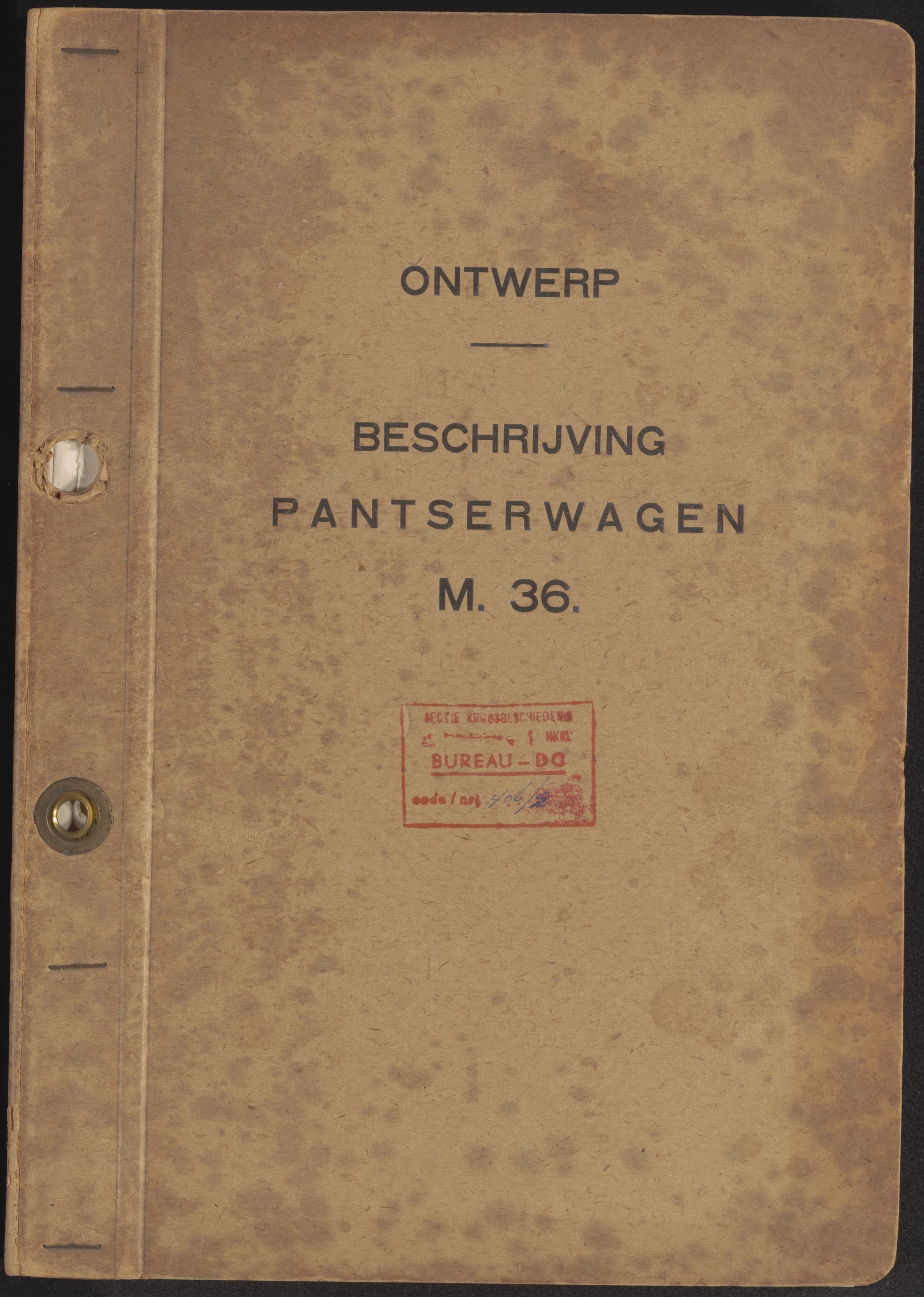
Wikimedia Commons. (2021). Landsverk L181 (M36), 1e Eskadron Pantserwagens. File:Landsverk L181 (M36), 1e Eskadron Pantserwagens.jpg - Wikimedia Commons
,_1e_Eskadron_Pantserwagens.jpg)