Karnitin75: Please note this idea is not fully finished and any details or issues missed are definetly overlooked. I am working on this for a future suggestion, and please answer the poll below after reading <3. That said- Happy reading!
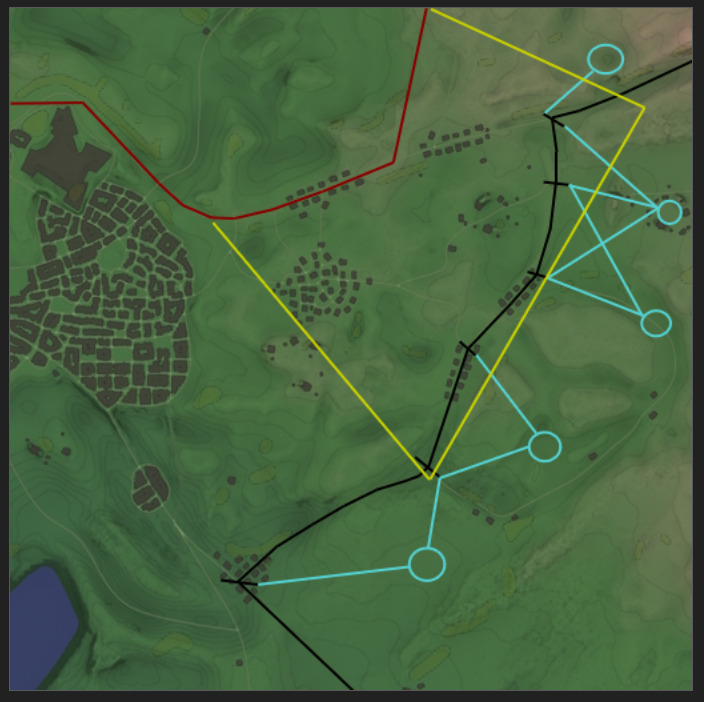
One team takes the role of convoy defenders, tasked with escorting and maintaining a logistics convoy from one side of the map to an extraction point on the opposite side.
The opposing team acts as attackers, whose objective is to locate, ambush, and destroy or sufficiently delay the convoy before it reaches safety or the match timer expires.
This creates a fully asymmetric battlefield where defenders must preserve movement and cohesion under pressure, while attackers focus on prediction, disruption, and coordinated interception rather than direct objective control.
The convoy itself consists of approximately 24 AI-controlled logistics vehicles, forming a long, distributed formation rather than a single target. This scale ensures that full 15–18 player teams on each side remain active throughout multiple simultaneous engagements along the convoy’s route. Different sections of the convoy naturally create different tactical priorities: lead vehicles control momentum and direction, central vehicles maintain structural continuity, and rear vehicles become vulnerable to flanking and pursuit attacks.
The convoy is partially treated as a health system, but operates as a physical formation. If a vehicle in the central portion is destroyed, the convoy splits: vehicles behind the destroyed unit halt, while vehicles ahead continue forward. This immediately fractures the formation into separate segments, creating opportunities for attackers to isolate and eliminate parts of the convoy in detail. To counter this, defenders must actively tow and clear destroyed vehicles from the road to restore movement and reconnect the formation, turning battlefield recovery into a core gameplay responsibility. Targeting lead and central convoy vehicles becomes a high-value strategy for attackers, as it produces maximum disruption rather than simple damage.
Combat flows continuously through a single-round structure beginning with convoy movement, followed by escalating ambush phases where semi-long-range engagements, flanking maneuvers, and coordinated strikes define the battlefield. The match concludes when the convoy reaches extraction, is destroyed, or when the timer expires. If the convoy fails to reach its destination within the time limit, victory is awarded to the attackers. This ensures defenders cannot indefinitely stall and that movement remains the central win condition.
To prevent spawn camping and maintain unpredictability, the attacking team’s spawn location relocates every five minutes along the edge of their designated map area. This constant rotation eliminates static spawn pressure, prevents camping positions from forming, and forces attackers to continuously adapt their approach routes. As a result, defenders must remain aware of multiple possible attack vectors at all times, reinforcing the fluid nature of the battlefield.
To further reinforce the convoy as the true center of combat, the defending team’s respawn system is also dynamically tied to convoy progression. Instead of spawning from a fixed rear location, defenders use a checkpoint-based forward spawn system that moves along with the convoy as it advances. This keeps defenders structurally connected to the action and prevents long travel times from breaking the flow of defense.
The existing artillery mechanic is transformed into a meaningful tactical system within this structure. Attackers can use artillery to pressure predicted convoy positions, disrupt movement, and force temporary halts, while defenders can use it to probe suspected ambush zones and suppress likely attacker positions. When under artillery fire, the convoy will temporarily stop, and its position will be revealed on the map, creating natural pauses in movement and new tactical openings. Artillery therefore shifts from a simple damage tool into a system of battlefield pressure and information control.
The entrenching system, using existing dozer blades and plows, is also given a clear tactical role under the “Ground Breaking” update concept. Vehicles equipped with these tools can prepare hull-down ambush positions, establish kill zones, and shape terrain along predicted convoy routes. This allows players to actively prepare the battlefield before engagement, turning ambushes into planned and reinforced encounters rather than improvised fights. Terrain itself becomes part of the strategic layer of the match.
Air combat is integrated as a support system rather than a separate win condition. Aircraft are earned through in-match performance such as kills, assists, and spotting. Fighters and interceptors contest airspace and protect or disrupt convoy movement, strike aircraft provide short, focused attacks on ground targets, and reconnaissance aircraft contribute battlefield awareness.
In BR ranges around 3.7–8.0, heavy and strategic bombers are excluded to prevent instant convoy destruction due to large payloads. In Cold War variants, helicopters and stand-off strike aircraft are introduced, balanced by limited interceptor spawns for defenders and SPAA convoy defense systems.
To ensure pacing remains consistent, the convoy is subject to a time condition: if a certain amount of vehicles does not reach extraction before the match timer expires, the attacking team is automatically awarded victory. This prevents indefinite stalling and ensures both sides remain under constant pressure to either advance or disrupt movement.
Ultimately, Convoy mode transforms War Thunder into a dynamic operational battlefield where victory is not determined by holding static points, but by controlling movement itself. Players fight across a constantly shifting front where convoys are physically disrupted, terrain is actively shaped, artillery creates pressure and information warfare, air power influences ground movement, and spawn locations remain unpredictable. Every system feeds into a single core idea: success comes from predicting, shaping, and breaking the movement of a living battlefield rather than capturing fixed objectives.
Polls:
- Yes
- No
- Nothing comes to mind/sounds good!
- Needs to be slightly refined
- Needs to be heavely refined
- Change can only come based on play-tests
- Already said no.
- Attacker Spawn
- Defender Spawn
- Convoy
- None of the above / I dont know
- Already said no.
Thank you for reading!