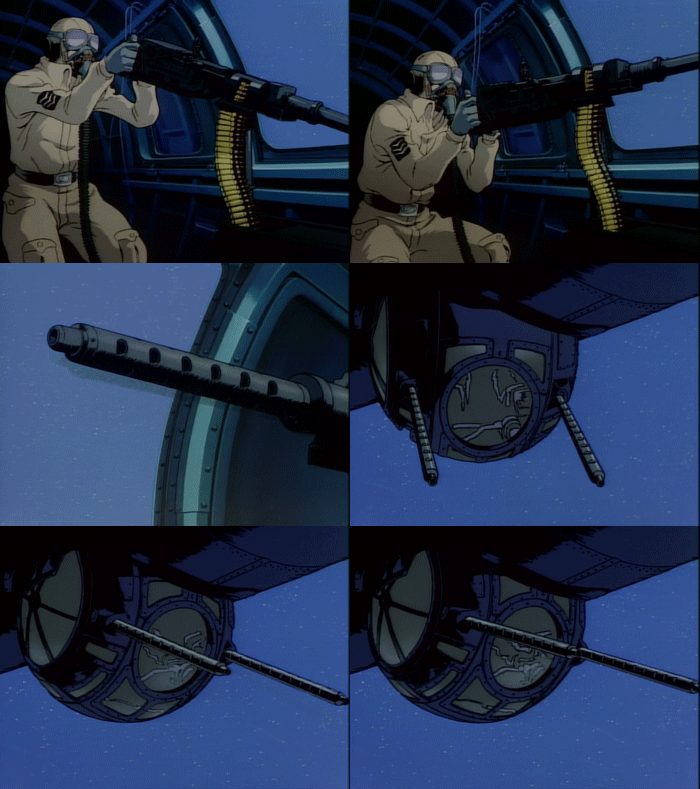
- Yes
- No
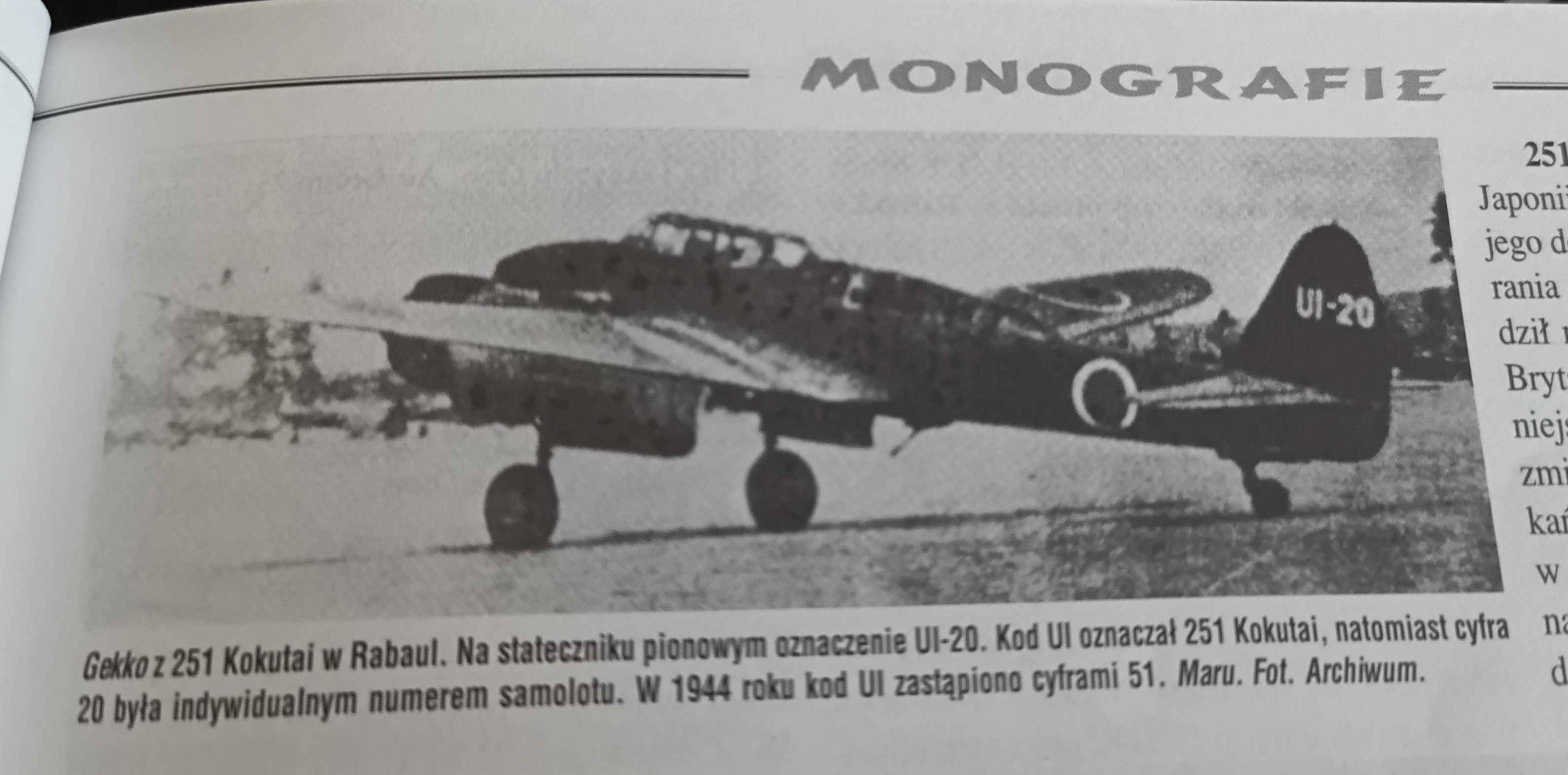
Nakajima J1N1-C Kai
The Nakajima J1N1-C Kai was a prototype Japanese Navy fighter developed in early 1943 from modifications of the Nakajima J1N1-C planes. Three prototypes were built, which made it possible to develop the Nakajima J1N1-S and J1N1-Sa night fighters.
History
In April 1942, the 251st Air Group, under the command of Lieutenant Colonel Yasuna Kozono, arrived at the Japanese Navy base on Rabalau, supporting Japanese Navy operations across the Solomon Islands, Papua New Guinea, the Australian coast, and the Coral Sea. During May and June, the Mitsubishi A6M fighters of the 251st Fighter Group increasingly encountered hard-to-shoot-down American heavy bombers B-17 and B-24. Kozono immediately came up with the idea of using the J1N1-C reconnaissance plane as a fighter, but initially, they decided to use the Type 99 No. 3 anti-aircraft cluster bomb weighing 30 kg; however, using it only managed to shoot down one B-17 and damage another. This bomb was not widely available in 1942 and was best suited to attacking bomber formations due to its random accuracy. That’s why they decided to look for a more reliable method of attacking B-17s. Overall, at the Rabalau air base, the Japanese Navy and Army were looking for ways to fight American heavy bombers, which led to the development in the near future of planes like the Kawasaki Ki-45 Otsu, Kawasaki Ki-45 Ko/Tei, Mitsubishi A6M3 with Type 2 guns, Mitsubishi Ki-46-II with a 37 mm gun, and later the Nakajima Ki-84 Tei. Lieutenant Colonel Yasuna Kozono stated that 20 mm angled guns should be used for safe attacks from below or above enemy bombers. This was Lt. Col. Kozono’s own concept, although in 1938 the Japanese Navy had tested the idea of 20 mm downward-facing guns for ground attacks on a Mitsubishi G3M bomber. Lt. Col. Kozono also talked to his pilots and concluded that it should work here as well, and that a plane like this could surprise and attack enemy aircraft. In November 1942, Lt. Col. Kozono returned to Japan to present his idea. First, he went to the Naval Aviation Technical Arsenal (Yokosuka) where he presented his concept as an excellent solution for combating heavy enemy bombers; however, it was deemed there that it was not even worth trying this concept. Lieutenant Colonel Kozono, undeterred by this, turned directly to the staff of the Japanese Navy command, where the aviation staff officer, Lieutenant Colonel Genda Minoru, was opposed. The only person interested in the concept was Rear Admiral Ushie Sugimoto, head of the Air Experiments Department at the Technical Naval Aviation Arsenal, who stated that it could be tried, but no work was started. Meanwhile, Kozono learned that prototype Nakajima J1N1-C were in Japan and received permission to modify three prototypes, which were modified in haste. In March 1943, the aircraft arrived at the Toyohashi air base for testing and crew training. The main test pilot there was Captain Yukio Endo (later an ace of Nakajima J1N1-S and J1N1-Sa planes). In the tests, large shooting targets (canvas ribbons) were used, pulled by Mitsubishi A6M aircraft, which were meant to simulate B-17 bombers. The prototype Nakajima J1N1-C Kai (kai - modified) didn’t have sights for the oblique guns, so Endo aimed by eye and managed to hit 13 targets during a 20-second gunfire series. After the shooting tests, Lieutenant Colonel Kozono asked his friend Major Kiyoto Hanamoto from the Naval Aviation Group in Yokosuka for help. Hanamoto used his Mitsubishi A6M fighter in a mock aerial battle, while Kozono flew the J1N1-C Kai. During the mock fight, it was shown that although the Zero is more maneuverable, thanks to the oblique guns, the J1N1-C Kai can attack from unexpected angles, and it was concluded that both planes would have equal chances in an air battle. However, the leadership of the Japanese Navy did not consider this a sufficient reason to put the Nakajima J1N1-C Kai into service as a fighter. Lieutenant Colonel Kozono, Captain Endo, and the rest of the 251st Fighter Wing returned to Rabaul in May 1943 with two modified prototype J1N1-C Kai and nine J1N1-C equipped to carry Type 99 No. 3 bombs. On the night of May 21, a Nakajima J1N1-C Kai fighter piloted by Corporal Shigetoshi Kudo scored its first two kills when it shot down two B-17E bombers from the 64th Squadron of the 43rd Bomb Group. By the end of June, he had shot down another two B-17 bombers using upward-firing guns and one Hudson bomber using downward-firing guns. Overall, two Nakajima J1N1-C Kai aircraft had shot down nine B-17 bombers by the end of June. The Japanese Naval Air Staff was very impressed by the effectiveness of the fighters equipped with oblique guns and approved a field modification for a larger number of aircraft. On August 23, 1943, the Nakajima J1N1-C Kai was accepted into service as the Nakajima J1N1-S (J1N2), and mass production of these planes began at the Nakajima factory (by the end of 1943, 150 Nakajima J1N1-S fighters had been built).


Construction description
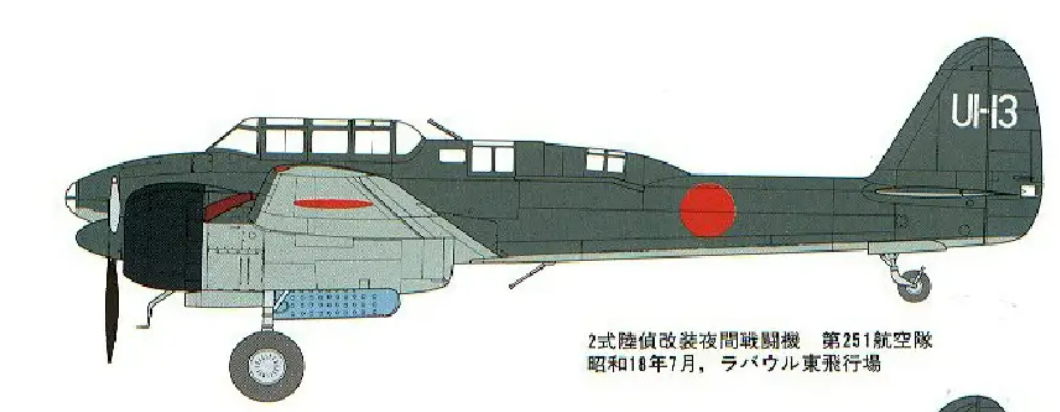
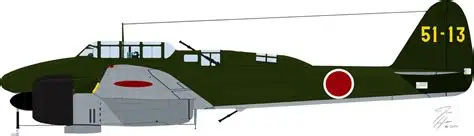
The Nakajima J1N1-C Kai, since it’s a prototype of the J1N1-S, is almost identical to it, but there are a few differences between them.
- The plane kept the glazing in the hump that it inherited from the Nakajima J1N1-C
- Most likely the plane was limited to only 30 kg bombs
- In the pilot’s seat, there was a 15 mm armor plate, not 9.5 mm like in the J1N1-S
Technical sketches
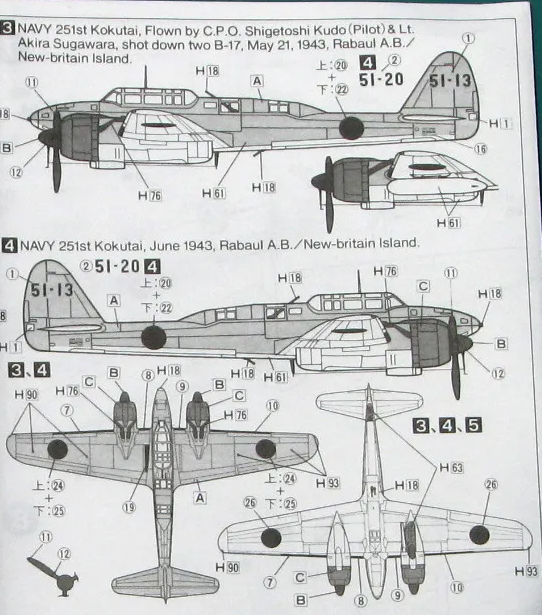
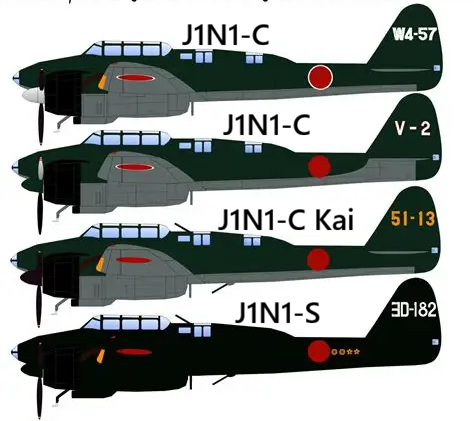
Comparison of the Nakajima J1N1-C Kai with other versions of the Nakajima J1N
General characteristics
- Crew: 2
- Length: 12,17 m
- Wingspan: 16,98 m
- Height: 4,56 m
- Wing area: 40,0 m2
- Empty weight: 4 540 kg
- Gross weight: 7010 kg
- Maximum Take-off Weight: 7 527 kg (?)
- Powerplant: 2 × 14-cylinder, two-cylinder, air-cooled, Nakajima NK1F Sakae 21 radial piston engine, with 840 kW (1,130 hp) each
- Propellers: Three-bladed propeller with constant rotational speed with a diameter of 3,048 mm.
Performance
- Maximum speed: 507 km/h
- Cruise Speed: 333 km/h
- Range: 2,544 km
- Maximum Range: 3,748 km
- Service ceiling: 9,320 m
- Time to Climb to: 9 minutes 35 seconds at an altitude of 5,000 m
- Climb Rate: 8,7 m/s
Armament
- Guns:
- 2 x Type 99 Model 2 cannons behind the cockpit at 30 degrees upwards (100 rounds per gun)
- 2 x Type 99 Model 2 cannons under hull at 30 degrees downwards (100 rounds per cannon)
- Bombs:
- 2 x 30 kg bombs
- Fuel dump tanks:
- 2 x 310 L dump tanks under wings
- 2 x 330 L dump tanks under wings
Armour
- 15 mm thick armor plate behind the pilot
- Self-sealing fuel tanks
Special thanks
Summary
The Nakajima J1N1-C Kai is an interesting plane for Japan in War Thunder. Thanks to its unique angled armament, this aircraft is perfect for surprise attacks on enemy fighters and bombers, and with a bit of skill, it can even be useful for attacking unarmored and exposed enemy vehicles and ships. This plane served as a model for future Japanese naval night fighters (Nakajima J1N1-S, Nakajima J1N1-Sa, Aichi S1A1, Nakajima J5N1 Kai, Mitsubishi A6M5-S, Yokosuka D4Y2-S, Yokosuka D4Y3-S, Yokosuka P1Y1-S, Yokosuka P1Y2-S, Nakajima C6N1-S) as well as for the army (Kawasaki Ki-45 Tei, Kawasaki Ki-102 Hei, Nakajima Ki-84 Tei, Mitsubishi Ki-46-III Otsu+Hei, Mitsubishi Ki-46-III Kai), so it would make a very good candidate for an event vehicle with a really interesting history. In my opinion, this plane shouldn’t be included in the regular tech tree due to the existence of the Nakajima J1N1-S, but it’s perfect as an event plane, premium vehicle, or battle pass reward. I encourage you to discuss in the comments and to share your own knowledge on this subject.
Finally, I apologize for the linguistic and logical errors because unfortunately English is not my main language and I had to use google translator.
Internet sources
月光 (航空機) - Wikipedia
Nakajima J1N Gekkō - Wikipedia
Nakajima J1N (“Gekko”) Prototypes and Projects | Secret Projects Forum
夜間戦闘機 『月光』/中島Nakajima J1N | 大日本帝国軍 主要兵器
Warplanes of Japan: Nakajima J1N Gekko - SilverHawkAuthor Website Military History Materials
Nakajima J1N1 C-Kai ‘Gekko’_251st Kokutai (Fujimi) | ModelPlanes.de
Nakajima J1N Gekko (Moonlight)
Book sources
- 日本航空機辞典 1910年(明治43年)~1945年(昭和20年) 上巻 (Encyclopedia of Japanese Aircraft 1910 (Meiji 43) – 1945 (Showa 20), Volume 1) page 240-242
- 野沢正『日本航空機総集 中島篇』(Masaru Nozawa ‘Comprehensive Collection of Japanese Aircraft: Nakajima Volume’) page 198-205
- Japońskie Samoloty Marynarki 1912-45 część II (Japanese naval aircraft 1912-45 part II) page 110-115
- Japanese Heavy Fighters 1937-1945 , page 111-128
- Lotnictwo Wojskowe 2/1998 (Military Aviation 2/1998) page 23-39
*『日本軍用機写真集』1 (ファイター) ,文林堂, (“Japanese Military Aircraft Photo Collection 1 (Fighters)”, Bunrindo) page 218-224 - Bunrindo - Famous Airplanes of The World 57 - Nakajima J1N ‘Gekko’ Navy Type 11 Night Fighter
Bunrindo - Famous Airplanes of The World 57 - Nakajima J1N ‘Gekko’ Navy Type 11 Night Fighter | PDF | Language Arts & Discipline | Foreign Language Studies - Model-art-595-Night-fighters.pdf - Dysk Google

Thank you for reading the suggestion, see you in the next one. Good luck pilots