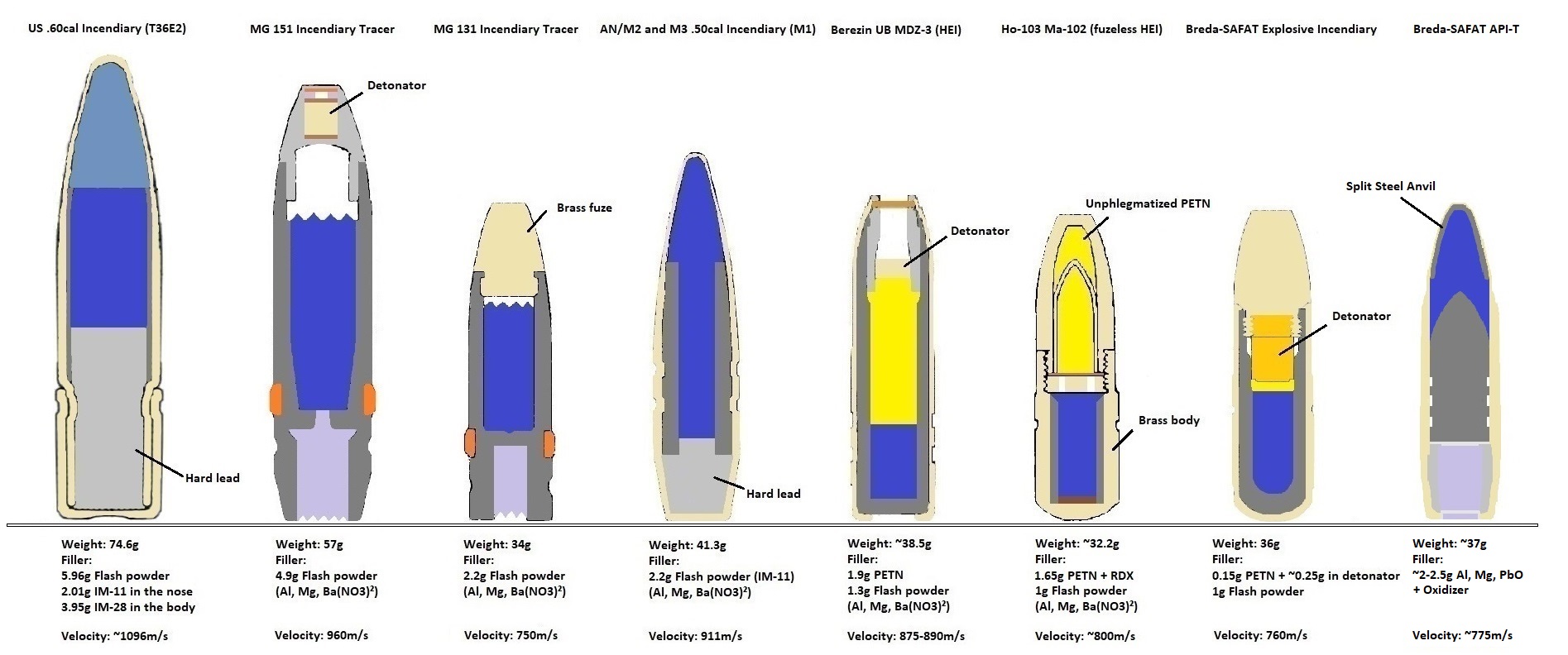
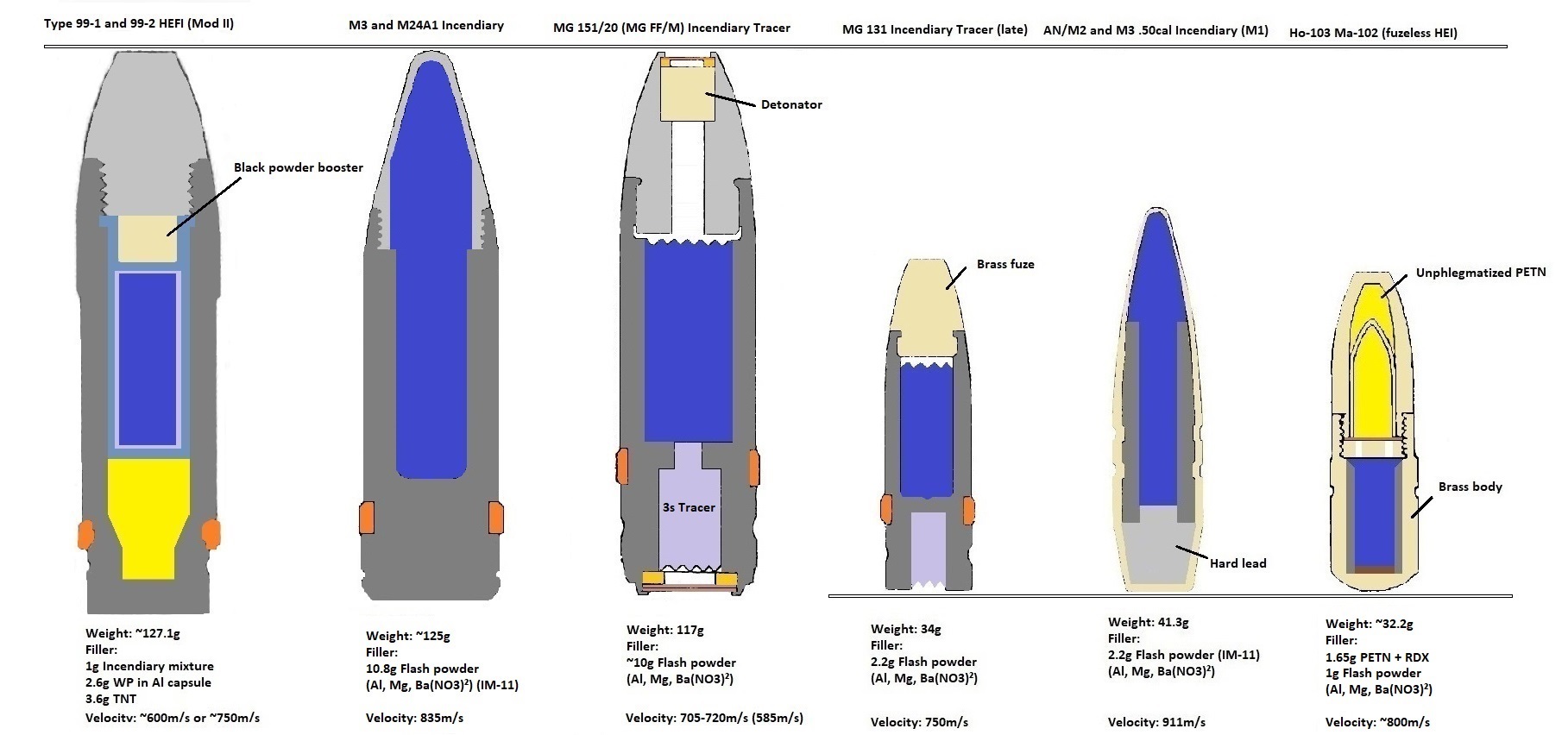
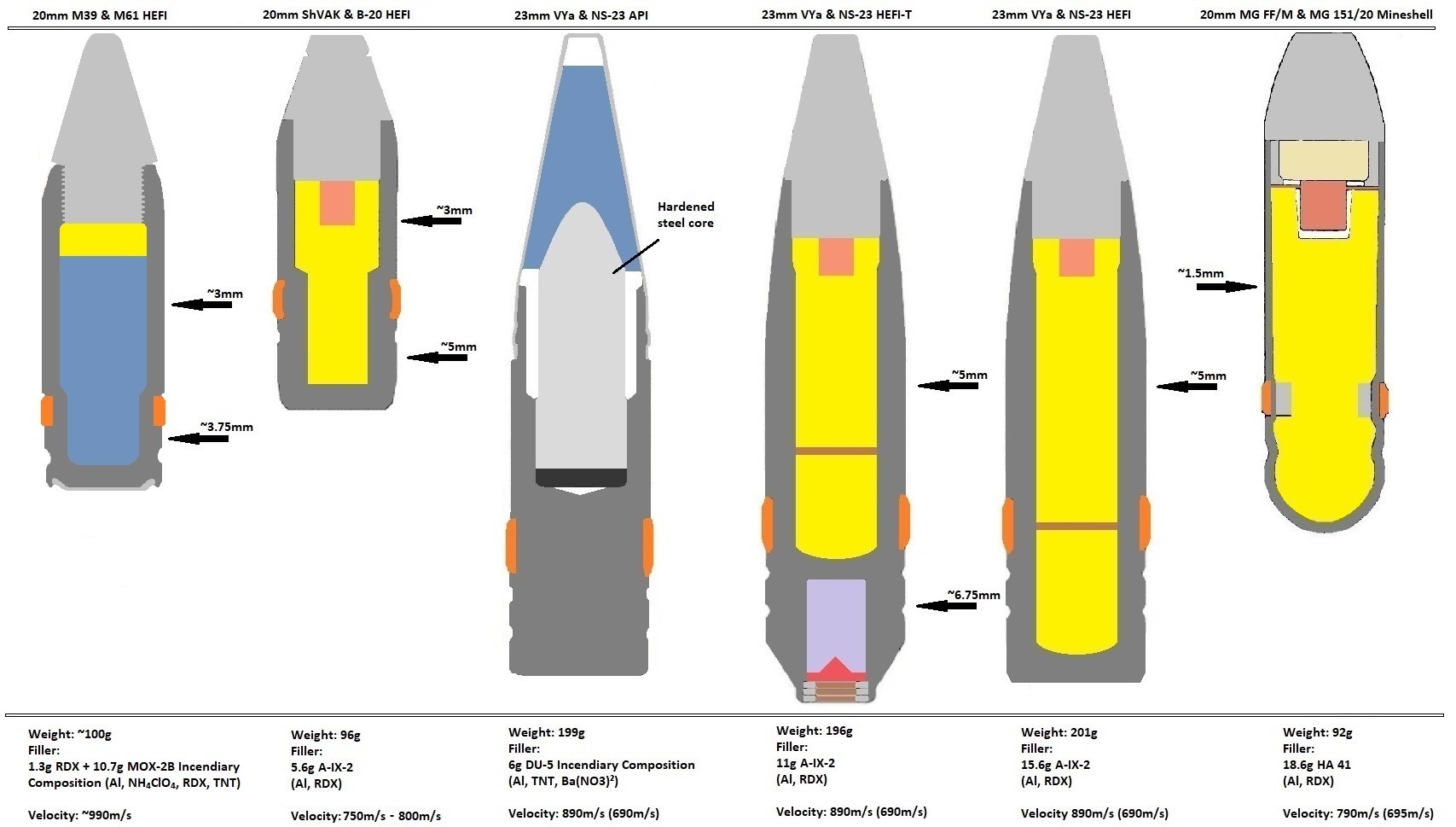
The shells and bullets are more or less based on a 1:1 scale.
7.7-7.92mm LMG Incendiary ammunition compared to 12.7 and 13.2mm HMG rounds

It’s clear how ineffective rifle caliber bullets are in comparison to even heavy machine gun bullets, since they can only carry little chemical content and only have a fraction of their kinetic energy that is going to be transferred into the fuel tank.
LMG: 2.7-3.5k J
HMG: 15-17k J

20mm Incendiary rounds compared to HMG

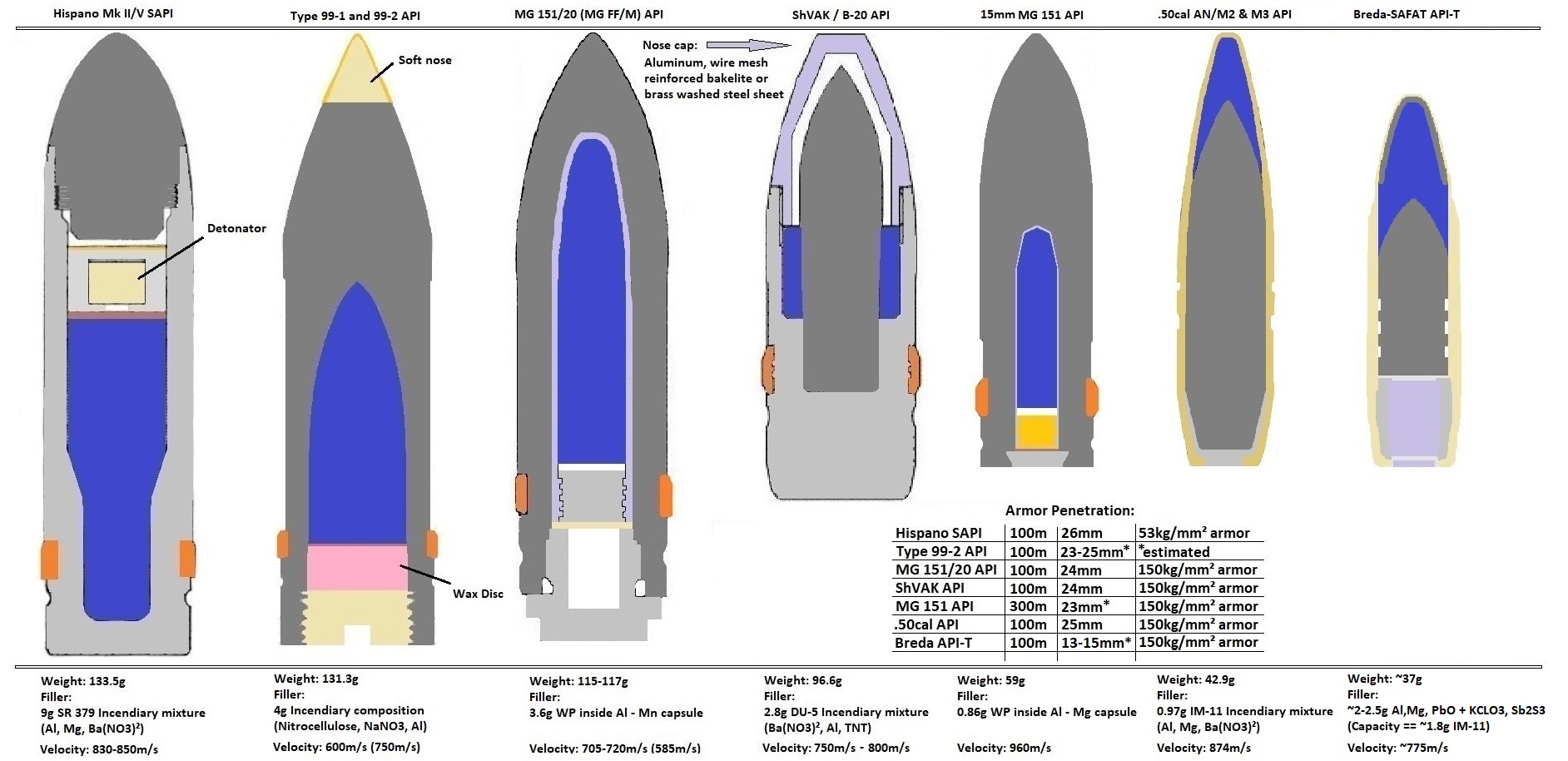
20mm Explosive and Explosive-Incendiary rounds. 15mm shell for comparison
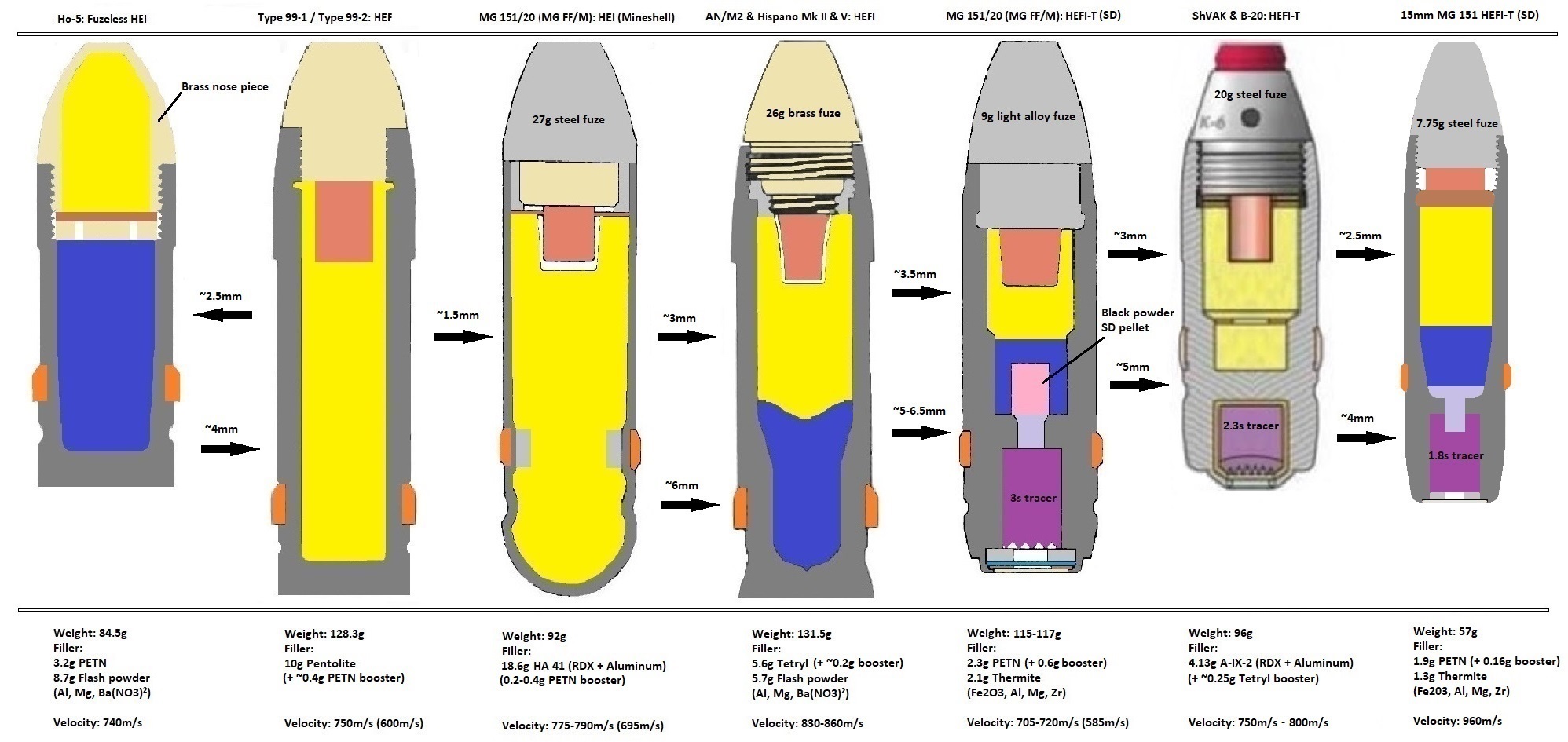
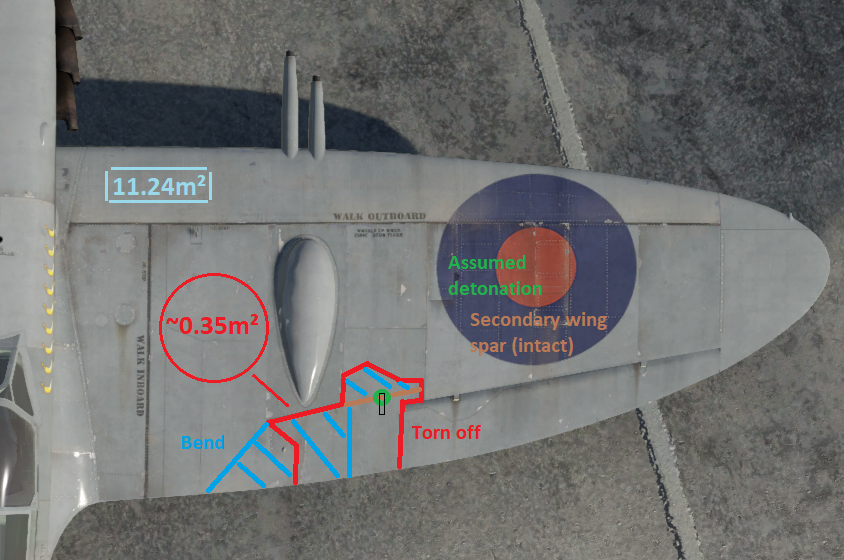
20mm Mineshell damage to Spitfire wing:




37mm shells and larger. 30mm Mineshell for comparison.
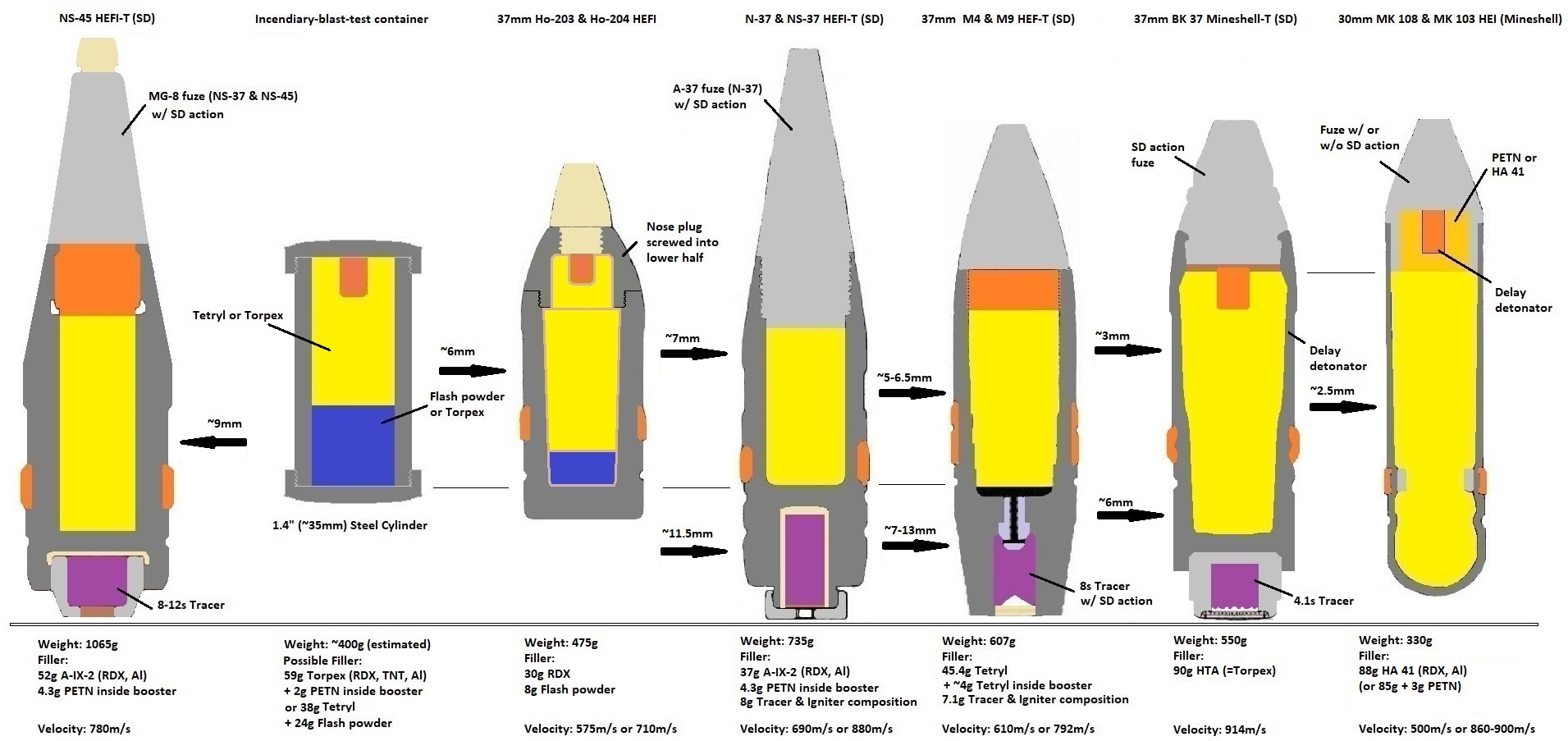
Blast Test container vs. Spitfire wing:


Damage of blast:

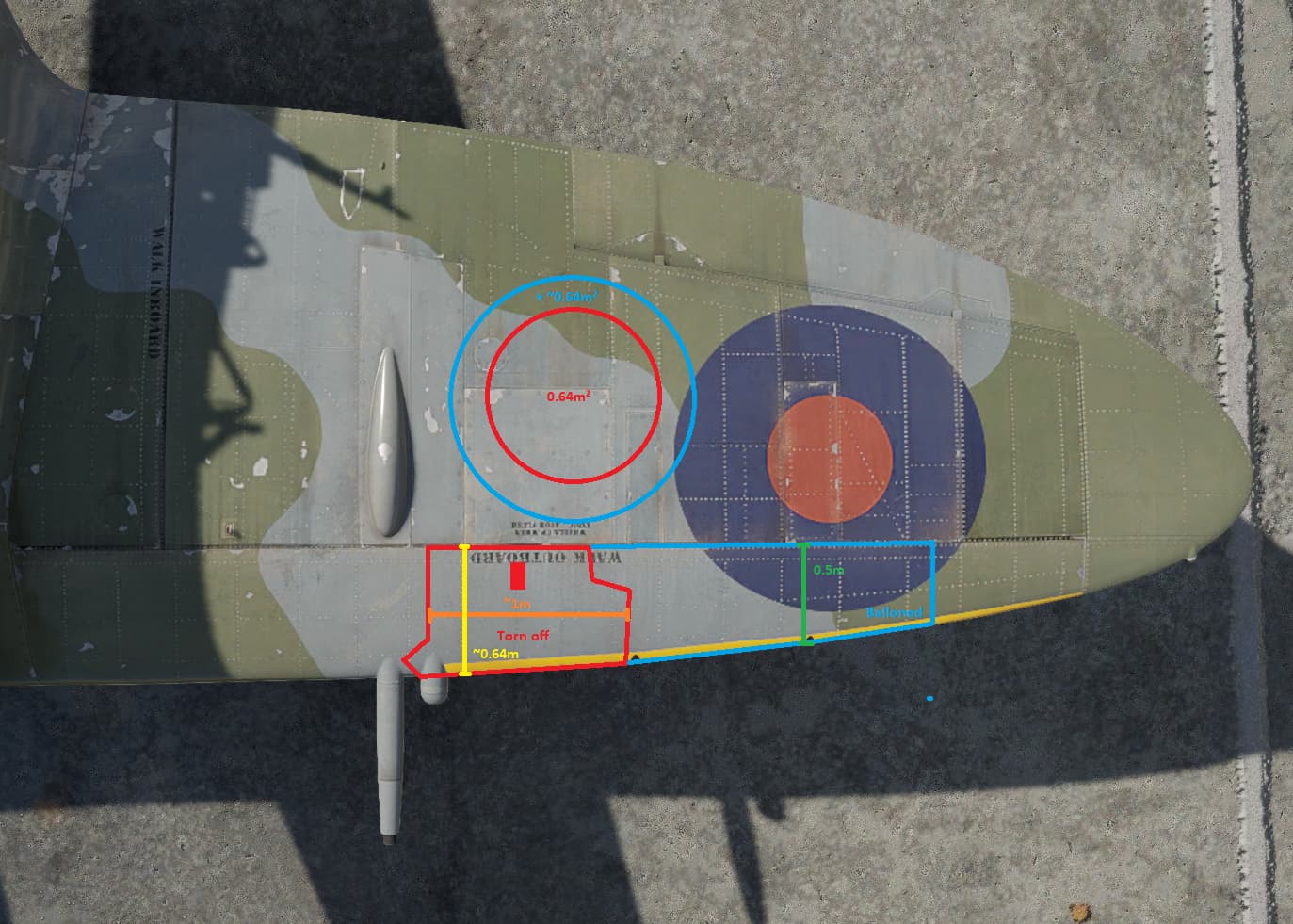


High structural damage but the main spar isn’t compromised other than a large hole in the center of it, as the blast escapes through the thin duralumin skin.
A portion of the skin is blown aways while a large part “balloons”, deforming from the pressure.
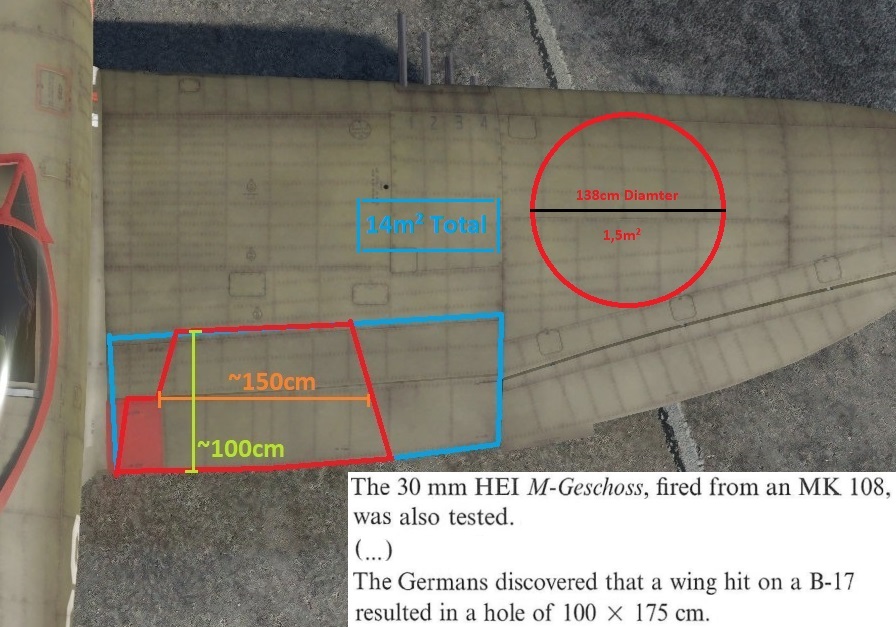
30mm Mineshell damage to Spitfire wing (Type B)


Damage of NS-37 and NS-45 shells against a Bf 109 and Ju 87 wing:

NS-37 hole diamater based on wing area destroyed.
- Entry: 30cm (Bf 109), 32cm (Ju 87)
- Exit: 76.5cm (Bf 109), 67cm (Ju 87)
NS-45 hole diamter:
- Entry: μ=58cm (Bf 109), μ=66.8cm (Ju 87)
- Exit: μ=87.8cm (Bf 109), μ=91.3cm (Ju 87)
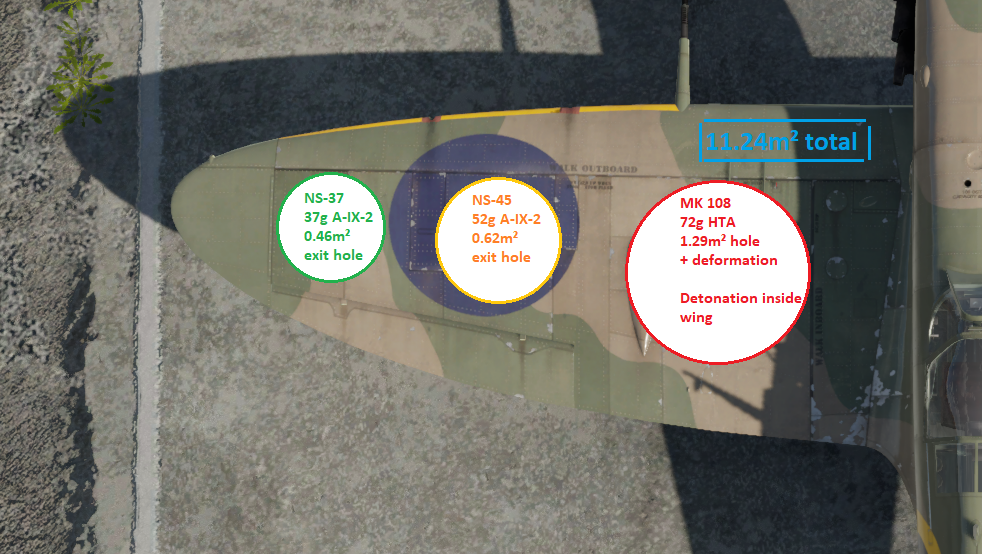
Blast comparison to 30mm Mineshell:
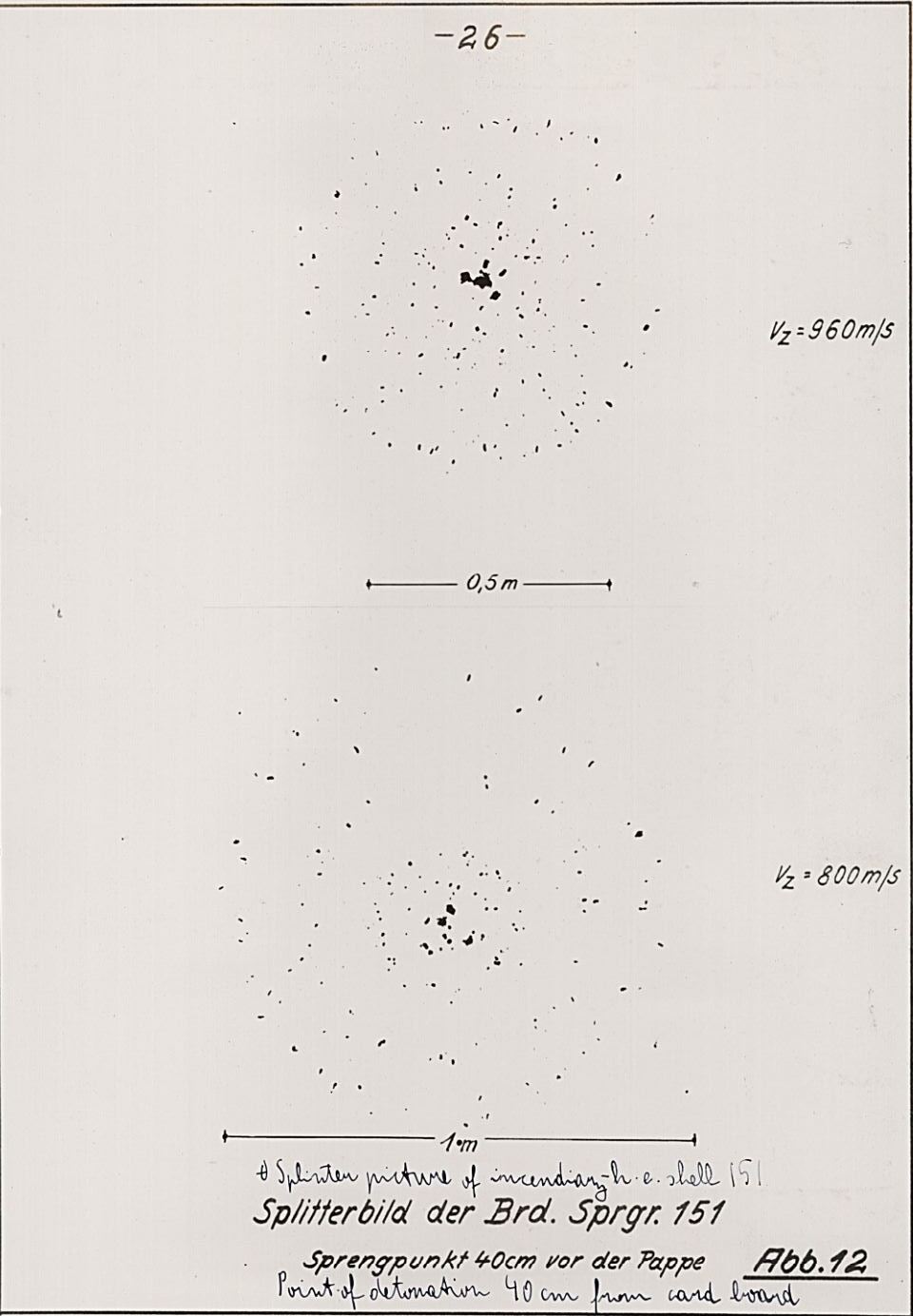
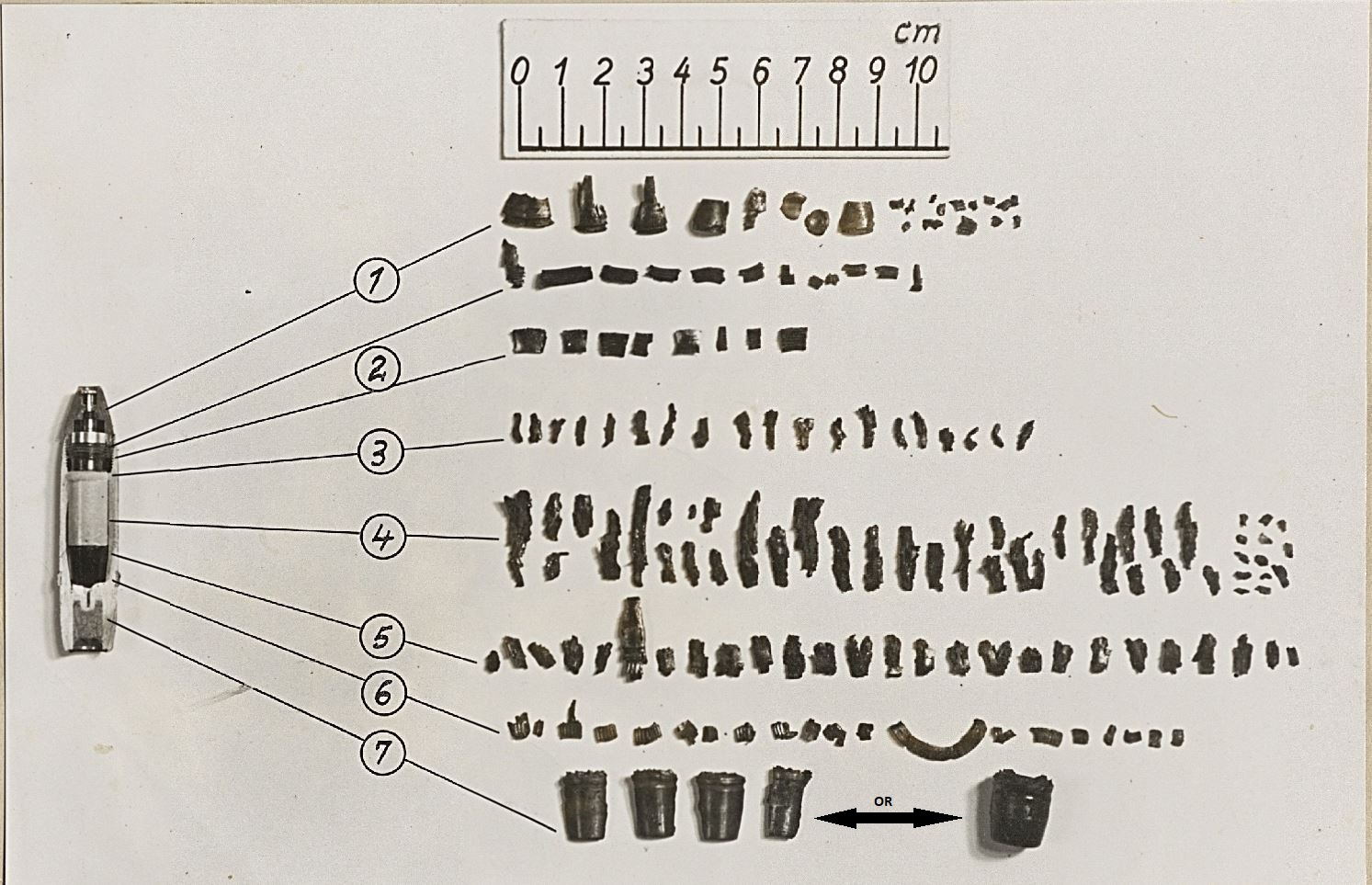
Fragmentation of a N-37 HEFI-T shell:

Out of ~660g recovered fragments from of the ~690g body&fuze, 84.42% (~557.2g) are effective steel fragments with a weight of above 0.5g.
- 9.4% (62g) with a weight between 0.5-1g
- 15% (99g) with a weight between 1-2g
- 11.4% (75g) with a weight between 2-4g
Larger fragments, like parts of the nose fuze and tracer tail assembly, can penetrate armor protecting fuel tanks or pilot and cause lethal damage to fuel tanks.
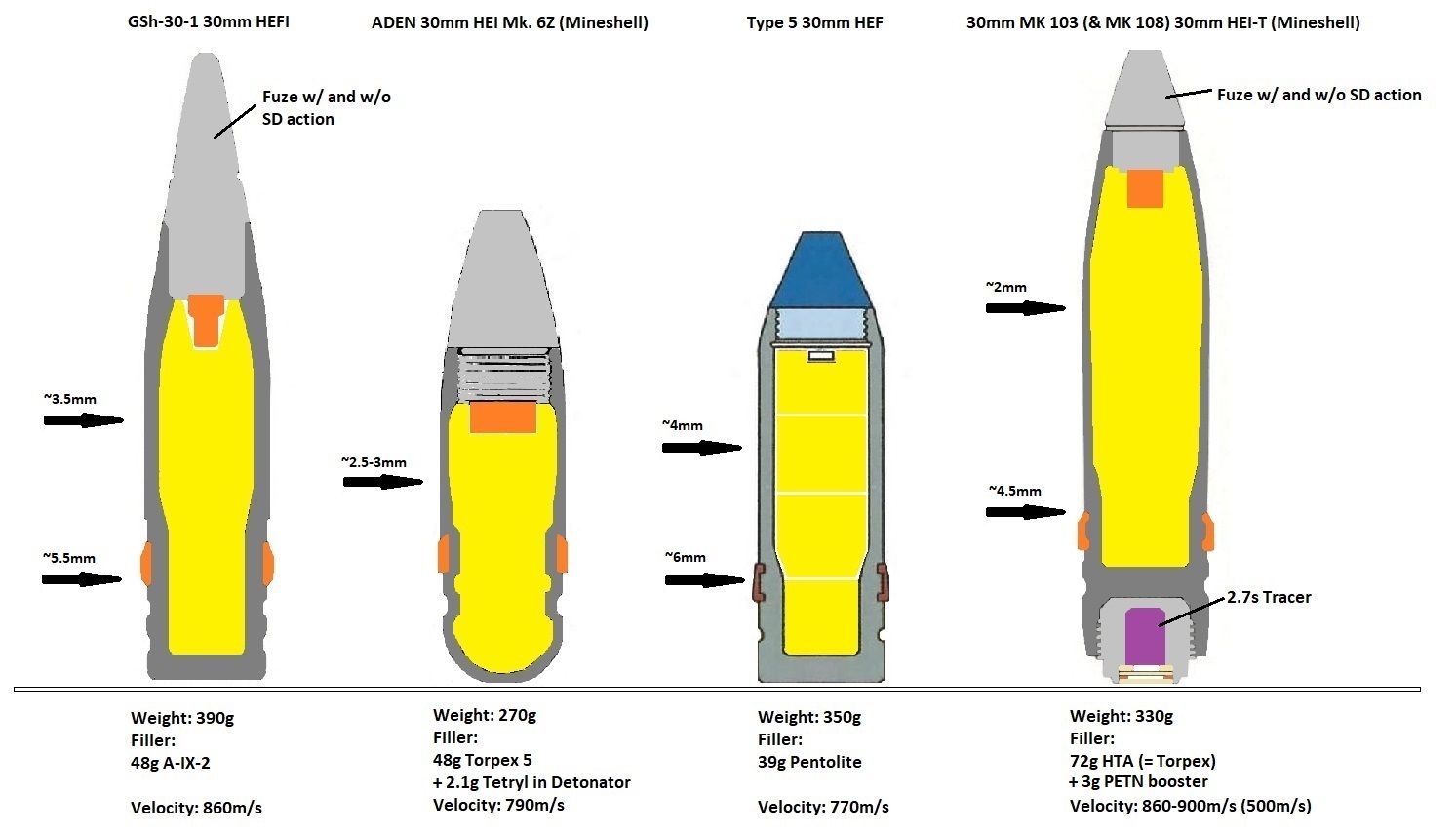
Comparison of fragment distribution of 30mm HEFI and HEI (Mineshell):
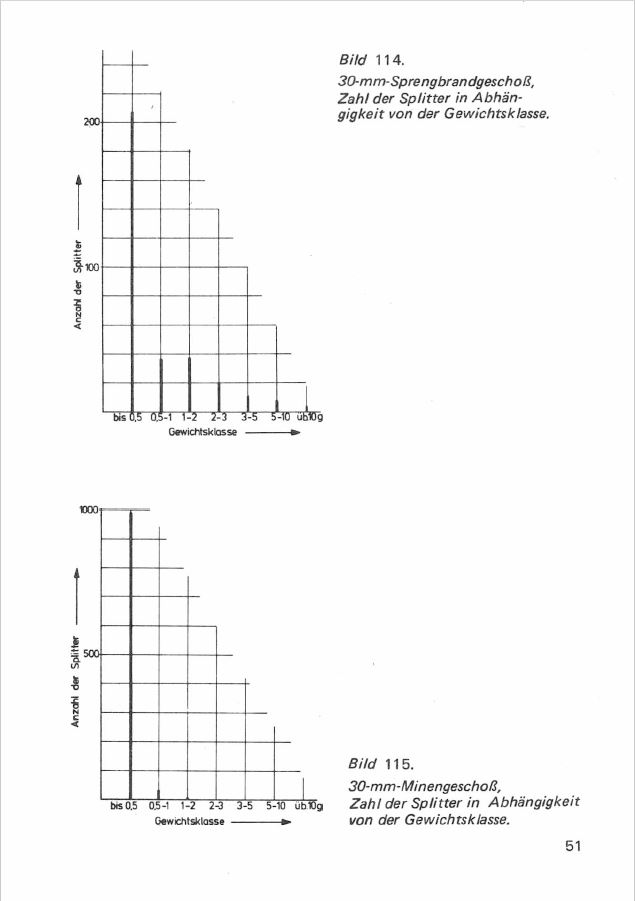
Mineshells, for the most part, only produce a large number of small fragments with a weight of only up to 0.5g, which quickly lose their velocity over a short distance.
Regular explosive rounds produce a much higher number of effective fragments.
——————————
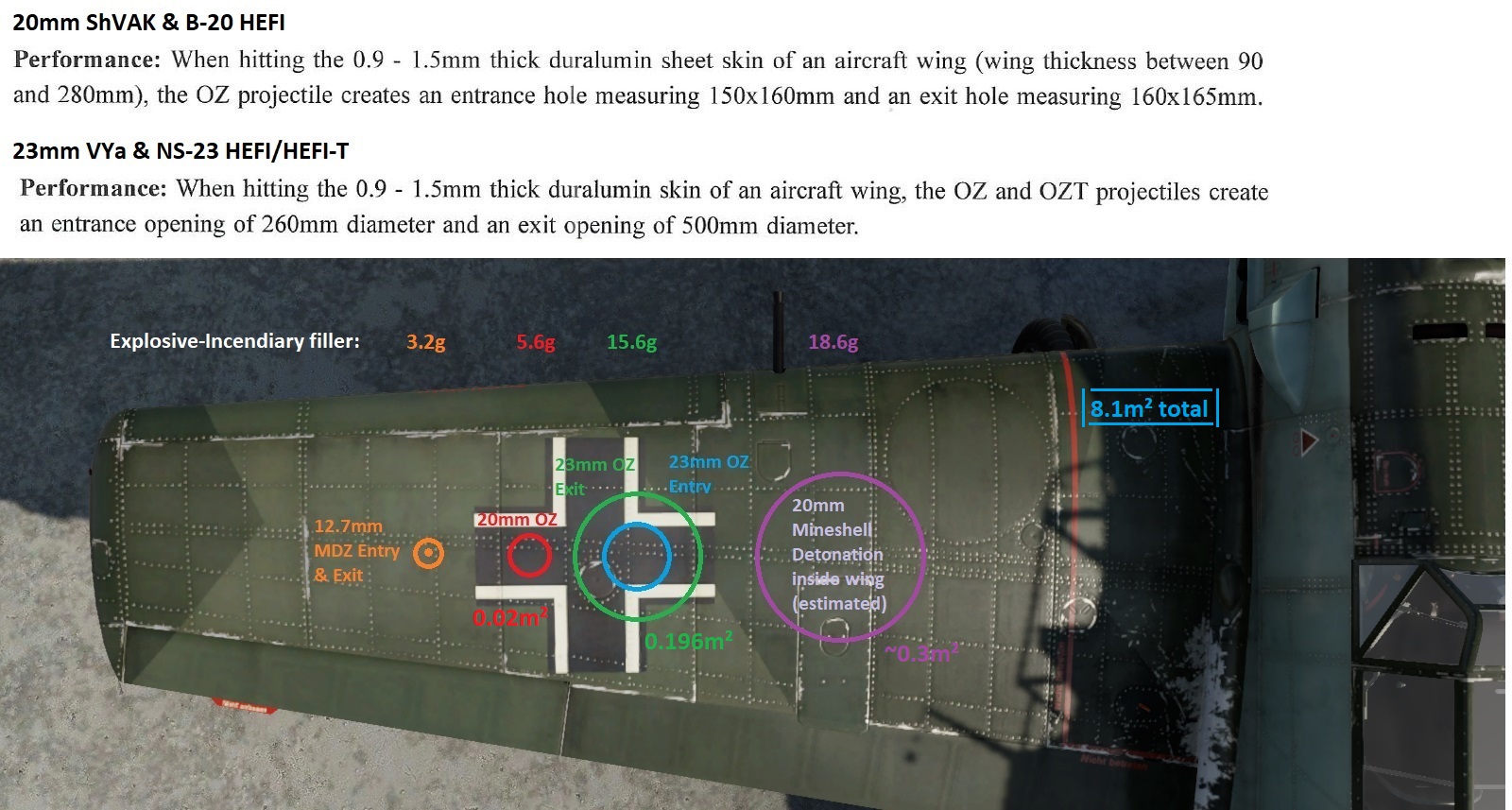
Assessment of (aluminized) explosive content against an aircrafts wing:
| Ammunition | Explosive amount | Damage in m² | Ratio m²/g | Notes |
|---|---|---|---|---|
| 12.7mm MDZ-3 | 3.2g PETN & Flash powder | 0.0095m² | 0.0030 | Exit hole |
| 20mm OZ | 5.6g A-IX-2 | 0.02m² | 0.0036 | |
| 23mm OZ | 15.6g A-IX-2 | 0.196m² | 0.0125 | Exit hole |
| 20mm Mineshell | 18.6g HA 41 | ~0.35m² | 0.0188 | Mineshell |
| 37mm OZT | 37g A-IX-2 (+4g PETN) | 0.46m² | 0.0112 | Exit hole |
| 45mm OZT | 52g A-IX-2 (+4g PETN) | 0.62m² | 0.0111 | Exit hole |
| 35mm Test Container | 59g Torpex (+2g PETN) | ~0.73m² | 0.0120 | Test Container |
| 30mm Mineshell w/ Tracer | 72g Torpex (+3g PETN) | ~1.29m² | 0.0172 | Mineshell |
| 30mm Mineshell w/o Tracer | 88g HA 41 | 1.75m² | 0.0199 | Mineshell |
It’s noticable that Mineshells achive a higher destruction ratio than thick walled explosive rounds, presumably because less energy is used to break the shell casing appart.
The actual damage is even larger, as bulging or balloning of the structure isn’t considered, only structure that is actually torn appart.
Another explanation would be the detonation inside the wing, even though the 35mm test container, which was detonated inside a wing, didn’t cause as much damage as Mineshells.
With the exception of the 12.7mm Berezin and 20mm ShVAK, all other projectiles seem to follow a similiar destruction ratio.
The small explosive content of the ShVAK and Berezin are probably unable to cause enough pressure built-up inside a duralumin wing to cause heavy blast damage from overpressure.
——————————
Required number of hits for the destruction of a four engined bomber (B-17), based on German assessment:

| Caliber | Shell weight | Required hits | Explosive content | Total content | Blast damage ratio | Blast damage | Fragmentation weight | Notes |
|---|---|---|---|---|---|---|---|---|
| 15mm | 57g | 75 | ~3.0g PETN | ~225g PETN | 0.0036 | 0.81m² | ~3975g | Explosive shell |
| 20mm | 92g | 20 | 18.6g HA 41 | 372g HA 41 | 0.0188 | 6.99m² | ~1450g | Mineshell |
| 30mm | 330g | 5 | 72g HTA + 3g PETN | ~375g HTA | 0.0188* | 6.77m² | ~1250g | Mineshell |
| 30mm | 330g | 4 | 88g HA 41 | 352 HA 41 | 0.0199 | 7.00m² | ~960g | Mineshell |
| 30mm | 270g | 7 | 48g Torpex + ~2g Tetryl | ~350g Torpex | 0.0188* | 6.58m² | ~1540g | Mineshell (ADEN) |
| 50mm | 1520g | 1 | 335g HTA + 12g PETN | 347g | 0.0188* | 6.52m² | ~1150g | Mineshell |
| 55mm | 1466g | 1 | 420g HTA + ~12g PETN | 432g | 0.0188* | 8.14m² | ~1000g | Mineshell |
The 15mm explosive shells bring roughly 4kg of fragments into the target. Mineshell less than 1.5kg, while producing much smaller and less effective fragments.
The killing power of explosives shells comes mostly from fragments that can damage fuel tanks, causing fuel leaks or fuel fires.
Structural damage is minimal in comparison.
Mineshells on the other hand, deal very high structural damage for minimal fragmentation.
The 20mm ShVAK would require 45 hits to bring roughly 4kg of fragments into the target, while the structural damage would be 0.91m².
Since the shell uses A-IX-2, it would have increased incendiary performance.
Additionally, effective fragments would also be larger, reducing the required number of hits.
For a Hispano it would be 34 hits, with at least 1.35m², potentially more, structural damage.
That is equal to a 22.5cm diameter hole, per hit.
But due to the incendiary effect and larger fragments, the realistic number is going to be lower.
An overview:
| Cannon | Caliber | Shell weight | Required hits for 4kg fragments | Explosive content | Total content | Blast damage ratio | Blast damage |
|---|---|---|---|---|---|---|---|
| ShVAK | 20mm | 96g | ~45 | 5.6g A-IX-2 | 252g | 0.0036 | 0.91m² |
| Hispano | 20mm | ~131.5g | ~34 | ~11g Tetryl&Flash powder | 343g | 0.0036 | ~1.35m² |
| NS-23 | 23mm | 201g | ~22 | 15.6g A-IX-2 | 343.2g | 0.0125 | 4.29m² |
| Type 5 | 30mm | 350g | ~13 | 39g Pentolite | 507 | 0.008* | 4.06m² |
| M4 | 37mm | 608g | ~7 | ~49g Tetryl | ~343g | 0.008* | 2.74m² |
It becomes apparent that 4kg of fragments for 20-37mm shells compared to a 15mm shell doesn’t make sense, since a light 15mm shell only produces few effective fragments.
→ Shell wall thickness of 2.5mm compared to 4-7mm.
At the same time the explosive content, for 4kg fragments, is close to or even exceeds that of Mineshells.
From „Aircaft vulnerability and overall effectiveness“ we know that 37mm M54 HEF-T is practically as effective as 30mm Mineshells (88g HA 41), or even slightly superior, when it comes to destroying a B-25 with structural damage and damage to fuel tanks.
If we consider it takes on average four 37mm hits instead, that would be roughly 2200g of fragments and blast damage of roughly 1.6m².
So the blast damage is considerable lower than Mineshells, but the fragments can deal lethal damage to fuel tanks, wing spars and control cables, while the slow burning tracer composition can ignite fuel. Additionally, engines might fail after a while from damage to oil systems or direct hits.
If we adjust the table for 2200g of fragment weight, with the assumption that 20mm and larger shells produce more effective fragments than a small 15mm explosive-tracer shell, we get the following results instead:
| Cannon | Caliber | Shell weight | Required hits for 2.2kg fragments | Explosive content | Total content | Blast damage ratio | Blast damage | RoF (Synchronized) | Firing time with 5% accuracy |
|---|---|---|---|---|---|---|---|---|---|
| ShVAK | 20mm | 96g | 25 | 5.6g A-IX-2 | 140g | 0.0036 | 0.56m² | 800 (600) RPM | 37.5s (50s) |
| Hispano | 20mm | ~131.5g | 19 | ~11g Tetryl&Flash powder | ~209g | 0.0036 | 0.75m² | 600 / 750 RPM | 38s / 30.4s |
| M39 | 20mm | 100g | 25 | 12g RDX+MOX-2B | 300g | 0.0125** | 3.75m² | 1500 RPM | 20s |
| NS-23 / NR-23 | 23mm | 201g | 12 | 15.6g A-IX-2 | 187.2g | 0.0125 | 2.34m² | 600(480) / 900 RPM | 24s(30s) / 16s |
| Type 5 | 30mm | 350g | 7 | 39g Pentolite | 273g | 0.008* | 2.18m² | 500 RPM | 16.8s |
| M4 | 37mm | 608g | 4 | ~49g Tetryl | ~196g | 0.008* | 1.57m² | 150 RPM | 32s |
| NS-37 / N-37 | 37mm | 735g | ~3 (3.2) | 37g A-IX-2 + 4g PETN | ~123g | 0.0111 | 1.37m² | 260 / 400 RPM | 13.8 / 9s |
| NS-45 | 45mm | 1065g | ~2 (2.2) | 52g A-IX-2 + ~4g PETN | ~112g | 0.0112 | 1.25m² | 260 RPM | 9.2s |
| BK-5 / Mk.214a | 50mm | 1820g | ~1 (1.5) | 250g HTA + 12g PETN | 262g | 0.012 | 3.14m² | 50 / 160 RPM | 24 / 7.5s |
Mineshell time on target:
| Cannon | Caliber | Number of hits | RoF (Synchronized) | Firing time with 5% accuracy |
|---|---|---|---|---|
| MG 151/20 | 20mm | 20 | 630 (553) RPM | 38.1 (43.4s) |
| MK 213 | 20mm | 20 | 1200 RPM | 20s |
| MK 103 | 30mm | 4 / 5 | 450 RPM | 10.7s / 13.3s |
| MK 108 | 30mm | 4 / 5 | 600 RPM | 8s / 10s |
| MK 108+ | 30mm | 4 / 5 | 850 RPM | 5.65s / 7.06s |
| MG 213 | 30mm | 5 | 1000 RPM | 6s |
| ADEN | 30mm | 7 | 1200 RPM | 7s |
The single shot effectiveness of a 37mm is roughly 3-4 times higher than a 20mm Hispano HEFI or Incendiary shell.
Mineshells and 37mm HEF-T have a more immediate effect, compared to smaller shells, that might only destroy the aircraft due to not making it back to base from the damage sustained. Crashing vs. crash landing.
If we go by this table, 20mm Mineshells aren’t optimal for destroying large, four engined bombers, as setting them on fire with incendiary or explosive-incendiary rounds yield similar results without the drawbacks of Mineshells.
20mm Mineshells should be more effective against fighters, that will go down more quickly from the structural damage sustained.
While 30mm Mineshells have a clear advantage over smaller and larger shells in killing bombers, due to their low weight but high destructive power.
The Type 5 30mm HEF shell effectiveness is probably lower, since it’s missing a tracer or any other incendiary material.
But this might be offset by the use of HEFI ammunition with large incendiary filler or additional 20mm Incendiary shells.
Larger cannons, like the NS-45 or BK 50 deliver an even higher fragment amount into the target, requiring even less shots for a kill.
The NS-45 would have had a high chance to destroy a twin engined bomber, like a He 111, in a a single shot.
The 50mm Mineshell increased the destruction potential further, greatly increasing the likelhood of a single shot being enough to destroy a bomber instead of 2. Important due to the low fire rate of the weapon.
*
For large shells with Tetryl and Pentolite I chose a blast ratio of 0.008 compared to 0.011-0.0125 of aluminized explosives. Based on the result of the incendiary blast test container, comparing Torpex to RDX/TNT.
For 30mm Mineshells with HTA the same blast damage ratio as 20mm Mineshellls was chosen.
Both were calculated from area damage of Spitfire wings.
**
MOX-2B uses ammonium perchlorate as oxidizer, which is much more powerful than barium nitrate.
Resulting in in more energy being released. The resulting blast damage should lie in the same category as 23mm HEFI, using just RDX+Aluminum. But the blast should theoretically even stronger.
Thus the same 0.0125 modifier is used, compared to ShVAK and Hispano shells.
——————————
Incendiary probability for different projectiles against P-38s fuel tanks
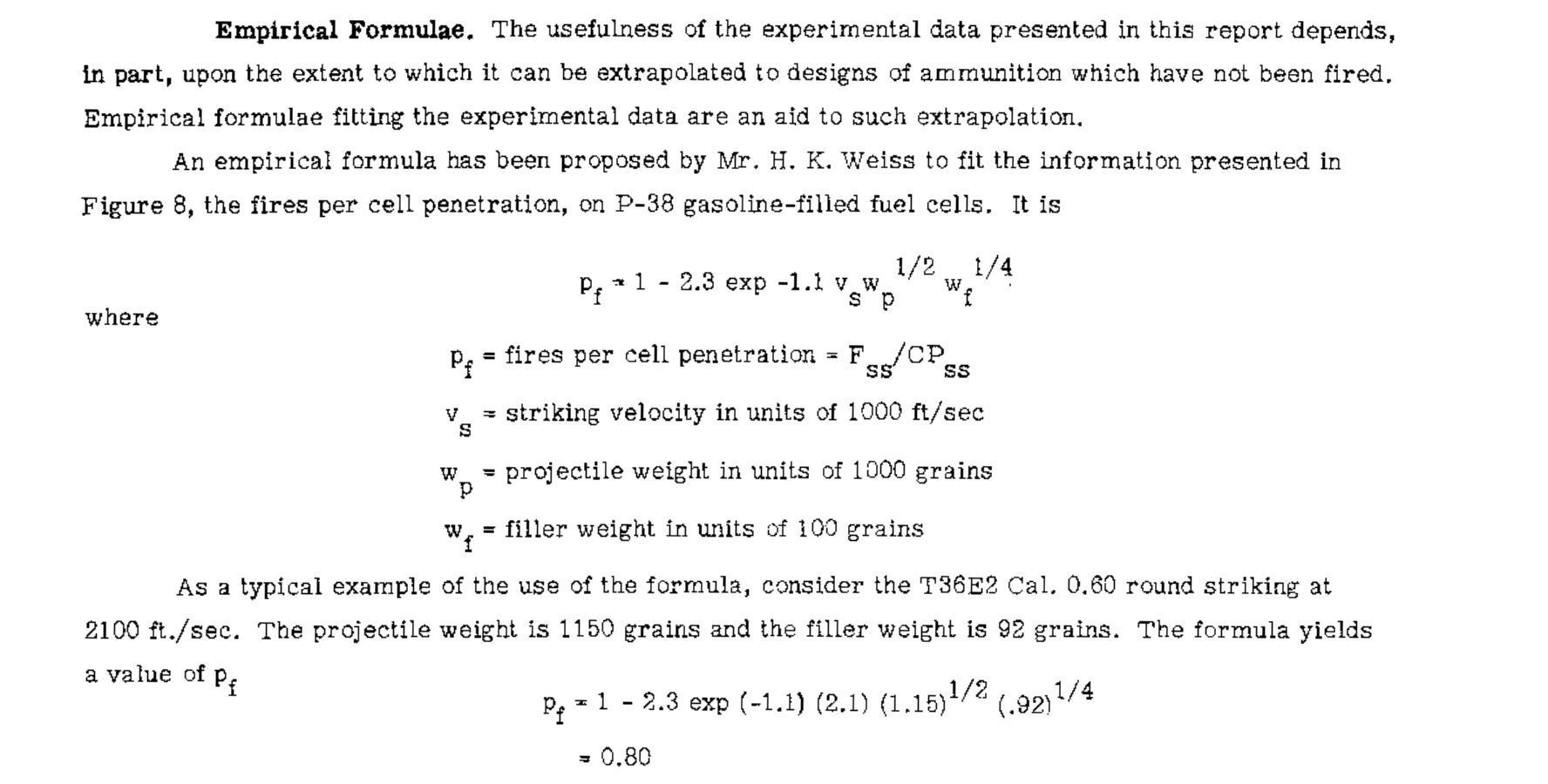
Therefore the probabilities are just rough estimate based on projectile weight, speed and filler.
In case of explosive ammunition, the effectiveness could greatly change, depending how close it detonates to the fuel cell, as additional explosive filler isn’t considered.
As such the light Soviet 12.7mm MDZ and Japanese Ma-102 have comperatively low fire chance, even though they are technically capable of dealing substantial damage, carrying more explosive filler than incendiary.
But they are also more likely to explode too far away from a fuel tank to perforate it.
Small and light rounds, or at insufficent velocities will result in negative probabilities, so the formula isn’t applicable.
But it shows that such calibers, like LMG bullets, are very ineffective in setting fires and would require already damaged fuel tanks to be able to set them on fire.
The German 13mm Incendiary shell only achives moderate probabilitiy at very close range (100m).
While at longer ranges the probabilitiy drops heavily, due to the combination of low muzzle velocity and poor ballistic performance, reducing the velocity quickly at range.
Large incendiary filler can compensate for low muzzle velocitiy, while both speed and projectile weight (size) are a key factor in effectivness to cause fires.
At 800yd (732m), both the .50cal M20 API-T and M23 Inc bullet have the same velocity, but the M23 retains a much higher fuel tank ignition probability, due to it’s large filler.
30mm projectiles and larger are most likely going to set fires, even while holding very little incendiary filler, since they are able to cause substantial damage to fuel cells, simply by their large size.
Even the small and slow Ho-155 shell is heavy enough to most likely cause lethal damage, when striking in the proximity of a tank.
The greater the chance, the greater the sustained damage and severity of the fire and the more lethal a hit becomes.
Larger explosive shells can of course also cause fuel leaks with indirect hits, which can be more easily ignited from secondary hits to the plane.
Additionally I added a modifier for incendiary filler. Which isn’t actually based on any scientific data but might help to distinguish between more or less effective incendiary elements.
It should also be noted that the ballistic data is for the most part merely a rough estimation, and most likely not 100% accurate.
Since the formula was derived from tests against P-38s, larger targets, like bombers, would most likely be more difficult to get set on fire. Especially by smaller calibers.
| ~400yd (366m) | |||||||
|---|---|---|---|---|---|---|---|
| Ammunition | Velocity m/s | Shell weight g | Filler weight g | Filler Type | Filler modifier | Probability | Shell behaviour |
| .303 Incendiary (B Mk VI) | 480 | 10 | 0.45 | Flash powder | 1.00 | - | Penetration |
| 4x .303 Incendiary (B Mk VI) | 480 | 40 | 1.8 | Flash powder | 1.00 | 0.15 | Penetration |
| 4x .303 Incendiary (100m) | 660 | 40 | 1.8 | Flash powder | 1.00 | 0.41 | Penetration |
| AN/M2 & M3 .50cal | - | - | - | - | - | - | - |
| .50al M8 API | 710 | 42.9 | 0.97 | Flash powder | 1.00 | 0.37 | Penetration |
| .50al M8 API (100m) | 835 | 42.9 | 0.97 | Flash powder | 1.00 | 0.50 | Penetration |
| .50al M8 API (1000m) | 480 | 42.9 | 0.97 | Flash powder | 1.00 | 0.05 | Penetration |
| .50cal M20 API-T | 720 | 40.4 | 1.17 | Flash powder | 1.00 | 0.40 | Penetration |
| .50cal M1 Incendiary | 720 | 41.3 | 2.2 | Flash powder | 1.00 | 0.53 | Penetration |
| .50cal M23 Incendiary | 792 | 33.2 | 5.83 | Flash powder | 1.10 | 0.70 | Penetration |
| M20 (800yd) | 566 | 40.4 | 1.17 | Flash powder | 1.00 | 0.20 | Penetration |
| M23 (800yd) | 566 | 33.2 | 5.83 | Flash powder | 1.10 | 0.47 | Penetration |
| 12.7mm Berezin UB | - | - | - | - | - | - | - |
| 12.7mm API | 680 | 49 | 1 | Flash powder | 1.00 | 0.40 | Penetration |
| 12.7mm API-T | 710 | 46 | 1 | Flash powder | 1.00 | 0.41 | Penetration |
| 12.7mm HEI (MDZ-3) | 650 | 38.5 | 1.3 | Flash powder | 1.00 | 0.32 | Detonation |
| 12.7mm Breda & Ho-103 | - | - | - | - | - | - | - |
| 12.7mm Breda API | 580 | 37 | 2.3 | Thermite | 0.60 | 0.22 | Penetration |
| 12.7mm Breda API-T | 600 | 37 | 2.5 | Thermite | 0.60 | 0.26 | Penetration |
| 12.7mm Breda/Ho-103 HEI | 600 | 36 | 1 | Flash powder | 1.00 | 0.17 | Detonation |
| 12.7mm Ma-102 | 600 | 32.2 | 1 | Flash powder | 1.00 | 0.12 | Detonation |
| Breda API-T (100m) | 715 | 37 | 2.5 | Thermite | 0.60 | 0.41 | Penetration |
| 13.2mm Type 3 HEI | 660 | 47 | 1.3 | Hexal (RDX + Aluminum) | 0.80 | 0.37 | Detonation |
| MG 131 | - | - | - | - | - | - | - |
| 13mm HEFI-T | 475 | 34 | 0.3 | Thermite | 0.60 | - | Detonation |
| 13mm Incendiary-T | 475 | 34 | 2.2 | Flash powder | 1.00 | 0.11 | Penetration |
| 13mm Incendiary-T (100m) | 661 | 34 | 2.2 | Flash powder | 1.00 | 0.39 | Penetration |
| Hispano | - | - | - | - | - | - | - |
| 20mm HEF-T | 635 | 120 | 2 | Tracer compound | 0.25 | 0.56 | Detonation |
| 20mm M96 Incendiary | 650 | 122 | 10.8 | Flash powder | 1.00 | 0.94 | Penetration |
| 20mm M97 HEFI | 650 | 131.5 | 2.3 | Flash powder | 1.00 | 0.83 | Detonation |
| 20mm Hispano HEFI | 650 | 131 | 5.7 | Flash powder | 1.00 | 0.91 | Detonation |
| 20mm Hispano SAPI | 650 | 134 | 11.6 | Flash powder | 1.00 | 0.95 | Penetration |
| Jet 20mm ammo | - | - | - | - | - | - | - |
| 20mm M24 M58 HEFI | 775 | 110 | 11.8 | MOX-2B | 1.20 | 0.97 | Detonation |
| 20mm M39/M61 M56 HEFI | 730 | 100 | 10.7 | MOX-2B | 1.20 | 0.95 | Detonation |
| Experimental .60cal ammo | - | - | - | - | - | - | - |
| .60cal T32E2 Incendiary | 900 | 74.6 | 5.96 | Flash powder | 1.10 | 0.93 | Penetration |
| .60cal T39 API | 900 | 74.7 | 2.59 | Flash powder | 1.00 | 0.86 | Penetration |
| MG 151/20 | - | - | - | - | - | - | - |
| 20mm HEFI-T | 519 | 117 | 2.3 | Thermite | 0.60 | 0.59 | Detonation |
| 20mm Mineshell | 447 | 92 | 18.6 | HA 41 | 0.50 | 0.72 | Detonation |
| 20mm Incendiary-T | 519 | 117 | 9.5 | Flash powder | 1.00 | 0.86 | Penetration |
| MG 151 | - | - | - | - | - | - | - |
| 15mm HEFI-T | 700 | 57 | 1.3 | Thermite | 0.60 | 0.43 | Detonation |
| 15mm Incendiary-T | 700 | 57 | 4.9 | Flash powder | 1.00 | 0.75 | Penetration |
| ShVAK / B20 (800m/s) | - | - | - | - | - | - | - |
| 20mm OFZ | 550 | 91 | 3.9 | Incendiary Composition | 1.00 | 0.71 | Detonation |
| 20mm OZ (Early) | 560 | 96 | 3.2 | Incendiary Composition | 1.00 | 0.71 | Detonation |
| 20mm OZ (Late) | 540 | 96 | 5.6 | A-IX-2 | 0.50 | 0.67 | Detonation |
| 20mm OZT | 413 | 96 | 4.13 | A-IX-2 | 0.50 | 0.41 | Detonation |
| 20mm BZ (API) | 560 | 96.5 | 2.8 | Incendiary Composition | 1.00 | 0.69 | Penetration |
| Ho-5 | - | - | - | - | - | - | - |
| 20mm Ho-5 HEFI | 480 | 84.5 | 3.7 | Flash powder | 1.00 | 0.59 | Detonation |
| 20mm Ho-5 HEFI-T | 480 | 90 | 2.5 | Flash powder | 1.00 | 0.54 | Detonation |
| 20mm Ho-5 Ma-202 | 465 | 80 | 8.7 | Flash powder | 1.00 | 0.69 | Detonation |
| Ma-202 (100m) | 650 | 80 | 8.7 | Flash powder | 1.00 | 0.86 | Detonation |
| 20mmType 99 cannons | - | - | - | - | - | - | - |
| 20mm Type 99-1 HEF-T | 450 | 128 | 4 | Tracer compound | 0.25 | 0.45 | Detonation |
| 20mm Type 99-2 HEF-T | 560 | 128 | 4 | Tracer compound | 0.25 | 0.62 | Detonation |
| 20mm Type 99-1 HEFI mod 2 | 420 | 127 | 3.7 | WP + Inc Composition | 1.00 | 0.64 | Detonation |
| 20mm Type 99-2 HEFI mod 2 | 530 | 127 | 3.7 | WP + Inc Composition | 1.00 | 0.78 | Detonation |
| 20mm Type 99-2 HEFI mod 4 | 530 | 130 | 5.7 | WP + Light Alloy container | 1.00 | 0.84 | Penetration |
| 20mm Type 99-2 HEFI Model 2 | 530 | 125 | 12.5 | Flash powder | 1.00 | 0.90 | Penetration |
| NS-23 / NR-23 | - | - | - | - | - | - | - |
| 23mm HEFI-T | 530 | 196 | 11 | A-IX-2 | 0.50 | 0.91 | Detonation |
| MK 108 | - | - | - | - | - | - | - |
| 30mm Mineshell | 346 | 330 | 88 | HA 41 | 0.50 | 0.98 | Detonation |
| 30mm Incendiary | 346 | 330 | 140 | Thermite | 0.60 | 0.99 | Penetration |
| 30mm Mine-Incendiary | 346 | 330 | 8 | Flash powder | 1.00 | 0.88 | Detonation |
| MK 101/103 | - | - | - | - | - | - | - |
| 30mm Mineshell-T | 693 | 330 | 72 | HTA | 0.50 | 1.00 | Detonation |
| 30mm Incendiary | 638 | 330 | 140 | Thermite | 0.60 | 1.00 | Penetration |
| 30mm Ho-155 | - | - | - | - | - | - | - |
| 30mm Ma-301 | 500 | 240 | 20 | Flash powder | 1.00 | 0.98 | Detonation |
| 30mm Type 5 | - | - | - | - | - | - | - |
| 30mm Incendiary | 620 | 354 | 27.5 | WP | 1.00 | 1.00 | Detonation |
| 37mm shells | - | - | - | - | - | - | - |
| US 37mm HEF-T | 520 | 608 | 5 | Tracer compound | 0.25 | 0.95 | Detonation |
| USSR 37mm HEFI-T NS-37 | 740 | 735 | 37 | A-IX-2 | 0.50 | 1.00 | Detonation |
| USSR 37mm HEFI-T N-37 | 590 | 735 | 37 | A-IX-2 | 0.50 | 1.00 | Detonation |
| JP 37mm Ho-203 HEFI | 450 | 440 | 8 | Flash powder | 1.00 | 0.97 | Detonation |
| JP Ho-204 HEFI | 555 | 440 | 8 | Flash powder | 1.00 | 0.99 | Detonation |
——————————
Likelyhood of striking a Bf 109s fuel tank and setting it on fire from behind at 400yd (366m)
Example: US .50cal AN/M2 firing M8 API
400yd was determined to be the effective range of US .50cal bullets fired from the aircraft AN/M2 with a dispersion of 4 mils for 75% of rounds fired and 8 mils for 100% of rounds.
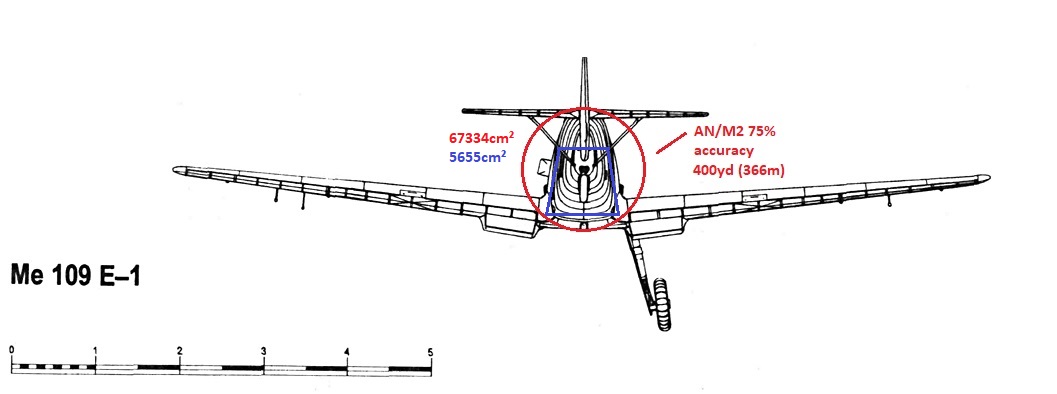
75% of bullets land within a area of 67334cm² while the fuel tank is a target roughly 5655cm².
For 75% accuracy the chance to strike the target is 8.4%, while for all bullets it’s merely 6.3%
With this and the probability of a M8 API to cause a fire in a single shot at this distance being 37% we can calculate the probability to destory the 109, assuming that a fire will always lead to destruction.
| Number of shots fired | Average Hits | Fires on average |
|---|---|---|
| 1 | 0.063 | 2.33% |
| 5 | 0.315 | 11.66% |
| 10 | 0.63 | 23.31% |
| 20 | 1.26 | 46.62% |
| 22 | 1.386 | 51.28% |
| 30 | 1.89 | 69.93% |
| 35 | 2.205 | 81.59% |
| 43 | 2.709 | 100.23% |
With 6 .50cals on a P-51 it would require roughly a 0.53s burst to cause a fire and potentially bring down the Bf 109.
However the fuel tank is protected by a dural screen and also deeper inside the aircraft than the P-38 wing tanks that were shot.
So the actual chance to cause a fire might be lower and the required time on target higher.
Example: US 20mm AN/M2 firing M96 Incendiary
Unlike the .50cal AN/M2 with 4 mil dispersion the Hispano (AN/M2) is more accurate.
Its 3 mil dispersion, for 75% of hits, creating a target area of just 37875cm³, resulting in a hit chance of 14.93% and 11.20% for all rounds, compared to the 6.4% for the AN/M2 .50cal.
| Number of shots fired | Average Hits | Fires on average |
|---|---|---|
| 1 | 0.112 | 10.55% |
| 2 | 0.224 | 21.09% |
| 3 | 0.336 | 31.64% |
| 4 | 0.448 | 42.18% |
| 5 | 0.56 | 52.73% |
| 7 | 0.784 | 73.82% |
| 9 | 1.008 | 94.91% |
| 10 | 1.12 | 105.46% |
At 366m M96 Incendiary has a 94% probability to cause a fire, in a chase at 500kph it’s 91%.
Not only is the likelyness much higher, the resulting fire will be many times more lethal compared to the .50cal M8 bullet, which can only cause minor damage to a fuel tank.
Example: German MG 151/20 firing Incendiary-T shells
German data suggests 3.8 mil accuracy for 100% of hits but the sample size was extremely low with just 11 rounds fired.
To convert to 75% accuracy like the US guns, I went with a factor of 1.5. Resulting in 2.53 mil accuracy.
This results in a hit chance of 20.9% fo for 75% of rounds fired and 15.7% for 100%.
Of course the lower muzzle velocity and higher drag would also result in increased aiming error, for landing shots in the first place. Which I might look into another day.
| Number of shots fired | Average Hits | Fires on average |
|---|---|---|
| 1 | 0.157 | 12.32% |
| 2 | 0.314 | 24.64% |
| 4 | 0.628 | 49.28% |
| 5 | 0.785 | 61.60% |
| 6 | 0.942 | 73.92% |
| 7 | 1.099 | 86.24% |
| 8 | 1.256 | 98.56% |
| 9 | 1.413 | 110.88% |
In reality the likeliness is going to be influenced by other factors:
- Not every fire is going to be lethal
- Internal strcture and distance to the fuel tank decreases the effectiveness of the bullets
- Impact velocity, and therefore fire chance, in air combat is reduced compared to ground testing*
- Accuracy decreases in the air, since the bullet has to travel a greater distance*
- Compound damage increases the likelyhood for fires.
*Because the projectile is fired from a moving aircraft, it suffers more drag. It also has to cover a greater distance as the target is moving away. However the opposite is true for a attack from the front.


